
In Scriptures, fasting is a discipline that focuses the heart for prayer, repentance, and seeking set-apart (divine) guidance. It is not a technique for earning favor but a posture of surrender, a deliberate turning away from physical sustenance to pursue YAHUAH with undivided attention. Three passages anchor this understanding immediately: Matatiyahu (Matthew) 6:16–18, where Yahusha (Jesus) assumes his disciples will fast and redirects their motive inward; Azara (Ezra) 8:23, where Azara (Ezra) and the returning exiles humble themselves before YAHUAH and seek a safe journey; and Yisha’aiyahu (Isaiah) 58, where the prophetic voice redefines fasting as inseparable from justice and mercy. Fasting appears over 70 times in Scriptures, woven through the Ta’anak (Old Testament) and Bariyt Hadash (New Testament) alike. What follows covers the primary scriptural (biblical) purposes, key passages with exegesis, what Yahusha taught, the types of fasts found in Scriptures, practical guidance, the ethical dimension of Yisha’aiyahu (Isaiah) 58, common dangers, and a scholarly perspective grounded in manuscript research.
Table of Contents
-
Key scriptural (biblical) passages that show fasting in action
-
Does Yisha’aiyahu (Isaiah) 58 change how we understand fasting?
-
What does manuscript research reveal about fasting in Scriptures?
What does Scriptures say the role of fasting is?
Scriptures presents fasting with a range of purposes, each grounded in specific texts. The list below draws on passages across both Ta’anak and Bariyt Hadash (Testaments), with a brief exegesis and, where the narrative is especially instructive, a short scriptural (biblical) example.
-
Strengthen prayer. Ma’ashiym (Acts) 13:2 records the congregation at Antiyukiyah (Antioch) “ministering to YAHUAH and fasting” before the Spirit commissioned Sha’ul (Paul) and Baranaba (Barnabas). Fasting here is not a substitute for prayer but its intensifier, clearing away distraction so the community could hear clearly. This is a corporate example, not a private one.
-
Seek set-apart (divine) guidance. Azara (Ezra) 8:21–23 is the clearest Ta’anak (Old Testament) example: Azara (Ezra) proclaimed a fast at the river Aahua (Ahava) so the people could humble themselves and ask YAHUAH for a safe road. He had already told the king he trusted YAHUAH’s protection, so fasting became the concrete act that aligned his words with his dependence.
-
Repentance and return to YAHUAH. Yual (Joel) 2:12–13 calls Yisharal (Israel) to return with fasting, weeping, and mourning. The fast is not the repentance itself but the physical expression of an inward turning. Nahamiyahu (Nehemiah) 1 shows the same pattern: Nahamiyahu (Nehemiah) fasted and confessed the sins of Yisharal (Israel) before petitioning YAHUAH about Yirushalam’s (Jerusalem’s) broken walls.
-
Humility and worship. The prophetess Ana (Anna) “served YAHUAH with fasting and prayers night and day” Luqah (Luke) 2:37. Her fast was not crisis-driven; it was a sustained posture of worship. Fasting must center on YAHUAH as its primary object, not the benefits it produces.
-
Intercession for others. Duiyd (David) fasted for his sick child in 2 Shamual (Samuel) 12:16 and wrote, “I humbled my soul with fasting” when his enemies were ill Tahliym (Psalms) 35:13. Intercession through fasting is a recurring pattern in the Tahliym (Psalms), where the faster bears the burden of another before YAHUAH.
-
Deliverance and spiritual warfare. Yahusha told his disciples that certain kinds of evil “do not come out except by prayer and fasting” Matatiyahu (Matthew) 17:21. Asatar’s (Esther’s) corporate fast before she approached King Ahashurush (Ahasuerus) in Asatar (Esther) 4:16 is the Ta’anak (Old Testament) parallel: the community fasted for three days before she risked her life, and the deliverance that followed was attributed to YAHUAH’s intervention.
-
Mourning and grief. The men of Yibiysh Gala’ad (Jabesh-gilead) fasted seven days after burying Saul and his sons in 1 Shamual (Samuel) 31:13. Fasting in mourning is not a performance of grief but a communal acknowledgment that life and death rest in YAHUAH’s hands. Shapatiym (Judges) 20:26 records Yisharal (Israel) weeping and fasting before YAHUAH after devastating military losses.
-
Corporate dedication and leadership commissioning. Ma’ashiym (Acts) 14:23 records that Sha’ul and Baranaba (Barnabas) appointed elders in every congregation “with prayer and fasting.” The fast here is preparatory and consecrating, marking a transition of authority. This pattern appears in Azara (Ezra), Nahamiyahu (Nehemiah), and the early congregation alike.
-
Prophetic revelation. Daniyal (Daniel) fasted for three weeks before receiving the vision recorded in Daniyal (Daniel) 10. The text connects the fast directly to the arrival of the heavenly messenger. Fasting in the prophetic tradition is a form of attentiveness, a quieting of the body so the spirit can receive.
-
Preparation for ministry. Yahusha fasted forty days and nights in the wilderness before beginning his public ministry Matatiyahu (Matthew) 4:1–2. Mashah (Moses) fasted forty days on Siyniy (Sinai) before receiving the Turah (Torah) Shamut (Exodus) 34:28. Both fasts preceded defining moments of set-apart (divine) commission.
Pro Tip: Align your fast to a single, named spiritual aim before you begin. Practitioners who enter a fast with a specific purpose, such as seeking clarity on a decision, confessing a particular sin, or interceding for someone by name, report far greater focus than those who fast generally. The scriptural (biblical) examples almost always name the reason.
Key scriptural (biblical) passages that show fasting in action
The passages below span private and corporate fasts, prophetic and preparatory fasts, and Ta’anak and Bariyt Hadash (Old and New Testament) contexts. Each one shows fasting functioning differently, which is why a single-sentence definition of its role always falls short.
| Passage | Type of Fast | How Fasting Functions | Application |
|---|---|---|---|
| Azara (Ezra) 8:21–23 | Corporate, preparatory | Azara (Ezra) calls a communal fast to seek safe passage and express dependence on YAHUAH rather than a military escort | Seek YAHUAH’s guidance before major decisions through communal or personal fasting |
| Yisha’aiyahu (Isaiah) 58:3–7 | Prophetic critique | YAHUAH rejects ritual fasting disconnected from justice; the “true fast” loosens oppression and feeds the hungry | Pair fasting with concrete acts of favor (mercy) and justice |
| Asatar (Esther) 4:15–17 | Corporate, intercessory | Asatar (Esther) calls a three-day total fast before approaching the king; the community’s fast accompanies her intercession | Corporate fasting amplifies intercession in moments of crisis |
| Daniyal (Daniel) 9:3; 10:2–3 | Private, prophetic | Daniyal (Daniel) fasts in sackcloth and ashes while confessing Yisharal’s (Israel’s) sins; a partial fast precedes prophetic revelation | Fasting with confession opens the heart to receive understanding |
| Matatiyahu (Matthew) 4:1–2 | Private, preparatory | Yahusha fasts forty days before his public ministry begins; the fast precedes and prepares for his mission | Fasting prepares the servant for the work YAHUAH has assigned |
| Matatiyahu (Matthew) 6:16–18 | Private, devotional | Yahusha assumes disciples will fast and redirects motive from public display to secret worship (devotion) before the Father | The condition of the heart matters more than the duration of the fast |
| Ma’ashiym (Acts) 13:2; 14:23 | Corporate, commissioning | The congregation fasts while worshiping; elders are appointed with prayer and fasting | Fasting accompanies major leadership decisions and commissions |
What did Yahusha (Jesus) teach about fasting?
Yahusha’s primary concern about fasting was motive, not method. In Matatiyahu (Matthew) 6:16–18, he does not say “if you fast” but “when you fast,” assuming the practice as a given for his disciples. His warning targets the hypocrites who disfigure their faces so others will notice their sacrifice. The instruction is pointed: wash your face, anoint your head, and let only your Father who sees in secret know what you are doing. Fasting aids prayer and deepens fellowship with YAHUAH, but it collapses into performance the moment it is done to impress.

In Matatiyahu (Matthew) 9:14–15, the disciples of Yahuhanan (John) ask why Yahusha’s disciples do not fast. His answer is the bridegroom metaphor: the wedding guests do not mourn while the bridegroom is with them. When the bridegroom is taken away, then they will fast. This is a statement about timing and presence, not a cancellation of fasting. The early congregation understood it that way. Ma’ashiym (Acts) 13:2 and 14:23 show fasting practiced as a normal part of communal discernment and leadership commissioning, not as a legal obligation but as a freely chosen discipline.
The Bariyt Hadash (New Testament) presents fasting as a disciple’s aid, a voluntary intensifier of prayer and dependence, not a requirement that earns standing before YAHUAH. That distinction matters for how you approach it.
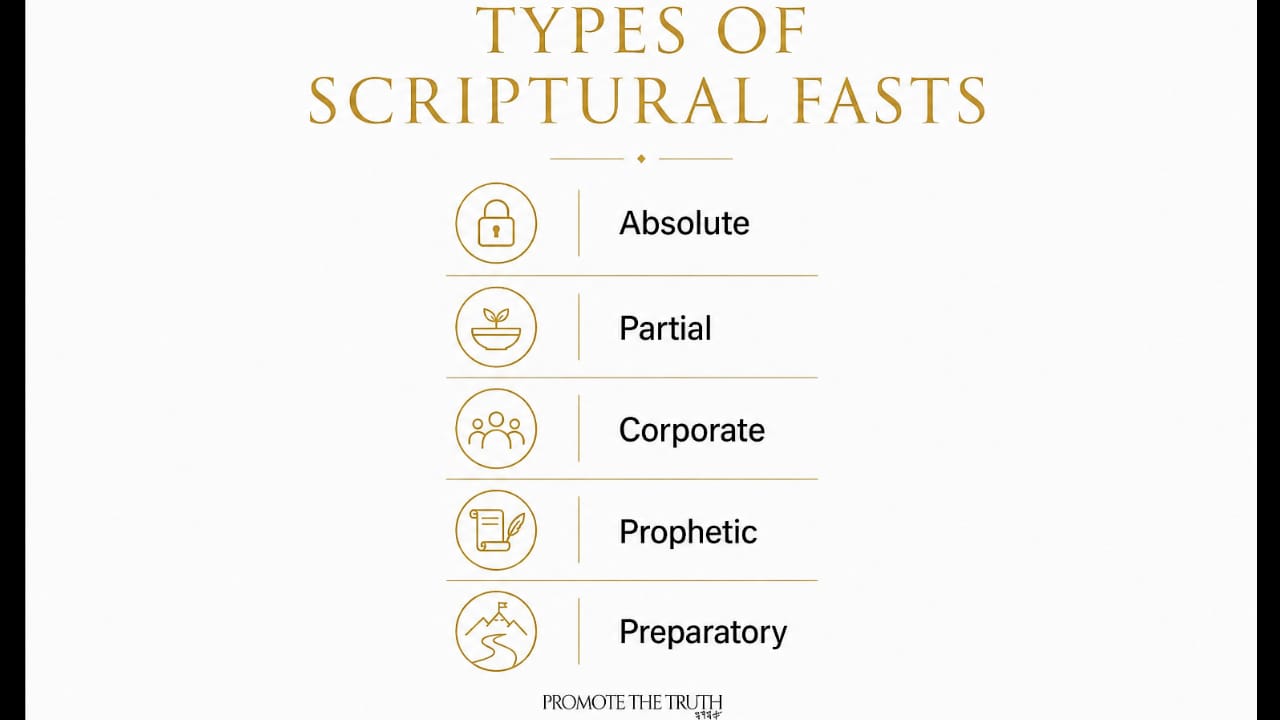
What types of fasts does Scriptures describe?
Scriptures records several distinct forms of fasting, and understanding the differences helps readers choose a responsible, text-informed approach.

| Type | Primary scriptural (biblical) Example | Modern Equivalent | Who It Fits |
|---|---|---|---|
| Absolute (total) | Asatar (Esther) 4:16 — no food or water for three days | Short-duration total fast (24 hours) with medical awareness | Healthy adults in crisis intercession; never prolonged without supervision |
| Partial Daniyal (Daniel)-style | Daniyal (Daniel) 1:12; 10:2–3 — no choice food, meat, or wine for 21 days | Eliminating processed food, meat, or sweets for a set period | Most adults; accessible entry point for new fasters |
| Prolonged (forty-day) | Mashah (Moses) in Shamut (Exodus) 34:28); Yahusha in Matatiyahu (Matthew) 4:2 | Not recommended without medical oversight | Exceptional cases only; not a general model for regular practice |
| Corporate/national | 2 Dabariy ah Yimiym (Chronicles) 20:3; Asatar (Esther) 4:16; Azara (Ezra) 8:21 | Assembly (Church) or community fast days; coordinated prayer seasons | Congregations, families, or study groups seeking collective guidance |
| Private/Worship (devotional) | Ana (Anna) in Luqah (Luke) 2:37; Duiyd (David) in Tahliym (Psalm) 35:13 | Weekly or monthly personal fast days | Individuals building a regular rhythm of prayer and dependence |
A note on health: Prolonged and absolute fasts carry real physical risk. Anyone with diabetes, a history of eating disorders, cardiovascular conditions, or pregnancy should consult a medical professional before beginning any fast that extends beyond a single meal. The goal of fasting is dependence on YAHUAH, not harm to the body he created.
How do you plan and observe a fast?
Practical preparation makes the difference between a fast that deepens your walk and one that simply leaves you irritable and distracted. The steps below reflect the patterns found across scriptural (biblical) examples and practical teaching on fasting.
-
Name your purpose. Before you begin, write down the specific spiritual aim: seeking guidance, confessing sin, interceding for someone, preparing for a ministry decision. Azara (Ezra) named his purpose before the fast began Azara (Ezra) 8:21.
-
Choose your type and duration. A 24-hour fast from one evening meal to the next is a solid starting point. A Daniyal (Daniel) -style fast (eliminating meat, sweets, and processed food) works well for longer periods. Avoid choosing a duration that is beyond your current physical capacity.
-
Prepare physically. Reduce caffeine and heavy meals in the day before a total fast to minimize withdrawal symptoms. Drink water consistently during partial fasts.
-
Set aside unhurried time for prayer and Scriptures. The fast loses its purpose if the hours freed from eating are filled with entertainment or work. Plan specific windows for prayer, reading, and quiet. You can pair this with a Scriptures reading plan to anchor each session to a passage.
-
Use Scripture prompts during the fast. Short, focused passages work well:
-
Yisha’aiyahu (Isaiah) 58:6–7 for fasts connected to justice and intercession
-
Tahliym (Psalms) 35:13 for personal humility and intercession
-
Matatiyahu (Matthew) 6:6 as a reminder to keep the fast between you and YAHUAH
-
Daniyal (Daniel) 9:4–6 as a model for confessional prayer
-
-
Break the fast gently. End with light food: broth, fruit, or a small meal. Reintroduce heavier food over several hours. For fasts longer than 24 hours, refeeding gradually is not optional; it is a health necessity.
-
Reflect and record. After the fast, write down what surfaced: insights, confessions, answers, or simply the experience of dependence. Many practitioners find that fasting acts as a spiritual mirror, surfacing hidden character issues that routine life keeps buried.
Pro Tip: Pair your fast with a specific passage you plan to memorize. The benefits of memorizing Scripture compound during a fast because hunger itself becomes a prompt to return to the text.
Does Yisha’aiyahu (Isaiah) 58 change how we understand fasting?
Yisha’aiyahu (Isaiah) 58 is the most searching critique of fasting in all of Scriptures. The people complain that they have fasted and YAHUAH has not noticed. His response is not that they fasted wrongly in a technical sense but that they fasted while exploiting workers, quarreling, and ignoring the hungry at their door. The fast YAHUAH chooses, He says, is this: loose the bonds of wickedness, undo the straps of the yoke, let the oppressed go free, share your bread with the hungry, bring the homeless poor into your house, cover the naked.
This passage does not abolish ritual fasting. It insists that ritual fasting is hollow without the ethical life that fasting is meant to produce. Several practical actions fall under what Yisha'aiyahu (Isaiah) calls the “true fast”:
-
Give food to the hungry. Not as an add-on to the fast but as its natural expression.
-
Advocate for the oppressed. The language of loosing bonds and breaking yokes is active and public, not merely private charity.
-
Welcome the stranger. Bringing the homeless poor into your house is a concrete act of hospitality, not a sentiment.
-
Clothe the naked. Material provision for those without resources is named alongside prayer as part of what pleases YAHUAH.
-
Stop pointing the finger. Yisha’aiyahu (Isaiah) 58:9 names accusation and malicious talk as incompatible with genuine fasting.
The connection to the article’s earlier purposes is direct. Repentance without behavioral change is incomplete. Worship expressed only in abstinence, without mercy toward others, falls short of what YAHUAH calls “your light breaking forth like the dawn” Yisha’aiyahu (Isaiah) 58:8. For readers studying community living principles alongside fasting, Yisha’aiyahu (Isaiah) 58 is the passage that ties them together most explicitly.
What are the dangers and misconceptions about fasting?
Fasting is one of the most misused disciplines in Scriptures. Understanding what can go wrong is as important as knowing the purposes.
Common mistaken motives and behaviors:
-
Public performance. Yahusha’s warning in Matatiyahu (Matthew) 6:16 targets exactly this: fasting to be seen. The moment a fast becomes a social signal of spirituality, it has already failed its purpose.
-
Using fasting to coerce YAHUAH. Richard Foster’s observation is precise: fasting can become an attempt to get YAHUAH to do what you want.
-
Fasting without moral change. Yisha’aiyahu (Isaiah) 58 is the scriptural warning here. The people fasted and continued exploiting workers. YAHUAH rejected the fast entirely. Historical assembly (church) teaching warns that physical abstinence without a concurrent increase in virtue renders the practice hollow.
-
Legalism. Treating fasting as a requirement for standing before YAHUAH contradicts the Bariyt Hadash’s (New Testament’s) presentation of it as a voluntary discipline. Fasting does not earn compassion (grace).
-
Fasting without prayer. A fast that is simply skipping meals without redirecting attention to YAHUAH is a diet, not a spiritual discipline.
When to seek help:
-
Medical consultation is necessary for anyone who is pregnant, nursing, diabetic, recovering from an eating disorder, or managing a cardiovascular condition before beginning any total or prolonged fast.
-
Pastoral counsel is wise for anyone who feels compelled to fast excessively or who uses fasting to punish themselves rather than draw near to YAHUAH.
-
Stop the fast immediately if you experience severe dizziness, fainting, heart palpitations, or extreme weakness. The body is YAHUAH’s creation, and harming it is not a spiritual virtue.
The Orthodox tradition states it plainly: “Fasting without effort in virtue is wholly in vain.” The same conviction runs through the prophetic tradition, the Bashurah (Gospels), and the early congregation. A fast that does not produce humility, favor (mercy), and a quieter spirit has missed its mark.
What does manuscript research reveal about fasting in Scriptures?
Fasting in the ancient world was not a private wellness practice. It was a covenantal act, embedded in communal life and tied to specific moments of national or communal significance. Yet the Ta’anak records dozens of additional fasts called in response to crisis, grief, warfare, and prophetic commission. Understanding that context changes how you read the fasting passages.
Promote The Truth’s approach to the Truth Scriptures translation draws directly on ancient Abariy (Hebrew) and Aramiyt (Aramaic) manuscript sources, including Dead Sea Scroll material for passages like Yisha’aiyahu (Isaiah). That matters for fasting study because Yisha’aiyahu (Isaiah) 58 in the Dead Sea Scrolls preserves textual details that inform the prophetic critique of empty ritual. Readers who want to engage fasting passages at that level will find the Original Scriptures translation a more precise tool than standard English versions.
The prophetic tradition of fasting is particularly significant. Daniyal’s (Daniel’s) fasts in chapters 9 and 10 precede major revelatory events. Azara’s (Ezra’s) fast at the river Aahua (Ahava) precedes the restoration community’s return to the land. Nahamiyahu’s (Nehemiah’s) fast precedes his petition to the king and his rebuilding of Yirushalam’s (Jerusalem’s) walls. In each case, fasting is not the climax of the story but the preparation for it. For readers studying prophetic Scripture patterns, this preparatory function of fasting is one of the most consistent threads in the entire canon.
Key Takeaways
Fasting in Scriptures is a discipline serving prayer, repentance, guidance, intercession, and prophetic preparation, always requiring genuine inward change to be acceptable to YAHUAH.
| Point | Details |
|---|---|
| Fasting appears over 70 times | Scriptures records fasting across both Ta’anak and Bariyt Hadash (Testaments), serving at least ten distinct spiritual purposes. |
| Motive determines validity | Yahusha’s first teaching on fasting Matatiyahu (Matthew) 6:16–18 targets the heart, not the method; public display disqualifies the fast. |
| Yisha’aiyahu (Isaiah) 58 demands justice | YAHUAH rejects fasting disconnected from favor (mercy); the true fast loosens oppression and feeds the hungry. |
| Types vary by context | Scriptures records absolute, partial, prolonged, corporate, and private fasts; choose a type appropriate to your health and purpose. |
| Promote The Truth resources | The Truth Scriptures translation and study series offer manuscript-aware tools for studying fasting passages in their original covenantal context. |
Why fasting belongs in serious Scriptures study
Fasting is one of those disciplines that serious students of Scriptures often read about but rarely practice with intention. What manuscript research has shown us at Promote The Truth is that the fasting passages are among the most theologically loaded texts in the canon, and they are also among the most frequently misread in popular English translations. When you read Azara’s (Ezra’s) fast at the river Aahua (Ahava) in a translation that flattens the covenantal vocabulary, you miss the weight of what he was doing. When Yisha’aiyahu (Isaiah) 58 is rendered in ways that soften the prophetic edge, the ethical demand gets lost.
We include fasting in Promote The Truth’s curriculum not because it is a trending spiritual topic but because the manuscript evidence demands it. The Abariy (Hebrew) and Aramiyt (Aramaic) sources show fasting woven into covenant renewal, prophetic commissioning, and communal discernment in ways that cannot be separated from the broader message of Scriptures. A student who understands fasting understands something essential about how YAHUAH’s people have always approached him: with humility, with dependence, and with a willingness to let the body’s discomfort become a teacher.
The responsible practice of fasting also requires the kind of careful, text-grounded study that Promote The Truth is built to support. Align your fast to a specific study goal. Read the passage in a translation that respects the original language. Let the fast be a season of attentiveness, not a performance.
Go deeper with the Truth Scriptures and study resources
Fasting passages like Yisha’aiyahu (Isaiah) 58, Daniyal (Daniel) 9–10, and Matatiyahu (Matthew) 6 carry layers of meaning that standard English translations often compress. Promote The Truth’s Truth Scriptures restoration, translated from ancient Abariy (Hebrew) and Aramiyt (Aramaic) manuscript sources, gives you access to those layers directly. It is the most manuscript-faithful English restoration of the Ta’anak and Bariyt Hadash available, and it is the text Promote The Truth uses in all of its teaching.

For readers who want to go further, the Scripture Study Series video channel covers fasting passages, prophetic texts, and covenant themes with the same manuscript-aware depth. You can also download a free sample of the Truth Scriptures to experience the translation approach firsthand before committing to the full text. If this work resonates with you, consider supporting the translation project so more of the ancient manuscripts can be made accessible. Start with the Truth Scriptures and let the original text speak.
Useful sources and further study
Primary passages to read:
-
Matatiyahu (Matthew) 6:16–18 (Yahusha’s teaching on motive)
-
Matatiyahu (Matthew) 9:14–15 (the bridegroom metaphor)
-
Yisha’aiyahu (Isaiah) 58:1–12 (the prophetic critique and true fast)
-
Azara (Ezra) 8:21–23 (corporate fast for guidance)
-
Asatar (Esther) 4:15–17 (corporate fast for deliverance)
-
Daniyal (Daniel) 1:8–16; 9:3; 10:2–3 (partial and prophetic fasts)
-
Ma’ashiym (Acts) 13:2; 14:23 (early congregation fasting with commissioning)
-
Luqah (Luke) 2:37 Ana’s (Anna’s) sustained fast as worship
-
Nahamiyahu (Nehemiah) 1:4 (fasting with confession and intercession)
-
Yual (Joel) 2:12–13 (fasting as repentance)
Recommended resources for deeper study:
-
Original Scriptures — Promote The Truth: The Truth Scriptures restoration translated from ancient Abariy (Hebrew) and Aramiyt (Aramaic) manuscripts; the most manuscript-aware English text for studying fasting passages in their original covenantal context.
-
Scripture Study Series — Promote The Truth: Video teachings covering fasting passages, prophetic texts, and covenant themes with manuscript-level depth.
-
Fasting: Aligning Our Loves with God and His Kingdom — Divergent Church: A pastoral, practice-oriented resource for readers seeking applied guidance on fasting and prayer.
-
Consecration Fasting and Prayer — Divergent Church: Practical guidance on consecration-style fasts and corporate fasting initiatives.
-
Ancient Interlinear Scriptures: A Complete Guide — Promote The Truth: For readers who want to study fasting passages in the original languages with interlinear tools.
Read carefully. Read in a manuscript-aware translation. Let the text set the terms of the practice, not the other way around.
This article is general educational information about scriptural (biblical) fasting and is not a substitute for medical advice, pastoral counsel, or professional guidance. Consult a qualified medical professional before undertaking any prolonged or total fast, and seek counsel for questions about your specific spiritual situation.