
Prophetic Scripture patterns are identifiable, recurring literary and thematic structures woven throughout the ancient Scriptures by inspired writers to communicate the messages of YAHUAH across generations. Learning to analyze these prophetic patterns requires recognizing them not as coincidences, but as intentional literary designs that reveal the unity and progressive unfolding of Scripture.
The most effective approach combines verse-by-verse exegesis, the historical-grammatical method, and careful cross-referencing throughout the prophetic writings. By studying each passage in its literary, historical, and Scriptural context, students can better understand how prophetic themes develop from the Ta’anak (Old Testament) to the Bariyt Hadash (New Testament). Scholars such as Thomas B. Clarke and Brian Britt have provided practical frameworks for this type of analysis, and their contributions continue to serve as valuable resources for serious students of Scripture.
The Most Consistent Elements Found Across Prophetic Scripture Patterns Include:
-
A crisis or covenantal breach that demands a set-apart (divine) response.
-
A set-apart (divine) appearance or a messenger sent to the Nabiya (prophet).
-
The commissioning or recommissioning of the Nabiya (prophet) for a specific task.
-
The fulfillment of YAHUAH’s purpose through the Nabiya’s (prophet’s) faithful obedience.
-
Secondary elements, such as fasting, prophetic assistants, rival teachers, and symbolic concealment.
Recognizing these recurring prophetic structures before interpreting a passage helps guard against one of the most common errors in prophetic Scripture study: reading modern assumptions back into ancient Scriptural texts.
How to Analyze Prophetic Scripture Patterns Using a Proven Methodology
The most reliable method for analyzing prophetic Scripture patterns is a systematic, verse-by-verse approach grounded in the original languages. Thomas B. Clarke’s pattern analysis methodology makes this process accessible even to readers without training in Abariy (Hebrew) or Aramiyt (Aramaic). His approach emphasizes identifying narrative patterns, thematic repetition, and typological connections throughout the prophetic books, providing students with a structured framework for understanding material that might otherwise seem complex.

Pro Tip: Before interpreting a prophetic passage, read it once solely to identify its narrative structure. Ask yourself: Is there a crisis? Does a set-apart (divine) figure appear? Is the Nabiya (prophet) given a task? Does the text show that task being carried out? Mapping these four elements first helps prevent premature theological conclusions and provides a stronger foundation for accurate prophetic Scripture study.
A practical methodology for studying prophetic Scripture follows this sequence:
-
Establish the historical setting. Identify the Nabiya (prophet), the audience, the political crisis, and the covenantal context before interpreting a single verse symbolically.
-
Read for narrative structure. Identify the four-part core pattern: crisis, set-apart (divine) appearance, commissioning, and enactment.
-
Note secondary elements. Mark references to fasting, assistants, rivals, hiding, silence, or death, as these secondary features help confirm which type scene the passage belongs to.
-
Cross-reference within the prophetic corpus. Compare the passage with parallel prophetic texts to confirm that a pattern is genuinely present rather than imposed.
-
Let the Scriptures (Bible) define their own symbols. Prophetic symbols should be interpreted by cross-referencing scripture itself, rather than relying on modern cultural analogies or numerological speculation.
-
Apply the literal-grammatical-historical hermeneutic. Interpret prophetic language with the same discipline you would apply to any other Scriptural (biblical) genre.
-
Check for partial and complete fulfillments. Many prophecies have both an initial historical fulfillment and a later, more complete fulfillment. Identify which stage the passage addresses.
Scholarly caution is essential throughout the study process. Numerological pattern hunting without a sound textual foundation often produces false interpretive systems. Valid prophetic Scripture pattern analysis prioritizes consistency across the entire prophetic corpus while respecting the original historical, literary, and covenantal context above all else.
What Are the Core Literary Patterns Found in Ancient Prophetic Texts?
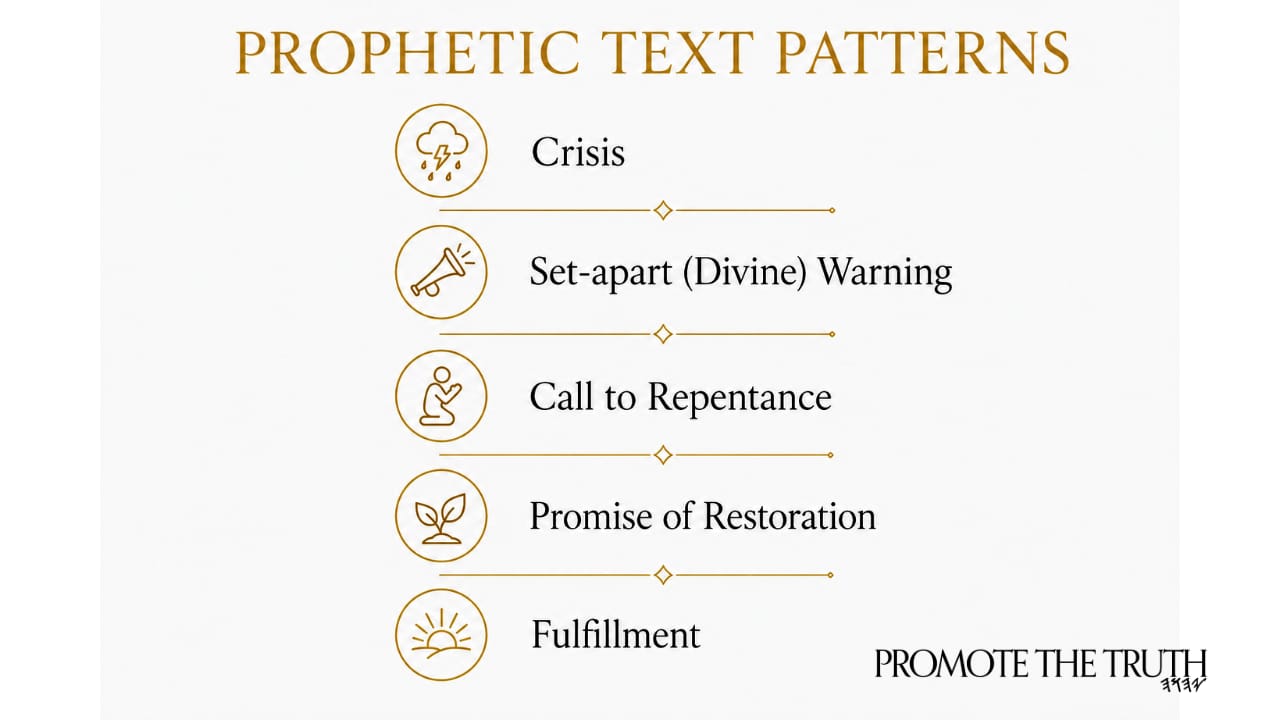
Brian Britt identified twenty-five Ta’anak (Old Testament) passages that share a common four-part prophetic pattern: a crisis or danger arises, a set-apart (divine) messenger appears, the Nabiya (prophet) is commissioned or recommissioned, and YAHUAH’s plan is carried out. This is not merely a loose thematic similarity. Rather, these passages follow the same structural sequence with enough consistency to form what scholars call a type scene—a recurring narrative pattern characterized by standard elements, motifs, and themes.
A helpful comparison for modern readers is the hero’s journey, a familiar narrative pattern in which the hero departs, receives assistance, overcomes obstacles, and returns transformed. Scriptural (Biblical) prophetic type scenes function in a similar way, but with a distinctly theological focus: the Nabiya’s (prophet’s) role as YAHUAH’s messenger and mediator to His covenant people.
Beyond the four-part core pattern, Britt also identified several recurring secondary elements found throughout many of these prophetic passages. These include food or fasting, a successor or prophetic assistant, rival or false Nabiyaiym (prophets), crossing or passing over, references to the Nabiya’s (prophet’s) death, a rock or hiding place, and periods of prophetic silence or concealment. Together, these recurring features strengthen the literary structure of the prophetic narratives and help readers recognize shared patterns across the prophetic corpus.
As Brian Britt explains:
“The third main element is the commissioning or recommissioning of the Nabiya (prophet). The moment of negativity must be overcome. This commission includes a new affirmation of the Nabiya’s (prophet’s) task and an immediate plan of action.”
— Brian Britt, as cited in Scripture Central’s analysis of prophetic type scenes
The account of Aliyahu (Elijah) in 1 Malakiym (1 Kings) 18–19 is one of the clearest Scriptural (biblical) examples of this complete prophetic pattern. Aliyahu (Elijah) confronts a covenantal crisis as the rulers lead Yisharal (Israel) into false worship. A messenger (angel) appears and strengthens him. YAHUAH then commissions him to anoint new Malakiym (kings) and to appoint Aliysha (Elisha) as his successor. Aliyahu (Elijah) immediately departs to carry out these commands. The account also contains all seven of the secondary elements, including the still, small voice as a form of prophetic concealment and the cave at Harab (Horeb) as a place of refuge.
Recognizing these prophetic Scripture patterns does not reduce prophetic texts to rigid formulas. Instead, it reveals how the ancient writers employed shared literary conventions to place their accounts within a recognized prophetic tradition, strengthening both the credibility and the theological significance of their messages for their original audiences.
What Scholarly Principles Guide Responsible Interpretation of Prophetic Patterns?
Responsible interpretation of prophetic Scripture patterns rests on a set of well-established scholarly principles, not on personal intuition or cultural trend-reading. Peter Gentry identifies seven characteristics of prophetic literature that serve as foundational guidelines for every serious student of Scripture:
-
Calling the people back to the covenant
-
The end of the covenant, judgment, and restoration
-
The function of repetition in Abariy (Hebrew) literature
-
The purpose of oracles concerning foreign nations
-
Typology and the new Shamut (Exodus)
-
Apocalyptic language
-
The “already and not yet” fulfillment structure
The literal-grammatical-historical hermeneutic is the non-negotiable foundation underlying all of these principles. Correctly interpreting Scriptural (biblical) prophecy requires this approach, avoiding ungrounded allegory and modern interpretive assumptions. The Emissaries’ (apostles’) own interpretive methods provide the authoritative model. Kapa (Peter), for example, recognized that Dabariym (Deuteronomy) 18:15–19 finds its ultimate fulfillment in Yahusha, who is YAHUAH (Christ), as the final Nabiya (prophet)—an interpretation that is also affirmed by the writer of Abariym (Hebrews).
Pro Tip: When a prophetic symbol appears, resist the instinct to reach for a contemporary political parallel. Instead, search for how that same symbol is used elsewhere in the Scriptural (biblical) text. Horns represent political powers or nations, while a woman represents the covenant community. The Scriptures (Bible) are their own best interpreter.
The “already and not yet” concept deserves particular attention. Prophetic fulfillment often employs this framework, reflecting both partial realization and future consummation. Yisha’aiyahu (Isaiah) 61:1–2 illustrates this precisely. Yahusha, who is YAHUAH (Christ), read this passage in Luqah (Luke) 4 and stopped mid-verse, fulfilling the first part at His first coming while leaving the day of vengeance for a future fulfillment. Collapsing both stages into a single event results in a serious misreading.
Intertextuality is equally critical. Effective study of prophetic literature requires careful contextual, intertextual, spiritual, and ethical reading practices. The Nabiyaiym (Prophets) consistently use the language of earlier covenantal acts, especially the Shamut (Exodus), to describe future events, linking YAHUAH’s past acts to future fulfillments. Allowing Scripture to interpret Scripture, rather than importing outside interpretive frameworks, keeps interpretation anchored in the text’s own logic.
Why Does Pattern Consistency Matter as Evidence of Set-apart (Divine) Authorship?
The consistency of prophetic Scripture patterns throughout the Ta’anak (Old Testament) is one of the most compelling internal arguments for the set-apart (divine) origin of Scripture. When twenty-five independent texts share the same four-part structural sequence across centuries of composition—despite being written by different authors, for different audiences, and during different historical crises—their remarkable coherence points beyond literary convention to a unified set-apart (divine) purpose.
Ta’anak (Old Testament) prophetic patterns center on four major acts of YAHUAH: Creation, the Flood, the Shamut (Exodus), and the Return from Exile. These events form the framework for prophetic declarations throughout the entire prophetic corpus. The Nabiyaiym (Prophets) did not invent new theological categories; rather, they applied YAHUAH’s established pattern of action to the crises of their own generations. This explains why the same structural pattern recurs with such remarkable consistency.
Prophetic literature primarily functions as covenant enforcement, calling for obedience through barakut (blessings) and curses rather than solely forecasting future events. Misunderstanding this purpose leads to a fundamental misinterpretation of prophetic themes."
— TMS Journal, “The Mosaic Covenant and Prophetic Literature”The presence of consistent literary patterns in prophetic Scripture demonstrates set-apart (divine) authorship and textual reliability, serving as internal evidence of inspiration. These recurring patterns confirm the thematic unity of Scripture and the consistent role of the Nabiyaiym (Prophets) across multiple books of the Scriptures (Bible). This is not merely a minor academic observation. For teachers, preachers, and students of prophecy, recognizing this consistency provides a stable interpretive framework that helps prevent the kind of erratic, event-driven speculation that has discredited many popular prophecy commentaries.
Prophetic literature also functions more often as forthtelling—calling people to covenant obedience—than as foretelling future events alone. This means the moral and relational dimensions of prophetic texts carry just as much weight as their predictive elements. Prophetic pattern analysis helps readers maintain this balance, leading to a more accurate and context-driven understanding of the Scriptures.
Promote The Truth Offers You a Path to Serious Prophetic Scripture Study
Serious study of prophetic Scripture patterns requires more than a good commentary. It requires access to the original text, a sound interpretive methodology, and a community committed to truth over tradition.

Promote The Truth is an international educational and media organization dedicated to equipping believers for this kind of in-depth Scriptural (biblical) study. As the publisher of the Truth Scriptures, a meticulous English restoration of the Ta’anak and Bariyt Hadash translated from ancient Abariy (Hebrew) and Aramiyt (Aramaic) manuscript sources, Promote The Truth provides direct access to the original scriptural text upon which prophetic pattern analysis depends.
Beyond the text itself, Promote The Truth’s digital video academy offers structured courses on prophetic interpretation, covenant theology the significance of the Name YAHUAH, and many other foundational Scriptural topics. Each course is designed to help students develop sound interpretive skills using the same scholarly principles outlined throughout this article.
If you are ready to move beyond surface-level reading and develop a deeper understanding of prophetic Scripture, explore Promote The Truth’s courses, resources, and the Truth Scriptures today, and begin studying the Scriptures with confidence, clarity, and faithfulness to the original text.
Key Takeaways
Recognizing recurring prophetic Scripture patterns requires a verse-by-verse study methodology grounded in historical context, cross-referencing, and the Scriptures’ own interpretive framework.
| Point | Details |
|---|---|
| Four-part core pattern | Brian Britt identified twenty-five Ta’anak (Old Testament) texts that share the same sequence of crisis, appearance, commissioning, and enactment, revealing a consistent prophetic Scripture pattern across multiple books. |
| Seven secondary elements | Fasting, assistants, rivals, crossing, death, hiding, and silence appear throughout many of the twenty-five type-scene texts, reinforcing the consistency of prophetic literary patterns. |
| Covenant enforcement focus | Prophetic literature primarily functions as covenant enforcement, rather than merely predicting future events, shaping how prophetic Scripture should be interpreted… |
| Literal-grammatical-historical method | Responsible interpretation avoids ungrounded allegory and modern cultural overlays, allowing Scripture to define its own symbols and interpret itself. |
| Promote The Truth resources | The Truth Scriptures and Promote The Truth’s digital academy provide access to the original Scriptural text and a structured methodology for serious prophetic Scripture study. |