
A consistent Scripture reading plan is a structured, repeatable approach to engaging with the Scriptures each day, anchored by a specific schedule, effective study methods, and accountability tools. Without that structure, many readers lose consistency within just a few weeks. The good news is that you do not need extraordinary willpower to develop a lasting Scripture reading habit. Instead, you need the right plan for your current season of life, a realistic schedule, and practical tools that keep you moving forward even when life becomes busy.
Promote The Truth has helped thousands of readers engage more deeply with the original Scriptural text, and the principles below are based on proven practices that foster long-term consistency and meaningful engagement.
How to Develop a Consistent Scripture Reading Plan That Fits Your Life
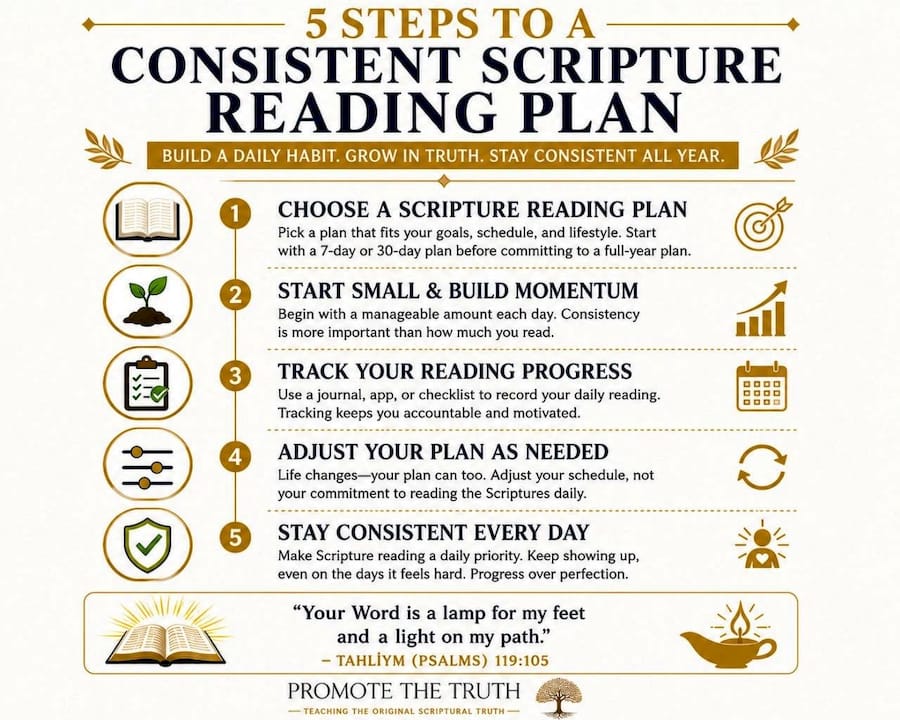
The first decision you make will largely determine whether your Scripture reading plan lasts beyond the first month. Choosing a plan that is too ambitious is one of the most common reasons people give up. Beginners benefit most from starting with a 7-day or 30-day Scripture reading plan before committing to a full-year schedule. That shorter commitment builds consistency and confidence without creating the frustration that often leads to abandoning the habit too soon.
Once you have established a consistent reading habit over 30 days, you can gradually increase your commitment. For example, a five-day weekday reading plan covers four chapters each weekday, allowing you to complete the entire Scriptures in one year while keeping weekends free for reflection, catch-up, or rest. This built-in flexibility helps prevent the “reading debt” cycle, where missed reading sessions accumulate until the plan feels overwhelming and is eventually abandoned.

Different Scripture reading plan styles serve different readers. Choosing the right approach increases your chances of building a consistent daily habit.
| Plan Type | Best For | Daily Commitment | Duration |
|---|---|---|---|
| Book-by-book | Beginners | 1–3 chapters | Flexible |
| Chronological | Experienced readers | 3–4 chapters | 1 year |
| Thematic | Topical study | 1–2 chapters | Varies |
| Devotional | Reflection-focused | 1 chapter + notes | Ongoing |
Book-by-book Scripture reading plans are often the best starting point for beginners because they build understanding, context, and confidence without the confusion of jumping between different books. Chronological and thematic reading plans are better suited for readers who are already familiar with the overall Scriptural narrative.
Pro Tip: Start with a single Scriptural (Biblical) book that is personally meaningful to you. Finishing one complete book builds far more confidence than abandoning a full-year Scripture reading plan after only a few days.
What Tools and Environment Setup Promote Successful Daily Scripture Reading?
Your environment shapes your behavior more than your intentions do. Attaching your Scripture reading to an existing habit—such as your morning coffee, lunch break, or bedtime routine—dramatically increases your likelihood of reading consistently each day. You are not finding extra time. You are anchoring a new habit to something you already do automatically.
The Center for Scriptures (Bible) Engagement has found that journaling and morning Scripture reading are associated with higher levels of Scripture engagement. That connection makes sense. Morning reading takes place before the day’s demands compete for your attention, and journaling encourages you to slow down, reflect, and process what you have read.
Set up your reading space before you need it. Practical preparation includes:
-
Place your Scripture text, journal, and pen in the same location every day.
-
Set your phone to Do Not Disturb before you begin reading.
-
Keep a simple reading log nearby to track your completed readings.
-
Use a dedicated notebook for questions, observations, and reflections.
-
Begin each session with a brief, quiet prayer to center your thoughts and focus.
Pro Tip: Use a physical or digital tracker that shows your reading progress as a percentage completed. Visible Progress is a stronger motivator than willpower alone, and seeing steady progress encourages you to return even after missing a day.
The translation you read also matters. Your engagement depends more on your personal connection with the text than on any particular translation. Choose a translation that balances readability with faithfulness to the original languages. Promote The Truth publishes the Truth Scriptures, a carefully translated restoration of the Ta’anak (Old Testament) and Bariyt Hadash (New Testament) from ancient Abariy (Hebrew) and Aramiyt (Aramaic) sources, providing readers with direct access to the text in a form intended to reflect its original meaning as closely as possible.
How to Execute Your Scripture Reading Plan with Better Comprehension and Real-Life Flexibility
Reading words on a page is not the same as engaging with them. The inductive Scripture (Bible) study method, which follows three simple steps—observe, interpret, and apply—gives every reading session a clear purpose. Observe what the text actually says. Interpret what it meant in its original context. Apply what it means to your life today. This three-step process transforms passive reading into active learning.
Active checkpoints after each reading session significantly improve comprehension and long-term retention. Active recall—the practice of writing a brief summary or noting confusing passages immediately after reading—helps cement what you have learned. Without this step, much of what you read is forgotten within hours.
A practical daily Scripture reading routine looks like this:
-
Sit in your designated reading space and set your phone to Do Not Disturb.
-
Begin with a brief prayer or a moment of quiet reflection.
-
Read your scheduled passage at a steady, unhurried pace.
-
Write a two- or three-sentence summary of what you have read.
-
Note any verse or passage that confused, challenged, or encouraged you.
-
Update your reading tracker and close with a brief reflection or prayer.
When you reach dense passages, such as genealogies or legal codes, consider switching to an audio format. Listening to narrated Scripture can reduce fatigue and help you maintain momentum through sections that may feel slow to read. You can also supplement your study with Promote The Truth’s Scripture study videos, which provide historical background and manuscript context for difficult passages.
Flexibility is not failure. Experienced readers build consistent patterns, not perfect streaks. Intentionally building 30 to 40 catch-up days into a yearly Scripture reading plan allows for real-life interruptions without derailing your progress. If you miss three days, do not start over. Simply continue where you left off and use one of your scheduled catch-up days to close the gap.
What Common Challenges Arise, and How Can You Overcome Inconsistencies in Scripture Reading?
Perfectionism is one of the greatest threats to a daily Scripture reading habit. Readers who treat a missed day as a failure often quit altogether instead of simply resuming their plan. The goal is to build a consistent pattern, not maintain an unbroken streak. True consistency means maintaining a steady rhythm with planned recovery built in, not achieving a flawless record.
Guilt only compounds the problem. When missing a reading session triggers shame, the next session feels like a burden rather than a gift. A healthier response is to treat a missed day the same way you would treat a missed workout: acknowledge it, return the next day, and move forward without self-condemnation.
Practical Ways to Stay on Track When Motivation Drops
-
Shorten your reading session temporarily. Read one chapter instead of four on difficult days.
-
Change your reading environment. A different chair or a quiet outdoor space can help restore your focus.
-
Read aloud. Hearing the words engages a different part of your attention and helps you slow down in a productive way.
-
Connect with a reading partner or small group. Shared accountability increases your likelihood of staying consistent.
-
Revisit your original reason for starting. Write it somewhere visible near your reading space to remind yourself why the habit matters.
Discipleship grows through reading the entire Scriptures over time, not by selecting only the passages you enjoy most. The sections that seem dry or difficult often provide the historical and theological context that makes the rest of Scripture easier to understand. Working through them patiently—even at a slower pace—builds a deeper and more complete understanding than skipping ahead to familiar passages.
Building a relational accountability structure also strengthens consistency. A trusted friend, a small group, or an online community that checks in regularly provides external encouragement that reinforces your personal commitment. You can also apply ancient Scriptural teachings to your daily life connecting what you read to practical decisions, relationships, and conversations throughout the week.
Key Takeaways
Building a consistent Scripture reading habit requires a realistic reading plan, a dedicated reading environment, active comprehension techniques, and a grace-based approach to missed reading sessions.
| Point | Details |
|---|---|
| Start with a short plan | A 7-day or 30-day Scripture reading plan helps build a consistent habit before committing to a full-year schedule. |
| Anchor your reading to daily routines | Attach your Scripture reading session to an existing daily habit, such as your morning coffee or bedtime routine… |
| Use active comprehension techniques | Write a brief summary after each reading session to improve comprehension, retention, and engagement. |
| Track your progress visibly | A physical or digital reading tracker encourages consistency and makes it easier to resume after missed days than relying on willpower alone. |
| Prioritize consistency over perfection | Build catch-up days into your reading plan and simply resume after any missed session without guilt. |
What I’ve Learned from Years of Watching People Start and Stop Reading Scripture
The people who sustain a daily Scripture reading habit over the long term are rarely the ones who begin with the most ambitious plans. Instead, they are the ones who start small, experience the momentum of finishing something, and build from there. I have watched people commit to reading the entire Scriptures in 90 days, only to burn out by the third week. I have also seen people commit to reading just one chapter a day and remain faithful to that habit two years later.
The most important shift is moving from obligation to curiosity. When you approach the text asking, “What does this actually say?” rather than, “How quickly can I finish this section?”, your entire reading experience changes. You begin to notice details you previously overlooked. You ask questions that lead you deeper into the historical and manuscript context of the Scriptures. That curiosity is what sustains the habit, even during seasons when motivation is low.
In this context, Compassion (Grace) is not merely a theological concept—it is a practical tool. A reader who misses a week and returns without shame will almost always outlast a reader who misses a week and quits because of guilt. Give yourself the same patience you would extend to a friend who is learning something new. The Scriptures will still be there tomorrow.
— Maria
Scripture Study Resources from Promote The Truth to Support Your Daily Scripture Reading
Promote The Truth offers a growing library of Scripture study resources designed to deepen your understanding of the Scriptures and strengthen your daily Scripture reading. From historical and manuscript studies to verse-by-verse teachings and educational videos, these resources help readers engage more deeply with the original Scriptural text and its historical context.

Scripture Study Resources from Promote The Truth to Support Your Reading
The Scripture Study Series video channel provides structured lessons that complement any Scripture reading plan, guiding viewers through the historical context, manuscript sources, and the significance of the Name YAHUAH. For readers seeking a more structured learning path, the Digital Video Academy offers comprehensive courses covering Scripture history, prophecy, and the original Scriptural worldview. These resources work alongside your daily Scripture reading plan, providing the historical and manuscript context needed to understand what you read rather than simply reading through the text.
Frequently Asked Questions (FAQ)
How Long Does It Take to Build a Consistent Scripture Reading Habit?
Research on habit formation suggests that a daily behavior becomes increasingly automatic after several weeks of consistent repetition. Starting with a 30-day Scripture reading plan gives you enough time to establish a sustainable habit before committing to a full-year reading plan.
What Is the Best Time of Day for Daily Scripture Reading?
Morning Scripture reading is associated with greater consistency, according to findings from the Center for Bible Engagement. Attaching your reading session to an established morning routine—such as before breakfast or while enjoying your morning coffee—helps anchor the habit to something you already do every day.
What Should I Do If I Miss Several Days in a Row?
Resume your Scripture reading plan on the next available day without restarting from the beginning. Experienced readers intentionally build 30 to 40 catch-up days into their yearly reading plans to accommodate real-life interruptions without losing momentum.
Which Scripture Reading Plan Works Best for Someone New to Regular Scripture Study?
A book-by-book Scripture reading plan is one of the best starting points for beginners. It develops a deeper understanding of the Scriptures by providing historical context and continuity at a manageable pace, without the confusion of jumping between multiple books simultaneously.
Does the Translation I Choose Affect My Consistency?
Your consistency depends more on your personal connection with the text than on any particular translation. Choose a translation that is both easy to read and faithful to the original languages. The Truth Scriptures, published by Promote The Truth, is a translation of the Ta’anak (Old Testament) and Bariyt Hadash (New Testament) from ancient Abariy (Hebrew) and Aramiyt (Aramaic) sources, making it an excellent choice for readers seeking a translation rooted in the original languages.