
Prophecy in Scripture is defined as Spirit-directed set-apart (divine) communication delivered through chosen messengers to guide, warn, and build up the community of faith. This definition distinguishes Scriptural (Biblical) prophecy from fortune-telling or speculative prediction. The role of prophecy in Scripture centers on the three core purposes Shaul (Paul) identifies in Qaranatiym Alaf (1 Corinthians) 14:3: edification, exhortation, and consolation. Understanding these purposes changes how you read every prophetic text, from Yisha’aiyahu’s (Isaiah’s) covenant warnings to the visions recorded in Hazun (Revelation). This guide explores the Scriptural (Biblical) purposes of prophecy, explains how to test prophetic claims, and shows how to interpret them faithfully.
What role does prophecy play in Scripture?
Prophecy is YAHUAH’s current word to His people, not merely a preview of future events. Scriptural (Biblical) prophecy centers on salvation and a relationship with YAHUAH rather than on information or sensationalism. That distinction matters enormously in how you study the text.
The prophetic tradition in Scripture carries several distinct functions. Each one serves the community of faith in a different way:
-
Set-Apart (Divine) Guidance: Prophets communicate YAHUAH’s direction to individuals, leaders, and entire nations during critical moments in covenant history.
-
Warning and Accountability: Ta’anak (Old Testament) prophets confront injustice, call for repentance, and hold the community to the standards of the covenant. Prophets are covenant messengers who challenge corrupt worship and social injustice with equal force.
-
Testimony to the Mashiyha (Messiah): Prophetic messages throughout the Scriptures (Bible) consistently point to the person and work of the Mashiyha (Messiah). Hazun (Revelation) 19:10 plainly states that the testimony of YAHUAH Mashiyha is the spirit of prophecy.
-
Edification of the Qahal (Church): Shaul (Paul) teaches in Qaranatiym Alaf (1 Corinthians) 14 that prophecy builds up the body of believers in ways that other spiritual gifts cannot replicate.
-
Consolation in Suffering: Prophetic messages bring comfort to communities experiencing pressure, exile, or persecution. Yisha’aiyahu (Isaiah) 40 opens with the words, “Be comforted. Yes, be comforted, My people,” precisely because the audience needed that assurance.
The significance of prophecy in YAHUAH Mashiyha rests on its multi-layered function. Prophecy is not a single-purpose tool. It teaches, corrects, warns, comforts, and points to YAHUAH’s ultimate purposes all at once.
How are Prophetic Claims Tested and Validated?
Scripture does not ask readers to accept every prophetic claim without scrutiny. Two primary tests appear throughout both Testaments, and they work together.

The Fulfillment Test from Dabariym (Deuteronomy) 18
Dabariym (Deuteronomy) 18:20–22 establishes the foundational standard: if a prophet’s words do not come to pass, those words did not come from YAHUAH. This test is blunt and practical. It removes ambiguity from the evaluation process. A prophecy that fails to materialize disqualifies the prophet, regardless of how persuasive the message or delivery may have been.
The Theological Alignment Test
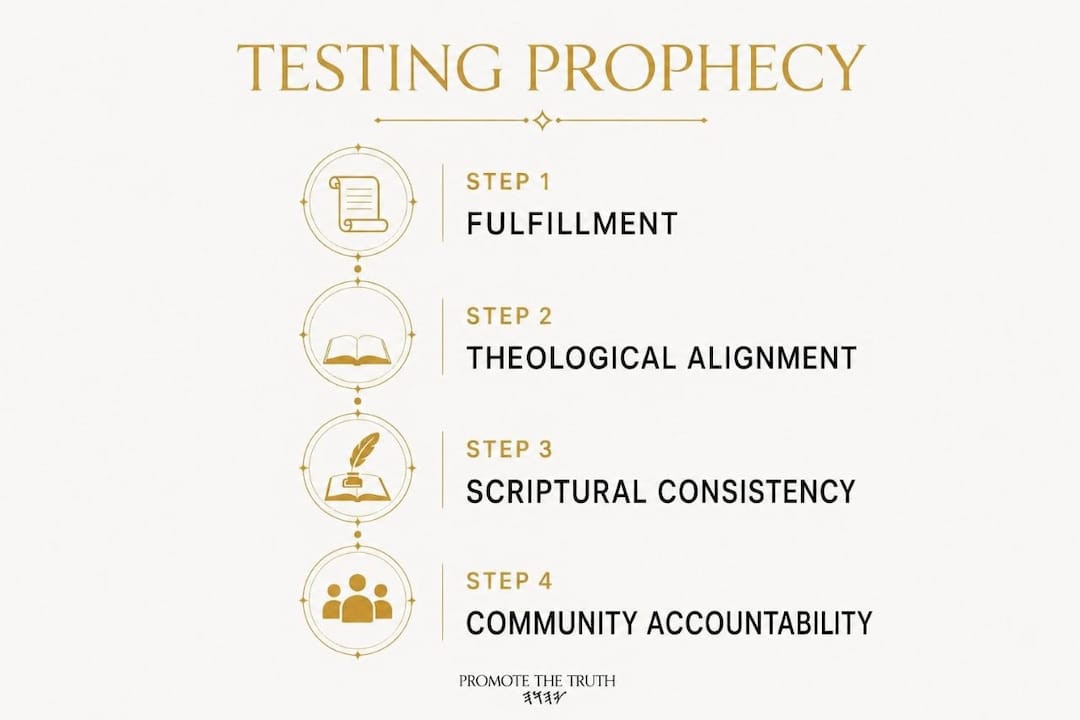
Fulfillment alone is not sufficient. A prediction can come true and still lead people away from YAHUAH. Dabariym (Deuteronomy) 13 warns that a prophet whose words come true but who directs worship toward other gods is still a false prophet. Prophecy must be tested against the standards of worship and moral character that YAHUAH has already revealed in Scripture.
New Testament Community Discernment
Shaul (Paul) instructs the Qahal (Church) in Qaranatiym Alaf (1 Corinthians) 14 to weigh prophetic messages together. No single person holds unchecked authority over prophetic interpretation. The community’s collective discernment serves as a safeguard. Combining Dabariym’s (Deuteronomy’s) fulfillment test with the Bariyt Hadash (New Testament) criteria for community edification provides a balanced and reliable approach to evaluating the authenticity of prophecy.
-
Does the prophecy align with YAHUAH’s revealed character and commands?
-
Does it come to pass as stated?
-
Does it build up the faith community of faith rather than divide or mislead it?
-
Does it bear fruit consistent with Scripture’s moral standards?
Pro Tip: Avoid any teacher or system that builds doctrine on date-setting or claims to predict the exact timing of prophetic fulfillment. Scripture’s prophetic texts are intended primarily for moral correction and covenant faithfulness, not for calendar precision.
What Principles Guide Faithful Interpretation of Scriptural (Biblical) Prophecy?
Interpreting prophecy in the Scriptures (Bible) requires a disciplined method. Without one, readers project their own assumptions onto the text rather than drawing its intended meaning from it.
The recognized standard is the grammatical-historical method. Hermeneutics seeks to discover what the Scriptural (Biblical) author meant by examining the original language, literary context, and historical setting. That method applies to prophetic texts just as it applies to the epistles and narrative literature.
Several principles flow directly from that method:
-
Let Scripture interpret Scripture. Hazun (Revelation), for example, draws heavily from Daniyal (Daniel), Yihazaqal (Ezekiel), and Yisha’aiyahu (Isaiah). Reading it without that Ta’anak (Old Testament) foundation leads to confusion. Interpreting Revelation via Old Testament allusions is not optional; it is essential for reading the text accurately.
-
Establish the plain historical meaning first. Interpreters should determine the plain historical meaning before exploring broader Scriptural fulfillment. Jumping directly to symbolic or end-times applications skips the essential foundation.
-
Trace fulfillment across the full canon. After establishing the plain meaning, trace how later Scripture confirms, expands, or fulfills the prophetic message. This two-stage process helps prevent both over-literalism and over-spiritualization.
-
Avoid building doctrine on isolated verses. Prophetic texts require careful cross-referencing. A single verse taken out of context can be used to support almost any position. The broader canonical context corrects that distortion.
The table below contrasts two common approaches to prophetic interpretation:
| Approach | Method | Risk |
|---|---|---|
| Grammatical-Historical | Original language, context, authorial intent | Requires more study time |
| Sensationalist or Date-Setting | Isolated symbols and the mapping of current events | Produces false expectations and doctrinal error |
The grammatical-historical method requires more effort. It also produces a more reliable and lasting understanding of how prophecy shapes Scripture from Barashiyt (Genesis) through Hazun (Revelation).
Pro Tip: When you encounter a difficult prophetic passage, read it in light of Scripture’s historical context. That single habit eliminates many interpretive errors before they arise.
What Is the ongoing Function of Prophecy in Faith Today?
Prophecy did not cease with the closing of the canon. The Bariyt Hadash (New Testament) teaches that the gift of prophecy remains available to believers. Feast of Shabua’ut (Pentecost) marks the fulfillment of Mashah’s (Moses’) hope that all of YAHUAH’s people would prophesy, pointing to a community-wide rather than an elite function.
The Ongoing Purposes of Prophecy Among YAHUAH’s People Today:
-
Strengthening Believers: Prophetic messages spoken within the community of faith reinforce trust in YAHUAH’s faithfulness, especially during times of hardship.
-
Encouraging repentance and growth: Prophecy today, like its Ta’anak (Old Testament) counterpart, calls people back to covenant faithfulness. It is not merely affirming. It also corrects.
-
Encouraging Repentance and Growth: Prophecy today, like its Ta’anak (Old Testament) counterpart, calls people back to covenant faithfulness. It does more than affirm; it also corrects.
-
Guarding Against False Teaching: A community that carefully weighs prophetic messages develops discernment. That discernment protects against false teachers and misleading doctrines.
-
Pointing Toward Salvation: Scriptural (Biblical) prophecy centers on salvation and a relationship with YAHUAH. Every genuine prophetic message, whether ancient or contemporary, serves that relational purpose. Promote The Truth’s teaching resources consistently emphasize this salvation-centered focus while exploring true salvation through the original Scriptural worldview.
Pro Tip: Approach prophetic gifts in your faith community with both openness and accountability. Shaul’s (Paul’s) instruction to “test everything” in Tashalaniyqiym Alaf (1 Thessalonians) 5:21 applies directly to prophetic messages spoken in any setting.
The function of prophecy in faith today is not to satisfy curiosity about the future. It is to strengthen, correct, and draw people closer to YAHUAH. That purpose has not changed since Dabariym (Deuteronomy).
Key Takeaways
Prophecy in Scripture functions as Spirit-directed, set-apart (divine) communication that edifies, warns, and points to YAHUAH’s purposes. It requires faithful interpretation through the grammatical-historical method and the discernment of the faith community.
| Point | Details |
|---|---|
| Core Purpose of Prophecy | Prophecy edifies, exhorts, and consoles the community of faith; it does more than merely predict future events. |
| Testing Prophetic Claims | Apply Dabariym’s (Deuteronomy’s) fulfillment test alongside theological alignment with YAHUAH’s revealed character. |
| Interpretive Method | Use the grammatical-historical method: establish the plain meaning before tracing broader Scriptural fulfillment. |
| Scripture Interprets Scripture | Read prophetic texts, especially Hazun (Revelation), in light of their Ta’anak (Old Testament) context to avoid interpretive error. |
| Ongoing relevance | Prophecy continues today as a Spirit-given gift for strengthening, correcting, and guiding believers. |
Why Most People Misread Prophecy (and What to Do Instead)
After years of studying prophetic texts and teaching Scripture, I have noticed one pattern more than any other: readers approach prophecy looking for a timeline. They want to know when. They want to map symbols onto current events. That impulse is understandable, but it consistently leads people away from what the text is actually communicating.
The prophets of the Ta’anak (Old Testament) were not primarily futurists. They were covenant messengers. Their role was to call YAHUAH’s people back to faithfulness, confront injustice, and remind the community of what YAHUAH had already revealed. Prediction was one tool in that work, not its primary purpose. When you read Amuts (Amos) or Yiramiyahu (Jeremiah) looking only for end-times clues, you miss the moral weight that made those books worth preserving.
My advice for anyone studying prophetic texts is this: read with humility before you read with curiosity. Ask what the original audience heard before asking what the text means for today. That discipline, combined with the Ta’anak (Old Testament) historical context taught by Promote The Truth, produces the kind of understanding that genuinely transforms how you live.
Prophecy is not a puzzle to solve. It is a message from YAHUAH intended to draw you closer to Him. The readers who benefit most from prophetic Scripture are not those with the most elaborate interpretive systems. They are the ones who approach the text with reverence, patience, and a genuine desire to know YAHUAH’s heart.
— Maria
Deepen Your Study of Scripture and Prophecy
The study of prophecy rewards those who go beyond surface-level readings and engage with the full depth of the ancient text.

Promote The Truth offers a growing library of teaching resources specifically designed for readers who want that depth. The Scripture Study Series video channel delivers in-depth teachings on prophetic texts, manuscript history, and the original Scriptural worldview. For a more structured learning path, the Digital Video Academy provides organized courses covering Scriptural themes, including prophecy, covenant, and the significance of the Name YAHUAH. Both resources are grounded in manuscript research and historical analysis, equipping readers with the tools to study prophetic messages in Scripture (the Bible) with confidence and clarity.
FAQ
What Is the Primary Role of Prophecy in Scripture?
Prophecy in Scripture serves to edify, exhort, and console the community of faith through Spirit-directed, set-apart (divine) communication. It also calls believers to covenant faithfulness and consistently points to the Mashiyha (Messiah).
How Do You Test Whether a Prophecy Is Genuine?
Apply Dabariym (Deuteronomy) 18:20–22: a genuine prophecy comes to pass as stated. Also, test it against YAHUAH’s revealed character and determine whether it builds up the community of faith rather than leading people astray.
What Is the Grammatical-Historical Method for Interpreting Prophecy?
The grammatical-historical method examines the original language, literary context, and historical setting to determine what the Scriptural (Biblical) author intended. It establishes the plain meaning of the text before exploring its broader Scriptural fulfillment.
Does Prophecy Still Function in the Qahal (Church) Today?
Yes. The Bariyt Hadash (New Testament) teaches that prophecy is a Spirit-given gift available to believers for strengthening, encouraging, and comforting the community of faith, subject to communal testing and discernment.
Why Is It Wrong to Use Prophecy for Date-Setting?
Scripture’s prophetic texts are intended primarily for moral correction and covenant faithfulness, not for calendar precision. Date-setting misrepresents the purpose of prophecy and consistently creates false expectations.