
The Shabat (Sabbath) is defined in Scripture as YAHUAH’s weekly, set-apart day of rest and worship, ordained at creation and woven through every layer of Scriptural (Biblical) teaching. The role that Shabat (Sabbath) scripture plays across the Ta’anak (Old Testament) and Bariyt Hadash (New Testament) is far richer than a simple rule about not working. Shamut (Exodus) 20:8–11 commands Yisharal (Israel) to remember and keep the Shabat (Sabbath) set-apart (holy), grounding that command directly in YAHUAH’s own rest after six days of creation. From Barashiyt (Genesis) to Hazun (Revelation), the Shabat (Sabbath) carries meaning as a covenant sign, a memorial of social justice, a reflection of Mashiyha’s (Messiah’s) mastership, and a forward-pointing promise of eternal rest.
What Is the Role of the Shabat (Sabbath) in Scripture?
The Shabat (Sabbath) is Aluah’s (God’s) weekly declaration that time itself is Qadush (holy). Shamut (Exodus) 20:8–11 establishes the command to stop ordinary work and devote the seventh day to worship, rest, and relationship with YAHUAH. The rationale is explicit: YAHUAH rested on the seventh day after creation, Baruk (blessed) that day, and set it apart. That act of set-apart (divine) rest becomes the model for human rest.
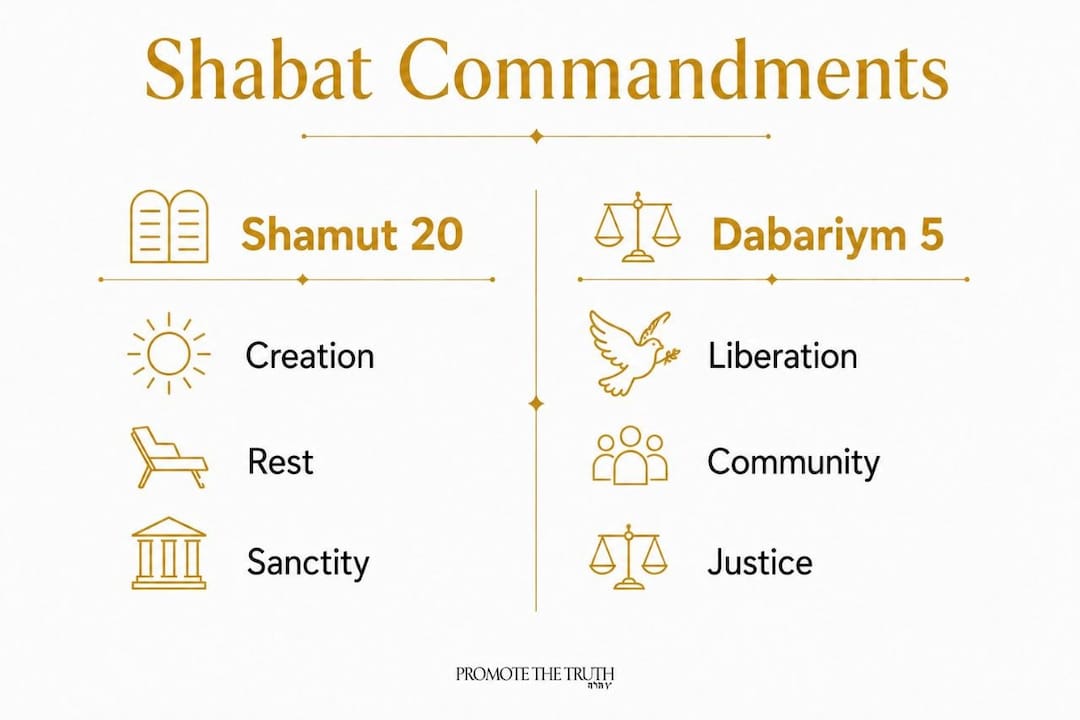
The 4th commandment appears twice in the Turah (Torah), and the two versions carry different emphases. Shamut (Exodus) grounds the Shabat (Sabbath) in creation rest, while Dabariym (Deuteronomy) grounds it in liberation from slavery. This layered theology shows that the Shabat (Sabbath) was never a single-purpose command. It simultaneously honors the Creator, remembers redemption, and protects the vulnerable.
Aluah (God) sets apart (sanctifies) the Shabat (Sabbath) by setting it apart from ordinary time, and believers set-apart (sanctify it) through qadush (holy) devotion and worship. Both acts are required. The Shabat (Sabbath) is not passive. It is a weekly, active renewal of the covenant relationship between YAHUAH and His people.

What Does the Ta’anak (Old Testament) Teach about Shabat (Sabbath) Observance?
The Ta’anak (Old Testament) presents the Shabat (Sabbath) through two distinct but complementary lenses: creation theology and covenant law.
Creation Foundation Shamut (Exodus) 20:
-
Aluah (God) rested on the seventh day after completing creation
-
Yisharal (Israel) is commanded to imitate that set-apart (divine) rest every week
-
The day is declared qadush (holy), meaning set apart from all other days
-
No ordinary work is permitted for any member of the household
Liberation Foundation Dabariym (Deuteronomy) 5:
-
Dabariym (Deuteronomy) 5:12–15 links Shabat (Sabbath) rest directly to Yisharal’s (Israel’s) liberation from Matsar (Egypt)
-
Rest is mandated for servants, animals, and sojourners, not just free Yisharaliym (Israelites)
-
The command becomes a weekly memorial of freedom and human dignity
-
Yisharal’s (Israel’s) memory of slavery becomes the ethical reason to grant rest to others
The covenant dimension of the Shabat (Sabbath) reaches its highest expression in Shamut (Exodus) 31:13–14:
“Speak to the children of Yisharal, saying, ‘You are to guard My Shabats by all means, for it is a sign between you and Me throughout your generations, so that you may know that I, YAHUAH, am setting you apart. You shall guard the Shabat, because it is Set-Apart to you. Everyone who violates the Shabat shall surely be put to death. Whoever does any work on it, that person shall be cut off from among their people.”
YAHUAH calls the Shabat a sign “between Me and you throughout your generations,” establishing it as a perpetual covenant marker between YAHUAH and Yisharal. The attachment of the death penalty for violating the Shabat demonstrates the seriousness with which YAHUAH regarded this Set-Apart day within the covenant relationship. The severity of the judgment underscores the Shabat’s unique role as a sign of obedience, separation, and belonging to YAHUAH.
The table below shows how the two Turah (Torah) versions of the 4th commandment differ in emphasis:
| Feature | Shamut (Exodus) 20 | Dabariym (Deuteronomy) 5 |
|---|---|---|
| Primary Rationale | Aluah’s (God’s) rest at creation | Yisharal’s (Israel’s) liberation from Matsar (Egypt) |
| Theological Focus | Creator and creation order | Redeemer and covenant memory |
| Social Scope | Household rest | Explicit rest for servants, animals, strangers |
| Tone | Commemorative | Ethical and memorial |
Understanding the Ta’anak (Old Testament) historical context behind these two versions helps readers see the Shabat (Sabbath) as a living, layered command rather than a static rule.
How Does the New Testament Reinterpret Shabat (Sabbath) Meaning?
Yahusha who is YAHUAH, does not abolish the Shabat (Sabbath). He reorients it. His declaration in Maraqu (Mark) 2:27 that "The Shabat was made for humans, not humans for the Shabat” is one of the most theologically dense statements in the Bashurah (Gospel). Yahusha who is YAHUAH as Master of the Shabat (Sabbath) in Matatiyahu (Matthew) 12:8 means that he holds authority over its meaning and application, not that He dismisses it.
The Abariy (Hebrew) and Aramiyt (Aramaic) origins of the Bashurah (Gospel) texts reveal that Yahusha who is YAHUAH, (Jesus’) Shabat (Sabbath) teachings were deeply rooted in the Turah (Torah) tradition, not a departure from it. His conflicts with the Parashiym (Pharisees) were about interpretation, not the validity of the day.
Key patterns in Yahusha who is YAHUAH’ (Jesus’) Shabat (Sabbath) practice include:
-
Healing on the Shabat (Sabbath): Yahusha , who is YAHUAH (Jesus), healed a man with a withered hand in Matatiyahu (Matthew) 12, a woman who had been bent over for eighteen years in Luqah (Luke) 13, and a man born blind in Yahuhanan (John) 9. Each healing was a deliberate act performed on the Shabat (Sabbath).
-
Feeding the Hungry: His disciples plucked grain on the Shabat (Sabbath), and Yahusha, who is YAHUAH (Jesus), defended them by citing Duiyd’s (David’s) example in 1 Shamual (1 Samuel) 21.
-
Teaching in Synagogues: Luqah (Luke) 4:16 records that Yahusha, who is YAHUAH (Jesus), read from Yisha’aiyahu (Isaiah) on the Shabat (Sabbath) “as was His custom,” showing regular Shabat (Sabbath) worship.
-
Compassion (Mercy) over Ritual: Yahusha, who is YAHUAH (Jesus), resolved tensions between law and compassion (mercy) by prioritizing the Shabat’s (Sabbath’s) purpose for human flourishing over rigid ritual compliance.
The early community continued to observe the Shabat (Sabbath) after the resurrection. Ma’ashiym (Acts) 13:14, 13:42, and 16:13 all record Shaul (Paul) and his companions gathering on the Shabat (Sabbath) for worship and teaching. The Bariyt Hadash (New Testament) does not replace the Shabat (Sabbath). It deepens its meaning through the lens of the Mashiyha’s (Messiah’s) Mastership.
What Social and Ethical Roles Does the Shabat (Sabbath) Fulfill?
The Shabat (Sabbath) is one of Scripture’s most direct social justice commands. Dabariym (Deuteronomy) explicitly mandates rest for servants, animals, and strangers, embedding ethical obligation within the act of worship. You cannot fully honor the Shabat (Sabbath) while exploiting those under your care. The two are inseparable.
This principle functions as what scholars at Yeshivat Maharat (is a Jewish educational institution) , describe as “enforced rhythm justice.” Shabat (Sabbath) law limits employer exploitation by creating a weekly, non-negotiable boundary on labor. No economic pressure can override it. That boundary protected the most vulnerable members of ancient Yisharaliy (Israelite) society, and its ethical logic applies just as directly today.
Dabariym (Deuteronomy) reframes the Shabat (Sabbath) as a community-wide reminder of liberation and human dignity, merging theological and ethical dimensions into a single act of observance. When Yisharal (Israel) rested, they were not just honoring YAHUAH; they were enacting the truth that no human being is merely a labor unit.
The connection between justice and worship is not incidental in Scripture. Yisha’aiyahu (Isaiah) 58:13–14 links proper Shabat (Sabbath) observance with caring for the hungry and oppressed. Amuts (Amos) 8:5 condemns merchants who resent the Shabat (Sabbath) because it interrupts their profit. The Nabiyaiym (Prophets) consistently treat Shabat (Sabbath)-breaking as a symptom of broader social injustice.
Pro Tip: When studying the Shabat’s (Sabbath’s) social dimension, read Dabariym (Deuteronomy) 5 alongside Yisha’aiyahu (Isaiah) 58 in the same sitting. Together, these two passages reveal how worship and justice function as a single, unified command in Scripture.
What is The Eschatological Significance of The Shabat (Sabbath)?
The Shabat (Sabbath) does not end with the weekly cycle. Scripture uses it as a forward-pointing sign of ultimate rest in YAHUAH’s eternal kingdom.
Abariym (Hebrews) 4 presents the most developed eschatological argument concerning the Shabat (Sabbath) in the Bariyt Hadash (New Testament). The author argues that Shabat (Sabbath) rest points to believers’ spiritual rest in Mashiyha (Messiah) and that a “Shabat (Sabbath) rest remains for the people of Aluah (God)” Abariym (Hebrews) 4:9). That remaining rest is not merely metaphorical. It describes the final, uninterrupted rest of Aluah’s (God’s) people in His presence.
Hazun (Revelation) 7:9–12 depicts a vast multitude before the throne of YAHUAH in eternal worship. That scene is the ultimate Shabat (Sabbath): creation completed, labor ended, and the people of Aluah (God) at rest in His presence forever.
The table below maps the Shabat’s (Sabbath’s) eschatological progression across Scripture:
| Scriptural (Biblical) Text | Shabat (Sabbath) Theme | Eschatological Meaning |
|---|---|---|
| Barashiyt (Genesis) 2:2–3 | Aluah (God) rests after creation | Original pattern of completed work and rest |
| Shamut (Exodus) 20:8–11 | Weekly rest commanded | Weekly rehearsal of creation’s completion |
| Abariym (Hebrews) 4:9–11 | Remaining Shabat (Sabbath) rest | Spiritual rest in Mashiyha (Messiah), pointing to eternity |
| Hazun (Revelation) 7:9–12 | Eternal worship before the throne | Final, unending Shabat (Sabbath) in Aluah’s (God’s) presence |
The weekly Shabat (Sabbath) functions as a rehearsal for eternity. Every time believers stop work, worship YAHUAH, and rest in His provision, they are practicing the posture they will hold forever. The Scripture Study Series from Promote The Truth explores these eschatological connections in depth, tracing the Shabat’s (Sabbath’s) meaning from Barashiyt (Genesis) through Hazun (Revelation).
YAHUAH’s covenant with His people, established in Shamut (Exodus) 31 and renewed through Mashiyha (Messiah), gives the Shabat (Sabbath) its permanent theological weight. The day is not a cultural artifact. It is a living sign of the relationship between the Creator and creation, pointing toward the day when that relationship is fully restored.
Key takeaways
The Shabat’s (Sabbath’s) role in Scripture is inseparable from creation, covenant, justice, and the eternal hope of rest in YAHUAH’s presence.
| Point | Details |
|---|---|
| Creation and covenant foundation | Shamut (Exodus ) 20 roots the Shabat (Sabbath) in Aluah’s (God’s) rest; Shamut (Exodus) 31 makes it a perpetual covenant sign. |
| Dual Turah (Torah) rationale | Shamut (Exodus) emphasizes creation; Dabariym (Deuteronomy ) emphasizes liberation, showing a layered theology. |
| Social justice command | Dabariym (Deuteronomy ) mandates rest for servants, animals, and strangers, linking worship with ethical action. |
| Mashiyha’s (Messiah’s) mastership | Yahusha, who is YAHUAH (Jesus) affirmed the Shabat’s (Sabbath’s) goodness and deepened its meaning through compassion (mercy) and healing. |
| Eschatological pointer | Abariym (Hebrews) 4 and Hazun ( Revelation) 7 present the Shabat (Sabbath) as a rehearsal for eternal rest in Aluah 's (God’s) presence. |
Why the Shabat (Sabbath) Still Speaks Directly to Us
I have spent years studying the Shabat (Sabbath) across manuscript traditions, and the thing that strikes me most is how consistently modern readers underestimate its scope. We tend to treat it as a rule about rest. Scripture treats it as a total reorientation of human life.
The Shabat (Sabbath) reorients human life from labor-centered busyness to worship-centered rest. That is not a minor adjustment. In a culture where productivity defines identity, the Shabat (Sabbath) is a weekly declaration that you are not what you produce. You are a covenant partner of YAHUAH, and that relationship takes priority over every economic demand.
What I find most convicting is the social dimension. The Shabat (Sabbath) is not just personal renewal. It is a communal act of justice. When you observe the Shabat (Sabbath), you are also granting rest to everyone in your sphere of influence. That is the Dabariym (Deuteronomy) logic, and it is just as applicable today as it was in ancient Yisharal (Israel).
- Yahusha, who is YAHUAH (Jesus), models the Shabat (Sabbath) perfectly. He worships, teaches and heals. He does not use the day for personal advancement. He uses it for the flourishing of others. That is the pattern worth imitating, and it is the one that most Shabat (Sabbath) discussions skip entirely.
My honest encouragement is this: Read the Shabat (Sabbath) commands in both Shamut (Exodus) and Dabariym (Deuteronomy) during the same week. Let the creation rationale and the liberation rationale sit together. The Shabat (Sabbath) is not a burden. It is an invitation into the rhythm YAHUAH built into creation itself.
— Maria
Go Deeper Into Shabat (Sabbath) Scripture with Promote The Truth
Promote The Truth has developed a rich library of teachings for those who want to move beyond surface-level Shabat (Sabbath) study.
The Scripture Study Series on YouTube covers the Shabat’s (Sabbath’s) role throughout the Ta’anak (Old Testament) and Bariyt Hadash (New Testament), drawing directly from ancient Abariy (Hebrew) and Aramiyt (Aramaic) manuscript sources. These video teachings are free, thorough, and grounded in the original text. For those who want to read the Scriptures in a meticulously restored English translation, the Truth Scriptures digital collection provides direct access to the original intent of every Shabat (Sabbath) command. Promote The Truth also offers structured online courses through its digital video academy for deeper, guided study of covenant theology and the significance of the Shabat (Sabbath).
FAQ
What is The Primary Purpose of Observing the Shabat (Sabbath)?
The Shabat’s (Sabbath’s) primary purpose is to set apart one day each week for rest and the worship of YAHUAH, grounded in Aluah’s (God’s) own rest after creation, as commanded in Shamut (Exodus) 20:8–11. It also serves as a memorial of liberation and a covenant sign between YAHUAH and His people.
How Does Deuteronomy Differ From Shamut (Exodus) on Shabat (Sabbath) Day Commandments?
Shamut (Exodus) 20 roots the Shabat (Sabbath) in creation rest, while Dabariym (Deuteronomy) 5:12–15 roots it in Yisharal’s (Israel’s) liberation from Matsariy (Egyptian) slavery and explicitly mandates rest for servants, animals, and sojourners. Together, these two accounts show that the Shabat (Sabbath) carries both theological and social justice dimensions.
What Did Yahusha, Who Is YAHUAH Teach About the Shabat (Sabbath)?
Yahusha, who is YAHUAH (Jesus), declared Himself Master (Lord) of the Shabat (Sabbath) in Matatiyahu (Matthew) 12:8 and taught that the Shabat (Sabbath) was made for human benefit, not rigid rule-keeping. His healing and acts of compassion (mercy) on the Shabat (Sabbath) modeled the day’s true purpose: human flourishing and worship.
Does the Shabat (Sabbath) Have Significance Beyond The Weekly Practice?
Abariym (Hebrews) 4:9 states …“it is still remains that a Shabat rest is open for the people of Aluah” , pointing to an eternal rest in YAHUAH’s presence. Hazun (Revelation) 7:9–12 depicts eternal worship before Aluah’s (God’s) throne as the ultimate fulfillment of the Shabat’s (Sabbath’s) promise.
Is The Shabat (Sabbath) only for Yisharal (Israel) or For All Believers?
Shamut (Exodus) 31 presents the Shabat (Sabbath) as a perpetual covenant sign between YAHUAH and His people throughout all generations. The Bariyt Hadash’s (New Testament’s) record of continued Shabat (Sabbath) observance by early believers in Ma’ashiym (Acts) 13 and Ma’ashiym (Acts) 16 indicates that the day’s significance extended beyond ethnic Yisharal (Israel) to all who follow Mashiyha (Messiah).
Recommended
-
Scripture Study Series YouTube Video Channel - Promote The Truth
-
Lunar-Solar vs. Gregorian: Exploring YAHUAH’s Calendar — PROMOTE THE TRUTH
-
Explore Scriptural (Biblical) Healing Scriptures: A Practical Guide to YAHUAH’s Word and Healing
-
Understand Ta’anak (Old Testament) Historical Context for a Deeper Faith