
Scriptural (Biblical) healing Scriptures are passages throughout the Ta’anak (Old Testament) and Bariyt Hadash (New Testament) that address YAHUAH’s (the Creator) power and willingness to restore the human body, mind, and spirit. When you explore Scriptural (Biblical) healing scriptures guide-style, with attention to context, covenant, and prayer practice, these verses become far more than words of comfort. They become a framework for approaching YAHUAH with faith and understanding. This guide walks through the foundational healing verses, explains how to pray them with purpose, corrects the most common misreadings, and shows you how to hold onto hope when healing unfolds on YAHUAH’s timing rather than your own.
Which Key Scriptural (Biblical) Verses Focus on Healing and What Do They Mean
The healing scriptures study begins with five passages that form the backbone of scriptural (biblical) teaching on restoration. Each one carries a distinct emphasis, and reading them together gives you a fuller picture than any single verse can provide.
-
Yisha’aiyahu (Isaiah) 53:5 declares that “…by His wounds, we are healed.” Yisha’aiyahu (Isaiah) 53:5 and Kapa Alaf (1 Peter) 2:24 primarily address spiritual healing, specifically forgiveness and salvation from sin, rather than a blanket guarantee of physical cure. The surrounding context speaks of sin-bearing and righteousness, not medical recovery. Misreading this verse as a physical promise sets up false expectations that can damage faith.
-
Kapa Alaf (1 Peter) 2:24 quotes Yisha’aiyahu (Isaiah) 53 directly and applies it to the work of Mashiyha (Messiah) on the stake. The healing being referenced is reconciliation with YAHUAH —the restoration of a broken relationship between Creator and His creation.
-
Ya’aqab (James) 5:14–15 shifts the focus to community and physical illness. Ya’aqab (James) 5:14–15 outlines a structured, faith-led process: the sick person calls the elders, the elders pray and anoint with oil in the name of YAHUAH, and the prayer of faith is declared to bring healing. This is the most procedurally specific passage on healing in the Scriptures.
-
Shamut (Exodus) 15:26 introduces YAHUAH as “the Aluah (Creator) who heals you,” but the promise is explicitly conditional upon obedience. As the verse states, YAHUAH’s people are to diligently obey His Voice, do what is right in His Eyes, listen to His Commandments, and guard His Laws. YAHUAH presents healing as part of a covenant relationship, not as an automatic benefit. Obedience to His Commandments is the relational context in which His healing promise operates.
-
Tahliym (Psalm) 103:2–4 calls the reader to honor YAHUAH and to “never forget how kind He has been.” Among His benefits, He forgives all our sins, heals all our diseases, saves our lives from destruction, and crowns us with lovingkindness and tender compassion. This pairing of forgiveness and healing reinforces that both spiritual and physical restoration are expressions of YAHUAH’s character, compassion, and purpose for His people.
The critical distinction across all five passages is that healing can be spiritual, emotional, or physical, and the Scriptures do not always specify which type is being referenced. Healing scriptures support emotional and spiritual restoration in addition to, and sometimes instead of, physical healing. Recognizing this distinction helps prevent the painful confusion that can arise from expecting one type of healing when YAHUAH may be providing another.
Pro Tip: When studying any healing verse, remember that YAHUAH’s healing is not restricted by race, color, or nationality. Healing comes from YAHUAH to those who call upon His Name, trust in Him, and seek to obey His Commandments and Ordinances. Rather than focusing only on who first received a promise, focus on YAHUAH’s character, His covenant, and the obedience and faith He desires from His people.

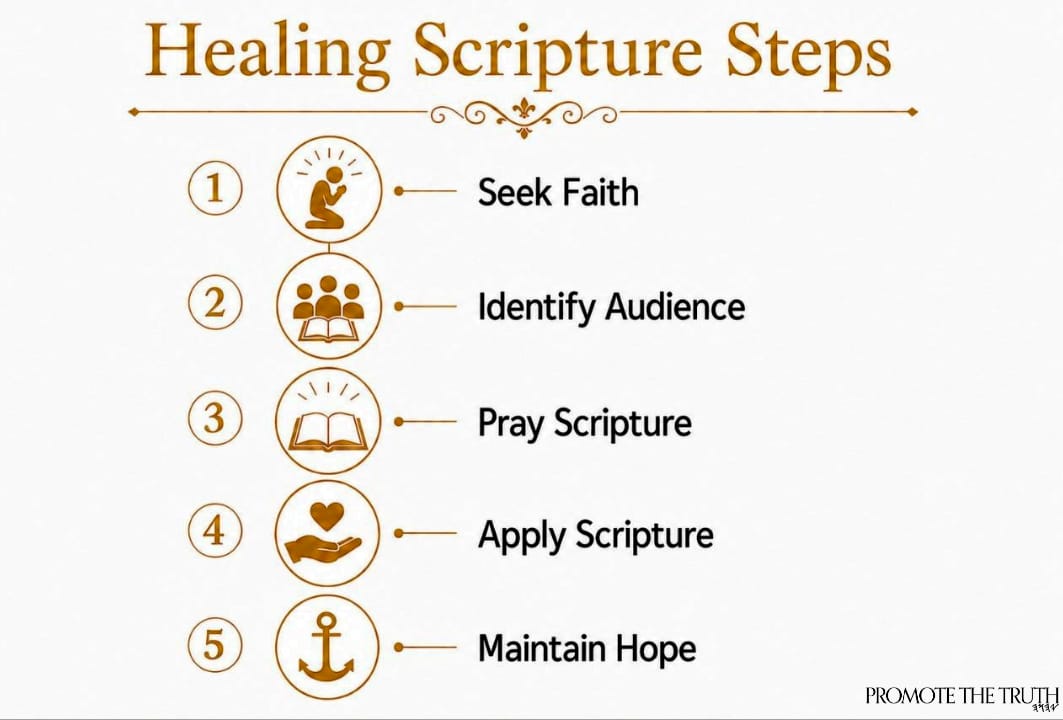
How to Pray and Apply Scriptural (Biblical) Healing Scriptures Effectively
Applying healing Scriptures through prayer is not a formula for unlocking results. Rather, it is a posture of trust directed toward YAHUAH, who is the source of all restoration. The process described in Ya’aqab (James) 5 provides the clearest Scriptural (Biblical) model for approaching healing through faith, prayer, and dependence upon YAHUAH.
-
Acknowledge the Illness Openly. The sick person in Ya’aqab (James) 5 takes the first step by calling for the elders. Bringing your need before the community is itself an act of faith, rather that sign of weakness. Instead of suffering in isolation, the person humbly seeks prayer, support, and intervention according to YAHUAH’s instructions.
-
Invite Community Prayer. Community-led healing prayer reinforces faith and strengthens the connection among believers, supporting both spiritual and physical restoration. You do not need to carry your illness alone. The assembly is designed to walk alongside you, bear your burdens, and support you through prayer, encouragement, and faith in YAHUAH.
-
Anoint with Oil in YAHUAH’s Name. The oil used in Scriptural (Biblical) anointing is a physical sign, typically olive oil, that represents the presence of the Set-Apart Spirit and YAHUAH’s attention to the situation. Anointing with oil is not a magical healing agent; rather, it is a symbol of consecration and YAHUAH’s Set-Apart presence. This practice is rooted in both Yahudiym (Jewish) and Guiym (Gentile) traditions and serves as an outward expression of faith, prayer, and dependence upon YAHUAH.
-
Pray the Prayer of Faith. This means trusting YAHUAH as the Healer, not trusting the ritual itself. Faith in healing prayer is reliance on YAHUAH’s power, not confidence in the procedure. The elders pray; YAHUAH heals.
-
Confess Sins if Relevant. Ya’aqab (James) 5:16 connects healing prayer with confession, stating, “Confess your shortcomings and weaknesses to one another. Pray for one another so that you will be healed…” This suggests that spiritual and physical restoration can sometimes be linked. While confession is not presented as a requirement for every healing prayer, it is a matter worth examining honestly before YAHUAH. Unconfessed sin, unresolved offenses, or spiritual burdens may at times hinder a person’s spiritual well-being, making sincere self-examination an important part of seeking restoration.
-
Submit to YAHUAH’s Will and Timing. The prayer of faith does not demand a specific outcome. It places the outcome in YAHUAH’s hands while declaring trust in His goodness, wisdom, and perfect timing.
Confess your shortcomings and weaknesses to one another. Pray for one another so that you will be healed. The earnest prayer of a righteous person is powerful in what it can accomplish.” — Ya’aqab (James) 5:16
YAHUAH also heals through medical means, natural processes, miracles, and prayer. Seeking medical help does not contradict faith. The source of all healing, regardless of the channel, is always YAHUAH. Integrating medical treatment with prayer honors Scripture’s teaching rather than contradicting it, recognizing that YAHUAH can work through many means to bring healing and restoration.
Pro Tip: Write out the healing verse you are praying before you begin. Reading the actual text aloud during prayer anchors your mind in YAHUAH’s words rather than your own fears. This is especially useful when praying for someone else, helping both of you focus on YAHUAH’s truth and promises instead of the circumstances.
What are Common Misunderstandings About Scriptural (Biblical) Healing Scriptures
Misunderstanding healing verses causes false expectations, and nuanced teaching on scriptural context is the most important safeguard against spiritual harm. The following table maps the most frequent misreadings against what the text actually teaches.
| Misunderstanding | What Scripture Actually Teaches |
|---|---|
| Yisha’aiyahu (Isaiah) 53:5 guarantees physical healing for all believers | The verse addresses spiritual healing through the Mashiyha’s (Messiah’s) atoning work, not a universal promise of physical healing. |
| Anointing oil carries healing power in itself | Oil is a symbol of the Set-Apart Spirit’s presence; the power to heal belongs to YAHUAH alone. |
| Strong enough faith always produces physical healing | Shaul’s (Paul’s) “thorn in the flesh” was not removed despite his prayers, demonstrating that YAHUAH’s will governs the outcome. |
| Healing promises are unconditional | Shamut (Exodus) 15:26 connects healing to covenant obedience, making the promise relational and conditional. |
| Delayed healing means absent faith | Scripture presents healing according to YAHUAH’s timing, not a human schedule. |
Several Additional Points Deserve Direct Attention.
-
The phrase “…And by His stripes that were on His body, we are healed” is quoted in Kapa Alaf (1 Peter) 2:24 in the context of returning to the Shepherd and Overseer of your souls, not in the context of physical recovery from sickness. The passage emphasizes spiritual restoration and reconciliation with YAHUAH. Therefore, using this verse as a direct promise of physical healing requires reading into the text an application that the author himself does not explicitly state.
-
YAHUAH’s will ultimately governs healing outcomes. Shaul (Paul) prayed three times for his thorn in the flesh to be removed, but YAHUAH said no, and Shaul received favor instead. That account alone dismantles the idea that persistent faith always produces a physical cure, demonstrating that YAHUAH’s purpose and will ultimately govern the outcome.
-
Anointing oil is a Scriptural (Biblical) symbol of consecration and YAHUAH’s set-apart presence, not a remedy with inherent healing properties. Treating it as a magical substance misplaces trust from YAHUAH onto a ritual object. The power is not in the oil itself, but in YAHUAH, whom the oil symbolizes.
-
Suffering is not evidence of sin or spiritual failure. Aiyub’s (Job’s) suffering was not caused by disobedience. Ala’azar (Lazarus) died before being raised. The man born blind in Yahuhanan (John) 9 was not blind because of his own sin or the sin of his parents. These examples demonstrate that suffering, illness, and even death are not always the result of personal wrongdoing. The Scriptures consistently resist the idea that illness is automatically evidence of sin or spiritual failure.
Pro Tip: When a healing verse feels like a promise that was not kept, read the five to ten verses surrounding it before drawing a conclusion. Context almost always clarifies whether the promise is covenantal, conditional, or eschatological. Understanding the context is often the key to resolving apparent difficulties and interpreting the passage accurately.
How Do You Maintain Hope When Healing Does Not Come as Expected
The most honest part of any guide to healing prayers is this: YAHUAH does not always heal on the timeline or in the manner we request. Distinguishing between prayers for present restoration and ultimate healing prevents discouragement and removes the spiritual pressure that comes when healing does not happen according to human expectation.
Hazun (Revelation) 21:4 promises that YAHUAH “will wipe away every tear from their eyes. Death will no longer exist . There will be no mourning, no crying and no more pain…” This is the final and complete healing. Every present healing is a foretaste of that promise, not the fullness of it. Holding this eschatological hope in view changes how you pray and how you wait.
Practical spiritual disciplines that sustain emotional healing and peace during ongoing suffering include the following.
-
Meditate on Tahliym (Psalm) 103:2–4 Daily. Recounting YAHUAH’s benefits, including past healing, acts of deliverance, and spiritual restoration, builds a record of His faithfulness that strengthens and sustains trust in the present. Remembering what YAHUAH has already done helps cultivate confidence in His continued care, compassion, and provision.
-
Stay in Community. Isolation amplifies suffering. The Ya’aqab (James) 5 model places healing in a communal context for a reason. Other believers carry what you cannot carry alone, offering prayer, support, encouragement, and strength during times of need.
-
Pursue Scriptural Purity and Covenant Alignment. Shamut (Exodus) 15:26 ties healing to a covenant relationship. Deepening your walk with YAHUAH through His Commandments and Ordinances keeps you in the relational space where His healing operates. As you grow in obedience and trust, you strengthen your covenant relationship with the One who declares, “I am YAHUAH who heals you.”
-
Pray the Tahliym (Psalms) of Lament. Tahliym (Psalms) 22, 38, and 88 are raw, honest prayers from people in pain. Praying them gives voice to suffering and provides language for expressing sorrow before YAHUAH without abandoning faith. They remind us that honest lament and steadfast trust can exist together.
-
Receive Medical Care Without Guilt. YAHUAH heals through multiple channels, including physicians, natural processes, and direct miracles. Accepting medical treatment is not a failure of faith. It is receiving YAHUAH’s provision through the means He has placed in the world. Seeking medical care and trusting YAHUAH are not opposing actions but can work together in the pursuit of healing and restoration.
Pro Tip: Keep a healing journal. Write down every prayer for healing, every scripture you prayed, and every answer you received, whether physical, emotional, or spiritual. Over months, patterns of YAHUAH’s faithfulness become visible in ways that daily experience obscures.
Key Takeaways
Scriptural (Biblical) healing scriptures address physical, spiritual, and emotional restoration, and their power is fully realized only when read in covenant context and prayed with faith directed toward YAHUAH as the sole source of healing.
| Point | Details |
|---|---|
| Spiritual Healing is Primary | Yisha’aiyahu (Isaiah) 53:5 and Kapa Alaf (1 Peter) 2:24 address forgiveness and salvation before physical healing. |
| Context Determines Meaning | Shamut (Exodus) 15:26 ties healing to covenant obedience, making the promise relational rather than automatic. |
| Community Prayer Is Scriptural (Biblical) | Ya’aqab (James) 5:14–15 prescribes prayer led by the elders, accompanied by anointing with oil, as the Scriptural model for healing. |
| Oil Is a Symbol, Not a Remedy | Anointing oil represents the Set-Apart Spirit’s presence; the power to heal belongs to YAHUAH alone. |
| Final Healing Is Eschatological | Hazun (Revelation) 21:4 promises complete restoration, giving believers hope beyond present suffering. |
What I Have Learned From Praying Healing Scriptures In Real Life
I have sat with people in hospital rooms holding open Scriptures, and I have prayed Ya’aqab (James) 5 over individuals who recovered and over individuals who did not. That experience taught me something that no theological commentary fully prepares you for: the healing scriptures are not a transaction. They are an invitation into relationship with YAHUAH during the most vulnerable moments of human life.
The verses that helped the most were not always the ones that promised restoration. Tahliym (Psalm) 22:1, which opens with the words, “My Aluah, my Aluah, why does it seem like You have forsaken me?...” gave people permission to be honest with YAHUAH about their pain, struggles, and questions. That honesty, more than any ritual or formula, often seemed to open the door to genuine peace, which is itself a form of healing.
I also learned that the original scriptural text matters enormously when studying healing passages. Translations that flatten covenant language or soften conditional promises can create the impression that healing is guaranteed when the text actually describes a relational dynamic. Reading from sources that honor the Abariy (Hebrew) and Aramiyt (Aramaic) manuscript tradition gives you a more accurate foundation for both prayer and expectation.
The most important posture I have found is this: approach healing scriptures with humility for what they actually say, not what you wish they said. YAHUAH is faithful. His faithfulness sometimes looks like physical restoration, and sometimes it looks like the Lovingkindness to endure. Both are real answers to prayer.
— Maria
Deepen Your Healing Scripture Study With Promote The Truth

Promote The Truth exists to help you engage the Scriptures at their deepest level, including the passages that speak to healing, covenant, and YAHUAH’s restorative power. The organization’s Scripture Study Series provides video teachings on healing passages drawn from ancient Abariy (Hebrew) and Aramiyt (Aramaic) manuscript sources, giving you the contextual grounding that transforms how you read and pray these verses.
For structured learning, the Digital Video Academy offers courses that walk through scriptural topics, including healing and covenant, with the depth and accuracy that serious seekers deserve. Join the Promote The Truth community and study the true Word of YAHUAH alongside fellow believers who are committed to understanding Scripture according to its original intent and context.
FAQ
What Do the Scriptures (Bible) Mean by Healing Scriptures?
Healing Scriptures are Scriptural (Biblical) passages that reveal YAHUAH’s power to restore physical health, emotional wholeness, and spiritual well-being. They span both the Ta’anak (Old Testament) and the Bariyt Hadash (New Testament), encompassing covenant promises, prayer practices, and eschatological hope.
Is Healing Guaranteed if I Pray with Enough Faith?
Physical healing is not guaranteed by faith alone. YAHUAH’s will governs the outcome of healing, as demonstrated by Shaul’s (Paul’s) unanswered prayer for the removal of his thorn in the flesh. Faith directs trust toward YAHUAH rather than toward a specific outcome.
What Is the Role of Anointing Oil in Healing Prayer?
Anointing oil is a symbol of the Set-Apart Spirit’s presence and YAHUAH’s attention, not a substance that possesses healing properties. Oil used in Scriptural (Biblical) anointing is a physical sign that expresses faith, not a ritual that produces healing on its own.
Does Yisha’aiyahu (Isaiah) 53:5 Promise Physical Healing for Believers Today?
Yisha’aiyahu (Isaiah) 53:5 primarily addresses spiritual healing, specifically forgiveness and reconciliation with YAHUAH through the Mashiyha’s (Messiah’s) atoning work. Applying this passage as a universal guarantee of physical healing misinterprets its covenantal and redemptive context. The emphasis is on spiritual restoration and redemption rather than on an unconditional promise of physical healing.
How Can I Maintain Faith When Healing Does Not Happen?
Hold the eschatological promise of Hazun (Revelation) 21:4 alongside your present prayers. Remain in community, and receive YAHUAH’s provision through all available means, including medical care. Distinguishing between present restoration and final healing removes false pressure, prevents unnecessary disappointment, and sustains genuine hope. It enables believers to trust YAHUAH faithfully in the present while looking forward to the complete restoration He has promised in the age to come.