
An ancient interlinear Scriptures (Bible) is a study resource that places the original Abariy (Hebrew) or Yuuniy (Greek) text directly above a literal, word-for-word English gloss, line by line. This format forms the foundation of serious interlinear Scriptures (Bible) study because it reveals the original structure of the ancient text before a translator’s interpretation influences its meaning. Alongside each word are parsing codes that identify important grammatical details such as tense, case, gender, number, and other linguistic features.
For Scriptures (Bible) students who desire to move beyond surface-level reading and engage more deeply with the Word of YAHUAH, learning to read an ancient interlinear is not merely beneficial—it is essential. It provides a direct window into the original languages and lays the groundwork for a richer, more accurate understanding of the Scriptures.
What Is an Ancient Interlinear Scriptures (Bible), and How Does It Work?
An interlinear Scriptures (Bible) presents the original Abariy (Hebrew) or Yuuniy (Greek) text on one line, with a literal English gloss printed directly beneath each word. This layout preserves the original word order, which often differs significantly from standard English sentence structure. That difference is not a flaw—it is the point. Seeing the Abariy (Hebrew) or Yuuniy (Greek) word order preserved reveals how the original authors constructed meaning, something that modern translations often smooth over.

The Three-Line Structure Most Interlinear Scriptures (Bibles) Use
Most interlinear Scriptures (Bibles) organize each verse into three layers:
-
Original script line: The Abariy (Hebrew) or Aramiyt (Aramaic) Ta’anak (Old Testament), or the Yuuniy (Greek) Bariyt Hadash (New Testament) word, presented in its native alphabet.
-
Transliteration line: A phonetic rendering of each word using English letters, helping readers engage with the pronunciation even without knowing the original alphabet
-
Gloss line: A literal English word or short phrase printed directly beneath each original word.
Parsing codes appear alongside each original word, identifying whether a verb is in the past or present tense, whether a noun is masculine or feminine, and which grammatical case it carries. These codes are one of the interlinear’s most powerful features for anyone serious about studying the interpretation of ancient texts.
Pro Tip: When you first open an interlinear, do not try to read it from left to right like a novel. Instead, focus on one verse at a time. Trace each original word to its English gloss and parsing code before moving on to the next word.
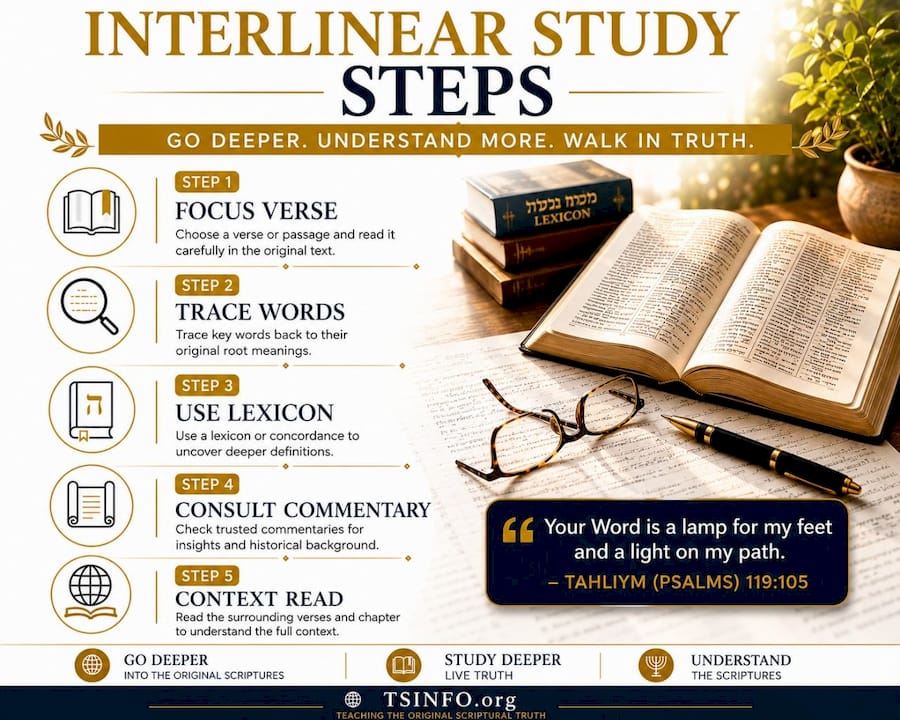
A practical example illustrates its value. In a standard English translation, the aspect of a Yuuniy (Greek) verb (whether an action is ongoing or completed) often disappears entirely. An interlinear preserves this distinction. That single detail can significantly affect the meaning of a passage, with important implications for doctrine and understanding.
Who Benefits Most from Using an Interlinear Scriptures (Bible)?
Interlinear Scriptures (Bibles) are designed for academic study, not casual devotional reading. That distinction matters because casual readers often find the format disorienting. The word order feels backward, the parsing codes look like a foreign language, and the gloss can read awkwardly. That experience is normal and expected.
The readers who benefit most from interlinear study include:
-
Seminary students and pastors who need to verify how a specific Yuuniy (Greek) or Abariy (Hebrew) word functions in a passage before preaching or teaching.
-
Serious Scriptures (Bible) students with at least a basic familiarity with Abariy (Hebrew) or Yuuniy (Greek) grammar, or a willingness to learn it alongside their studies.
-
Researchers and scholars working in the interpretation of ancient texts, manuscript comparison, or textual criticism.
-
Faith learners connected with organizations like Promote The Truth who want direct access to the original Scriptural text without relying solely on a translator’s choices.
Casual readers are not excluded, but they need supplemental tools. An analytical lexicon explains what each gloss word means across its full range of uses, while a basic grammar guide explains the parsing codes. Without these two tools, the interlinear gloss provides individual words but not their full meaning.
Free digital resources have made interlinear access far more widespread than it once was. Scripture4All, freely accessible since 2004, offers Abariy (Hebrew) and Yuuniy (Greek) interlinear texts online at no cost. That accessibility is significant because it means the primary barrier to interlinear Scriptures (Bible) study is no longer financial—it is educational.
Interpretive Challenges When Studying Ancient Interlinear Texts
The greatest risk in interlinear study is treating a literal gloss as a complete translation. It is not. Literal glosses are raw material that require grammatical knowledge and lexicon support to be interpreted correctly. A gloss provides the surface meaning of a word, but it does not convey the idiom, syntax, or cultural context that shaped how the word was used thousands of years ago.
Scholars identify several specific challenges that every interlinear Scriptures (Bible) student should understand and address:
-
Anachronistic interpretation: Reading modern concepts back into ancient words is one of the most common mistakes. An Abariy (Hebrew) word translated as “soul” does not carry the same philosophical weight that it does in modern Western thought. Recovering the original cultural context is not optional—it is the work.
-
Manuscript variants: The ancient texts exist in multiple manuscript traditions. A word in one manuscript may differ from the corresponding word in another. Textual criticism is the discipline that evaluates these variants and identifies the most likely original wording.
-
Editorial shaping: Ancient texts passed through scribal hands over centuries. Textual and source criticism together reveal how that transmission process affected the text, which matters when you are reading a gloss that reflects one manuscript tradition.
-
Syntax blindness: Abariy (Hebrew) and Yuuniy (Greek) syntax does not map directly onto English. A gloss preserves the original word order but cannot show how clauses relate to one another without grammatical knowledge.
-
Over-reliance on the gloss: Depending entirely on the interlinear translator’s word choices can perpetuate interpretive bias rather than uncovering the full range of the text’s meaning.
Pro Tip: Always read an interlinear passage alongside at least one scholarly commentary and one analytical lexicon. The interlinear shows you what the words are. The commentary and lexicon help you understand what they mean.
Understanding how to read Scripture in its historical context is the discipline that holds all of this together. Linguistic study without historical grounding can produce confident misinterpretations.
Practical Steps to Begin Your Interlinear Scriptural (Bible) Study
Starting with a familiar verse is the most effective approach for new interlinear readers. Beginning with a well-known passage such as Yahuhanan (John) 3:16 or Tahliym (Psalm) 23 allows you to focus on learning the format rather than decoding unfamiliar content at the same time. You already know what the passage says. Now you are learning how it was originally written.
Here is a practical framework to get started:
-
Session one (30–60 minutes): Open your interlinear to a familiar verse. Identify the original script line, the transliteration, and the gloss. Do not worry about the parsing codes yet. Simply learn the structure.
-
Session two: Choose one word from the verse. Look it up in an analytical lexicon. Read its full range of meanings, then compare that range with what the gloss presents.
-
Session three: Read the parsing code for one verb in the passage. Identify its tense and voice. Ask how those grammatical details affect your understanding of the verse.
-
Ongoing practice: Add one new verse during each study session. Gradually expand to the surrounding verses so you build passage-level understanding rather than just word-level knowledge.
Common Beginner Mistakes to Avoid
-
Skipping the transliteration line and jumping straight to the gloss.
-
Treating the gloss as a translation rather than as a starting point.
-
Studying words in isolation without reading the surrounding verses.
-
Expecting fluency within weeks rather than months.
For readers working with Abariy (Hebrew) texts, building even a basic foundation in Scriptural Abariy (Biblical Hebrew) dramatically increases what you can gain from an interlinear. You do not need to be fluent. You need enough grammatical knowledge to understand what the parsing codes are telling you.
Pro Tip: Keep a study notebook where you record each word you look up, along with its parsing code and lexicon definition. After three months, that notebook becomes a valuable personal reference that will accelerate every future study session.
Key Takeaways
An interlinear Scriptures (Bible) is one of the most direct tools for accessing the original Scriptures, but it requires grammatical knowledge, lexicon support, and historical context to use responsibly.
| Point | Details |
|---|---|
| Core definition | An interlinear Scriptures (Bible) aligns the original Abariy (Hebrew) or Yuuniy (Greek) text with a literal English gloss, line by line. |
| Three-layer structure | The original script, transliteration, and gloss work together to reveal word-level meaning. |
| Audience fit | Most effective for students with a basic knowledge of Abariy (Hebrew) or Yuuniy (Greek) and access to an analytical lexicon. |
| Interpretive risk | Glosses are raw material, not complete translations. Anachronistic interpretation and syntax blindness are real dangers. |
| Best starting practice | Begin with a familiar verse and spend 30–60 minutes learning the format before analyzing its grammar. |
Why I Think Most Students Underestimate the Interlinear’s Demands
The interlinear Scriptures (Bible) is one of the most honest study tools available. It does not pretend to provide a finished interpretation. Instead, it presents the raw text and requires you to do the work. That honesty is its greatest strength—and also the reason so many students abandon it after only a week.
What I have observed is that students who treat the interlinear as a shortcut to discovering “what the Yuuniy (Greek) really says” often end up more confused than when they started. They pull a gloss out of context, compare it with a popular translation, and conclude that the translation is wrong. Sometimes it is. More often, however, the gloss is only one possible rendering of a word that carries three or four legitimate meanings, depending on its syntax and context.
The students who thrive in interlinear study are the ones who treat it as a beginning, not an answer. They use it to ask better questions. They bring those questions to lexicons, grammars, and commentaries. They read Scripture in its historical context before deciding what a word means. That discipline is slower, but it is also the only approach that consistently leads to sound interpretation.
The interlinear does not replace deeper scholarship—it opens the door to it. Walk through that door with patience, and the original text of Scripture will reward you in ways that no English translation alone ever could.
— Maria
Promote The Truth Resources for Deeper Scripture Study
Promote The Truth publishes the Truth Scriptures, a comprehensive English restoration of the Ta’anak (Old Testament) and Bariyt Hadash New Testament), translated from ancient Abariy (Hebrew) and Aramiyt (Aramaic) manuscript sources. For students developing their interlinear Scriptures (Bible) study skills, these resources provide direct access to the original Scriptural text alongside study tools designed to deepen understanding and encourage careful, text-based study.
If your goal is to move beyond surface-level reading and engage more deeply with the Word of YAHUAH, the Truth Scriptures provide a strong foundation for serious Scriptures (Bible) study. When used together with an interlinear Scriptures (Bible), analytical lexicons, and grammatical resources, they help readers examine the original languages with greater confidence while building a deeper appreciation for the historical and linguistic context of Scripture.

Deepen your understanding of the original Scriptures today. The Scripture Study Series on the Promote The Truth video channel offers clear, verse-by-verse teaching that works hand in hand with your interlinear Scripture (Bible) study. Through engaging visual and audio instruction, you'll gain valuable insights into the original text and its meaning.
For those who want to go even deeper, Truth Scriptures for Abariym 1 is available as a free download. Whether you're beginning your journey or expanding your knowledge of the Abariy (Hebrew) text, these resources will help you study the original Word of YAHUAH with greater clarity, confidence, and accuracy.
Don't miss the opportunity to deepen your Scripture study. Visit TSINFO.org for Scripture study resources, teachings, and tools, or go directly to TruthScriptures.store to download your free copy of Truth Scriptures for Abariym (Hebrews) 1. Begin exploring the original Word of YAHUAH with greater accuracy, confidence, and understanding today.
Frequently Asked Questions (FAQ)
What Is an Interlinear Scriptures (Bible)?
An interlinear Scriptures (Bible) places the original Abariy (Hebrew) or Yuuniy (Greek) text above a literal, word-for-word English gloss, with parsing codes identifying the grammatical function of each word. It is designed for in-depth study rather than casual reading.
Do I Need to Know Abariy (Hebrew) or Yuuniy (Greek) to Use an Interlinear Scriptures (Bible)?
A basic familiarity with Abariy (Hebrew) or Yuuniy (Greek) grammar is highly beneficial, but beginners can start by using the transliteration line and an analytical lexicon alongside the interlinear text. Fluency is not required to benefit from interlinear study.
What Are the Biggest Mistakes Beginners Make with Interlinear Scriptures (Bibles)?
The most common mistake is treating the literal gloss as a complete translation rather than as raw material that requires lexicon and grammatical support to be interpreted correctly. Anachronistic interpretation—reading modern concepts into ancient words—is the second most common mistake.
How Long Does It Take to Get Comfortable with an Interlinear Scriptures (Bible)?
Spending 30–60 minutes studying a single familiar verse during your first session helps you become familiar with the layout. Most students develop confidence in using the format after several months of consistent practice.
What Tools Should I Use Alongside an Interlinear Scriptures (Bible)?
An analytical lexicon, a basic Abariy (Hebrew) or Yuuniy (Greek) grammar guide, and at least one scholarly commentary are the three essential tools that transform an interlinear from a challenging text into a productive study resource.