The Tahliym (Psalms) function as Scripture’s prayerbook and songbook, giving congregations a shared, Scripturally (biblically) grounded vocabulary for expressing the full range of human emotion before YAHUAH. They are not supplementary material; they are the worship language that the Scriptures themselves provide. Three core roles define their place in both gathered and private worship:
-
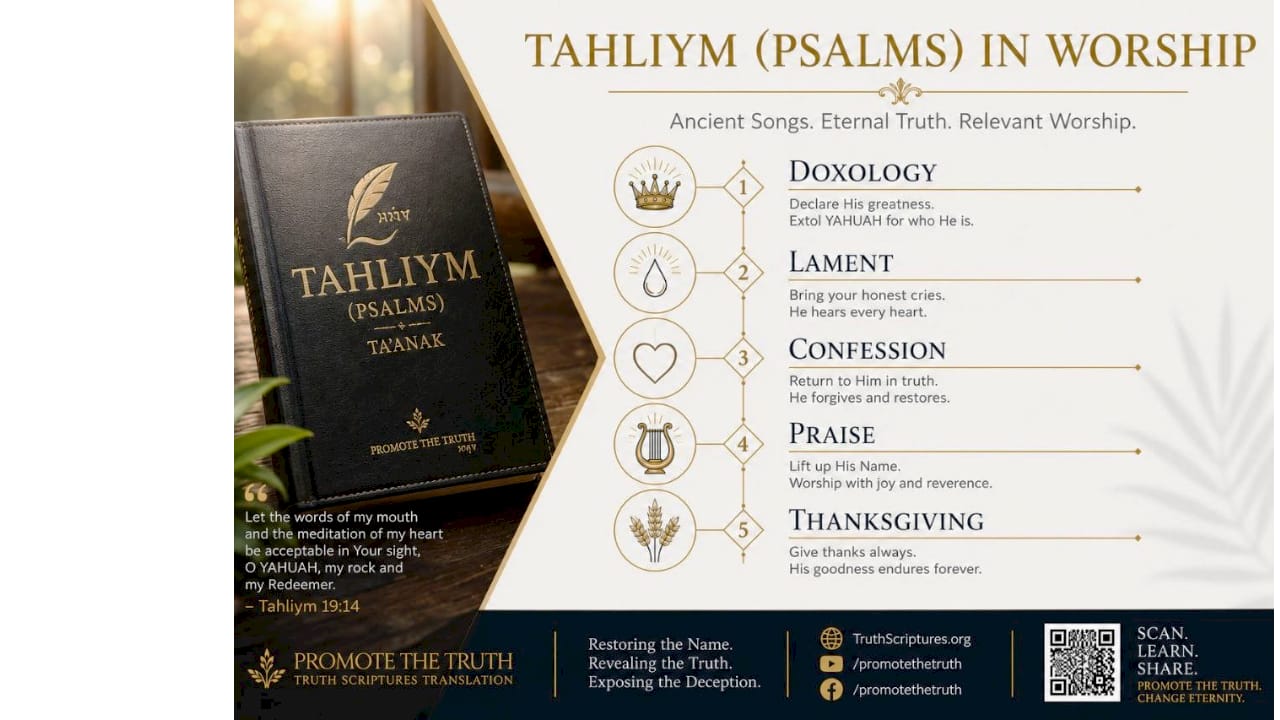
Expressive: The Tahliym (Psalms) give voice to praise, lament, confession, thanksgiving, and even righteous anger, encompassing every honest human experience before Aluah (God).
-
Formative: They teach worshipers how to pray, reshaping personal emotions into redemptive-historical speech about who Aluah (God) is and what He has done.
-
Liturgical: They serve as calls to worship, responsive readings, songs of worship, prayers of confession, and responses to the sermon, functioning as the structural backbone of the worship service.
The sections below trace the theology behind these roles, demonstrate how congregations in the United States can apply them, and address the denominational diversity and practical objections you are likely to encounter.
Table of Contents
-
What Is the Role of the Tahliym (Psalms) in Worship, Theologically and Historically?
-
How Do the Tahliym (Psalms) Shape Individual Prayer and Spiritual Formation?
-
How Can U.S. Congregations Integrate Tahliym (Psalms) into Regular Worship?
-
Why Do Translation and Manuscript Choices Matter for Worship?
-
Why the Tahliym (Psalms) Deserve More Than a Supporting Role in Worship
-
Deepen Your Study of the Tahliym (Psalms) with Promote The Truth
What Is the Role of the Tahliym (Psalms) in Worship, Theologically and Historically?
The Tahliym (Psalms) are inspired Scripture, and that single fact carries enormous weight for worship. They are not human compositions about Aluah (God); they are Aluah (God)-breathed words that form the language through which His people address Him. That distinction matters for how a congregation receives them. Singing or praying a Tahliym (Psalm) is not merely performing a religious text; it is speaking Scripture back to its Author.
Historically, the Book of Tahliym’s role in worship stretches across every major era of the Qahal (church). Ancient Yisharal (Israel) sang the Tahliym (Psalms) in Ahiykal (Temple) liturgy, with specific Tahliym (Psalms) assigned to particular feasts and days. The early Qahal (church) inherited this practice directly. By the fourth century, Basil of Caesarea observed that his Qahal (parishioners) rarely remembered sermons yet regularly sang the Tahliym (Psalms) at home and in the marketplace, a testimony to the formative power of sung Scripture. Monastic communities built the entire Daily Office around the Book of Tahliym, cycling through all 150 Tahliym (Psalms) weekly or even daily. The Book of Common Prayer carried this practice into Anglican worship, and the Genevan Psalter gave Reformed congregations metrical Tahliym (Psalm) singing as their primary form of corporate worship.
What the historical arc of prayer in ancient Scripture reveals is that the Tahliym (Psalms) have never been optional. They have served as the liturgical backbone of corporate and daily prayer across more than a millennium of Early Believers of Yahusha, who is YAHUAH (Christian) practice.
Theologically, the Tahliym (Psalms) accomplish something that no other Scriptural (biblical) genre does in quite the same way. They model doxology, lament, confession, and trust within a single collection. They align personal emotion with the redemptive story of Aluah’s (God’s) faithfulness, what some writers describe as a “conversion of language,” in which raw emotion is shaped into faithful prayer. That formative work is why the Tahliym (Psalms) belong at the center of congregational life, not at its edges.
How Do the Tahliym (Psalms) Function in Corporate Worship?
The Tahliym (Psalms) serve as the Qahal’s (church’s) ancient songbook and prayerbook, and their corporate roles are both specific and practical. Here are the core liturgical functions:
-
Call to worship: Tahliym (Psalms) 95, 100, and 150 open services by summoning the congregation into Aluah’s (God’s) presence with praise.
-
Prayer of confession: Tahliym (Psalm) 51 is the classic penitential text; Tahliym (Psalms) 32 and 130 serve the same function.
-
Responsive reading: A leader reads one verse, and the congregation responds with the next, creating a dialogue that draws everyone into the text.
-
Sung setting: Metrical Tahliym (Psalms), Anglican chant, and modern arrangements all preserve the text while encouraging congregational participation.
-
Sermon response: A Tahliym (Psalm) chosen to echo the sermon’s theme gives the congregation a Scriptural way to respond to the Dabar (Word).
-
Offertory and benediction: Tahliym (Psalms) of trust and Barakut (blessings) conclude the service with Scripture rather than sentiment.
Musical Settings and How They Work
Metrical Tahliym (Psalms) translate Abariy (Hebrew) poetry into rhymed, metered verse that fits familiar tunes. Early Protestants championed this approach so that entire congregations, not just trained choirs, could sing the Tahliym (Psalms). The trade-off is that metrical versification sometimes adds to or omits portions of the text to fit the meter.
Anglican chant takes a different approach: the congregation sings the Scriptural (biblical) text as written, using a style that falls between spoken and sung speech. This preserves the parallelism of Abariy (Hebrew) poetry, where the “rhyme” comes from similar or contrasting thoughts rather than end sounds. For congregations new to chanting, a cantor or choir can sing the verses while the congregation responds with a repeated antiphon, a format called Responsive Scriptures Reading (responsorial psalmody) that is used widely in Catholic, Episcopal, and Lutheran congregations.
Modern musical arrangements, from jazz compositions to contemporary praise settings, can also carry Tahliym (Psalm) texts. Calvary Third United Presbyterian Church in Fort Wayne, Indiana, commissioned jazz compositions to bring the Tahliym (Psalms) into worship with fresh energy. The Calvin College Psalm Festival drew from Anglican chant, blues, the Genevan Book of Tahliym (Psalter), Set-apart (Sacred) Harp, and contemporary Christian music, all within a single event, demonstrating that no single tradition owns the Tahliym (Psalms).
Where Tahliym (Psalms) Can Appear in a Single Worship Service:
-
Opening call to worship (Tahliym (Psalm) 95 or 100)
-
Prayer of confession (Tahliym (Psalm) 51 or 130)
-
Prayer of illumination before the sermon
-
Congregational prayer or lament
-
Sermon response (Tahliym (Psalm) thematically linked to the message)
-
Offertory reading or song
-
Closing benediction or sending
Globally, monastic communities and cathedral traditions have maintained daily Tahliym (Psalm) cycles for centuries. These practices offer U.S. congregations a proven model: repetition, structure, and the gradual use of the full Tahliym (Psalter) over time.
How Do the Tahliym (Psalms) Shape Individual Prayer and Spiritual Formation?
The Tahliym (Psalms) train individual prayer by providing language for feelings that a person may not otherwise know how to bring before Aluah (God). Grief, anger, doubt, and desperate trust all have a Tahliym (Psalm). That is not incidental; it is by design.
Shepherd-like, the Tahliym (Psalms) are indispensable. At a funeral, Tahliym (Psalm) 23 gives mourners words when their own fail. In a counseling session, Tahliym (Psalm) 88’s raw lament (“I am overwhelmed with troubles, and my life draws near to death”) names suffering without rushing to resolution. At a hospital bedside, Tahliym (Psalm) 91 speaks of protection and refuge in language that has carried believers through centuries of crisis. The Tahliym (Psalms) also have a place in healing and spiritual care contexts, where Scripture’s direct address to suffering is exactly what a person needs.
Practical approaches for personal Tahliym (psalm) use:
-
Reflective Scripture Reading with a Tahliym (Psalm): Read slowly, pause on a phrase that captures your attention, reflect on its meaning, and respond in prayer.
-
Line-by-line praying: Work through a psalm verse by verse, turning each line into a personal prayer.
-
Memorization through singing: As Eric Sarwar, a Presbyterian pastor in Pakistan, notes, “The best way to memorize is singing.” The benefits of memorizing Scripture apply with particular force to the Tahliym (Psalms) because their poetic structure makes them memorable.
-
Chanting for retention: Even simple tones help assembly (congregants) carry Tahliym (Psalm) texts through the week.
Pro Tip: Start a personal Tahliym (Psalm) journal. Each week, choose one Tahliym (Psalm), read it daily, and write a single sentence of response. After three months, you will have a prayer vocabulary you did not have before.
Leaders can teach the assembly (congregants) to pray Tahliym (Psalms) by starting with responsive readings during worship, then moving to small-group practice, where members pray a Tahliym (psalm) together aloud, and finally to sermon-based exercises that connect a Tahliym (psalm) to the week’s Scripture reading. The role of community in scriptural learning is especially evident here: praying Tahliym together builds a shared language that deepens the bonds within the assembly over time.
How Can U.S. Qahal (Congregations) Integrate Tahliym (Psalms) Into Regular Worship?
The path forward is straightforward: start small with responsive readings, teach the qahal (congregation) what they are doing and why, introduce musical settings gradually, and build repetition into the calendar until Tahliym (psalm) use becomes habitual.
A six-month implementation plan:
-
Month 1: Introduce one Tahliym (Psalm) by choosing a day of the week as a responsive reading. Print the text in the bulletin or project it. Briefly explain the Tahliym’s (psalm’s) context before reading.
-
Month 2: Add a second Tahliym (Psalm) moment, such as a call to worship or a prayer of confession drawn from the Tahliym (Psalms). Begin a short sermon series on the Book of Tahliym’s structure.
-
Month 3: Introduce a simple metrical Tahliym (Psalm) or a responsive Scripture reading setting with a repeated antiphon. Teach the assembly the tune before the service begins.
-
Month 4: Bring Tahliym (Psalms) into small groups by choosing a day of the week. Use the same Tahliym (Psalm) the congregation sang during the assembly meeting as the week’s devotional text.
-
Month 5: Expand to a full Tahliym (Psalm) reading, not just selected verses. Granite Springs Congregation and similar congregations have found that reading entire Tahliym (Psalms) across services builds a genuine love for the Book of Tahliym over time.
-
Month 6: Evaluate engagement. Ask the congregation which Tahliym (Psalms) have stayed with them. Plan the next quarter based on what resonated.
Practical tips for music:
-
Choose metrical tunes the congregation already knows before introducing new ones.
-
Teach the pointing (the marks that show where the melody shifts) in a brief rehearsal before the meeting starts.
-
Project text for sung Tahliym (Psalms) rather than relying on bulletins; it keeps eyes up and voices engaged.
-
Check licensing requirements for any published musical settings you reproduce…
The learning curve is real, but it is shorter than most leaders expect. Qahal (Congregations) that encounter the same Tahliym (Psalms) repeatedly, across singing, reading, and prayer, develop what one worship director described as a “storehouse” of love for the Tahliym (Psalms) that sustains worship through every season.
How Do U.S. Denominations Differ in Their Use of Tahliym (Psalms), and How Do You Handle Objections?
Tahliym (Psalm) use in the United States ranges from exclusive Tahliym singing (psalmody) to occasional inclusion, and understanding that range helps leaders navigate their own context wisely.
Some Reformed traditions practice exclusive Tahliym Singing (psalmody), singing only the 150 Tahliym (Psalms) in corporate worship, based on the conviction that the Book of Tahliym (Psalter) is the set-apart (divinely) given hymnbook for the Assembly (church). Anglican, Episcopal, Lutheran, Catholic, and Methodist congregations typically sing or chant Tahliym (Psalms) weekly as part of a lectionary cycle. Many evangelical and nondenominational Assemblies (churches) blend Tahliym (Psalms) with contemporary worship songs, using Tahliym (Psalm) texts as calls to worship or responsive readings without necessarily singing them. Liturgical renewal movements across multiple denominations have pushed for more intentional Tahliym (Psalm) use in recent decades.
| Tradition | Typical Tahliym (Psalm) Practice |
|---|---|
| Reformed (exclusive Tahliym singing (psalmody)) | Only the 150 Tahliym (Psalms) sung in worship |
| Anglican / Episcopal | Weekly Tahliym (Psalm) chanted or sung from the lectionary. |
| Lutheran / Methodist | Lectionary Tahliym (Psalm), often responsorial. |
| Catholic | Responsorial Tahliym (Psalm) at every Sunday Mass. |
| Evangelical / Nondenominational | Mixed: Tahliym (Psalm) texts in readings, with occasional songs. |
Common objections and how to respond:
-
“The language feels old-fashioned.” Fresh musical arrangements and accessible translations address this directly. The emotional content of the Tahliym (Psalms) is anything but dated; the presentation can be updated without altering the text.
-
“Some Tahliym (Psalms) are too violent or angry.” These imprecatory Tahliym (Psalms) are part of the full worship vocabulary. N.T. Wright argues that the Tahliym (Psalms) force empathic engagement with realities like injustice and grief that comfortable congregations might otherwise ignore. Teaching their context is more faithful than skipping them.
-
“Our congregation won’t learn new music.” Start with spoken responsive readings. No new music is required. Once the congregation knows the texts, musical settings become easier to introduce.
-
“We already have enough songs.” The Tahliym (Psalms) are not competing with the congregation’s existing repertoire; they are the Scriptural foundation beneath it.
Why Do Translation and Manuscript Choices Matter for Worship Use?
Translation and textual choices directly affect the nuance, theological tone, and emotional impact of a Tahliym (Psalm) in worship. A Qahal (congregation) that hears a dynamically paraphrased Tahliym (Psalm) and one that hears a more literal rendering will receive different impressions of the same text, and both leaders and planners should make that choice deliberately.
The key distinctions:
-
Metrical versification adapts the text to fit musical meter, sometimes adding or omitting words. It aids singing but can soften or shift meaning.
-
Literal translations preserve the Abariy (Hebrew) parallelism and imagery more closely, which is valuable for teaching and for lament texts where precision matters.
-
Dynamic equivalence translations prioritize contemporary readability, which can help newer worshipers engage but may lose the weight of specific theological terms.
-
Textual variants in the manuscript tradition can affect specific verses, particularly in the Tahliym (Psalms), where the Abariy (Hebrew), Yuuniy (Greek) Septuagint (also known as the Seventy Scholars, or LXX), and Aramiyt (Aramaic) Targum traditions sometimes diverge.
Promote The Truth’s manuscript-grounded approach to the Ta’anak (Old Testament) reflects this conviction: translation choices carry theological weight, and worshipers deserve access to the text’s original intent. For leaders selecting Tahliym (Psalms) for sensitive settings—such as imprecatory texts or lament Tahliym (Psalms) used in grief ministry—consulting translation notes and an annotated Book of Tahliym is not merely an academic exercise; it is a shepherding responsibility. Understanding the historical context of the Ta’anak along with poetic structures of Scriptural (biblical) parallelism equips leaders to interpret and present each Tahliym (Psalm) with greater confidence, accuracy, and faithfulness. Comparing multiple translations side by side also helps leaders evaluate how different renderings communicate the same Tahliym (Psalm), enabling them to choose the translation that best conveys the intended meaning for corporate worship.
Key Takeaways
The Tahliym (Psalms) are Scripture’s own worship resource—expressive in range, formative in purpose, and liturgically versatile across every tradition and season of congregational life.
| Point | Details |
|---|---|
| Expressive and formative | Tahliym (Psalms) provide language for every human emotion while shaping personal feelings into faithful, Scripture-grounded prayer. |
| Liturgical versatility | Tahliym (Psalms) serve as a call to worship, a prayer of confession, a responsive reading, a sung setting, and a sermon response within a single worship service. |
| Start with responsive readings | Introduce Tahliym (Psalms) through spoken responsive readings before adding musical settings. The learning curve shortens quickly through consistent practice. |
| Denominational sensitivity | Practice ranges from exclusive Tahliym singing (psalmody) in some Reformed traditions to weekly lectionary use in Anglican, Episcopal, Lutheran, Methodist, and Catholic worship. |
| Promote The Truth resources | Promote The Truth’s manuscript-grounded study tools and courses help leaders choose, understand, and teach Tahliym (Psalms) with textual integrity and confidence. |
Why the Tahliym (Psalms) Deserve More Than a Supporting Role in Worship
Most worship leaders I have observed treat the Tahliym (Psalms) as seasoning—a verse here, a responsive reading there, something added when the service needs a Scriptural touch. That approach understates what the Book of Tahliym truly is. It is the only book of Scripture written specifically to be sung and prayed in gathered worship, and the Qahal (church) has recognized this for thousands of years.
What surprises leaders most when they commit to the regular use of Tahliym (Psalms) is not congregational resistance. That usually fades within a month. What surprises them is how quickly the Tahliym (Psalms) begin to accomplish their formative work. Congregants start using the language of the Tahliym (Psalms) in their personal prayers. Lament becomes possible in a community that previously knew only how to celebrate. Grief finds a place within gathered worship. The full range of human experience—not just the comfortable parts—enters the assembly.
If there is one practical step to take at your next worship gathering, let it be this: open the service with Tahliym (Psalm) 95, read responsively, with no music required. Watch what happens when the assembly speaks Scripture to one another before a single song is sung. That simple moment demonstrates the enduring purpose of the Tahliym (Psalms)—to shape worship, strengthen the assembly, and give the people of YAHUAH the very words of Scripture with which to praise, lament, trust, and pray.
Deepen Your Study of the Tahliym (Psalms) with Promote The Truth
Promote The Truth offers something most worship resources do not: manuscript-grounded study tools built on meticulous research into the original Abariy (Hebrew) and Aramiyt (Aramaic) texts. For leaders who want to teach the Tahliym (Psalms) with textual integrity, rather than relying solely on liturgical convenience, that foundation makes a meaningful difference. By understanding the original manuscripts, historical context, and Scriptural language, leaders can teach, pray, and apply the Tahliym (Psalms) with greater confidence, clarity, and faithfulness.
Teach-along video lessons that explore the Scriptures in depth, including the Tahliym (Psalms), with careful attention to the original languages, manuscript evidence, and historical context. These lessons are ideal for assembly leaders, small-group facilitators, and anyone seeking a deeper personal study of Scripture.
-
Digital Video Academy courses: Structured teaching series designed for leaders who want a systematic approach to Scripture study, including the poetic and wisdom literature of the Ta’anak (Old Testament). These courses help build a stronger foundation for teaching, preaching, and leading worship with confidence.
-
Truth Scriptures Ta’anak (Old Testament) Preface (free download): A free introductory resource that explains the translation philosophy, manuscript sources, and textual approach behind the Truth Scriptures. It is especially valuable for leaders making informed translation choices when teaching or using the Tahliym (Psalms) in worship.
Begin with the free Truth Scriptures Ta’anak (Old Testament) Preface, then continue with the Scripture Study Series and Digital Video Academy courses to deepen your understanding of the Tahliym (Psalms) and the rest of the Ta’anak (Old Testament). The Tahliym (Psalms) deserve more than occasional use in worship—they deserve careful study, faithful teaching, and thoughtful application. Promote The Truth equips leaders with the manuscript-grounded resources needed to help the assembly encounter the Scriptures with confidence and textual integrity.
Useful Sources for Further Study
-
Calvin Institute of Christian Worship: Singing More Tahliym (Psalms) in Worship — A feature article on why and how congregations are reclaiming Tahliym (Psalm) singing, with practical examples from multiple traditions and musical formats. Highly recommended for worship planners.
-
Calvin Institute of Christian Worship: Using More Tahliym (Psalms) in Worship — A companion article covering the Book of Tahliym’s structure, emotional diversity, and congregational implementation strategies, including the Calvin College Psalm Festival case study.
-
Calvin Institute of Christian Worship: Tahliym (Psalms) in Worship — Aluah (God) Knows We Need Help Praying — Case studies from congregations that have integrated Tahliym (Psalms) into small groups, before-and-after-service studies, and weekly worship services over time.
-
N.T. Wright Online: Tahliym (Psalms) Aiding Believers of Yahusha, who is YAHUAH (Christian) Worship for Over a Millennium — Wright’s reflection on the Tahliym (Psalms’) historical continuity in Believers of Yahusha, who is YAHUAH (Christian), worship and their capacity to engage worshipers with the realities of injustice and grief.
-
Desiring Aluah (God): The Role of the Tahliym (Psalms) in the Life of the Qahal (Church) — A Shepherding (pastoral) interview covering Bonhoeffer’s argument for the Book of Tahliym (Psalter) and the theological case for keeping the Tahliym (Psalms) central to congregational prayer.
-
Covenant Baptist Theological Seminary: Singing Tahliym (Psalms) in Public Worship (Ron Miller) — A focused treatment of exclusive Tahliym singing (psalmody) and the Reformed case for Tahliym (Psalm) singing, useful for leaders in, or engaging with, that tradition.
-
Worship Leader Magazine: How the Tahliym (Psalms) Shape Corporate Worship Today — A practical worship leader’s perspective on responsive readings, musical settings, and teaching strategies for introducing more Tahliym (Psalms) into contemporary worship services.
-
Promote The Truth.Com — Discover manuscript-grounded study resources, Scripture teaching videos, and comprehensive digital courses designed for leaders, teachers, and serious students of Scripture who want to study the Tahliym (Psalms) from the perspective of the original text and faithful translation. Explore the Truth Scriptures Ta'anak (OT) Preface to understand the translation philosophy, manuscript sources, and textual principles behind the Truth Scriptures, equipping you to make informed, Scripture-based decisions when selecting and teaching the Tahliym (Psalms) for worship.