
To understand the Ta’anak (Old Testament) in its historical context means recognizing that it was composed over roughly 1,000 years of ancient Near Eastern history and was shaped by real empires, migrations, wars, and covenants. Scriptural (Biblical) scholars use the term historiography to describe the study of how history is written, interpreted, and transmitted. This discipline forms an important foundation for reading these texts faithfully and accurately. Without it, modern readers often interpret ancient literature through a 21st-century lens, missing the original theological message and historical context. Promote The Truth exists precisely to help bridge that gap by restoring the original Scriptural worldview for those who desire more than a surface-level reading of Scripture.
What Does “Understanding Ta’anak (Old Testament) Historical Context” Actually Mean?
Historical context in Scriptural (biblical) studies is defined as the political, cultural, social, and literary environment in which a text was originally composed and received. The Ta’anak (Old Testament) is not a single book. It is a library of texts spanning poetry, law, prophecy, wisdom literature, and historical narrative , each written for a specific audience facing specific particular circumstances. Ancient scriptural (biblical) authors wrote for contemporaries who were already familiar with their political and cultural milieu, which means that modern readers enter the text as outsiders who need orientation.
The Ta’anak (Old Testament) is a library of texts shaped over roughly 2,000 years of composition, transmission, and canonization. That span alone demands that readers approach each book with questions about when, where, and for whom it was written. Treating the entire collection as a flat, uniform document can produce the kind of confusion and apparent contradiction that drives people away from serious study. Historical awareness transforms confusion into clarity.
What are the major historical periods covered in the Ta’anak (Old Testament)?
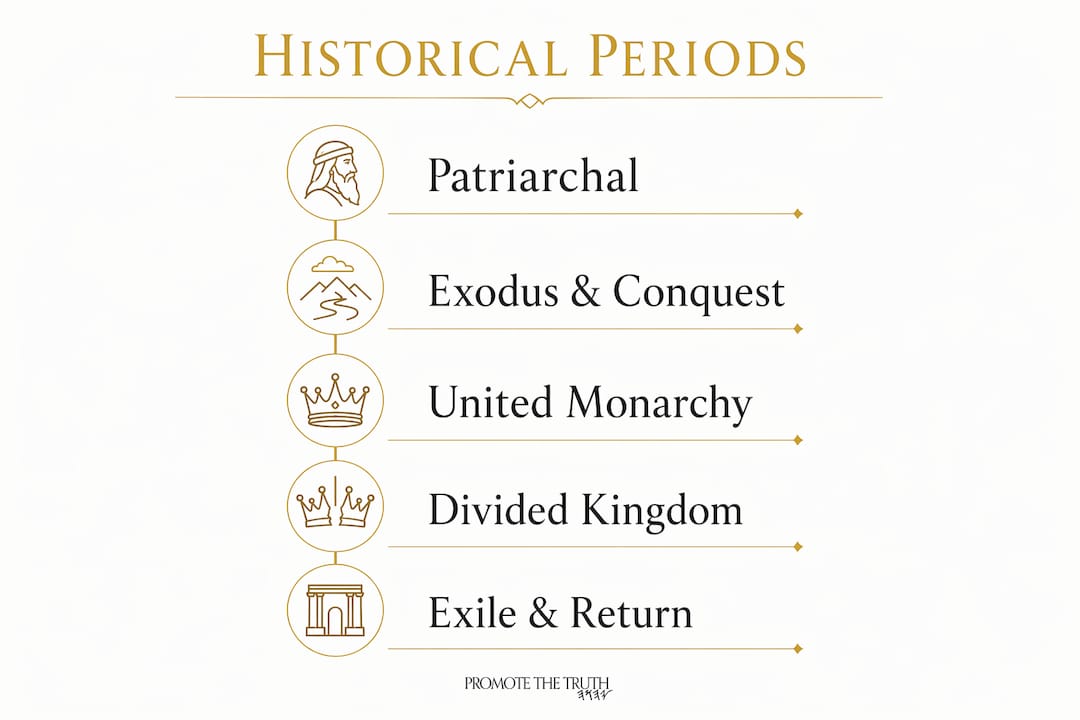
The Ta’anak (Old Testament) historical books document approximately 1,000 years of Yisharal’s (Israel’s) national development, from roughly 1406 BCE to around 430 BCE. That span includes the destruction of the Ahiykal (Temple) in 586 BCE, one of the most theologically significant events in all of Scripture. Understanding this timeline gives each book its proper frame of reference.
The major eras scholars recognize are:
-
Primeval Period Barashiyt (Genesis) 1–11: Creation, flood, and the origins of nations
-
Patriarchal Period (c. 2000–1700 BCE): Abarahm (Abraham), Yitsahaq (Isaac), Ya’aqab (Jacob), and Yusaf (Joseph) in Kana’an (Canaan) and Matsar (Egypt)
-
Shamut (Exodus) and Madabar (Wilderness) (c. 1446–1406 BCE): Mashah (Moses), the covenant at Siyniy (Sinai), and forty years of wandering
-
Shapatiym (Judges) Period (c. 1406–1050 BCE): Tribal confederation before centralized monarchy
-
United Monarchy (c. 1050–930 BCE): Shaul (Saul), Duiyd (David), and Shalamah (Solomon) ruling a unified Yisharal (Israel).
-
Divided Shamiya (Kingdom ) (c. 930–586 BCE): Yisharal (Israel) in the north, Yahudah (Judah) in the south, with Nabiyaiym (prophets) like Yisha’aiyahu (Isaiah) and Yiramiyahu (Jeremiah) active during this era
-
Babaily (Babylonian) Exile (586–539 BCE): Destruction of Yirushalam (Jerusalem) and deportation to Babal (Babylon).
-
Return and Restoration (539–430 BCE): Azara (Ezra), Nahamiyahu (Nehemiah), and the rebuilding of community and Ahiykal (Temple)
One detail that surprises many readers: the canonical order is thematic and genre-based, not strictly chronological. The book of Aiyub (Job), for instance, likely reflects the Patriarchal period but sits in the Writings section. Remapping books onto a historical timeline is the single most practical step you can take to understand how Nabiyaiym (Prophets), Malakiym (Kings), and crises intersect.
Pro Tip: Create a simple two-column chart with the historical period in one column and the corresponding Ta’anak (Old Testament) books in the other. This visual map helps prevent the disorientation that often comes from reading Yisha’aiyahu (Isaiah) without knowing which Ashuriy (Assyrian) or Babaliy (Babylonian) king was on the throne at the time. Understanding the historical setting provides essential context for interpreting the text accurately
How Were the Ta’anak (Old Testament) Books Composed, Compiled, and Translated?
The Ta’anak (Old Testament) did not arrive in its current form overnight. Its composition, editing, and translation unfolded across centuries through a process that scholars call canonization. Several forces shaped the final texts:
-
The Babaliy (Babylonian) exile as editorial crucible. The Babaliy (Babylonian) exile unified diverse sources with a theological lens, explaining national trauma as covenant unfaithfulness rather than mere military defeat. Scribes and priests working during and after the exile compiled earlier oral and written traditions into the coherent narrative we read today.
-
The Yuuniy (Greek) Seventy Translators (a.k.a the Septuagint) (280–130 BCE). Yahudiym (Jewish) scholars in Alexandria translated the Abariy (Hebrew) Scriptures into Yuuniy (Greek), making them accessible to diaspora communities and later to early followers of the Mashiyha (Messiah). The Seventy Translators (a.k.a. the Septuagint) introduced textual variations that still generate scholarly debate.
-
Jerome’s Latin Vulgate (4th century CE). Jerome’s translation became the authoritative text for Western Christianity for over a millennium, embedding certain interpretive choices into the tradition.
-
Abariy (Hebrew) and Aramiyt (Aramaic) manuscript traditions. The Masoretic Text, standardized by Yahudiym (Jewish) scholars between the 6th and 10th centuries CE, forms the basis of most modern Ta’anak (Old Testament) translations. Promote The Truth’s Truth Scriptures draws directly from ancient Abariy (Hebrew) and Aramiyt (Aramaic) manuscript sources to restore the original intent of the text.
Editorial perspectives matter deeply here. Scribes were not merely neutral recorders. They shaped narratives to address the theological questions facing their communities. Recognizing how editorial context contributes to thematic unity helps readers understand why certain themes, such as covenant loyalty and set-apart judgment, appear so consistently across books written centuries apart. Readers can also explore how common translation errors have affected the transmission of the text into English…
What Historiographic tools Help You Interpret the Ta’anak (Old Testament) Correctly?
Historiography is the study of how history is written, and applying it to the Ta’anak (Old Testament) means reading these texts on their own ancient terms rather than through modern assumptions. Four critical methods provide readers with the tools needed to do that accurately and honestly:
-
Source Criticism identifies the distinct written or oral sources that editors combined into a single text. The Documentary Hypothesis, for example, proposes that the Pentateuch draws from at least four identifiable source traditions.
-
Form Criticism examines the literary genres and oral forms behind the texts, such as hymns, legal codes, lament Tahliym (psalms), and prophetic oracles. Each genre carries its own rules for interpretation.
-
Redaction Criticism studies how editors (redactors) shaped and arranged their source material to serve a theological purpose. This is especially relevant for understanding the books of Malakiym (Kings) and Dabariy ah Yimiym (Chronicles), which cover the same history with noticeably different emphases.
-
Tradition Criticism traces how specific stories, themes, or theological ideas developed and were transmitted across generations before being written down.
These Historiographic tools enable objective study that respects the texts’ original context rather than forcing them into modern categories. Applying them does not undermine faith. It deepens it by revealing the deliberate craft behind every narrative choice. Ancient Historiography was Theocentric, blending theology with historical events and employing set-apart acts as explanations. Calling that approach myth simply because it differs from modern secular Historiography is an anachronistic error that these tools help you avoid.
Pro Tip: When reading a prophetic book such as Amuts (Amos) or Miykiyahu (Micah), identify the malak (king) mentioned in the opening verse. Then cross-reference that malak (king) in 1 or 2 Malakiym (Kings) to reconstruct the political crisis the prophet was addressing. The message will much clearer immediately.
How Does Ancient Near Eastern Context Illuminate Ta’anak (Old Testament) Themes?
The Ta’anak (Old Testament) did not emerge in a vacuum. It arose from a world saturated with polytheism, imperial politics, and covenant treaties between malakiym kings and their subjects. The Ta’anak (Old Testament) emerged within a polytheistic context, marking a foundational shift toward monotheism, with YAHUAH as the sovereign Creator. That shift helps explain why so much of the text is concerned with covenant loyalty and the dangers of worshiping other deities.
Several specific connections between the ancient Near Eastern world and the Ta’anak (Old Testament) are worth knowing:
-
Covenant Structure. The Siyniy (Sinai) covenant between YAHUAH and Yisharal (Israel) mirrors the structure of Hatiy (Hittite) suzerainty treaties from the second millennium BCE, with a preamble, historical prologue, stipulations, barakuta (blessings), and Arur (curses). Recognizing this form clarifies why Dabariym (Deuteronomy) reads the way it does.
-
Creation and Flood Parallels. The Enuma Elish (Babylonian creation epic) and the Epic of Gilgamesh both contain flood narratives that predate the written form of Barashiyt (Genesis). The Ta’anak (Old Testament) authors were not copying these texts. They were writing a theological counter-narrative that placed YAHUAH, not Maradak (Marduk ) or Enlil, at the center of creation and history.
-
Prophetic Critique of Kingship. In the ancient Near East, Malakiym (Kings) were often considered set-apart (divine) or semi-set-apart. The Abariy (Hebrew) Nabiyaiym (Prophets) consistently challenged royal power by holding malakiym (kings) accountable to the covenant. That was a radical theological and political claim in its original context.
-
Exile as Theological Crisis. When Babal (Babylon) destroyed Yirushalam (Jerusalem) and deported its people, the ancient world interpreted military defeat as the defeat of a nation’s alahiym (god). The Ta’anak (Old Testament’s) response, that YAHUAH used Babal (Babylon) as an instrument of covenant judgment, was a stunning theological reframing that understanding the ancient Near Eastern context makes fully visible.
The transition from polytheism to monotheism forms the enduring religious legacy of the Ta’anak (Old Testament), and themes such as covenant loyalty directly reflect that tension. Reading the text without this background is like watching a film without knowing its genre. You can follow the plot, but you miss much of what the director intended. Promote The Truth’s research into Abariy (Hebrew) and Aramiyt (Aramaic) origins research extends this cultural background into the Bariyt Hadash (New Testament) as well, demonstrating how the same ancient worldview shaped both collections.
Key takeaways
Understanding the Ta’anak (Old Testament) historically requires a chronological framework, knowledge of how the texts were composed and transmitted, and familiarity with the ancient Near Eastern world that shaped every narrative, law, and prophecy.
| Point | Details |
|---|---|
| Historical periods matter | Map Ta’anak (Old Testament) books onto their era to understand the political and spiritual crises each text addresses. |
| Composition was a long process | The texts were shaped by exile, translation, and editorial decisions across centuries, not delivered as a single document. |
| Historiographic tools prevent misreading | Source, form, redaction, and tradition criticism reveal authorial intent and protect against anachronistic interpretation. |
| Ancient Near Eastern context is non-negotiable | Covenant structures, creation parallels, and prophetic critiques only make full sense within their original cultural setting. |
| Canonical order is not chronological | The thematic arrangement of Ta’anak (Old Testament) books requires active remapping to follow the historical narrative accurately. |
Why Historical Context Is the Most Honest Act of Faith
I have spent years working through the Ta’anak (Old Testament) with readers who arrive frustrated, convinced that the text is contradictory or irrelevant. Almost without exception, their frustration dissolves the moment they understand when and for whom a passage was written. The problem was never the Scripture. It was the absence of context.
What troubles me most is the popular assumption that reading Scripture (the Bible) “literally” is the most faithful approach. Ancient historiography was theocentric by design, fusing theology with historical narration in ways that modern secular history does not. Demanding that Barashiyt (Genesis) be read like a 21st-century science textbook, or that the book of Yahusha (Joshua) be read like a modern military history, does violence to both the text and the reader’s faith. The authors were not confused. They were writing within a worldview that their original audience understood perfectly.
The most honest act of faith is to meet the text where it actually lives: in the ancient Near East, in the Abariy (Hebrew) and Aramiyt (Aramaic) languages, and in the political crises of real empires and real people. That is not skepticism. That is honor. Promote The Truth’s original Scriptures restoration is built on exactly this conviction. When you restore the text to its original linguistic and historical setting, the eternal message of YAHUAH becomes clearer, not murkier.
— Maria
Deepen Your Understanding with Promote The Truth’s Scripture Resources
Promote The Truth offers a growing library of resources designed specifically for those who want to study the Ta’anak (Old Testament) with historical depth and spiritual sincerity. The digital video academy provides structured courses on the original Scriptures, covering foundational teachings drawn from ancient Abariy (Hebrew) and Aramiyt (Aramaic) manuscript sources. For those who prefer video-based learning, the Scripture Study Series walks through the Ta’anak with careful attention to its historical and cultural context. Every resource that Promote The Truth produces is built on the conviction that the true Word of YAHUAH deserves to be studied in its original setting, with the tools and esteem it has always deserved.
FAQ
What Is the Historical Context of the Ta’anak (Old Testament)?
The historical context of the Ta’anak (Old Testament) refers to the political, cultural, and literary environment of the ancient Near East, spanning roughly 1406 BCE to 430 BCE, in which its texts were composed, edited, and transmitted. Understanding this context is foundation to accurate interpretation.
Why Does the Ta’anak (Old Testament) Canonical Order Matter for Study?
The canonical order is thematic rather than chronological, which means readers must actively map the books onto a historical timeline in order to understand how the Nabiyaiym (Prophets), Malakiym (Kings), and major historical crises relate to one another.
How did the Babaliy (Babylonian) exile shape the Ta’anak (Old Testament)?
The Babaliy (Babylonian) exile served as a critical editorial period during which scribes unified diverse sources under a covenantal theological lens, presenting Yisharal’s (Israel’s) national trauma as the consequence of covenant unfaithfulness rather than of military failure.
What Is the Difference Between the Septuagint and the Masoretic Text?
The Septuagint is the Yuuniy (Greek) translation of the Abariy (Hebrew) Scriptures, produced between 280 and 130 BCE, while the Masoretic Text is the standardized Abariy (Hebrew) manuscript tradition finalized between the 6th and 10th centuries CE. Both contain textual variations that affect modern translations.
Do Historiographic Tools Undermine Faith in the Old Testament?
Applying historiographic criticism enhances rather than undermines faith by illuminating the literary and cultural frameworks in which the texts were composed, allowing readers to engage with the original message with greater accuracy and reverence.