
Scriptural (Biblical) parallelism is the foundational poetic device of Abariy (Hebrew) Scripture, arranging lines to mirror, contrast, or build upon one another in order to emphasize theological truth. Scholars commonly refer to this literary technique as semantic parallelism, a concept introduced by the 18th-century scholar and bishop Robert Lowth, whose groundbreaking study of Abariy (Hebrew) poetry transformed how Western readers understand Scriptural verse.
Understanding Scriptural (Biblical) parallelism changes the way you read the Tahliym (Psalms), Mashaliym (Proverbs), and the prophetic writings. Passages that may initially seem repetitive reveal themselves to be carefully crafted, richly layered, and theologically profound. Once you recognize the patterns, you begin to see meaning where others see repetition, uncovering the literary beauty and theological depth woven throughout the Scriptures.
This complete guide explores every major type of Scriptural parallelism, examines authentic examples from Scripture, and provides practical methods for recognizing and applying these patterns in your own study of YAHUAH’s Word.
What is Scriptural (Biblical) Parallelism and Why Does it Matter?
Scriptural (Biblical) parallelism is the structural and semantic arrangement of poetic lines in Abariy (Hebrew) Scripture, in which they reflect, contrast, or develop one another. The most common unit is the bicolon, a pair of lines, although tricola (three-line units) also appear throughout the Tahliym (Psalms) and the prophetic writings. This structure is not merely decorative. It is the primary vehicle through which Abariy (Hebrew) poets communicated layered theological truth.
The device operates through what scholars describe as a “rhyme of thought” rather than a rhyme of sound. Two lines do not need to end with matching sounds. Instead, their ideas correspond, contrast, or intensify one another. That distinction matters because it means parallelism works equally well in translation, which is why it has survived the transition from ancient Abariy (Hebrew) into Yuuniy (Greek), Aramiyt (Aramaic), and English.

Recognizing this structure prevents a common reading error: treating each verse as a standalone unit. When you encounter two lines together, the second line is always doing something in relation to the first. It is either deepening it, contrasting with it, or extending it. That relationship conveys the intended meaning
What Are the Main Types of Scriptural (Biblical) Parallelism and Their Functions?
Seven common types of Scriptural (Biblical) parallelism appear throughout Abariy (Hebrew) Scripture, each serving a distinct rhetorical purpose. Understanding these types gives you the vocabulary to identify what you may already sense when reading poetic texts.
-
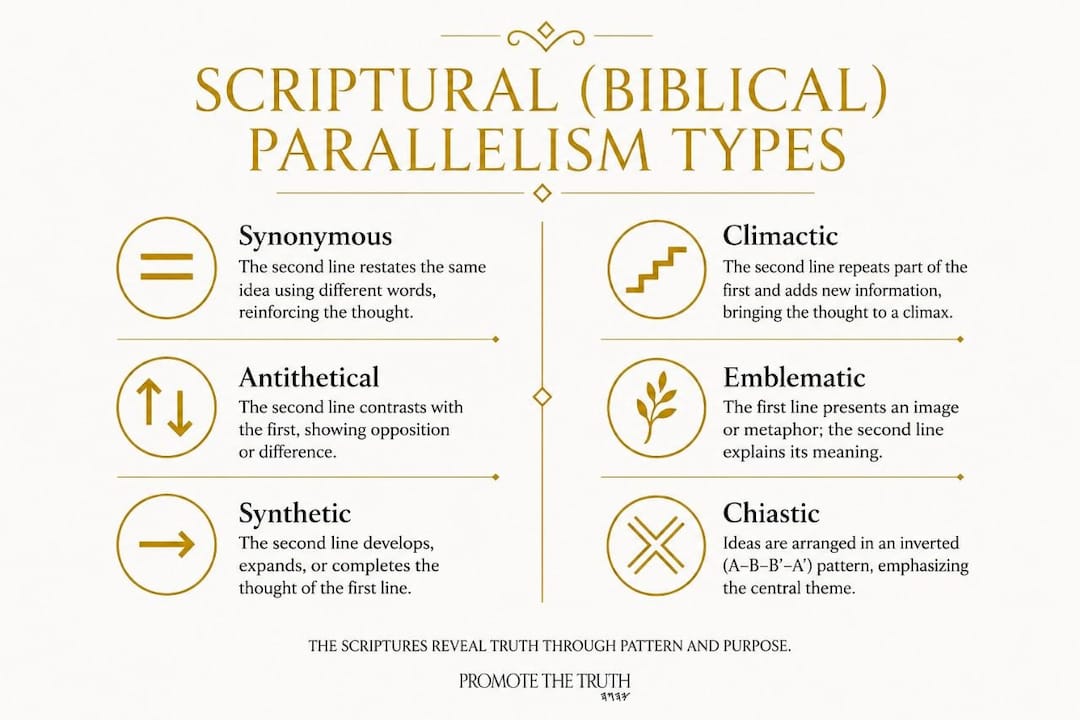
Synonymous Parallelism: The second line restates the first in different words. The goal is emphasis, not redundancy. Tahliym (Psalm) 19:1 reads, “The heavens declare the Esteem of Aluah. The skies display the work of His hands.” Both lines express the same idea, but the second line makes the first more vivid and concrete.
-
Antithetical Parallelism: The second line contrasts with the first. Mashaliym (Proverbs) 10:1 states, “A wise child makes their father happy, but a foolish child makes their mother sad.” The contrast sharpens both ideas simultaneously. This type appears frequently throughout wisdom literature.
-
Synthetic Parallelism: The second line completes or extends the thought of the first rather than restating or contrasting it. Tahliym (Psalm) 23:1 illustrates this pattern: “YAHUAH is my shepherd; I do not lack anything.” The second line flows naturally from the first as its logical consequence.
-
Climactic Parallelism: Each successive line builds in intensity by repeating part of the previous line and adding to it. This creates a staircase effect that leads the reader toward a theological climax.
-
Emblematic Parallelism: One line states a truth, and the other provides a vivid image or simile to illustrate it. Mashaliym (Proverbs) 25:25 uses this form: “Good news from far away is as refreshing as cold water when you are thirsty.”
-
Alternate Parallelism: Lines alternate in an ABAB pattern, where the first and third lines correspond, and the second and fourth lines correspond. This creates a woven structure that rewards careful reading.
-
Chiastic Parallelism: Lines follow an ABBA pattern, creating a mirror-like structure. The center of the chiasm serves as the theological pivot. Chiastic structures appear both in individual verses and across entire Tahliym (Psalms), directing the reader’s attention to the central idea.
Pro Tip: Never read the second line of a parallel pair as mere repetition. Ask yourself: What does this line add, intensify, or contrast? That question consistently unlocks the poet’s intent.
How Does Understanding Scriptural (Biblical) Parallelism Enhance Scripture Interpretation?
Recognizing the relationships between lines helps readers grasp nuanced emphasis and the progression of imagery that a surface reading would otherwise miss. When you understand that the second line always does something in relation to the first, you stop reading verses in isolation. Instead, you begin reading them as unified units of meaning.
Here are four ways parallelism directly improves your study:
-
Prevents Theological Errors. Lifting a single line from a parallel pair and treating it as a complete statement often distorts its meaning. The second line qualifies, intensifies, or reframes the first. Reading both lines together gives you the full theological message.
-
Reveals Emotional Progression. Synonymous parallelism does not merely repeat; it escalates. Each restatement adds emotional weight, which is why the Tahliym (Psalms) remain so powerful even in translation. The poet is not being redundant. The poet is pressing deeper.
-
Guides Pacing and Meditation. Slowing down to reflect on how the second line intensifies or concretizes the first mirrors the oral tradition of ancient Abariy (Hebrew) culture. These texts were sung and chanted. The pause between the lines was part of the experience.
-
Unlocks Imagery. Emblematic parallelism places a concrete image alongside an abstract truth. When you recognize that structure, the image becomes a theological lens rather than mere decoration.
Pro Tip: When studying a poetic passage, read the first line aloud, pause, and then read the second. Ask yourself what changed. That pause is where the meaning unfolds.
Learning to read Scripture in its historical context alongside parallelism analysis gives you both the literary and cultural framework needed for accurate interpretation.
What Are Illustrative Examples of Scriptural (Biblical) Parallelism in Key Scriptural Passages?
Concrete examples make the different types of Scriptural (Biblical) parallelism visible and memorable. The table below maps each type to a representative Scriptural passage and explains the relationship between its lines.
| Type | Scripture Example | Line Relationship |
|---|---|---|
| Synonymous | Tahliym (Psalm) 19:1: “The heavens declare the Esteem of Aluah. The skies display the work of His hands.” | The second line restates and makes the first more concrete through a parallel image. |
| Antithetical | Mashaliym (Proverbs) 10:1: “A wise child makes their father happy, but a foolish child makes their mother sad.” | The second line directly contrasts the first, sharpening both truths. |
| Synthetic | Tahliym (Psalm) “YAHUAH is my shepherd; I dol not lack anythig.” | The second line expresses the logical consequence of the first. |
| Emblematic | Mashaliym (Proverbs) 25:25: “Good news from far away is as refreshing as cold water when you are thirsty.” | One line presents a vivid image, while the other expresses the corresponding truth. |
| Chiastic | Tahliym (Psalm) 124:7: “We escaped like a bird from a hunter’s trap. The trap was broken, and we escaped.” | The ABBA mirror structure centers attention on the broken snare as the theological pivot. |
Synonymous parallelism deepens the emotional and theological impact of a passage by restating an idea in different words rather than merely repeating it. The second line of Tahliym (Psalm) 19:1 does not simply repeat the first; it develops it with greater specificity. “The heavens” becomes “the skies,” while “the Esteem of Aluah” is expressed through “the work of His hands.” Each shift enriches the imagery and deepens the reader’s understanding of Aluah’s revealed greatness.
Chiastic parallelism creates mirror-like structures that draw attention to the central theme. In Tahliym (Psalms) 124:7, the phrase “we escaped” appears at both the beginning and the end of the verse, framing the central image of the broken trap. The broken trap is the theological focal point, emphasizing that deliverance comes because YAHUAH has shattered the means of captivity. The structure itself directs the reader’s attention to that central truth.
The Ta’anak (Old Testament) historical context behind these passages adds another layer of meaning. Knowing that Tahliym (Psalms) 124 was a Song of Ascents sung by pilgrims traveling to Yirushalam (Jerusalem) makes the imagery of escape and freedom even more resonant.
What Are Common Misconceptions About Scriptural (Biblical) Parallelism?
The most damaging misconception is that parallel lines simply repeat the same idea. In Scriptural (Biblical) parallelism, lines rarely repeat ideas exactly. Instead, the second line adds distinct meaning, intensity, or detail, forming a spectrum of relationships rather than fitting into fixed categories. Treating parallelism as mere redundancy causes readers to skim the second line, which is often where the theological weight lies.
A second misconception is that every parallel pair must fit neatly into one of the seven categories. Modern scholars caution against overly rigid categories for parallelism, advocating greater flexibility to capture the poetic imagination and dynamic meaning of the text. The categories are tools for analysis, not rules of composition. A passage may blend multiple types or resist easy classification altogether.
-
Parallelism does not require identical grammar or syntax between lines.
-
The second line does not need to be the same length as the first.
-
Variant repetition, in which a word or phrase shifts slightly between lines, is a deliberate literary technique, not a translation error.
-
Recognizing variant repetitions rather than expecting perfectly matched lines, helps readers grasp the nuanced and layered meaning intended by Scriptural (Biblical) poets.
Pro Tip: When a parallel pair resists easy categorization, it is often a sign that something theologically significant is happening. Sit with the tension rather than forcing it into a label.
How Can Readers Practically Apply Parallelism in Their Scripture Study?
Awareness of parallelism is useful only if it changes how you actually read Scripture. These steps help turn that knowledge into practice:
-
Slow Your Reading Pace. Poetic texts in the Tahliym (Psalms) and Mashaliym (Proverbs) were composed for oral delivery with deliberate pauses. Reading too quickly collapses the structure. Read one line, pause, and then read the second.
-
Annotate Parallel Structures. Mark the first line with a bracket and the second with a matching bracket. Draw an arrow between them and write a single word describing the relationship, such as “intensifies,” “contrasts,” or “extends.” This physical act trains your eye to recognize the structure.
-
Ask the Second-Line Question. After reading any parallel pair, ask, What does the second line add that the first does not? That question lies at the heart of parallelism analysis.
-
Study Wisdom Literature First. Mashaliym (Proverbs) and Tahliym (Psalms) contain the highest concentration of parallelism in Scripture. Starting there builds pattern recognition before moving to prophetic texts such as Yisha’aiyahu (Isaiah) or Yiramiyahu (Jeremiah), where parallelism operates on larger structural scales.
-
Use Guided Video Resources. The Scripture Study Series from Promote The Truth offers video teachings that explain Scriptural (Biblical) poetry and literary devices with clarity and depth. Watching a teacher work through a passage in real time significantly accelerates the learning process.
Parallelism functions at multiple textual scales, from short bicolon pairs to larger chiastic structures spanning entire Tahliym (Psalms). Once you can recognize it in a single verse, train yourself to identify it across an entire Tahliym (Psalms) or chapter. These larger structures reveal a theological architecture that verse-by-verse reading alone cannot uncover.
Key Takeaways
Scriptural (Biblical) parallelism is the primary poetic device in Abariy (Hebrew) Scripture. Recognizing its types and functions transforms how you read, interpret, and meditate on Scriptural texts.
| Point | Details |
|---|---|
| Core Definition | Parallelism arranges lines to mirror, contrast, or build upon one another for theological emphasis. |
| Seven Key Types | Synonymous, antithetical, synthetic, climactic, emblematic, alternate, and chiastic parallelism each serve a distinct rhetorical purpose. |
| Second-Line Rule | The second line always adds meaning, intensity, or contrast. It never merely repeats the first. |
| Interpretive Benefit | Recognizing the relationships between lines prevents theological errors and reveals layers of meaning that a surface reading can miss. |
| Practical Application | Slow your reading pace, annotate parallel structures, and ask what the second line adds to uncover the poet’s intent. |
Why Parallelism Changed How I Read the Tahliym (Psalms)
The first time I truly understood antithetical parallelism, I was reading Mashaliym (Proverbs) 10 slowly, line by line. I had read those verses dozens of times before. But the moment I stopped treating the second line as a simple restatement and started asking what it was doing in relation to the first, the entire passage opened up. The contrast was not merely literary. It was theological. The poet was not saying the same thing twice. The poet was building a case.
What surprised me most was how modern scholarship has moved away from rigid categories. For years, I tried to label every parallel pair as synonymous or antithetical. That approach actually slowed my understanding. The more useful practice is to read the two lines as a single unit and ask what their relationship is, without feeling the need to assign a label. That flexibility is not a lack of rigor. It is a more honest response to what the text is actually doing.
The oral dimension also changed my reading rhythm permanently. These texts were not written to be read silently and quickly. The pause between parallel lines was a feature, not a gap. When I started treating that pause as a moment of reflection, the Tahliym (Psalms) began to feel the way I imagine they sounded to their original audience. That shift alone is worth the study.
— Maria
Deepen Your Study With Promote The Truth
Promote The Truth offers a growing library of video teachings and educational resources designed for readers who want to go beyond surface-level Scripture study. The Scripture Study Series explores Scriptural (Biblical) poetry, Abariy (Hebrew) literary devices, manuscript traditions, and the historical context that shaped the Scriptures we read today. For those seeking a more structured learning experience, the Digital Video Academy provides in-depth courses on the Ta’anak (Old Testament) and Bariyt Hadash (New Testament), grounded in ancient Abariy (Hebrew) and Aramiyt (Aramaic) manuscript sources. Together, these resources equip sincere students of Scripture with the historical, linguistic, and theological foundation needed to engage the original message of YAHUAH’s Word with greater accuracy, confidence, and reverence.
FAQ
What Is the Simplest Definition of Scriptural (Biblical) Parallelism?
Scriptural (Biblical) parallelism is a poetic device in Abariy (Hebrew) Scripture in which two or more lines correspond in meaning or structure to deepen theological emphasis. The second line adds to, contrasts with, or extends the first.
What Are the Most Common Types of Scriptural (Biblical) Parallelism?
The seven most widely recognized types are synonymous, antithetical, synthetic, climactic, emblematic, alternate, and chiastic parallelism. Each type appears extensively in wisdom literature, such as Tahliym (Psalms) and Mashaliym (Proverbs).
Is Parallelism the Same as Repetition?
Parallelism is not simple repetition. The second line in a parallel pair adds distinct meaning, intensity, or contrast rather than simply repeating the first line.
Where Does Scriptural (Biblical) Parallelism Appear Most Often in Scripture?
Parallelism appears most frequently in Tahliym (Psalms), Mashaliym (Proverbs), and the prophetic books. It also operates on larger structural scales across entire Tahliym (Psalms) through chiastic and ring structures.
Why Did Abariy (Hebrew) Poets Use Parallelism Instead of Rhyme?
Abariy (Hebrew) poetry relies on a “rhyme of thought” rather than a rhyme of sound. This approach communicates layered truth effectively and survives translation into other languages in ways that sound-based rhyme cannot.