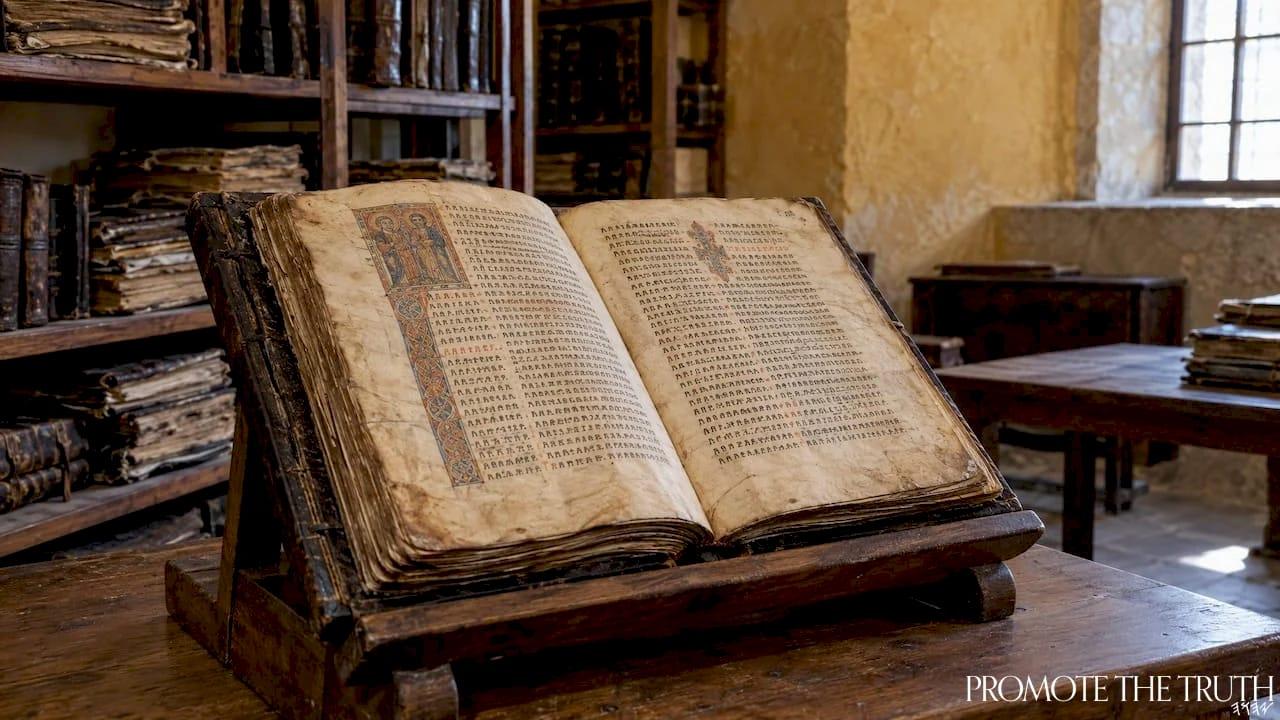
The “lost books of the Scriptures (Bible)” are ancient writings that some communities read, quoted or mentioned, but that do not appear in every Scriptures (Bible) today. Most of them are not lost at all. Many survive in full, a few are known only by title, and a handful exist as fragments. Almost none were “removed” from a Scriptures (Bible) that once contained them. Below, we sort the writings into clear groups, explain how the different canons came about, and show how to study these texts with care.
TL;DR
-
“Lost books” is a popular label for several different things: the Apocrypha or Deuterocanon, other Second Ahiykal (Temple) writings such as Hanuk (Enoch), books named in Scripture that have not survived, and later bashurah (gospels).
-
The Apocrypha were written roughly between the third century BCE and the first century CE, and traditions treat them differently: Catholic and Orthodox Christians receive them as Scriptures, while Jews and most Protestants do not.
-
The number of books in the Apocrypha depends on the edition, so a “15 lost books” list is a count, not a fixed set.
-
Reading these texts in their historical setting, and alongside the earliest Abariy (Hebrew) and Aramiyt (Aramaic) sources, is the surest way to understand them.
Table of Contents
What “lost” really means
The word carries three meanings, and mixing them causes most of the confusion online.
-
Truly lost. Scriptures itself names works that we do not have, such as the Book of the Wars of YAHUAH in Bamadabar (Numbers) 21:14 and the Book of Yishar (Jasher) in Yahusha (Joshua) 10:13; 2 Shamual (Samuel) 1:18. We know them only by title or by a brief quotation.
-
Set apart, not lost. These are the books of the Apocrypha, which are still copied, translated and printed. They are “lost” only to readers whose Scriptures (Bible) does not include them.
-
Never part of the Scriptures. Later bashurah (gospels) and revelations, written well after the emissary (apostolic) age, circulated widely in some places but were never received as Scriptures by the communities that preserved the text.
Keeping these three groups apart lets you ask a better question than “which books were taken out?” The better question is: who read this book, when was it written, and which community received it?
The Apocrypha: books outside the Abariy (Hebrew) canon
The term comes from a Yuuniy (Greek) word meaning “hidden things.” According to study, it first carried either a negative or a mystical sense. The same source describes these writings as literature of the Second Ahiykal (Temple) period found outside the 24 books of the Abariy (Hebrew) canon. It dates them from the third century BCE to the first century CE and places their roots in the land of Yisharal (Israel), Antiyukiyah (Antioch), Alakasanadariyah (Alexandria) and perhaps Paras (Persia).
The study adds that these books were not in the canon of the Abariy (Hebrew) Scriptures but were found in the Yuuniy (Greek) translation known as the Septuagint. That is why they appear in so many later manuscripts.
Well-known titles in this group include:
-
Tubiyahu (Tobit) and Yahudiyt (Judith)
-
Wisdom of Shalamah (Solomon)
-
Qahlatiy (Ecclesiasticus)
-
Baruk (Baruch) and the Letter of Yiramiyahu (Jeremiah)
-
1 and 2 Makabiym (Maccabees)
-
Additions to Asatar (Esther) and Daniyal (Daniel)
-
Prayer of Manashah (Manasseh)
The exact list depends on the edition. The 1611 King James Version printed its own set between the Testaments, and other publishers count the books differently, so a number like “15” depends on how a printer divides the material.
For a closer look at this literature, see our guide to reading the Apocrypha in context and our manuscript study of the Deuterocanonical books.
Apocrypha and canon: how the traditions differ
When readers ask how the Apocrypha differs from the canon, they are really asking whose canon. The answer changes by tradition.
| Tradition | How it treats these books |
|---|---|
| Jewish | Outside the 24-book Abariy (Hebrew) canon; not considered canonical |
| Catholic | Called Deuterocanonical books; received as Scripture |
| Eastern Orthodox | Called Anagignoskomena (“things worthy of being read”); received in the Orthodox Bible |
| Protestant | Omitted from printed Bibles or placed in a separate section; honored by many but not held as Scripture |
The following table summarizes the current understanding. Whether a tradition regards these books as Scripture significantly influences how each is interpreted and valued.
Were books removed from the Scriptures (Bible) ?
This is the claim behind most “lost books” headlines, and the historical record does not support it in the simple form. Expert explains that the apocryphal books were written after the last prophet of the Abariy (Hebrew) Scriptures, Malakiyahu (Malachi), and were not seen as Scripture by early communities. Jerome included some of this material in his Latin Vulgate but marked it off as different from the main text.
The same source records what happened at the Reformation. Martin Luther placed these books between the Testaments with a title saying they were not held equal to the Scriptures but were good to read, and John Calvin later rejected them entirely, which became the dominant Protestant view. So the shape of the Protestant Old Testament was settled by a choice about which text to follow, not by a secret deletion.
If you want the longer story of how communities recognized the books they received, our timeline of canon formation walks through it step by step.
Books named in Scriptures but not preserved
Several works are cited by the Scriptural writers themselves, which is where the “lost” idea has its firmest footing.
-
The Book of the Wars of YAHUAH, quoted in Bamadabar (Numbers) 21:14.
-
The Book of Yishar (Jasher), named in Yahusha (Joshua) 10:13 and 2 Shamual (Samuel) 1:18.
-
Dabariy ah Yimiym (Chronicles) of the Malakiym (Kings), referred to repeatedly in Malakiym (Kings) and Dabariy ah Yimiym (Chronicles).
-
A letter to Qaranat (Corinth), which Shaul (Paul) mentions in 1 Qaranatiym (Corinthians) 5:9, before the letter we call 1 Qaranatiym (Corinthians).
Naming a source does not make it Scripture. Writers of every age cite histories, songs and letters. What we can say honestly is that these works existed, that the Scriptural authors knew them, and that we do not have the originals. Be cautious with any modern book that claims to be the “Book of Yishar (Jasher).” Texts printed under that title in recent centuries are not the ancient work named in Yahusha (Joshua).
Hanuk (Enoch) and other Second Ahiykal (Temple) writings
The Book of Hanuk (Enoch) draws the most interest. Yahudah (Jude) 14 quotes a prophecy of Hanuk (Enoch), and that has led many readers to ask why the book is not in their Scriptures (Bible). Hanuk (Enoch) is a Second Ahiykal (Temple) work in the wider world of these writings, and it is preserved in full in the Kushiy (Ethiopian) Orthodox tradition. Other works in this circle include Yubal (Jubilees), which divides history into periods of years and is also valued in Kush (Ethiopia), and the Dead Sea Scrolls collection, which shows how many such writings were in circulation before the first century.

The lesson is that a quotation shows a writer knew a text. It does not tell us how his community ranked it. When you study these works, treat them as windows into how people thought and prayed in the centuries before Mashiyha (Messiah), and keep a clear line between reading a book for history and receiving it as Scripture.
Later bashurah (gospels) and “forgotten” writings
Collections sold as the “lost books” often include bashurah (gospels) attributed to Tama (Thomas), Kapa (Peter), Mariym (Mary) or Piyliyp (Philip), and infancy stories about the childhood of Yahusha. These come from a later period than the emissary (apostolic) writings and, in many cases, from circles that taught ideas the earliest communities did not recognize. They are valuable to historians of early community. They were not hidden by a council, because most of them were never in the running to begin with.
A good rule: ask how early a text is, in what language it was written, and whether the community closest to its authors treated it as Scripture.
A word on missing verses
Some readers ask why a verse such as Matatiyahu (Matthew) 17:21 is missing or footnoted in modern Scriptures (Bible). This is a different issue from lost books. It concerns variations among manuscript copies of a book that is in the Scriptures (Bible). Translators compare manuscripts and decide which readings to place in the text and which to footnote. That is one reason it matters which manuscripts a translation follows, and it is why we point readers to the earliest Abariy (Hebrew) and Aramiyt (Aramaic) sources whenever they are available. Our guide on the Hebrew and Aramaic origins of the New Testament explains why the source language shapes meaning.
Our perspective
We and many others believe the question behind “lost books” is not about secrets. It is about trust: can I rely on the Scriptures in my hands?
That is why we work from the earliest Abariy (Hebrew) and Aramiyt (Aramaic) manuscript sources and restore the Name YAHUAH and the original names and meanings that most translations leave behind. When the source language is honored, the text speaks with its original intent, and many of the puzzles people bring to the Apocrypha and the canon become easier to see in context.
We encourage you to read the Apocrypha as history and background, to learn how the canon was recognized, and to place every book against the Ta’anak and the Bariyt Hadash. Study is an act of reverence. Take your time, and keep your Scripture open beside every other book.
Maria
How to study these books well
-
Start with the Scriptures. Know the Ta’anak and Bariyt Hadash first, so that every other writing is read against them.
-
Identify the group. Is the book Apocrypha, a Second Ahiykal (Temple) writing, a book named in Scripture, or a later bashurah (gospels)?
-
Check the date and the language. Early texts written in Abariy (Hebrew) or Aramiyt (Aramaic), or translated from them, sit closer to the world of the Scriptures.
-
Read in context. Our guides on reading Scripture in its historical context and on the historical setting of the Ta’anak help you see the world these texts came from.
-
Mind the format. The shift from scroll to codex shaped what was bound together. Our article on codex versus scroll explains how.
-
Understand the Greek layer. Many of these books survive in Yuuniy (Greek), and our guide to why Scripture was translated into Greek shows what that means for names and terms.
A scholar’s view is useful here too. In his introduction to the Apocrypha, Some argues that these books have often been treated as a lesser Scriptures (Bible) and deserve renewed attention, and that they invite readers to think again about what canon means.
Study the Scriptures from the original sources
If this topic leads you to want a translation built on the earliest manuscripts, we publish the Truth Scriptures, a restoration of the Ta’anak and Bariyt Hadash translated from ancient Abariy (Hebrew) and Aramiyt (Aramaic) manuscript sources, with the Name YAHUAH restored throughout.
You can order the Truth Scriptures translation or explore the Truth Scriptures Digital Collection. For guided study, the PTT Virtual Retreats are available at £197 each on our Virtual Retreat page, and a free Names and Places download is available.
FAQ
What are the lost books of the Scriptures (Bible)?
The phrase covers several groups: the Apocrypha, other Second Ahiykal (Temple) writings such as Hanuk (Enoch), works named in Scripture such as the Book of Yishar (Jasher), and later bashurah (gospels). Many survive in full, and a few are known only by title or fragments.
What is the difference between the Apocrypha and the canon?
The Apocrypha are writings from roughly the third century BCE to the first century CE that stand outside the 24-book Abariy (Hebrew) canon, according to the study. Catholics and Orthodox receive them as Scripture, while Jews and most Protestants do not.
Were books taken out of the Scriptures (Bible)?
The historical record points to different communities receiving different books, not a single removal. Expert notes that early communities did not see the apocryphal books as Scripture, and that Protestant Bibles later followed that pattern after Luther and Calvin.
Are there really 15 lost books?
No fixed list exists. The count depends on the edition and on how a publisher divides books such as Baruk (Baruch) and the Letter of Yiramiyahu (Jeremiah), so numbers differ from one printing to the next.
Should I read the Apocrypha?
Many students read them for history and background on the world before and during the time of Mashiyha (Messiah). Read them in context, with the Scriptures as your foundation, and use study guides that identify date, language and tradition.
Sources
-
Cambridge Companion to the Hebrew Bible/Old Testament: Deuterocanonical/apocryphal books
-
Tyndale House: Why do our Bibles contain these books and not others?