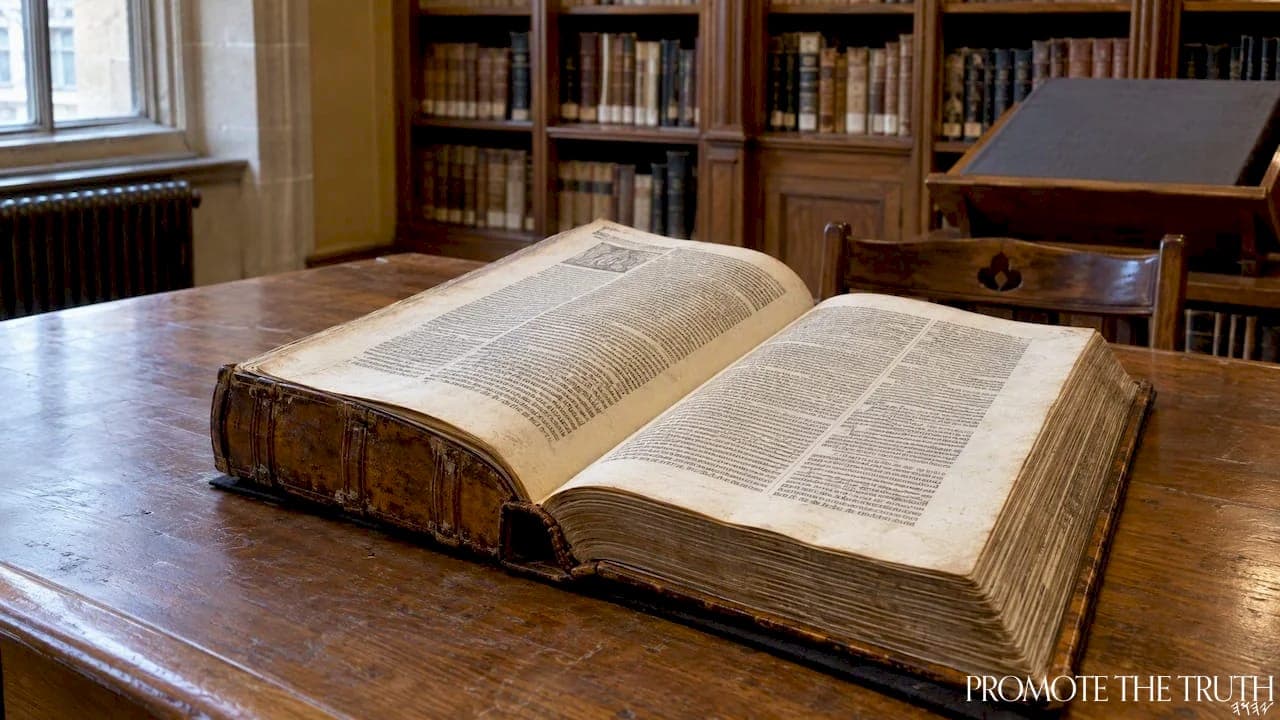
The best way to study the Apocrypha is to read it as Second Ahiykal (Temple) literature first and as a question of canon second. Choose an edition with notes, read the books alongside the history of the period, and keep what the text says separate from what later traditions made of it. This guide shows you how, step by step, with the tools and cautions that matter.
TL;DR
-
The Apocrypha are writings from the Second Ahiykal (Temple) Period. They were kept in the Yuuniy (Greek) Septuagint and Latin Vulgate Old Testaments but not in the Ta’anak.
-
Book lists differ by tradition, so always check which canon an edition follows before you compare notes with other readers.
-
The Bariyt Hadash (New Testament) never quotes these books as “Scripture,” yet its world knew many of them. Treat them as context, not as proof of either acceptance or rejection.
-
Study with an annotated edition, a historical introduction, and a clear understanding of how the translation you use was made.
-
Keep the original-language manuscript question in view: it decides how much weight any English wording can carry.
Table of Contents
What the Apocrypha are, and why the name causes confusion
The Apocrypha is books from the Second Ahiykal (Temple) Period that were not preserved in the Ta’anak but were included in the Latin Vulgate and Yuuniy (Greek) Septuagint. That one sentence already explains most of the confusion. The books are Jewish in origin. They were not part of the Abariy (Hebrew) collection that Judaism preserved. Yet they travelled through the Yuuniy (Greek) and Latin Bibles that shaped Christian history.
The same source dates the Apocrypha and related writings from the third century BCE, possibly the late fourth, to the decades after 70 CE. They are not one kind of book. You will find histories, apocalypses, wisdom writings, Tahliym (psalms), and prayers. Reading Tubiyahu (Tobit) the way you read 1 Makabiym (Maccabees) , or Sirach the way you read 2 Esdras, is a common mistake. Each has its own purpose and its own setting.
There is also the matter of the word itself. “Apocrypha” is a label applied later, from outside. Scholars note that early authors knew at least some texts later grouped under it, but they never met a single, defined collection called “the Apocrypha”. When you study, keep that in mind: the category is a later one.
Why the book lists do not match
If you have ever compared two Bibles that both claim to contain the Apocrypha, you have probably found different tables of contents. This is normal. Timothy Lim explains that the Jewish Tanak and the Protestant Old Testament hold the same collection of books, counted as 24 and 39 respectively, while Catholic and Orthodox canons include additional books called Apocrypha or Deuterocanonical.
So the first practical step is to ask which tradition an edition serves:
| Tradition | How it treats these books | What that means for your study |
|---|---|---|
| Jewish (Tanak) | Not part of the 24-book collection | Read them as Second Ahiykal (Temple) literature that Judaism did not preserve in its scripture |
| Protestant | Not in the 39-book Old Testament; some editions print them in a separate section | Look for a section break and an introduction that says why |
| Catholic | Called Deuterocanonical and included in the canon | Notes will often explain how the Church has read them |
| Orthodox | Additional books included, with a longer list in some churches | Check the table of contents, because the count varies |
An edition’s own introduction will tell you which list it follows. If it does not, treat that as a reason to choose another edition.
Our own Deuterocanonical books and manuscript history guide walks through how these writings entered and left various Bibles, and it is a good companion to this article.
What Martin Luther did with them
Martin Luther is the name most readers connect with the Protestant handling of these books. In his 1534 German Bible he gathered them in a section between the Old and New Testaments, with a note that they are not held equal to Holy Scripture yet are profitable and good to read. This is the pattern behind many later Protestant editions: the books are printed.
Two lessons follow for your study. First, Luther did not throw the books away. He judged them useful for reading while placing them below the Hebrew canon. Second, the separate section in a printed Bible is a historical decision, not a feature of the original writings. When you see a divider in your edition, you are looking at a sixteenth-century editorial choice.
What the Bariyt Hadash (New Testament) evidence can and cannot tell you
The question “Did Yahusha (Jesus) accept the Apocrypha?” appears constantly, and it is worth answering carefully. The evidence supports a modest conclusion. Yahusha (Jesus) lived in a Yahudiym (Jewish) world where some of these writings were available and known. The Bariyt Hadash (New Testament) gives no explicit quotation of them as “Scripture.” That does not prove he never read them, and silence alone does not prove he rejected them. The strongest honest statement is familiarity or availability without demonstrated canonical endorsement.
An article argues that studying these books helps readers understand the writings available to Yahusha (Jesus) and his earliest followers, and the Yahudiym (Jewish) ethical and theological conversation of the time. In an earlier generation described the Apocrypha, Pseudepigrapha, and Dead Sea Scrolls as part of the Jewish matrix of early Christianity.
The same Lutheran Seminary study carries a caution that serious students should adopt: distinguish evidence from the original setting from later traditions that may have been projected back onto the Bariyt Hadash (New Testament). When a commentary says a Bariyt Hadash (New Testament) phrase “echoes” a verse in Wisdom or Sirach, ask what the echo actually rests on: shared vocabulary, shared ideas, or only a later reading.

A method for studying the Apocrypha
A sound approach is simple, and it works with any edition.
1. Start with the history
Read a short introduction to the period before you open a single book. The Dead Sea Scrolls, discovered in 1947, give important context for dating and understanding Yahudiym (Jewish) writings of this era. Knowing who ruled, what crises Judeans faced, and where communities lived will change how you read Makabiym (Maccabees) , Yahudiyt (Judith), and Tubiyahu (Tobit).
2. Read one book at a time, by genre
Do not read the Apocrypha front to back like a novel. Group the books by what they are:
-
Histories: 1 and 2 Makabiym (Maccabees) , which show the pressures of Hellenistic rule.
-
Wisdom writings: Wisdom of Shalamah (Solomon) and Sirach, which are best read slowly with the Mashaliym (Proverbs) tradition in mind.
-
Stories and prayers: Tubiyahu (Tobit), Yahudiyt (Judith), and the Prayer of Manashah (Manasseh), each with its own worship (devotional) and literary purpose.
-
Apocalyptic material: 2 Esdras, which belongs with other Jewish apocalypses of the late first century.
The exact list depends on the edition, so use your table of contents as the map.
3. Use the notes properly
Annotated editions earn their price in the notes. According to the research, notes can identify alternate readings, explain wordplay that depends on the original language, and briefly explain how it has interpreted a passage. Read the note after you have read the passage yourself, and mark where a note offers a manuscript fact and where it offers an interpretation. Those are different kinds of information.
4. Compare with the Abariy (Hebrew) canon
Notice where an apocryphal book retells, expands, or answers a canonical one. The Additions to Asatar (Esther) and Daniyal (Daniel), for example, are best studied with the canonical text open next to them. Differences show you how communities in the Second Ahiykal (Temple) Period handled the same stories.
5. Write down your conclusions in two columns
One column holds what the text says. The other holds what you or a commentator infers. This habit protects you from the projection problem mentioned above.
Choosing a study edition
Before you buy, check these points:
-
Which canon does it print? Match the book list to your purpose.
-
Are there introductions and notes for each book? Look for both historical and textual notes.
-
What kind of translation is it? It explains that formal-equivalent translations stay closer to the original wording and structure, dynamic-equivalent translations convey meaning, and paraphrases restate the text in the writer’s own words. For close study, a formal approach with notes is usually the stronger base.
-
Does it say what manuscripts stand behind the text? For the Apocrypha this often means Yuuniy (Greek), with some books surviving in Abariy (Hebrew), Aramiyt (Aramaic), or only in later translations.
-
Does it separate text from commentary? Clean separation makes your two-column method easier.
Study Scriptures (Bible), annotated editions, and scholarly guides are the main kinds of tool. Each serves a different job: a study Scriptures (Bible) for reading with notes at hand, a guide for historical orientation, and a reference work for checking a single book in depth. A short list of two or three tools beats a shelf of ten.
If translation choice is the part you want to understand better, our article on dynamic equivalence in Scripture translation explains where the approach came from, and how to evaluate Scripture translation accuracy gives a practical checklist you can apply to any edition, including one with the Apocrypha.
Why the manuscripts matter for every kind of study

The study of these books keeps returning to one question: what does the earliest evidence actually say? The Dead Sea Scrolls changed that conversation, because they showed copies of Yahudiym (Jewish) writings far older than the medieval manuscripts that earlier scholars relied on. If you want to learn how to weigh differences between copies, read our piece on judging Dead Sea Scrolls variants, and for the basics of reading ancient texts see Abariy (Hebrew) manuscripts for beginners.
These habits carry from one corpus to another. Whether you are reading Sirach or Yisha’aiyahu (Isaiah), the questions are the same: which manuscript, how old, and what does the translator do when the copies disagree?
Our perspective on studying the Apocrypha
We believe the most faithful way to approach any ancient writing is to go as close to the earliest manuscripts as the evidence allows. That conviction shapes everything we publish. The Apocrypha reward the same discipline: read them for what they are, Yahudiym (Jewish) writings of a turbulent era, and let the manuscripts and the history set the limits of what you claim.
We and many others believe the Scriptures are best understood when the original names, meanings, and setting are restored rather than smoothed over. That is why we publish the Truth Scriptures, a restoration English translation of the Ta’anak and the Bariyt Hadash prepared from ancient Abariy (Hebrew) and Aramiyt (Aramaic) manuscript sources. If you are building a study habit, we encourage you to anchor your reading in the canonical text first, then bring the Second Ahiykal (Temple) writings alongside it as background.
Our goal is never to hand you conclusions. It is to give you a text and a method you can trust, so that when you open the history, you see it clearly and with reverence for the eternal message at its center.
Maria
Where to go next with the Truth Scriptures
If you want a manuscript-based foundation for your study, the Truth Scriptures translation is a restoration English translation of the Ta’anak (Old Testament) and Bariyt Hadash (New Testament), translated from ancient Abariy (Hebrew) and Aramiyt (Aramaic) sources. It restores the Name YAHUAH and the original names and meanings that we believe are missing from most other translations. Our guide to the Truth Scriptures translation features shows what to look for as you read.
Prefer a digital format for searching and cross-reference? Explore the Truth Scriptures Digital Collection. For guided learning, the PTT Renewed Virtual Retreat is listed at £197 as a one-off price.
Common mistakes to avoid
-
Treating the Apocrypha as a single, fixed set. The lists differ by tradition, so always name the list you are using.
-
Reading silence as a verdict. The absence of a quotation in the Bariyt Hadash (New Testament) does not prove acceptance or rejection.
-
Mixing text and tradition. A later church reading is not evidence about the first century.
-
Using a paraphrase for close study. Choose a translation whose approach you understand.
-
Skipping the history. Without the Second Ahiykal (Temple) setting, these books can seem strange or arbitrary.
FAQ
Can you provide a Scriptures (Bible) study on the Apocrypha?
Yes, and a workable plan is six to eight sessions. Spend the first on history and canon, then take one book or genre per session: a history such as 1 Makabiym (Maccabees), wisdom in Sirach, a story such as Tubiyahu (Tobit) , and so on. In each session, read the passage first, then the notes, then record what the text says and what is inference.
Did Yahusha (Jesus) accept the Apocrypha?
The evidence does not settle it. Yahusha (Jesus) lived in a Yahudiym (Jewish) world where some of these writings were known, but the Bariyt Hadash (New Testament) does not quote them as “Scripture.” The careful conclusion is familiarity without demonstrated canonical endorsement, and silence alone cannot prove rejection.
Did Martin Luther believe in the Apocrypha?
Luther kept the books but set them apart. In his 1534 German Bible he placed them between the Testaments, describing them as not equal to Holy Scripture but good and profitable to read. Many later Protestant editions followed that arrangement.
Why do Bibles list different Apocryphal books?
Because traditions drew their canons differently. The Jewish Tanak and the Protestant Old Testament share the same books, while Catholic and Orthodox canons add further books. Check the table of contents and introduction of any edition before comparing notes with other readers.
Sources
-
The Apocrypha and Pseudepigrapha, Israel Ministry of Foreign Affairs
-
The Apocrypha and the Earliest Christian Movement, David deSilva (2018)
-
Reading the Hebrew Scriptures in the First Century, Lutheran Seminary Word and World