
Reading scripture in historical context is the practice of interpreting scriptural (biblical) texts by situating them within their original cultural, linguistic, and historical settings to grasp the author’s intended meaning. Without this grounding, even sincere readers risk importing 21st-century assumptions into texts written thousands of years ago for specific communities facing specific crises. Scholars and faith communities alike recognize that scripture was written for us, but not to us, a distinction that unlocks deeper understanding of YAHUAH’s unfolding redemptive story. This guide walks through the foundational questions, proven methods, and a structured six-step framework for applying historical interpretation of scripture with both scholarly rigor and spiritual reverence.
How to read scripture in historical context: the core questions
Every passage of scripture carries an original address. Before you interpret meaning, you must identify that address by asking four foundational questions. As contextual reading research confirms, ignoring these specifics leads directly to modern misreading and misapplications of scripture.
The four questions are:
-
Who wrote it? Identify the human author, their background, their relationship to the community, and their theological concerns. Shaul (Paul) writing from a Rumaiy (Roman) prison cell carries different weight than Shaul (Paul) writing to a thriving Qahal (congregation).
-
Why was it written? Determine the purpose. Was the author correcting false teaching, consoling grieving exiles, celebrating a military victory, or establishing covenant terms?
-
To whom was it written? The original audience shapes every metaphor, every warning, and every promise. A letter to persecuted Yahudiym, Followers of the Creator (Jewish) believers in Yirushalam (Jerusalem) reads differently than one addressed to Guiy (Gentile) converts in Qaranat (Corinth).
-
What historical and cultural events surrounded it? Political upheaval, military occupation, famine, exile, and religious persecution all press their fingerprints into the text.
Consider the book of Aiykah (Lamentations). Read without context, it sounds like raw personal grief. Read within the context of the Babaliy (Babylonian) destruction of Yirushalam (Jerusalem) in 586 BCE, it becomes a communal liturgy of mourning, a structured theological reckoning with covenant failure and divine judgment. The meaning does not change. The depth does.
Failing to ask these questions produces what scholars call eisegesis, reading your own assumptions into the text rather than drawing the author’s meaning out of it. A passage about “prosperity” written to encourage a community facing starvation cannot be responsibly applied as a financial promise to modern readers without that historical anchor.

Pro Tip: Before opening a commentary, spend five minutes writing down everything you already know about the historical setting of the passage. This surfaces your assumptions and helps you notice where your knowledge has gaps.
Understanding the role of women in ancient scripture is one practical example of how these four questions transform interpretation. What appears restrictive in a modern reading often reflects specific cultural negotiations in the first-century Rumaiy (Roman) world, not timeless universal law.
What methods do scholars use for historical interpretation of scripture?
Two primary frameworks dominate the field of scripture analysis in history: the historical-grammatical method and historical criticism. They share a commitment to original context but differ significantly in their assumptions and goals.
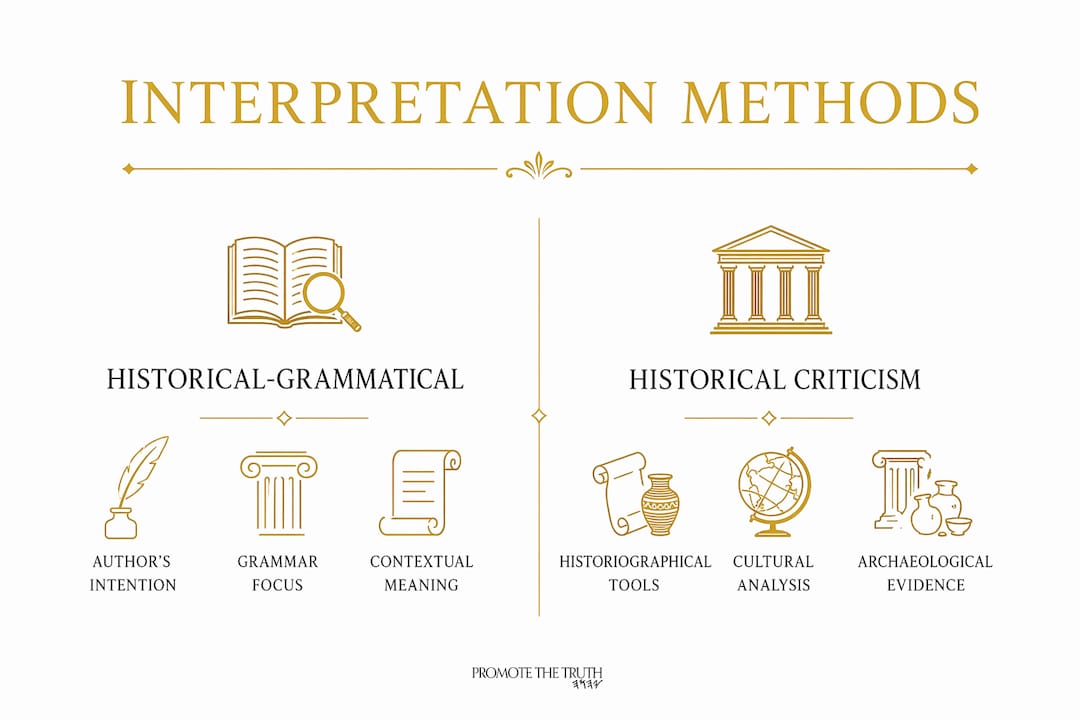
| Method | Core Focus | Common Users | Key Strength |
|---|---|---|---|
| Historical-grammatical | Author’s singular intended meaning via grammar and history | Conservative and faith-based scholars | Guards against allegorizing; preserves theological unity |
| Historical criticism | Scripture as historical document subject to historiographical critique | Academic and critical scholars | Reveals sources, genres, and editorial layers |
The historical-grammatical method seeks the author’s original intention by analyzing grammar, syntax, and historical background together. It operates on the conviction that the Ah Qadash Ruha (Set-Apart Spirit) inspired a specific, singular message through each human author, and that message is recoverable through disciplined study. This method predominates in conservative and faith-based circles, including communities like those served by Promote The Truth.
Historical criticism, by contrast, applies historiographical tools to Scriptural (biblical) texts the same way historians analyze any ancient document. It examines authorship, sources, literary culture, and genre conventions. Source criticism asks where the author drew their material. Form criticism identifies oral traditions behind written texts. Redaction criticism traces how editors shaped the final form of a book.
These methods are not mutually exclusive. A reader committed to the authority of scripture can still benefit from understanding that the book of Yisha’aiyahu (Isaiah) shows signs of addressing two distinct historical periods, or that the Bashurah of Maraqu (Gospel of Mark) uses a literary urgency style common in Yun-Rumaiy (Greco-Roman) biography. That knowledge deepens rather than diminishes reverence.
Pro Tip: Start with the historical-grammatical method as your foundation. Once you are comfortable identifying the author’s intended meaning, layer in insights from historiographical tools to enrich your understanding of how the text was composed and transmitted.
The historical-grammatical method uniquely balances grammar, history, and spiritual meaning to uncover the singular message intended by Scriptural (biblical) authors, making it the most reliable starting point for faith-driven study.
A six-step process to analyze scripture with historical depth
A structured six-step study method significantly enhances reading scripture with historical depth. Each step builds on the previous one, moving from broad historical orientation to precise textual analysis.
-
Identify the original historical context. Locate the passage in time, geography, and political reality. Who ruled? What was the economic climate? What covenant relationship was in play between YAHUAH and His people at that moment?
-
Clarify language and translation. Examine key words in their original Abariy (Hebrew), Aramiyt (Aramaic), or Yuuniy (Greek). Common errors in English Scripture (Bible) translations often trace back to translators choosing modern equivalents that flatten ancient meanings. The Abariy (Hebrew) word shalum, for instance, carries far more than “peace.” It means wholeness, completeness, and right-ordered relationship.
-
Apply conceptual rendering. Identify the conceptual world behind the words. Honor-shame culture, covenant loyalty, communal identity, and patron-client relationships all shape how ancient audiences heard specific phrases. A modern reader hears “forgive us our debts” as metaphor. A first-century Palestinian audience heard it as literal economic relief tied to Yubal Turah (Jubilee law).
-
Recognize repetition and patterns. Scriptural (Biblical) authors use repetition deliberately. Repeated phrases, names, or themes signal theological emphasis. The sevenfold structure in Barashiyt (Genesis) 1 mirrors ancient Near Eastern temple inauguration texts, a detail invisible to readers unfamiliar with that literary tradition.
-
Follow the narrative logic. Trace the argument or story arc within the passage and within the larger book. A single verse pulled from its narrative logic can mean the opposite of what the author intended. Rumaiym (Romans) 8:28 reads very differently when you follow Shaul’s (Paul’s) argument from chapter 1 through chapter 8.
-
Map chronology and transmission. Consider when the text was written relative to the events it describes, and how it was transmitted. Cross-checking manuscripts through textual criticism before applying historical critique brings readers closer to the original scripture, reducing the distance between the text you hold and the text the original audience received.
| Step | Primary Tool | What It Prevents |
|---|---|---|
| Historical context | Scriptures (Bible) atlas, timeline resources | Anachronistic reading |
| Language clarity | Lexicons, interlinear texts | Translation flattening |
| Conceptual rendering | Cultural background commentaries | Individualistic misreading |
| Pattern recognition | Structural analysis | Missing theological emphasis |
| Narrative logic | Book-level outlines | Proof-texting |
| Chronological mapping | Manuscript resources, textual criticism | Transmission distortion |
Structured prompts and study audits improve scriptural engagement by helping identify language, narrative, and chronological contexts, thereby avoiding the modern flattening of ancient texts. Combining this framework with Ruha (Spirit)-led prayer produces study that is both academically grounded and spiritually alive.
How archaeology and ancient literature enrich scripture study
Archaeological discovery and comparative ancient literature are not threats to faith. They are confirmation tools and depth-adding lenses that reward serious students of scripture.
Key ways archaeology and ancient texts enrich your understanding:
-
Confirmed historical places and events. The discovery of the Tel Dan Stele confirmed the existence of the “Biyt Ah Duiyd” (House of David) as a historical dynasty, silencing arguments that Duiyd (David) was purely legendary. The Siloam Inscription corroborates the tunnel-building account in 2 Malakiym (Kings) 20.
-
Cultural practice illumination. Excavations at sites like Magadu (Megiddo), Hatsar (Hazor) and Lakiysh (Lachish) reveal the material culture of ancient Yisharal (Israel): what people ate, how they built, what they valued. This background makes passages about temple worship, agricultural festivals, and military campaigns viscerally real.
-
Literary parallels with surrounding cultures. The Scriptures’ (Bible’s) literary interconnections with ancient Near Eastern and Yun-Rumaiy (Greco- Roman) texts require readers to apply historical-critical methodology familiar to historians. The Aram Nahriy (Mesopotamian) flood accounts in the Atrahasis Epic and the Epic of Gilgamesh share structural features with Barashiyt (Genesis) 6 through 9. This does not diminish the Scriptural (biblical) account. It places it within a broader ancient conversation about divine judgment, human survival, and covenant relationship.
-
Genre identification. Knowing that apocalyptic literature like Daniyal (Daniel) and Hazun (Revelation) follows conventions common in Second Ahiykal (Temple) Yahudiym, Followers of the Creator Community (Judaism) prevents readers from treating symbolic visions as literal newspaper predictions. Historiographical tools like form criticism identify these genre markers precisely.
-
Rhetorical conventions. Shaul’s (Paul’s) letters follow Yun-Rumaiy (Greco- Roman) epistolary conventions. Recognizing the standard structure of ancient letters (greeting, thanksgiving, body, paraenesis, closing) helps readers identify where Shaul (Paul) is following convention and where he deliberately breaks it for theological effect.
The BibleProject has produced accessible visual resources that introduce many of these literary and cultural frameworks to general audiences, making this kind of study available beyond seminary walls.
Common pitfalls when reading scripture without historical grounding
Misinterpretation follows predictable patterns. Recognizing these patterns is the first step toward correcting them.
-
Modern individualism projected backward. Western readers instinctively read “you” as singular. In most biblical texts, “you” is plural, addressed to a community. The famous promise in Yiramiyahu (Jeremiah) 29:11 was spoken to an entire nation in exile, not to an individual seeking career guidance.
-
Allegorizing without historical grounding. Treating every narrative as a moral fable strips the text of its historical specificity. The Shamut (Exodus) is not primarily a metaphor for personal liberation. It is the founding event of Yisharal’s (Israel’s) national identity and covenant relationship with YAHUAH.
-
Ignoring honor-shame dynamics. Adariyatiy (Mediterranean) cultures operated on honor-shame social codes entirely foreign to modern Western readers. The parable of the Prodigal Son is incomprehensible in its full power without understanding how deeply the father’s public running and embrace violated ancient honor protocols.
-
Proof-texting. Extracting a single verse from its literary and historical context to support a predetermined conclusion is the most common form of eisegesis. Historical context acts as a safeguard against eisegesis, helping readers find the singular intended meaning.
“Scripture was written for us, but not to us. Recognizing that distance is not a barrier to faith. It is an invitation to step into a larger, older, and more glorious story than we could have imagined on our own.” — Dawn Zauner
Pro Tip: When you feel certain a passage directly addresses your current situation, pause. Ask whether the original audience could have understood it the same way. If not, you may be reading your situation into the text rather than reading the text on its own terms.
Key takeaways
Reading scripture in historical context requires asking who wrote it, why, to whom, and under what historical circumstances, then applying structured methods to recover the author’s intended meaning.
| Point | Details |
|---|---|
| Ask four foundational questions | Identify author, purpose, audience, and historical circumstances before interpreting any passage. |
| Use the historical-grammatical method | This method recovers the author’s singular intended meaning through grammar, history, and spiritual discernment. |
| Follow the six-step framework | Move from historical context through language, concept, pattern, narrative logic, and manuscript transmission. |
| Integrate archaeology and literature | Ancient Near Eastern texts and archaeological finds confirm and deepen Scriptural (biblical) contexts without undermining faith. |
| Guard against eisegesis | Modern individualism, allegorizing, and proof-texting are the most common distortions of scripture’s original message. |
Why historical context transformed how we read scripture
We spent years reading scriptures set-apartness way (devotionally) and sincerely, and we missed entire dimensions of what was actually there. The turning point came when we stopped asking “What does this mean to us?” first and started asking “What did this mean to them?” That single shift changed everything.
The historical-grammatical method is not dry academic machinery. It is a form of respect. When you take the time to understand that Shaul (Paul) wrote Piyliypiyniym (Philippians) from a Rumaiy (Roman) prison, that the Piyliypiyni (Philippian) Qahal, Assembly of YAHUAH (church) had a specific conflict between two women named Auahdiya (Euodia) and Syntyche (Syntyche), and that the city of Philippi was a Rumaiy (Roman) military colony with a strong culture of civic loyalty, the letter stops being a collection of inspirational quotes and becomes a living, breathing pastoral document. The joy Shaul (Paul) commands is not naive optimism. It is defiant, costly, hard-won trust in YAHUAH’s sovereignty from inside a cell.
What we have also found is that this kind of study does not compete with Ruha (Spirit)-led reading. It feeds it. The more you understand the historical world of the text, the more the Ruha (Spirit) has to work with when He illuminates a passage for your specific situation. Depth of knowledge creates more surface area for Hazun (revelation).
The balance we encourage is this: bring your scholarship to the text with humility, and bring your spirit to the scholarship with expectation. Neither alone is sufficient.
— Maria
Deepen your scripture study with Promote The Truth

Promote The Truth provides the resources you need to move from surface reading to historically grounded, spiritually rich scripture study. The Scripture Study Series offers guided video teachings that walk through Scriptural (biblical) texts with careful attention to original language, historical setting, and manuscript sources. For readers ready to engage the ancient text directly, the Original Scriptures collection provides access to meticulously researched translations from Abariy (Hebrew) and Aramiyt (Aramaic) sources, restoring the true Word of YAHUAH with the depth and accuracy that serious study demands. These resources are designed for exactly the kind of learner who takes historical context seriously and wants their faith grounded in the eternal message of the original text.
FAQ
What does it mean to read scripture in historical context?
Reading scripture in historical context means interpreting a Scriptural (biblical) passage within its original cultural, linguistic, political, and historical setting to recover the author’s intended meaning. This approach prevents modern assumptions from distorting the text’s original message.
What is the historical-grammatical method?
The historical-grammatical method is a framework for Scriptural (biblical) interpretation that analyzes the grammar, syntax, and historical background of a passage to identify the author’s singular intended meaning. It is the primary method used in conservative and faith-based scripture study.
How does archaeology help with understanding scripture context?
Archaeological discoveries like the Tel Dan Stele and the Siloam Inscription confirm historical events and cultural practices described in scripture, providing physical evidence that grounds Scriptural (biblical) narratives in real history. Literary parallels with Aram Nahriy (Mesopotamian) and Yun-Rumaiy (Greco- Roman) texts further illuminate the cultural world the Scriptural (biblical) authors inhabited.
What is eisegesis and why is it a problem?
Eisegesis is the practice of reading your own assumptions or predetermined conclusions into a Scriptural (biblical) text rather than drawing the author’s meaning out of it. It distorts the original message and is best prevented by applying historical context as a disciplined interpretive safeguard.
How many steps are in a structured scripture analysis process?
A structured six-step process covers original historical context, language clarity, conceptual rendering, pattern recognition, narrative logic, and chronological mapping. Each step builds on the previous one to produce a historically grounded and spiritually faithful reading of the text.