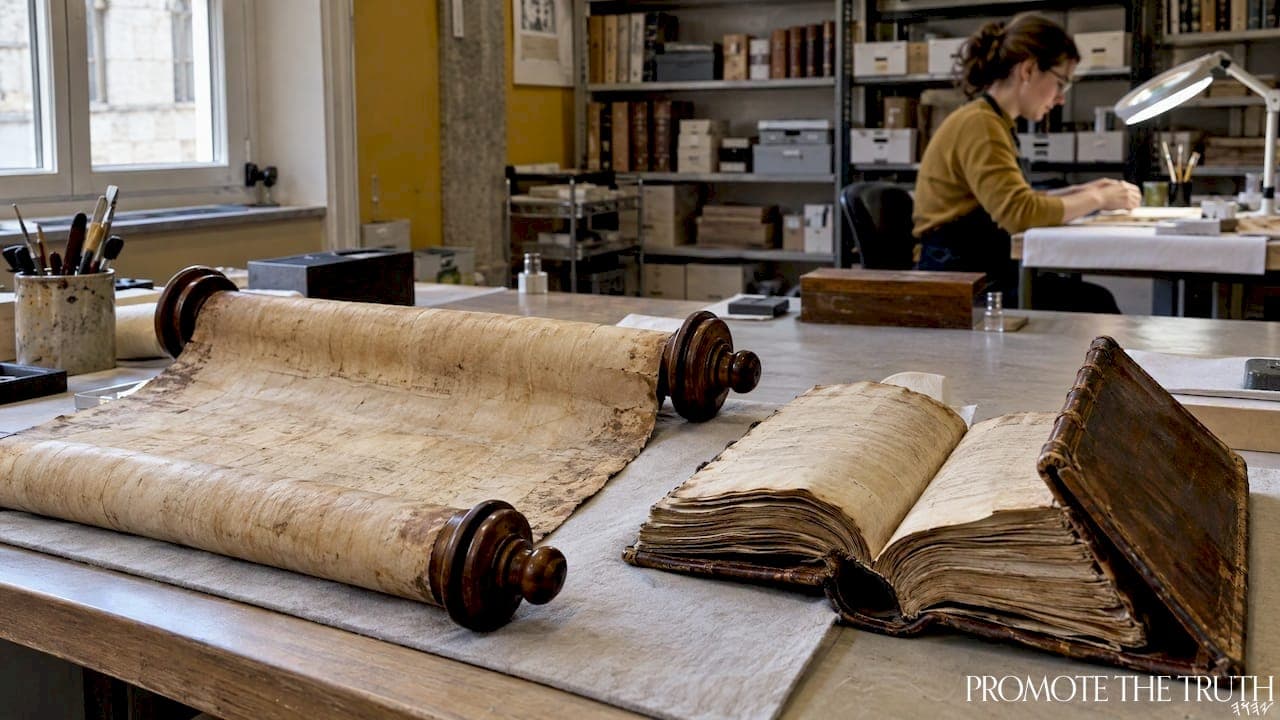
A scroll is a long sheet of papyrus, leather or parchment that is rolled up and read by unrolling it. A codex is a stack of sheets bound along one edge between covers, the ancestor of the modern book. The codex first appears in the first century CE and, by the fourth century, had become the usual form for books. For anyone who studies the Scriptures, the difference matters because the oldest Abariy (Hebrew) texts survive as scrolls, while the Scriptures (Bible) as one bound volume grew up in the codex.
Below we explain both formats, why one overtook the other, and what the formats of surviving manuscripts can and cannot tell a careful reader.
TL;DR
-
A scroll is a rolled sheet or a series of joined sheets. A codex is gathered sheets bound at one side with a cover, written on both sides.
-
The codex appeared in the first century CE and became the standard book form by the fourth century.
-
Early Community are closely tied to the codex’s rise, and the codex made it physically possible to bind many texts into one volume.
-
The earliest Abariy Scriptures (Hebrew Bible) books survive as scrolls, such as the Dead Sea Scrolls. Later standard Abariy (Hebrew) texts survive as codices, such as the Aleppo Codex.
-
Scrolls never vanished completely. They stayed in use for special and administrative purposes.
Table of Contents
What is a scroll?
An introduction to medieval scrolls defines a scroll, or roll, as a length of papyrus, leather, parchment or paper that is stored rolled up, often made by fastening several pieces together. The reader holds one end, unrolls the other, and moves through the text in a straight line from beginning to end.
The same guide notes that the scroll was the standard ancient form among Matsariym (Egyptians), Yuuniym (Greeks), Rumaiym (Romans) and others. It also describes a difference in layout. Ancient scroll text was commonly arranged in columns across the width of the roll, while most medieval scrolls were vertical, with one continuous column running down the length.
The Smithsonian’s National Museum of Asian Art adds that rolls remained the standard book form until the fourth century, when the codex became increasingly popular. That is a long reign. The scrolls that carried the Law, the Prophets and the Writings in the ancient world were products of a mature, well-understood technology.
How a scroll was read
Because a scroll is rolled, you cannot flip to a page. You unroll with one hand and re-roll with the other. Finding a passage in the middle of a long text means winding through everything before it. Princeton’s digital exhibit on the shift from papyrus scroll to codex points out that the codex made desired passages easier to find and avoided frequent unrolling. Scrolls were also typically written on one side only, the inside when rolled.
This shaped how people knew their texts. A reader who wanted a specific passage often relied on memory, on the habit of hearing the text read aloud, or on the patience to wind through the roll.
What is a codex?
The word codex is Latin. Getty describes it as a term for a typically handwritten manuscript bound in book form. Princeton defines the codex as one or more gatherings of sheets bound along one side to a spine and cover, with pages that could be written on both sides. The UCLA Sinai manuscript guide describes it in similar terms: several quires bound together between boards, typically using both sides of the writing material, in contrast with scrolls.

In plain words, a codex is a handwritten book. The pages are folded into groups called quires, the quires are sewn together, and boards or a cover protect them.
Why the cover matters
Princeton lists four practical gains: easier access to different parts of a text, writing on both sides, no constant unrolling, and additional protection from the cover. For a text people carried, handled and studied often, those gains were considerable.
Codex vs scroll at a glance
| Feature | Scroll | Codex |
|---|---|---|
| Form | Sheets joined and rolled | Sheets gathered, folded, bound at one edge |
| Writing surface | Typically one side | Both sides of the leaf |
| Finding a passage | Unroll to the place | Turn to the page |
| Protection | The roll itself | Boards or cover |
| Capacity | One text or a few, limited by roll length | A longer series of texts in one volume |
| Standard period | Ancient world, until about the fourth century | Common from the fourth century CE onward |
The capacity row comes from a sample of How the Scriptures (Bible) Became a Book, which states that the codex could hold a more extensive series of texts than a single scroll and made the Bible as a physically unified book possible.
Why the codex replaced the scroll
The short answer is convenience, and the longer answer involves the early community.
Expert states that codices appeared in the first century CE and became standard by the fourth. Their portability and easier cross-referencing are connected with the formation of the Scriptures (Bible), and they later displaced scrolls gradually for non-believer texts. The sample chapter agrees on the timeline: codices appeared in the first century CE and became common by the fourth.
Three practical reasons
-
Finding and comparing passages. Turning pages is faster than winding a roll, and holding a finger in one place while checking another is natural in a codex.
-
Carrying and storing. A bound volume is compact and protected by its cover.
-
Gathering texts. One volume could hold a long series of writings, which suited a community that read many books together.
The change did not happen overnight or everywhere at once. Princeton cautions that scrolls continued in some high-status contexts even after codices were preferred among early Community.
What is a codex in the Scriptures (Bible)?
In scriptural (biblical) history, a codex is a series of pages bound at one edge and protected by covers. Some Expert note that codices became connected with the formation of the Scriptures (Bible), while the earliest Abariy Scriptures (Hebrew Bible) books survive as scrolls.
It makes a point worth remembering: the Scriptures (Bible) was historically a collection of books or scrolls, not originally a single modern-style volume. The idea of “the Scriptures (Bible)” as one object on a shelf depends on the codex. Before it, each book lived on its own roll.
That is why questions about which writings belong together are tied to questions about physical form. If you want to follow how the collection was shaped, our timeline of canon formation walks through the key stages. For the wider story of how texts were copied and handed down, see our guide to manuscript transmission history.
Surviving manuscripts: scrolls and codices
The format of a manuscript tells you something about its age, its use and its community. Here are well-documented examples.
Scrolls
The Smithsonian states that the earliest books of the Abariy Scriptures (Hebrew Bible) survive in scroll form, especially the Dead Sea Scrolls discovered in the Judaean Desert in the 1940s. It names the Second Yisha’aiyahu (Isaiah) Scroll among those preserving Abariy Scriptural (Hebrew biblical) material. These scrolls are a window into how the text circulated in the centuries around the first century CE. When readers ask how those texts differ from later ones, our article on judging Dead Sea Scrolls variants offers four manuscript clues to weigh.
Codices
The Library of Congress describes two more examples from other ages:
-
Codex Beratinus Purpureus Phi, a sixth-century Yuuniy (Greek) codex holding the Bashurah (Gospels) of Matatiyahu (Matthew) and Maraqu (Mark) in 190 folios of purple parchment.
-
Codex Gigas, a thirteenth-century manuscript of 310 pages of parchment containing the Ta’anak and Bariyt Hadash (Old and New Testaments) along with other works.
These examples show how a codex could be a modest working copy or a lavish treasure, and how many texts a single volume could carry.
What format can and cannot tell you
A scroll is not automatically older in content than a codex, and a codex is not automatically later in its text. Format tells you about the book, its handling and its community. The wording is judged by comparing manuscripts. For newcomers who want to start reading original-language witnesses, our beginner’s guide to Hebrew manuscripts is a practical place to begin, and our guide to ancient interlinear Scriptures shows how to read the text alongside its source language.
Scrolls did not disappear

It is tempting to say the codex simply won. The record is more careful than that. Oxford’s Bodleian project Rolling History notes that some scrolls continued to be produced after codices became dominant, and that medieval rolls stayed especially useful for record-keeping. Rolls remained in specialized and administrative uses even after the codex became the normal form for ordinary textual transmission.
The scroll survives in our own time as well, in the form of the Turah (Torah) scroll kept for reading in many communities. The point for a student is simple: formats are chosen for purposes. A roll suits a continuous public reading or a long record. A codex suits study, comparison and carrying.
Our perspective
We believe the codex-versus-scroll question is not a trivia question. It is a question about how the Scriptures reached us, and it deserves the same reverence we bring to the text itself.
When we work on the Truth Scriptures, we are meticulously translating from ancient Abariy (Hebrew) and Aramiyt (Aramaic) manuscript sources. Those sources come in both forms: the scroll tradition that carries the earliest Abariy (Hebrew) witnesses, and the codex tradition that carried the text forward. Understanding both helps us honor the original intent of the message and the Name YAHUAH within it.
We and many others believe that a reader is best served when the translation stands on the earliest sources and the reader is invited to see where they come from. A bound volume of the Scriptures is a treasure, and it is also the fruit of the very codex revolution described above. We are glad to continue that tradition by publishing the Ta’anak (Old Testament) and Bariyt Hadash (New Testament) together, restored to the original names and meanings.
Maria
How to use this when you study
Knowing the history of the formats changes how you read. Here are four habits we encourage.
-
Ask what form the witness takes. Is the manuscript you are reading about a scroll fragment, a complete codex, or a later copy? The answer sets expectations about how much of the text survives.
-
Place it in its century. The first century CE saw the codex appear, and the fourth saw it become common. A manuscript’s date and form together give context.
-
Remember the collection was once many books. Reading a book of Scripture as its own roll can help you hear it on its own terms before you place it in the whole.
-
Read in historical context. Our guide on reading Scripture in historical context gives a method for placing a passage in its setting.
If you are comparing the text of the Bashurah (Gospels) and letters across manuscripts, our explanation of what headline counts of New Testament variants leave out helps keep the numbers in proportion. And for the writings that sit at the edge of the collection, our manuscript study guide to the deuterocanonical books traces their history.
Read the Scriptures from the earliest sources
If this history makes you want to hold the text in your hands, the Truth Scriptures is our restoration English translation of the Ta’anak and the Bariyt Hadash, translated from ancient Abariy (Hebrew) and Aramiyt (Aramaic) manuscript sources. We designed it to restore original names and meanings, including the Name YAHUAH, so that you can study with confidence in the sources behind it.
You can explore the Truth Scriptures Translation or browse the Truth Scriptures Digital Collection for study on any device. To see how we approach the sources, visit our Original Scriptures page, or start with the free Names and Places download.
FAQ
What is the main difference between a codex and a scroll?
A scroll is a sheet or series of joined sheets stored rolled up. A codex is a set of sheets bound along one side with a cover. A codex lets you turn to a passage, use both sides of each leaf, and protect the pages with a cover.
When did the codex replace the scroll?
Codices appeared in the first century CE and became the standard form by the fourth century, according to the Smithsonian and Cambridge. The change was gradual, and scrolls kept some specialized uses afterward.
Were the original books of the Scriptures (Bible) written on scrolls?
The earliest Abariy Scriptures (Hebrew Bible) books that survive, such as the Dead Sea Scrolls, are in scroll form. The Scriptures (Bible) as one bound volume came later and is tied to the codex, which could hold a longer series of texts than a single roll.
Why did early Community favor the codex?
Scholars connect the codex’s portability and easier cross-referencing with the formation of the early Scriptures (Bible). Study describes the move from roll to leaf-book among early Community as a major revolution in book production.
Which famous manuscripts are codices?
Examples include the Aleppo Codex and the St. Petersburg Pentateuch, the sixth-century Codex Beratinus Purpureus Phi, and the thirteenth-century Codex Gigas. Each is described by the Smithsonian or the Library of Congress.
Sources
-
The Earliest Scriptures, Smithsonian National Museum of Asian Art
-
How the Bible Became a Book, Cambridge University Press (sample chapter)
-
In the Beginning was the Codex, Studies in Church History (Cambridge)