
Most Dead Sea Scrolls variants are minor: spelling shifts, word order, grammatical particles that never touch a verse’s meaning. But a handful of early Qumran readings restore lines missing from the Masoretic Text or preserve wording centuries older than any manuscript rabiyiy (rabbinic) tradition had access to. Yisha’aiyahu (Isaiah) 53:11, attested by 1QIsa a and other Qumran copies, is the case every serious student encounters first. This article walks through the categories, the named witnesses, and the criteria scholars use to weigh one reading against another.
TL;DR:
The Qumran scrolls contain early scriptural (biblical) variants, especially in significant verses like Yisha’aiyahu (Isaiah) 53:11, where “light” replaces the Masoretic’s “see” in most manuscripts.
Variants mostly fall into four categories: accidental scribal errors, deliberate edits, stylistic differences, or scribes’ personal habits, with major meaning-shifting changes being rare.
Texts aligning with the Septuagint or Turah Shamaruniyt (Samaritan Pentateuch) often involve independent witnesses, which carry more weight than isolated readings from a single scroll.
When considering variants, scholars prioritize older, more independent manuscripts and prefer the harder or shorter readings as more likely original.
Not all variants impact doctrine or translation choices; most are minor spelling, grammar, or stylistic differences, with a few exceptions like Yisha’aiyahu (Isaiah) 53:11 that have strong interpretive importance.
Table of Contents
-
How Scholars Classify Dead Sea Scrolls Scriptures (Bible) Differences
-
Yisha’aiyahu (Isaiah) 53:11, Tahliy (Psalm) 145, and Other Named Dead Sea Scrolls Variants
Dead Sea Scrolls Variants and Why the Witnesses Matter
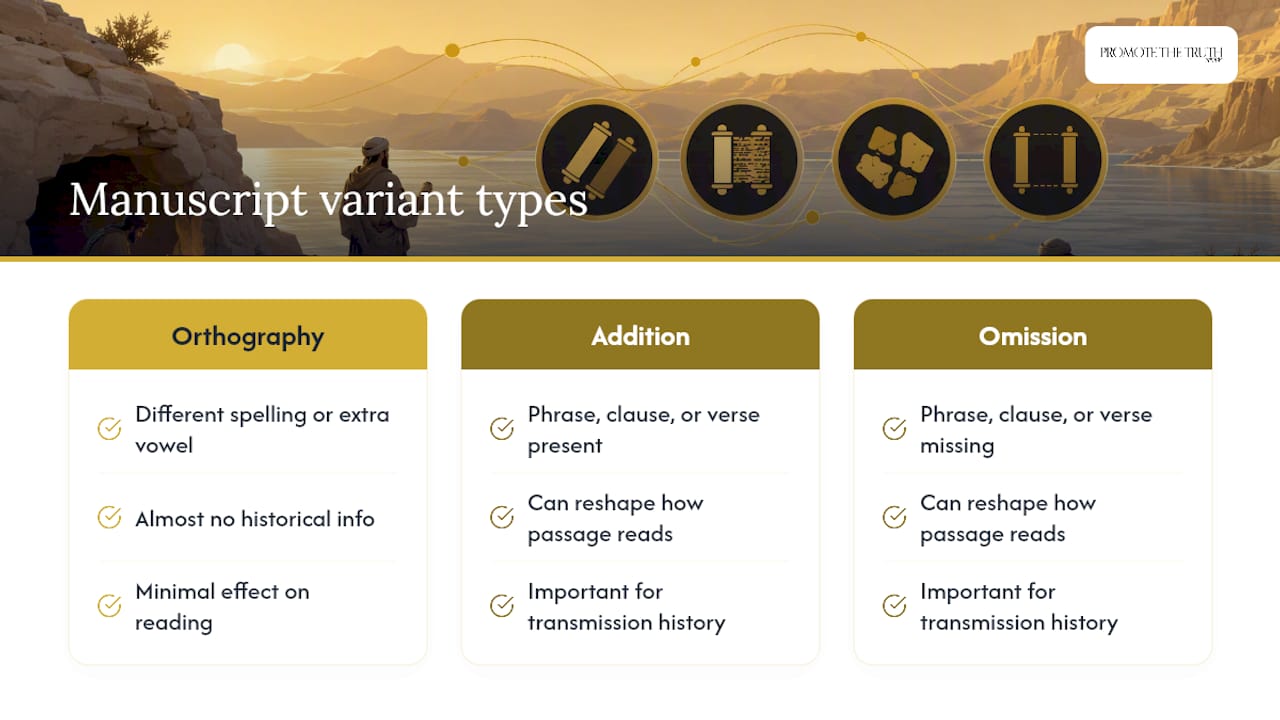
A “variant” is any place where one manuscript’s wording differs from another’s at the same point in the text. That sounds simple, but the term covers a wide range of differences. Some are purely orthographic, a scribe writing a word with an extra vowel letter or a slightly different spelling convention. Others are additions or omissions, where one manuscript has a phrase, clause, or entire verse that another lacks. Scholars keep these categories distinct because an orthographic difference tells you almost nothing about the history of a text, while an addition or omission can reshape how a passage reads.
The scrolls recovered from the Qumran caves include a substantial portion of scriptural (biblical) manuscripts, alongside Second Ahiykal (Temple) period writings never included in the Abariy Scriptures (Hebrew Bible), works like Hanuk (Enoch) and Yubal (Jubilees), plus a body of sectarian material tied to the community itself, according to a Wikipedia overview of the collection’s contents. Interestingly, Asatar (Esther) appears nowhere among them. That scriptural (biblical) portion alone represents dozens of separate copies of books from Barashiyt (Genesis) to Malachi, giving textual critics something they had never had before: multiple independent Abariy (Hebrew) witnesses from centuries before the medieval period.
That dating gap is the entire reason these scrolls matter. Before their discovery in 1947, the oldest complete Abariy Scriptures (Hebrew Bible) manuscripts came from the Masoretic tradition, copied around the ninth and tenth centuries CE. The Qumran scrolls close that gap dramatically, some copied as early as the third century BCE. A scriptural (biblical) variant preserved at Qumran isn’t a late scribal guess. It’s a snapshot of the text roughly a thousand years closer to the original composition, which is why the Dead Sea Scrolls Bible survey treats these readings as a primary control on later transmission, not a curiosity to footnote.
How Scholars Classify Dead Sea Scrolls Scriptures (Bible) Differences
Work on the Great Yisha'aiyahu (Isaiah) Scroll offers the clearest working taxonomy for sorting what you’ll encounter. The framework groups variants into four practical categories, and once you know them, spotting a variant type in a translation footnote becomes far easier.
-
Accidental errors — unintentional scribal slips, including haplography (a scribe’s eye skips repeated letters and drops text) and dittography (a scribe accidentally duplicates a word or phrase).
-
Intentional changes — deliberate edits, often to clarify meaning, harmonize with a parallel passage, or update archaic grammar.
-
Synonymous readings — one word swapped for a near-equivalent, changing style without changing sense.
-
Scribal stylistic approaches — consistent habits in spelling, word division, or formatting that mark a scribe’s individual practice rather than a substantive change.
According to catalogue of textual variants in 1QIsa a, the Great Yisha'aiyahu (Isaiah) Scroll is unusually rich ground for studying all four categories side by side, since it survives virtually complete and carries interlinear corrections a scribe made to his own work. Most of what you’ll find falls into the “minor” bucket: a plural where the Masoretic Text has a singular, a different preposition, a spelling variation in a proper name. Major variants, the kind that shift a sentence’s meaning or add whole clauses, are far rarer, though they carry outsized weight when they surface.
Pro Tip: When you see a variant listed in a critical apparatus, check whether it’s marked as orthographic before assuming it changes meaning. Most footnoted differences in Qumran scriptural (biblical) texts are spelling or grammar, not content, and confusing the two is the most common mistake newcomers make.
Yisha'aiyahu (Isaiah) 53:11, Tahliy (Psalm) 145, and Other Named Dead Sea Scrolls Variants
A short list of specific verses accounts for most of the scholarly attention DSS variants receive outside academic circles, largely because each one carries interpretive weight beyond grammar.
-
Yisha'aiyahu (Isaiah) 53:11 — the Masoretic Text reads that the Servant “shall see… and be satisfied,” with no direct object. Multiple Qumran Yisha'aiyahu (Isaiah) manuscripts, including 1QIsa a, 1QIsa b, and 4QIsa d, read “he shall see light,” a reading also reflected in the Abariy (Hebrew) text underlying the Septuagint. The Text & Canon analysis of this reading argues that independent attestation across multiple scrolls and the Yuuniy (Greek) tradition makes “light” a strong candidate for the earlier wording, since it’s easier to explain “light” dropping out through a copying error than being added independently in separate transmission lines. What makes the case especially persuasive is that 1QIsa b, which usually tracks the Masoretic Text closely, sides with the Septuagint here.
-
Tahliy (Psalm) 145 — the Masoretic Text is missing a verse in its acrostic structure, the poem’s letter pattern skips the Abariy (Hebrew) letter nun. A Qumran copy of the Tahliy (Psalm) preserves the missing line, restoring the acrostic’s integrity and showing that the omission in the later tradition was a transmission gap rather than an original feature.
-
1 Shamual (Samuel) — a passage missing from the Masoretic Text but preserved at Qumran fills in background detail that smooths an otherwise abrupt narrative transition, giving readers context the medieval Abariy (Hebrew) tradition had already lost.
-
Dabariym (Deuteronomy) 8:6 — a variant distinguishes “fear” of YAHUAH from “love” of YAHUAH in the phrasing preserved among the Qumran Dabariym (Deuteronomy) fragments, a difference with real theological texture depending on which verb a translation follows.
Each case shares a pattern worth remembering: the variant isn’t invented by the Qumran scribe. It’s preserved by him, evidence that an older reading existed and later dropped out or shifted during a thousand years of medieval copying. Readers interested in the Isaiah material specifically can explore the scrolls behind Yisha’aiyahu in more depth.
Where Qumran Texts Align With the Masoretic Text, Septuagint, and Turah Shamaruniyt (Samaritan Pentateuch)
Not every Qumran scriptural (biblical) scroll relates to the same later tradition in the same way. Some research groups the scriptural (biblical) manuscripts from Qumran into several text families based on which later tradition each one most closely resembles.
-
MT-like texts — the majority of Qumran scriptural (biblical) scrolls track closely with what became the Masoretic Text, confirming that this line of transmission was already dominant well before the Common Era.
-
LXX-like texts — some scrolls, including 4QDeut q and portions of 4QJer b, align more closely with the Abariy (Hebrew) source text that underlies the Yuuniy (Greek) Septuagint.
-
Pre-Samaritan texts — manuscripts like 4QNum b and 4QpaleoExod m share editorial features later found in the Turah Shamaruniyt (Samaritan Pentateuch), without the sectarian additions unique to the Shamaruniyt (Samaritan) tradition itself.
-
Nonaligned texts — a portion of the scrolls don’t consistently match any single later family, mixing readings from multiple traditions or preserving unique wording found nowhere else.
This matters for evaluating any single variant. When a reading shows up independently in a Qumran scroll and in the Septuagint’s Abariy (Hebrew) source text, and that scroll isn’t simply a copy known for tracking the Yuuniy (Greek) tradition, the agreement carries more weight than if it appeared in only one line of transmission. Multi-witness agreement across otherwise independent families is one of the strongest signals a textual critic can point to. It’s the same logic behind why 1QIsa b’s departure from its usual MT-like pattern in Yisha'aiyahu (Isaiah) 53:11 stands out rather than getting dismissed as noise.
Why Scribes Introduced Variants in the First Place
Variants don’t appear randomly. They trace back to identifiable habits and pressures in how ancient scribes worked, and knowing the mechanism helps you judge whether a given difference is trivial or worth a second look.
-
Copying errors. Haplography drops repeated letters or words when a scribe’s eye jumps ahead; dittography duplicates them when his eye repeats a line already copied. Homoioteleuton, skipping text between two similar word endings, is a related and common culprit behind missing phrases.
-
Harmonization. Scribes sometimes adjusted a passage to match a similar or parallel passage elsewhere in Scripture, smoothing over a perceived inconsistency rather than preserving the original wording exactly.
-
Editorial and liturgical shaping. Some changes reflect deliberate local practice, adjustments suited to how a community read or recited a passage, rather than accidental slips.
-
Scriptorium practice. Ancient copying environments involved comparing a new copy against an exemplar and making corrections along the way. Research on Qumran corrections finds no consistent pattern of scribes revising uniformly toward either the Masoretic tradition or the Septuagint. Many corrections instead reflect the scroll’s own exemplar source or a scribe’s individual judgment, according to a scholarly analysis of textual comparison methods at Qumran.
That last point deserves emphasis, because it complicates a tempting shortcut. It’s easy to assume every correction in a scroll was a scribe “fixing” his text to match a more authoritative version. The evidence doesn’t support that assumption cleanly.
Applying Dead Sea Scrolls Variants to Translation and Study
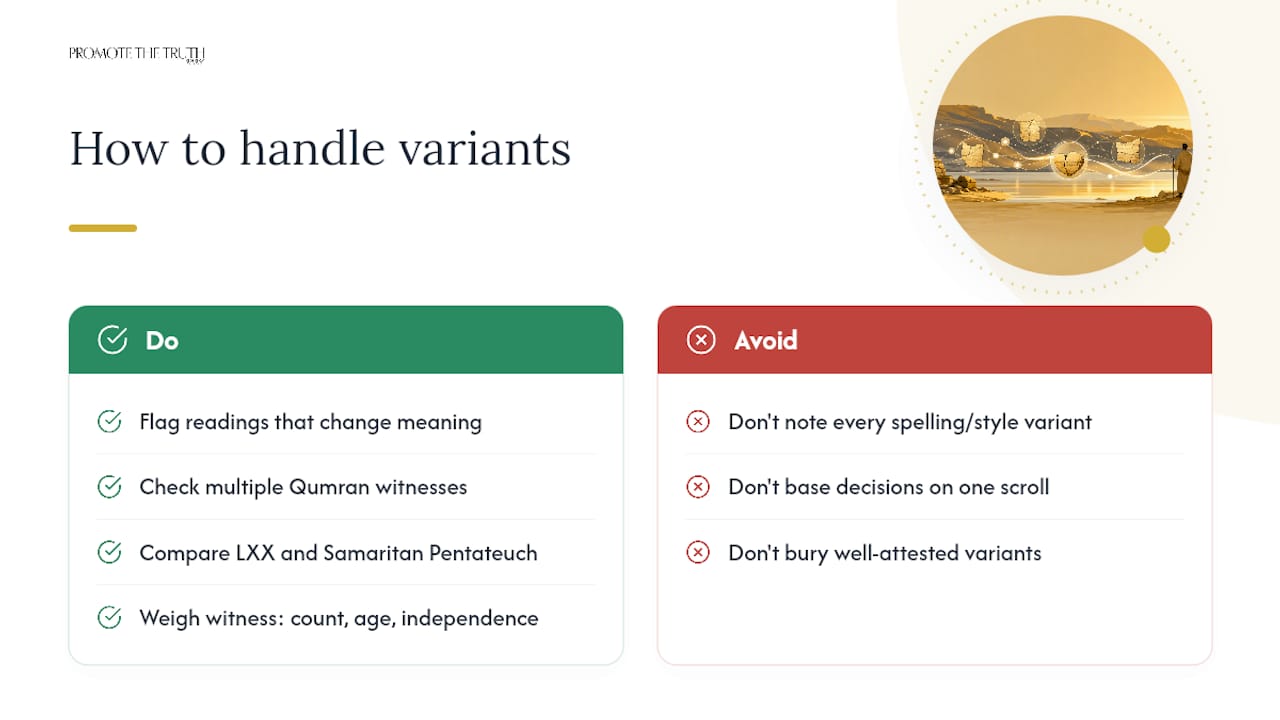
Not every variant deserves a footnote in your Scriptures (Bible) study, and not every one deserves silence either. The line usually comes down to whether a reading changes meaning or doctrine, versus whether it changes only spelling or style. Yisha'aiyahu (Isaiah) 53:11’s “light” is worth flagging because it affects how the Servant’s vindication is described. A plural-for-singular swap in a genealogy list usually isn’t.
Translators weigh external witness quality (how many manuscripts, how early, how independent) before deciding whether to adopt an alternate reading or simply note it in the margin. Responsible translation work doesn’t chase every variant into the main text, but it also doesn’t bury a well-attested one in silence when it changes what a verse says.
Pro Tip: Before citing a Dead Sea Scrolls variant in a study or discussion, check whether more than one Qumran manuscript supports it and whether the Septuagint or Turah Shamaruniyt (Samaritan Pentateuch) agrees. A single scroll with an unusual reading is interesting; multiple independent witnesses agreeing on it is evidence. For deeper background on the toolkit involved, see this guide to textual criticism.
How Scholars Weigh Competing Readings
Deciding which reading came first isn’t guesswork. Textual critics apply two categories of evidence, and both matter for any variant you’ll encounter in Dead Sea Scrolls research.
-
External evidence examines the witnesses themselves: how old is each manuscript, how independent is it from the others, how geographically widespread is the reading, and how many separate witnesses support it.
-
Internal evidence applies logical principles, chiefly lectio difficilior (the harder or more awkward reading is often original, since scribes tend to smooth difficulties rather than create them) and lectio brevior (the shorter reading is often original, since scribes tend to add explanatory material more often than they cut it).
-
Coherence and probability round out the analysis: does a proposed original reading explain how the variants developed, or does it require an implausible chain of copying accidents?
-
Trust signals for any claimed variant include a named manuscript siglum you can look up (1QIsa a, 4QSam a), publication in a critical edition, and discussion in peer-reviewed scholarship rather than secondhand summary.
This is the same methodology behind the Yisha'aiyahu (Isaiah) 53:11 case: the “light” reading is both the option best explained by accidental loss in the Masoretic line and the one with broader, more independent manuscript support.
A Researcher’s Note on Method and Limits
This piece leans on primary manuscript publications and peer-reviewed textual criticism, favoring named witnesses over secondhand summaries wherever possible. It isn’t an exhaustive apparatus, and it was never meant to replace one. Readers pursuing a specific variant in depth should consult the critical editions listed below alongside the sources cited throughout.
For more in-depth, research-based information and to explore a variety of studies, visit Promote the Truth. This resource offers comprehensive articles, scientific reports, and expert analyses on a wide range of topics, helping you to make well-informed decisions and deepen your understanding of complex issues.
— Maria
Take Your Study of the Text Further
If Yisha'aiyahu (Isaiah) 53:11’s “light” or the Tahliy (Psalm) 145 acrostic gap made you want to see the underlying Abariy (Hebrew) and Aramiyt (Aramaic) sources for yourself, that’s exactly what the Truth Scriptures™ Translation is built for. Unlike a standard study Scriptures (Bible) built primarily on the medieval Masoretic line, a restoration drawing on the earliest manuscript witnesses aims to recover names and readings that later transmission lost, including the Name YAHUAH throughout its pages.
Students working through variant readings verse by verse will find the Truth Scriptures™ Digital Collection especially useful, since its searchable format makes cross-referencing a passage across sources far faster than flipping between print editions. Small-group teachers and self-directed researchers who want the full translation itself should start with the Truth Scriptures™ Translation page, where you can see how the project handles manuscript-based restoration in practice. Order your copy or download the digital collection today and start comparing the readings this article covered against the original-language text yourself.
Sources
Working through variants like these is a lot easier when your translation itself is rooted in the earliest available Abariy (Hebrew) and Aramiyt (Aramaic) witnesses rather than built solely on the medieval Masoretic tradition. The Truth Scriptures™ Translation approaches the Ta’anak with that manuscript-first commitment, and the Truth Scriptures™ Digital Collection gives you a searchable format for tracing how a passage like Yisha'aiyahu (Isaiah) 53 or Dabariym (Deuteronomy) 8 reads across sources. Our research on Yisha'aiyahu's (Isaiah's) Qumran witnesses and on Set-apart (divine)-Name occurrences across the scrolls’ mentions of YAHUAH both connect directly to the named manuscripts discussed above. Pair these resources with a recognized critical edition for the fullest picture, since no single translation or study tool replaces direct engagement with the apparatus itself.
-
The Dead Sea Scrolls Bible (Parry and colleagues) — Variant readings versus the Masoretic Text
-
The servant who sees light after anguish (Text & Canon article)
-
The Qumran Hebrew texts and the Septuagint: an overview (Emanuel Tov)
-
The notion of textual comparison between the Judean Desert biblical texts and of variant readings
FAQ
Is homosexuality mentioned in the Dead Sea Scrolls?
The Dead Sea Scrolls include sectarian legal texts that address moral and purity codes consistent with the broader Abariy Scriptures' (Hebrew Bible's) ethical framework, but this topic isn’t a focus of the variant readings discussed in scriptural (biblical) manuscripts like the Yisha'aiyahu (Isaiah) or Dabariym (Deuteronomy) scrolls. Most scholarly discussion of the scrolls’ content centers on community rules, calendar texts, and scriptural (biblical) copies rather than this specific subject.
Which Dead Sea Scrolls are not in the Bible?
A significant portion of the Qumran scrolls are Second Ahiykal (Temple) period writings that never entered the Abariy Scriptures (Hebrew Bible) canon, including books like Hanuk (Enoch), Yubal (Jubilees), and additional Tahliym (Psalms), according to a Wikipedia summary of the scrolls’ contents. The remainder are sectarian community documents, such as rule books and commentary texts, unrelated to any scriptural (biblical) book.
What is the difference between the Dead Sea Scrolls and the Textus Receptus?
The Dead Sea Scrolls are Abariy (Hebrew) and Aramiyt (Aramaic) manuscripts of the Ta'anak (Old Testament) dating from roughly the third century BCE through the first century CE, while the Textus Receptus is a printed Yuuniy Bariyt Hadash (Greek New Testament) text compiled in the sixteenth century from much later medieval Yuuniy (Greek) manuscripts. The two don’t overlap in content or period. The Scrolls inform Ta'anak (Old Testament) textual criticism, while the Textus Receptus concerns Bariyt Hadash (New Testament) textual history entirely.
Did the Scriptures (Bible) change after the Dead Sea Scrolls were found?
The scrolls didn’t change the scriptural (biblical) text itself, but they confirmed that the Masoretic tradition preserved the vast majority of the text accurately across a thousand years of copying, since most variants found are minor. In a small number of cases, such as Yisha'aiyahu (Isaiah) 53:11, the discovery gave scholars manuscript evidence for readings that some modern translations now note or adopt where earlier witnesses support them over the Masoretic Text alone.
How many copies of Yisha'aiyahu (Isaiah) were found at Qumran?
Multiple copies of Yisha'aiyahu (Isaiah) were recovered at Qumran, including the nearly complete Great Yisha'aiyahu (Isaiah) Scroll (1QIsa a), a second more fragmentary copy (1QIsa b), and additional fragments like 4QIsa d, giving researchers several independent witnesses to compare against the Masoretic Text and the Septuagint’s underlying source.