
The history of the Scriptural (biblical) canon is often presented as though an authority eventually decided which books were “the Scriptures (Bible).” But a closer examination of manuscript history reveals a more complicated story.
The Scriptures existed before later councils, bishops, and formal canon lists. Communities copied, preserved, read, and transmitted Scriptural writings for generations before later religious institutions produced official lists of books.
The Muratorian Fragment, the writings of early historians, Athanasius’ Festal Letter of 367 CE, and later regional councils such as Hippo and Carthage are important historical witnesses to this process. However, these documents should be understood as evidence of what particular communities recognized at particular points in history—not as proof that a later council created the Word of YAHUAH.
For students seeking the Truth, an even more important question is:
What did the earliest available Scriptural manuscripts actually say?
That question is central to the Promote The Truth approach. The Truth Scriptures Project emphasizes examining ancient Abariy (Hebrew) and Aramiyt (Aramaic) manuscript sources and restoring the original Scriptural names, terminology, and message rather than depending solely upon later translations and traditions.
TL;DR:
The Scriptures existed and were transmitted before later church councils created formal lists.
The Muratorian Fragment provides evidence of an early collection of writings being recognized in the second century.
Athanasius’ Festal Letter of 367 CE contains the 27-book Bariyt Hadash (New Testament) list that later became standard in many traditions.
The councils of Hippo and Carthage belong to the later history of recognizing and affirming particular collections of writings.
A canon list is historical evidence of what a community recognized; it should not automatically be confused with the original Scriptural manuscripts themselves.
Different religious traditions eventually developed different collections of books, demonstrating that the history of canon recognition was not uniform.
Manuscripts, language, names, textual transmission, and historical evidence must therefore be examined carefully.
Promote The Truth places particular emphasis on the earliest available Scriptural sources, including ancient Abariy (Hebrew) and Aramiyt (Aramaic) manuscript traditions.
The Truth Scriptures Project seeks to restore YAHUAH’s Name, Scriptural names, terminology, and the original message rather than simply reproducing later translation traditions.
Table of Contents
What Does “Canon” Mean?
The word canon is commonly used to describe an accepted collection or list of books regarded as authoritative within a religious tradition.
This is an important historical concept, but students should be careful not to confuse a later list of recognized books with the actual Scriptural writings from which those books originated.
A list tells us what a particular community considered authoritative.
A manuscript gives us evidence concerning what was actually written, copied, preserved, and transmitted.
Those are related questions, but they are not identical.
This distinction becomes especially important when studying the history of Scripture because different communities eventually recognized different collections of writings.
Therefore, instead of beginning with:
“Who decided what belongs in the Scriptures (Bible)?”
a more fundamental question is:
“What do the earliest available Scriptural sources reveal?”
This approach is consistent with the stated purpose of the Truth Scriptures Project, which seeks to examine the earliest available textual sources and restore the Scriptural text rather than relying exclusively upon later translations and interpretations.
Scripture Existed Before Canon Lists
One of the most important principles to understand is that Scripture did not begin to exist when a later religious authority wrote a list of books.
The writings existed first.
They were copied.
They were transmitted.
They were read.
They were taught.
They were preserved.
Later communities produced lists identifying which writings they recognized.
This means canon history should be understood as a history of recognition, transmission, collection, and religious authority, rather than as the moment when YAHUAH’s Word suddenly came into existence.
The attached article correctly identifies this broad historical pattern: communities were already reading and using Scriptural writings long before later formal lists appeared.
But from a Promote The Truth perspective, the study cannot stop with the later lists.
The next step is to examine the actual textual evidence…
A Timeline of Canon Recognition
The following timeline provides a simplified overview of several major milestones.
Before the Common Era
The writings that make up the ancient Abariy (Hebrew) Scriptural tradition were transmitted for generations before Christianity existed.
The Scriptural collection was not produced by fourth-century Christian councils.
The ancient writings existed within the Yisharaliy (Israelite) Scriptural tradition long before later debates over Christian canon lists.
Second and First Centuries BCE
Ancient Scriptural writings continued to be copied and transmitted.
Different textual traditions also existed, making manuscript comparison essential for understanding how the text was preserved.
First Century CE
The writings associated with the Bariyt Hadash began to circulate among the followers of YAHUAH.
Letters and other writings were copied and shared among communities.
Second Century CE
The Muratorian Fragment provides evidence of an early collection of writings that were being recognized and discussed.
However, it does not represent a complete modern Scriptures (Bible), and its damaged condition makes interpretation of portions of the list difficult.
Second Century CE
Marcion promoted a restricted collection of writings.
His approach became part of the wider debate about which writings represented authentic Scriptural teaching.
Fourth Century CE
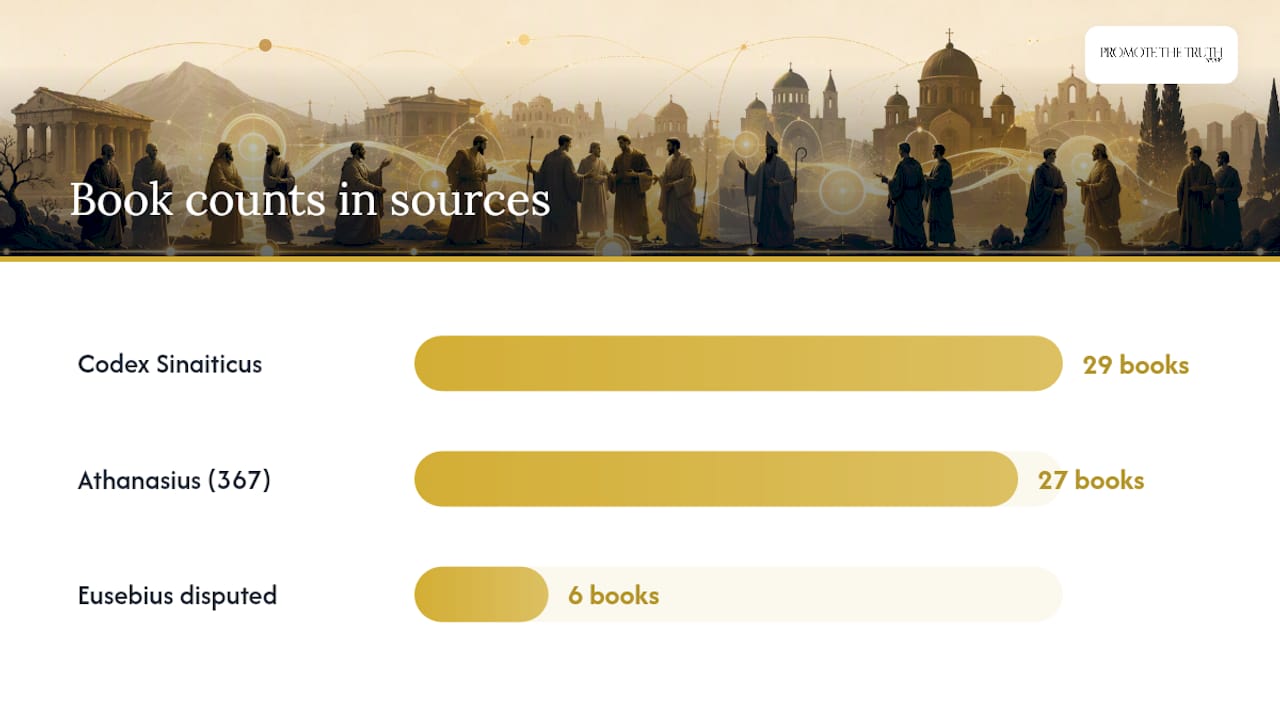
Eusebius described categories of writings that were accepted, disputed, or rejected in different communities.
This demonstrates that questions about several books remained unsettled in parts of the religious world.
367 CE
Athanasius of Alexandria issued his Festal Letter containing the 27-book Bariyt Hadash (New Testament) list that later became standard in many traditions.
This is one of the most important milestones in the history of the Bariyt Hadash (New Testament) canon.
393 CE
The regional Council of Hippo produced a canon list corresponding broadly to the Bariyt Hadash (New Testament) collection that had already gained significant recognition.
397 CE
The regional Council of Carthage likewise affirmed a similar collection.
These events are historically important, but they occurred centuries after the Scriptural writings themselves had already been circulating..
The Muratorian Fragment
The Muratorian Fragment is frequently discussed as one of the earliest surviving witnesses to a developing Bariyt Hadash (New Testament) collection.
Its importance is historical.
It demonstrates that by the late second century, communities were already distinguishing between writings that they considered authoritative and other writings.
But the fragment should not be treated as a perfect table of contents for the Scriptures.
It is damaged.
Its beginning is missing.
Its original extent is uncertain.
And its collection does not simply reproduce the exact 27-book Bariyt Hadash (New Testament) arrangement found in many modern Scriptures (Bible).
This is significant.
The evidence shows that recognition of writings developed over time.
It also demonstrates why students should distinguish between:
-
a manuscript,
-
a quotation,
-
a community’s reading practice,
-
a canon list,
-
and the original Scriptural text.
Each provides a different type of evidence…
Marcion and the Question of Scriptural Authority
Marcion of Sinope became an important figure in the second-century debate over authoritative writings.
His approach rejected the Abariy (Hebrew) Scriptures and promoted a restricted collection of writings.
This controversy forced other communities to articulate more clearly which writings they considered authoritative.
However, the existence of this debate does not mean that Marcion or the later church councils created Scripture.
Rather, it demonstrates that questions concerning Scriptural authority were already being debated among communities that possessed different collections of writings.
This historical reality should encourage careful examination rather than unquestioning acceptance of later traditions.
The question remains:
What textual evidence existed before these later debates?.
Athanasius and the 367 Festal Letter
Athanasius’ Festal Letter of 367 CE is one of the most frequently cited milestones in Bariyt Hadash (New Testament) canon history.
The letter contains the 27 books that eventually became the standard Bariyt Hadash (New Testament) collection in many traditions.
This makes the document historically valuable.
But there is an important distinction.
Athanasius did not write the books.
He did not create the writings.
He produced a list identifying which writings he regarded as authoritative.
Therefore, the letter is evidence for fourth-century recognition, not evidence that fourth-century authority created the Scriptural writings.
This distinction is essential when studying canon history from a manuscript-centered perspective.
Hippo and Carthage
The regional councils of Hippo and Carthage are frequently presented in simplified accounts as though they “decided what books were in the Scriptures (Bible).”
That description is too simplistic.
Both councils occurred after generations of Scriptural reading, copying, teaching, and debate.
Their lists therefore provide evidence of what these regional communities recognized.
They should not be confused with the origin of the Scriptural writings.
The timeline in the original article correctly places Hippo in 393 CE and Carthage in 397 CE, following Athanasius’ 367 CE list.
From a Promote The Truth perspective, this distinction is important:
A council can document what a community accepted without possessing the authority to create YAHUAH’s Word.
Why Canon Lists Differ
One of the strongest reasons to examine canon history carefully is that not every religious tradition has the same collection of books.
Different traditions developed different boundaries around their collections of Scripture.
The Ta’anak (Old Testament) collection is particularly important because the history involves different textual traditions and different religious communities.
Rather than assuming that one later list automatically settles the question, students should investigate:
-
Which manuscripts existed?
-
Which languages were involved?
-
Which writings were being copied?
-
Which writings were being quoted?
-
Which books were being read publicly?
-
What names and terminology appear in the manuscripts?
-
What changes occurred during transmission?
-
Which later traditions influenced translations?
These questions move the discussion away from simply asking which institution won the canon debate.
They direct attention toward the text itself…
Manuscripts Are More Important Than Later Lists
A canon list can tell us what a person or community recognized.
A manuscript can provide evidence of what was actually preserved in written form.
This is why manuscript research is so important.
Promote The Truth describes its Truth Scriptures Project as an effort to examine the earliest available Scriptural sources and restore the text through ancient manuscript evidence.
The project specifically emphasizes the use of ancient Abariy (Hebrew) and Aramiyt (Aramaic) sources.
That approach changes the question.
Instead of asking only:
“Which books did later leaders approve?”
the student can ask:
“What do the earliest available manuscripts reveal about the text, names, words, and message?”
This is a much broader investigation…
The Problem of Later Translation Traditions
Another important issue is the difference between an ancient manuscript and a modern translation.
Every translation involves decisions.
A translator must determine how to represent words, names, grammatical structures, idioms, and cultural concepts in another language.
Over many centuries, additional layers of translation and interpretation can develop.
This can affect:
-
Personal names
-
Place names
-
Titles
-
Set-apart (Divine) Names
-
Key theological words
-
Sentence structure
-
Cultural context
-
Scriptural terminology
Promote The Truth specifically identifies this problem as one of the reasons for the Truth Scriptures Project. The project states that its purpose is to examine the earliest available sources and produce a restoration that preserves original names and terminology.
Therefore, canon history and translation history should not be treated as the same subject.
A book can be included in a canon while the wording of that book in a later translation still requires careful examination.
The Importance of Abariy (Hebrew) and Aramiyt (Aramaic)
The language of the earliest available sources matters.
The Truth Scriptures Project emphasizes ancient Abariy (Hebrew) and Aramiyt (Aramaic) manuscript traditions as part of its restoration approach.
This is especially important when studying Scriptural names.
A translated or transliterated name can become so familiar that readers may forget that the original name had a linguistic form and meaning.
Promote The Truth therefore places emphasis on restoring Scriptural names rather than automatically preserving later conventional forms.
The Promote The Truth resource collection itself includes restored names and Scriptural terminology throughout its Truth Scriptures resources, including forms such as Shamut (Exodus), Yahuhanan (John), Abariym (Hebrews), and Yahudah (Jude).
This naming approach is part of a broader restoration philosophy.
The objective is not simply to produce a different English Scriptures (Bible).
The objective is to investigate the original textual and linguistic evidence and restore what has been obscured through later transmission.
What Canon History Does and Does Not Prove
Canon history can establish several important historical facts.
It can show:
-
when certain lists appeared;
-
which books particular communities recognized;
-
which books were disputed;
-
how different regions differed;
-
how collections became more standardized;
-
and how later institutions documented their positions.
But canon history by itself cannot prove that a particular later institution created the original Scriptures.
Nor can a later canon list automatically prove that every wording in a modern translation accurately represents the earliest available text.
This is why canon history must be combined with manuscript study.
The two questions are related but distinct:
Canon Question
Which writings did a particular community recognize as authoritative?
Textual Question
What did the earliest available manuscript evidence preserve?
For serious Scriptural study, both questions deserve investigation.
Promote The Truth and the Truth Scriptures Project
Promote The Truth places manuscript research and restoration at the center of its approach to Scripture.
The Truth Scriptures Project describes its mission as restoring the original essence and truth of Scripture through the use of the oldest available Scriptural materials, while restoring the Name YAHUAH, the Name Yahusha, and the Abariy (Hebrew) and Aramiyt (Aramaic) roots of the text.
The project also states that its translation work is intended to be updated when new ancient sources become available.
This is an important distinction from simply reproducing a traditional English Scriptures (Bible).
The Promote The Truth approach asks readers to examine the evidence behind the translation.
The official Truth Scriptures resources describe the project as using ancient Abariy (Hebrew) and Aramiyt (Aramaic) sources while restoring Scriptural names and terminology.
The Promote The Truth collection also provides manuscript-based resources for individual books and passages, allowing students to examine the restoration approach more closely.
How to Study Scripture Through Its Earliest Sources
A serious student of Scripture can approach canon history through several steps.
1. Identify the Historical Source
Ask:
What document are we examining?
Is it:
-
a manuscript?
-
a canon list?
-
a quotation?
-
a translation?
-
a commentary?
-
a church council statement?
Do not treat all sources as though they provide the same kind of evidence.
2. Determine Its Date
Ask:
When was the source produced?
A fourth-century list cannot be used as though it were a first-century manuscript.
Likewise, a later translation should not automatically be treated as though it represents the earliest available wording.
Chronology matters.
3. Examine the Language
Ask:
What language does the source represent?
For Promote The Truth-oriented study, this includes careful attention to Abariy (Hebrew) and Aramiyt (Aramaic) manuscript traditions.
Language can affect names, words, meanings, and interpretation.
4. Examine the Names
Do not overlook Scriptural names.
The Name YAHUAH is central to the Promote The Truth approach.
Promote The Truth’s official resources specifically emphasize restoration of YAHUAH’s Name and other original Scriptural names.
This means names should not be treated as insignificant details.
5. Compare the Textual Evidence
When multiple witnesses exist, compare them.
Ask:
-
What wording is preserved?
-
Are there differences?
-
Which witness is earlier?
-
Is the difference linguistic, scribal, or interpretive?
-
Does a later translation introduce terminology that is absent from the earlier source?
This type of investigation is much more informative than simply comparing modern English Scriptures (Bible).
6. Separate Scripture From Tradition
A later religious tradition may explain how a community understood a text.
But tradition should not automatically be treated as equivalent to the original Scriptural text.
The student should distinguish between:
what the manuscript says
and
what later interpreters say the manuscript means.
The Canon Is Not the Same as the Original Text
This may be the most important lesson from the entire timeline.
The existence of a canon list does not eliminate the need for textual investigation.
A book can be included in a recognized collection while questions remain about:
-
manuscript variants;
-
translation choices;
-
names;
-
terminology;
-
textual transmission;
-
and the relationship between later copies and earlier witnesses.
Likewise, the existence of a disputed book does not automatically tell us whether every later translation or interpretation of that book is accurate.
Canon history answers one type of question.
Manuscript research answers another.
The serious student should not confuse them.
Why the Muratorian-to-Athanasius Timeline Matters
The period between the Muratorian Fragment and Athanasius’ Festal Letter demonstrates that the Bariyt Hadash (New Testament) collection developed through a lengthy historical process.
The original article identifies the Muratorian Fragment as an early partial list and Athanasius’ 367 letter as the first surviving list containing the 27 books of the later standard Bariyt Hadash (New Testament).
This timeline is valuable because it prevents an overly simplistic claim that the entire Scriptures (Bible) was finalized at one particular council.
At the same time, it should not lead to the opposite mistake of assuming that later canon lists are irrelevant.
They are valuable historical witnesses.
The proper conclusion is more balanced:
Canon lists are evidence of historical recognition, while manuscripts provide evidence for the underlying textual tradition.
Both need to be examined carefully.
A Restoration Approach to Scripture
Promote The Truth takes the discussion one step further by asking readers to return to the earliest available Scriptural evidence.
Its Truth Scriptures Project describes a restoration of the Ta’anak and Bariyt Hadash based upon ancient manuscript sources, with attention to original Scriptural names, terminology, and language.
The Promote The Truth approach therefore does not begin and end with:
“Which books were eventually placed in the Scriptures (Bible)?”
Instead, it asks:
“What did the earliest available Scriptures actually preserve?”
That includes examining:
-
the text;
-
the manuscripts;
-
the languages;
-
the names;
-
the words;
-
the historical context;
-
and the transmission history.
This is why the history of canon formation is useful—but it should be only one part of a much larger Scriptural investigation.
Conclusion
The journey from the Muratorian Fragment to Athanasius and the later councils of Hippo and Carthage demonstrates that the recognition of Scriptural (biblical) books developed over centuries.
The historical evidence does not support reducing this process to one person or one council suddenly creating the Scriptures.
The writings existed before the lists.
The communities read and copied them before later councils recorded collections.
Athanasius’ 367 Festal Letter is therefore an important historical witness to fourth-century recognition of a 27-book Bariyt Hadash (New Testament) collection. Hippo and Carthage provide additional evidence of later regional recognition.
But none of these events removes the need to examine the actual textual evidence.
For those seeking the Truth, the more fundamental task is to return to the earliest available Scriptural sources and investigate what they preserve.
This is the direction emphasized by Promote The Truth and the Truth Scriptures Project: examine ancient Abariy (Hebrew) and Aramiyt (Aramaic) manuscript evidence, restore the Name YAHUAH, preserve Scriptural names and terminology, and seek to recover the original message rather than depending exclusively on later translation traditions.
The question should therefore not simply be:
“Who decided what books belong in the Scriptures (Bible)?”
A deeper question is:
“What did YAHUAH’s Word actually say in the earliest available Scriptural sources?”
That is where serious Scripture study begins.
Promote The Truth’s Research Into the Original Text
The history has been approached from the ground up, through direct manuscript research rather than secondhand summary. Work centers on a restoration English translation of the Ta’anak (Old Testament) and Bariyt Hadash (New Testament) drawn from ancient Abariy (Hebrew) and Aramiyt (Aramaic) manuscript sources.
That research extends into study series, articles, and teaching resources built for readers who want to engage the text itself, not just commentary about it. Guides covering manuscript transmission history and historical evidence types walk readers through exactly the kind of source evaluation this article has covered, applied at a deeper, verse-by-verse level. For readers who want to see how these translation choices play out on the page, sample chapters and downloadable resources offer a direct, low-commitment starting point.
— Maria
Where to Go Next for Primary-Text Study
If this history has you wanting to read the texts themselves rather than more commentary about them, an Original Scriptures collection offers a direct route in. It is a restoration English translation built from ancient Abariy (Hebrew) and Aramiyt (Aramaic) manuscript sources rather than a paraphrase of existing English editions, which matters if you want to see the textual choices this article discussed reflected in an actual reading experience.
Readers who want to start light before committing can grab the free sample download of Abariym (Hebrews) 1 and see the translation approach firsthand at no cost. If you already know you want the fuller text, the Original Scriptures collection is the place to start, and the Truth Scriptures Digital Collection offers the complete set for readers ready to study both Ta’anak and Bariyt Hadash (Testaments) in depth. For a more guided, audiovisual entry point, the Scripture Study Series video channel walks through many of the same historical and textual questions raised here, book by book. Start with the free Abariym (Hebrews) sample if you’re undecided. It costs nothing and shows you exactly what a restoration translation looks like on the page.
Sources
-
Promote The Truth — a dedicated platform committed to advocating for honesty and transparency in media and public discourse. By supporting this initiative, you help amplify voices that seek to uncover misinformation, challenge misleading narratives, and promote factual accuracy. Whether you’re sharing articles, participating in discussions, or simply spreading awareness, Promote The Truth serves as a valuable resource for anyone interested in fostering a more truthful and informed society.
-
The Canonization of the New Testament | Religious Studies Center
FAQ
What is the Scriptural (biblical) canon?
The Scriptural (biblical) canon is a collection or list of writings recognized as authoritative by a particular religious tradition. Canon history therefore describes the development of these recognized collections over time.
Did Athanasius create the Bariyt Hadash (New Testament)?
No. Athanasius’ Festal Letter of 367 CE is historically important because it contains the 27-book Bariyt Hadash (New Testament) list that later became standard in many traditions. It represents recognition of a collection rather than the creation of the writings themselves.
What is the Muratorian Fragment?
The Muratorian Fragment is an early and damaged document containing a list of several writings regarded as authoritative by an ancient Christian community. It is important evidence for the developing recognition of Bariyt Hadash (New Testament) writings.
Did the Council of Hippo create the Scriptures (Bible)?
Hippo was a regional council that produced a list of recognized writings. The writings themselves had already been circulating for generations. Therefore, it is more accurate to describe the council as a historical witness to recognition rather than the creator of the Scriptures.
Why are there different Scriptural (biblical) canons?
Different religious communities inherited different textual traditions and developed different judgments concerning which writings belonged in their collections. This is one reason traditions have differences in their Scriptural (biblical) collections.
Why are manuscripts important?
Manuscripts provide direct historical evidence about the text that was copied and preserved. They can reveal differences in wording, language, names, terminology, and transmission that may not be visible when comparing only modern translations.
Why does Promote The Truth emphasize ancient manuscripts?
The Truth Scriptures Project states that it seeks to restore Scripture using the earliest available textual sources, including ancient Abariy (Hebrew) and Aramiyt (Aramaic) sources.
Why does Promote The Truth use the Name YAHUAH?
Restoring the Name YAHUAH is one of the stated objectives of the Truth Scriptures Project. Promote The Truth presents the Name as an essential part of restoring the Scriptural text and removing later substitutions.
Is canon history enough to determine the original wording of Scripture?
No. Canon history primarily tells us which writings communities recognized. Determining the wording and transmission of those writings requires examination of manuscripts, languages, textual variants, and translation history.
Where can I study the Truth Scriptures?
Promote The Truth provides the Truth Scriptures Project and related manuscript-based resources for studying the restored Ta’anak and Bariyt Hadash. The project emphasizes ancient Abariy (Hebrew) and Aramiyt (Aramaic) sources and restoration of Scriptural names and terminology.