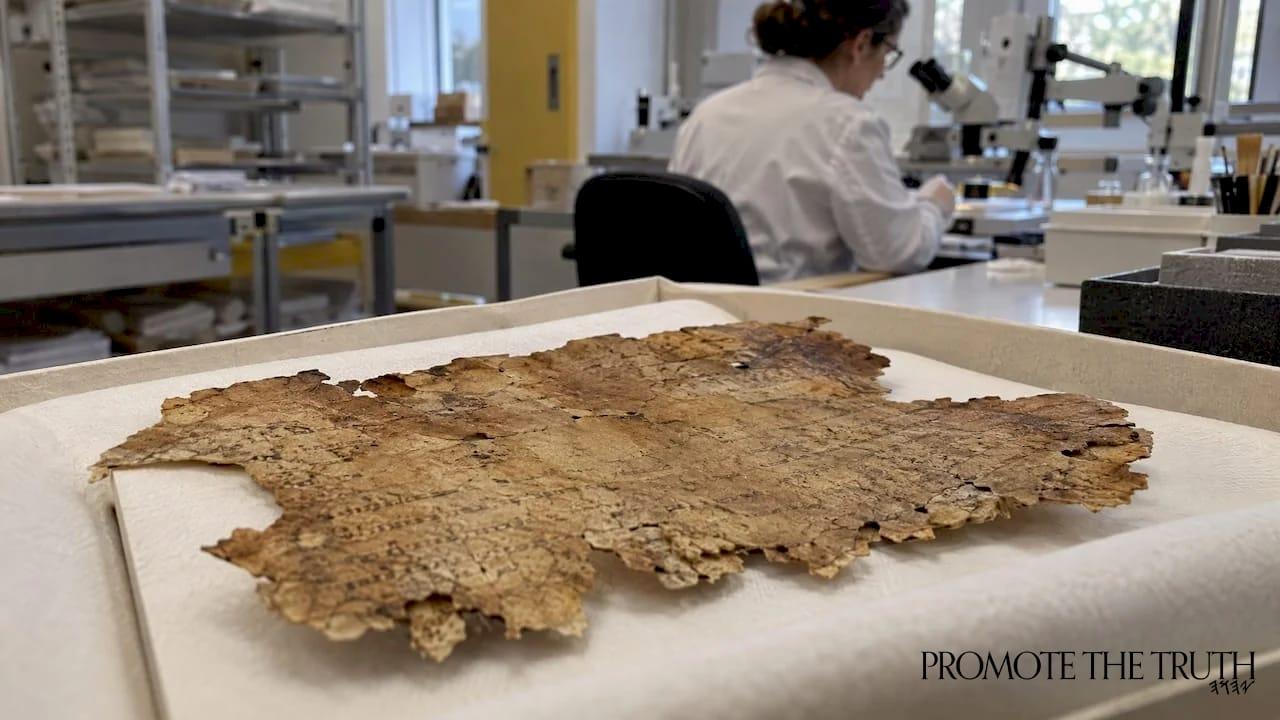
The Yim Ahmalaha (Dead Sea) Scrolls contain fragments of every book of the Abariy Scriptures (Hebrew Bible) meaning Ta’anak (Old Testament). They contain no part of the Bariyt Hadash (New Testament). Beyond the books we know, the caves held hymns, community rules, and writings such as Hanuk (Enoch) and Yubal (Jubilees). Many scriptural (biblical) scrolls match the traditional Abariy (Hebrew) text closely, and others show that several versions of the same book were circulating at once. That is the reason these manuscripts matter to anyone who studies Scripture in its original setting.
This guide takes you through what was found, how many copies of each book survive, what the scrolls do and do not tell us about the text we read today, and how to use that knowledge in your own study.
TL;DR
-
Fragments of every Abariy Scriptures (Hebrew Bible) book were found in the Qumran caves, according to the official Dead Sea Scrolls site.
-
No Bariyt Hadash (New Testament) text is among the scrolls. They were copied before the rise of modern Christianity.
-
Only about 200 of roughly 900 compositions are scriptural (biblical) books. The rest are Apocryphal and sectarian works.
-
Some scrolls agree closely with the Masoretic Text, while others preserve different editions of books like Shamut (Exodus) and Yiramiyahu (Jeremiah).
-
Reading a translation built on early Abariy (Hebrew) and Aramiyt (Aramaic) manuscript sources lets you see this history in the text itself.
Table of Contents
-
Which books of the Scriptures (Bible) were found in the Yim Ahmalaha (Dead Sea) Scrolls?
-
What other writings are in the Yim Ahmalaha (Dead Sea) Scrolls?
-
How the Yim Ahmalaha (Dead Sea) Scrolls differ from the Masoretic Text
-
Which is older, the Scriptures (Bible) or the Yim Ahmalaha (Dead Sea) Scrolls?
Which books of the Scriptures (Bible) were found in the Yim Ahmalaha (Dead Sea) Scrolls?
Between 1947 and 1956, thousands of fragments of scriptural (biblical) and early documents came out of eleven caves near Khirbet Qumran, on the northwest shore of the Yim Ahmalaha (Dead Sea). Most are fragments, not complete books. Scholars count just over 200 of roughly 900 compositions as books of the Ta’anak (Old Testament). They note that the Great Yisha’aiyahu (Isaiah) Scroll is especially well preserved, while most of the rest is extremely fragmented.
Here is his count of copies for each book:
| Book | Copies found |
|---|---|
| Barashiyt (Genesis) | 19–20 |
| Shamut (Exodus) | 17 |
| Uiyqara (Leviticus) | 13 |
| Bamadabar (Numbers) | 7 |
| Dabariym (Deuteronomy) | 30 |
| Yahusha (Joshua) | 2 |
| Shapatiym (Judges) | 3 |
| 1–2 Shamual (Samuel) | 4 |
| 1–2 Malakiym (Kings) | 3 |
| Yisha’aiyahu (Isaiah) | 21 |
| Yiramiyahu (Jeremiah) | 6 |
| Yihazaqal (Ezekiel) | 6 |
| The Twelve (Minor) Prophets | 8–9 |
| Tahliym (Psalms) | 36 |
| Aiyub (Job) | 4 |
| Mashaliym (Proverbs) | 2 |
| Rut (Ruth) | 4 |
| Shiyr D’ Shalamah (Song of Solomon) | 4 |
| Qahlat (Ecclesiastes) | 2 |
| Aiykah (Lamentations) | 4 |
| Asatar (Esther) | 0 |
| Daniyal (Daniel) | 8 |
| Azara-Nahamiyahu (Ezra–Nehemiah) | 1 |
| 1–2 Dabariy ah Yimiym (Chronicles) | 1 |
Three patterns stand out.
The Turah (Torah), Tahliym (Psalms), and Yisha’aiyahu (Isaiah) dominate. Dabariym (Deuteronomy) (30 copies), Tahliym (Psalms) (36), Yisha’aiyahu (Isaiah) (21), and Barashiyt (Genesis) (19–20) were clearly the books the Qumran community read and copied most. That fits the way the Bariyt Hadash later quotes them.
Some books survive thinly. Dabariy ah Yimiym (Chronicles) and Azara-Nahamiyahu (Ezra–Nehemiah) each appear in a single copy, and Yahusha (Joshua) and Mashaliym (Proverbs) in two. Where a book survives in one fragment, we can say little about how widely it circulated.

Scrolls from other sites
Qumran is not the only source. Some notes that additional scriptural (biblical) texts turned up at Masada, Wadi Murabba’at, and Nahal Hever. One example is the Twelve Minor Prophets scroll from Nahal Hever. The official site describes it as early evidence for gathering the short prophetic books into a single work.
Where the Yisha’aiyahu (Isaiah) scroll fits
Yisha’aiyahu (Isaiah) gets special attention because one of its copies is so complete. If you want to see how a long prophetic book looks in its earliest surviving form, our page on the Yisha’aiyahu (Isaiah) Dead Sea Scrolls walks through it.
What the Yim Ahmalaha (Dead Sea) Scrolls do not contain
No Bariyt Hadash (New Testament)
Study gives two reasons no Bariyt Hadash (New Testament) text is among the scrolls. The Qumran sect was not Christian, and the scroll collection was created and copied before Christianity arose in the first century. If you want the manuscript story of the Bariyt Hadash, we cover it separately in our study of New Testament textual variants and of Shem Tob’s Matthew.
No complete Scriptures (Bible)
The scrolls are not a single bound Scriptures (Bible). Each book was written on its own scroll or scrolls, and the idea of one volume holding them all belongs to a later age. Our article on codex versus scroll explains how the change in format shaped the way Scripture was gathered and handed down.
What other writings are in the Yim Ahmalaha (Dead Sea) Scrolls?
The collection is wider than the biblical books. The Library of Congress sorts the Qumran library into scriptural (biblical), Apocryphal or pseudepigraphical, and sectarian works. The official site adds categories such as calendrical, legal, historical, poetical and liturgical, and wisdom texts.
Apocrypha and pseudepigrapha
Two terms need a plain definition. According to Research Encyclopedia of Religion, “apocrypha” names books accepted as canonical in Catholic and Eastern Orthodox traditions but not in the Abariy Scriptures (Hebrew Bible). “Pseudepigrapha” are early books outside any Western canon, often written in the name of a scriptural (biblical) figure.
The counts he gives are specific:
-
Tubiyahu (Tobit): five partial copies, four in Aramiyt (Aramaic) and one in Abariy (Hebrew).
-
Wisdom of Ben Sira (Sirach): one Abariy (Hebrew) copy.
-
Letter of Yiramiyahu (Jeremiah): one Yuuniy (Greek) copy.
-
1 Hanuk (Enoch): eleven Aramiyt (Aramaic) copies of its booklets.
-
Yubal (Jubilees): fourteen Abariy (Hebrew) copies.
So only three Apocryphal books appear among the scrolls: Ben Sira, Tubiyahu (Tobit), and the Epistle of Yiramiyahu (Jeremiah). The Hanuk (Enoch) and Yubal (Jubilees) material is pseudepigraphal, and its many copies show how highly those works were valued in this community. For help reading such books responsibly, see our guides to Apocrypha for study, the deuterocanonical books, and the lost books of the Scriptures.
Sectarian works
Research guide explains that Cave 4, found by Bedouin in 1952, is the most significant cave. It yielded thousands of fragments making up 75 percent of all the material from the Qumran caves, while Cave 1 gave us the Community Rule, the War scroll, and two Isaiah scrolls.
These writings show what the community believed and how it kept time and feasts, which is useful background for anyone studying the calendar and the appointed times.
How the Yim Ahmalaha (Dead Sea) Scrolls differ from the Masoretic Text
The Masoretic Text is the traditional Abariy (Hebrew) text preserved by scribes. The Masoretes later added vowel marks and accents, a work that began in the fifth century CE. Literature’s study dates those systems to roughly 500–700 CE. The scrolls are far older, so they let us compare.
Many scrolls agree
The official site notes that some copies are identical to the traditional Hebrew text used today, while others preserve differences from a period before the text was standardized. The oldest Shamut (Exodus) scroll, 4Q17 (about 250 BC), matches the Masoretic version.
Some scrolls differ
Other scrolls read differently. Examples include:
-
Shamut (Exodus). A Paleo-Abariy (Hebrew) Shamut (Exodus) scroll (100–25 BC) belongs to the tradition behind the Shamaruniy Shamut (Samaritan Exodus), which contains more material than the Jewish text.
-
Yiramiyahu (Jeremiah). A long and a short edition both existed, and It notes that Daniyal (Daniel), Yiramiyahu (Jeremiah), and Aiyub (Job) are longer or shorter in the Septuagint than in the Masoretic Text.
-
Tahliym (Psalms). The 11Q Tahliym (Psalms) a scroll contains 48 tahliym (psalms), seven of them not in the standard Masoretic version, along with an ancient note crediting Duiyd (David) with composing the Tahliym (Psalms).
-
Dabariym (Deuteronomy) 32:8–9. Research cite this passage as one where the scroll reading differs theologically from the Masoretic and King James text.
The proportions
study report that scriptural (biblical) manuscripts make up about 40% of the identified scrolls. By classification, about 35% of them belong to the Masoretic tradition, 5% to the Septuagint family, and 5% to the Shamaruniy (Samaritan), with the remainder not aligned to any one type. That means the Masoretic form was the most common single type at Qumran, but it was one voice among several.

A review published in September 2026 makes the same point for general readers: the text we use today was one version of several circulating when the scrolls were copied.
Two groups of manuscripts
A Studies article reports nearly 200 scriptural (biblical) manuscripts in the Yiradan (Jordan) Rift. About 170 come from Qumran (250 BCE–68 CE). A second group from Masada and other sites (132–35 CE) furnishes only the later, standardized form. The same article mentions different editions of Yiramiyahu (Jeremiah) and Dabariy ah Yimiym (Chronicles).
The picture is one of careful copying alongside real variety. After 70 CE dispersed Jewish communities preserved these versions, including the one that became the Masoretic Text.
Which is older: the Scriptures (Bible) or the Yim Ahmalaha (Dead Sea) Scrolls?
The question mixes two things. The books of the Scriptures (Bible) were composed over centuries, and the scrolls are copies. The Qumran scrolls date from about 250 BCE to 68 CE. They are the oldest scriptural (biblical) manuscripts we have, but the writings they copy are older still.
For example, the official site describes the 11Q paleoLeviticus a scroll (1–50 CE) as written in the ancient Abariy (Hebrew) script used in First Ahiykal (Temple) times. A copy made in the first century CE can carry a script far older than itself. The age of a manuscript tells you when it was copied, and the age of a text is a separate question.
How to read the evidence well
A reader asking about Yim Ahmalaha (Dead Sea) Scrolls Scriptures (Bible) differences usually wants to know whether the text can be trusted. Four habits help.
-
Start with the manuscript, not the headline. A claim that the scrolls “prove” the Scriptures (Bible) unchanged, or that they overturn it, is almost always simpler than the evidence.
-
Ask which tradition a scroll belongs to. A scroll close to the Masoretic Text, one in the Septuagint tradition, and one in the Shamaruniy (Samaritan) tradition each tell a different story.
-
Remember how small the fragments are. Most scrolls survive in pieces, so a missing verse may be damage and not a different reading.
-
Compare editions, not single words. Long and short Yiramiyahu (Jeremiah) is a question of whole editions.
We walk through this method in more depth in our guide on how to judge Dead Sea Scrolls variants and in our scholar’s guide to manuscript transmission history.
There is a second reason many readers come to these scrolls: the Name. Our study on YAHUAH in the Dead Sea Scrolls looks at how the Name of the Creator appears in these manuscripts.
A translation built on the ancient manuscripts
If you want to read Scripture with this history in view, the translation you choose matters. The Truth Scriptures™ is an English restoration of the Ta’anak (Old Testament) and the Bariyt Hadash (New Testament), translated from ancient Abariy (Hebrew) and Aramiyt (Aramaic) manuscript sources, restoring the Name YAHUAH and original names and meanings. You can see the Truth Scriptures™ Translation or the Truth Scriptures™ Digital Collection.
For a free first look, our Truth Scriptures downloads include a study of names and places and a chapter on the appointed times in Uiyqra (Leviticus) 23. Our Scripture Study Series videos go through the manuscript questions in a teaching format.
Our perspective
We and many others believe the Yim Ahmalaha (Dead Sea) Scrolls are among the great gifts to anyone who loves the Scriptures. For centuries the oldest Abariy (Hebrew) manuscripts most readers could point to were far removed from the time of the prophets. Then the caves of Qumran returned copies from before the turn of the era, and the conversation changed.
What strikes us most is not that the scrolls settle every question. It is that they invite us back to the sources. Yisha'aiyahu (Isaiah), Tahliym (Psalms), Dabariym (Deuteronomy), and the Turah (Torah) were copied again and again by people who treated them as the living Word of YAHUAH. The variety among the manuscripts is a reminder that the text has a history, and that history is worth knowing.
That is why we publish the Truth Scriptures from ancient Abariy (Hebrew) and Aramiyt (Aramaic) manuscript sources, and why we teach manuscript research alongside it. When a reader sees the original names, the Name YAHUAH, and the meaning of the text restored, the Scriptures speak with the weight they carried for those first readers. We encourage you to hold the Scriptures in a translation that honors that original intent, and to keep studying.
Maria
FAQ
What books of the Scriptures (Bible) are in the Yim Ahmalaha (Dead Sea) Scrolls?
Fragments of every Abariy Scriptures (Hebrew Bible) book were found at Qumran. Dabariym (Deuteronomy), Tahliym (Psalms), Yisha'aiyahu (Isaiah), and Barashiyt (Genesis) are the best represented, with 30, 36, 21, and 19–20 copies respectively. The Great Yisha'aiyahu (Isaiah) Scroll is especially well preserved.
Is the Apocrypha in the Yim Ahmalaha (Dead Sea) Scrolls?
Three Apocryphal books appear: Ben Sira (Sirach), Tubiyahu (Tobit), and the Letter of Yiramiyahu (Jeremiah). The scrolls also include pseudepigraphal works such as 1 Hanuk (Enoch) and Yubal (Jubilees), which are not in the Western canons. These are valuable for background study of the period.
Are there Bariyt Hadash (New Testament) books in the Yim Ahmalaha (Dead Sea) Scrolls?
No. The Qumran community was not Christian, and the scrolls were copied before Christianity arose in the first century. The Bariyt Hadash is studied through other manuscript traditions.
How do the Yim Ahmalaha (Dead Sea) Scrolls compare with the Masoretic Text?
Many scriptural (biblical) scrolls closely match the Masoretic Text, and about 35% of the scriptural (biblical) manuscripts belong to that tradition. Others follow the Septuagint or Shamaruniy (Samaritan) traditions, or preserve different editions of books such as Yiramiyahu (Jeremiah) and Shamut (Exodus). Together they show that several versions of many books circulated before the text was standardized.
Which is older, the Scriptures (Bible) or the Yim Ahmalaha (Dead Sea) Scrolls?
The scriptural (biblical) books are older than the scrolls, which are copies made between about 250 BCE and 68 CE. The scrolls are the oldest scriptural (biblical) manuscripts we have, and they preserve writings composed earlier.
Sources
-
What Do the Dead Sea Scrolls Really Prove? Yale University Press
-
Textual Variations in the Dead Sea Scrolls (Olson and Parry, BYU)
-
What Are the Earliest Versions and Translations of the Bible? Bible Odyssey
-
New Directions in the Study of the Dead Sea Scrolls, BYU Studies