Scriptural (Biblical) manuscript transmission history is defined as the process by which scribes copied, preserved, and passed down the texts of Scripture across centuries, producing the manuscript tradition scholars study today. No original autographs survive. The perishable materials used for original documents, primarily papyrus and animal skins, decayed long before any systematic preservation effort began. What remains is a vast network of hand-copied manuscripts, anchored by pillars like the Masoretic Text, the Dead Sea Scrolls, and over 5,600 Yuuniy Bariyt Hadash (Greek New Testament) manuscripts that together allow scholars to reconstruct the Scriptural (Biblical) text with remarkable confidence.
What is Scriptural (Biblical) Manuscript Transmission History?
The transmission of Scriptural (Biblical) texts refers to the entire chain of copying events that carried Scripture from its original composition to the manuscripts we hold today. Scholars in this field practice textual criticism, the recognized academic discipline for evaluating manuscript evidence and identifying the most probable original readings. The term “scriptural (biblical) manuscript transmission history” is an accurate descriptive label for this field, while “textual criticism” and “textual tradition” are the standard terms used in academic literature. Understanding both labels helps you read scholarly sources without confusion.
The transmission process began with communities who treated these texts as set-apart (sacred). Scribes reproduced them by hand, generation after generation, across geographies as different as Alakasanadariyah (Alexandria), Babal (Babylon), and Constantinople. Each copying event introduced the possibility of variation, which is exactly why the discipline of textual criticism exists.

What are The Main Types and Categories of Scriptural (Biblical) Manuscripts?
Manuscripts of the Scriptural (Biblical) text fall into distinct categories based on material, script style, and date. The classification system scholars use today reflects centuries of cataloging work.
For the Bariyt Hadash (New Testament) alone, the manuscript evidence is staggering. Yuuniy Bariyt Hadash (Greek New Testament manuscripts break down into four main groups by material and script:
-
Papyri: Approximately 150 manuscripts, the oldest surviving copies, written on papyrus sheets
-
Majuscules (uncials): Approximately 340 manuscripts written in large, capital-style Yuuniy (Greek) letters on parchment
-
Minuscules: Over 2,900 manuscripts using a cursive script that became common from the 7th century onward
-
Lectionaries: Approximately 2,500 manuscripts organized for liturgical reading rather than continuous text
The Abariy Scripture (Hebrew Bible) tradition rests on a smaller but equally significant set of manuscripts. The Aleppo Codex (c. 920 CE) and the Leningrad Codex (c. 1008–1009 CE) are the two most authoritative complete manuscripts of the Masoretic Text. Both were produced by the Masoretes, a group of Yahudiym (Jewish) scribes who developed an elaborate system of vowel markings and marginal notes to guard textual accuracy.
| Manuscript Category | Material | Approximate Count | Date range | |
|---|---|---|---|---|
| Abariy Scriptures (Hebrew Bible) scrolls | Papyrus, leather | Hundreds of fragments | 3rd century BCE onward | |
| Yuuniy (Greek) papyri (NT) | Papyrus | ~150 | 2nd–7th century CE | |
| Majuscules/uncials (NT) | Parchment | ~340 | 4th–10th century CE | |
| Minuscules (NT) | Parchment, paper | 2,900+ | 9th–16th century CE | |
| Lectionaries (NT) | Parchment, paper | ~2,500 | 6th–16th century CE |
The sheer volume of this evidence sets the Scriptural (Biblical) text apart from virtually every other ancient document. Hamar (Homer’s) Iliad survives in fewer than 650 manuscripts. The Scriptural (Biblical) text survives in thousands, which gives textual critics far more data for comparison.
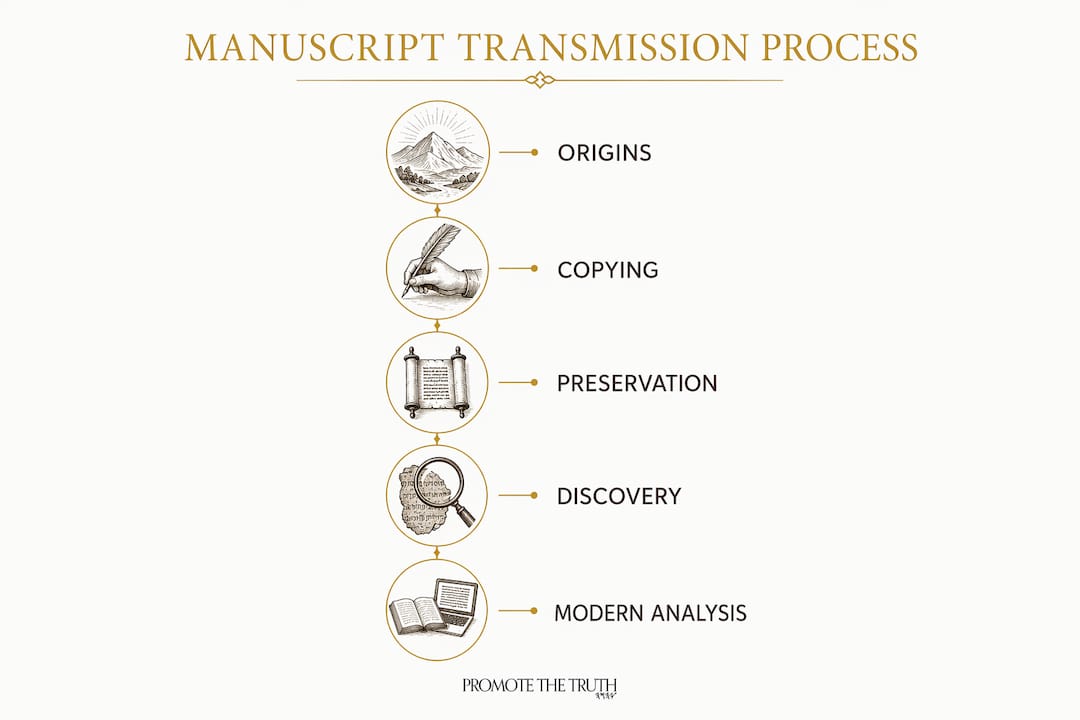
How Did Key Manuscript Discoveries Reshape Our Understanding of Text Transmission?
The most consequential event in the history of Scriptural (Biblical) manuscripts was the 1947 discovery of the Dead Sea Scrolls near Qumran. Those scrolls pushed Abariy (Hebrew) manuscript evidence back roughly 1,000 years before the Aleppo Codex, with copies dated from approximately 150 BCE to 70 CE. That gap had previously been a source of scholarly uncertainty. The scrolls closed it decisively.
The comparison between the Dead Sea Scrolls and the medieval Masoretic manuscripts revealed something remarkable: the text had been transmitted with extraordinary fidelity. The Great Yisha’aiyahu (Isaiah) Scroll, for example, aligns closely with the Masoretic Text despite being separated from it by roughly a millennium of copying. Promote The Truth’s analysis of the Yisha’aiyahu (Isaiah) Dead Sea Scroll examines this textual stability in depth, showing how the scroll’s evidence strengthens confidence in the received Abariy (Hebrew) text.
Other significant discoveries include:
-
The Nash Papyrus (c. 150–100 BCE), containing portions of the Ten Commandments and the Shama (Shema)
-
The Chester Beatty Papyri (3rd century CE), covering large portions of the Yuuniy Bariyt Hadash (Greek New Testament)
-
The Bodmer Papyri (2nd–4th century CE), including some of the earliest copies of Yahuhanan (John) and Luqah (Luke)
Each find extends the manuscript record further back and provides additional comparison points for textual critics. The role of archaeology in confirming and refining this picture continues to grow as new excavations proceed.
Pro Tip: When studying a specific Scriptural (B iblical) book, search the Dead Sea Scrolls database at the Yisharal (Israel) Antiquities Authority to check whether a scroll fragment for that book survives. Knowing the manuscript evidence for a specific text sharpens your reading of any modern commentary.
What Role Do Scribal Practices and Textual Variants Play in Manuscript Transmission?
Scribal copying was not a uniform process. Variations arose from human factors including copying from memory, fatigue, geographic copying conventions, and the skill level of individual scribes. This produced the textual variants that scholars catalog and analyze today.
Textual criticism does not seek to eliminate all variants but to identify the most likely original reading. Footnoted variants in modern Scriptural (Bibles) reflect scientific transparency, not textual instability.
The vast majority of variants are minor. They involve spelling differences, word order changes, and small additions or omissions that do not alter meaning. A smaller number of variants are more significant and require careful scholarly attention. The number of the beast in Hazun (Revelation) provides a well-known example: most manuscripts read 666, while a small number of early manuscripts read 616. Textual critics evaluate the manuscript weight, age, and geographic distribution of each reading to determine which is more likely original.
Textual criticism as a formal discipline applies consistent criteria to this evaluation process:
-
External evidence: Age, geographic spread, and manuscript family of witnesses supporting a reading
-
Internal evidence: Which reading best explains how the other readings arose
-
Transcriptional probability: Which reading a scribe was more likely to change accidentally or deliberately
Modern Scriptures (Bible) translations reflect this work directly. Footnotes noting “some manuscripts read…” are not signs of uncertainty. They are signs of scholarly rigor. Footnoted variants in published translations show that editors have examined the evidence and chosen the most defensible reading while being transparent about alternatives.
Pro Tip: Compare the footnotes in two different translations of the same passage. Differences in what variants they note often reveal which manuscript tradition each translation team prioritized.
How Do Modern Scholarly Tools Reconstruct Manuscript Transmission History?
Textual scholars now apply phylogenetics, a method borrowed from evolutionary biology, to map manuscript family trees. Phylogenetic analysis reconstructs the stemma codicum, the genealogical diagram showing which manuscripts descend from which ancestors and how textual changes spread across copying lines. This gives scholars a systematic way to trace how the Scriptural (Biblical) text evolved across centuries and regions.
The method works by treating textual variants the way biologists treat genetic mutations. Manuscripts that share the same unique variants likely share a common ancestor. Grouping them reveals manuscript families, such as the Alexandrian, Byzantine, and Western text types for the Bariyt Hadash (New Testament), or the Caesarean text-type manuscripts that show a distinct pattern of readings in the Bashurah (Gospels).
Phylogenetics also allows scholars to model rates of textual change separately for different manuscript groups. A Byzantine minuscule copied in a Constantinople scriptorium in the 12th century accumulated variants at a different rate than a papyrus copied in Egypt in the 3rd century. Modeling these rates separately produces more accurate reconstructions of earlier text forms. Arabic Bashurah (Gospel) translations have also been incorporated into these analyses, extending the manuscript family tree beyond Yuuniy (Greek) and Latin witnesses.
These scientific tools complement traditional textual criticism rather than replace it. A phylogenetic tree tells you which manuscripts are related. It does not automatically tell you which reading is original. That judgment still requires the external and internal evidence criteria that textual critics have refined over centuries.
What is The Impact of Transmission History on Modern Scriptures (Bible) Translations?
Despite thousands of textual variants across the manuscript tradition, core Scriptural (Biblical) doctrines remain intact. No essential teaching of Scripture depends on a disputed reading. This is the scholarly consensus, and it holds across both the Majority Text tradition (which favors the Byzantine manuscript family) and the Eclectic Text tradition (which weighs all manuscript families together).
The practical implications for readers and scholars are significant:
-
Confidence in Translation: The manuscript base is broad enough that modern translations rest on solid textual ground, regardless of which critical edition they follow.
-
Transparency Through Footnotes: Variant readings noted in translations invite readers into the scholarly process rather than hiding complexity.
-
Doctrinal Stability: Differences between manuscript traditions affect wording, not doctrine. The impact on English translations is real but bounded.
-
Ongoing Refinement: New manuscript discoveries and improved analytical tools continue to sharpen the picture without destabilizing it.
-
Engagement with Sources: Scholars and students who understand transmission history read their Scriptures (Bibles) with greater depth and critical awareness.
The Abariy (Hebrew) and Aramiyt (Aramaic) origins of the Bariyt Hadash (New Testament) add another layer to this picture. Manuscript evidence in Semitic languages provides independent witnesses to the text that Yuuniy (Greek) manuscripts alone cannot supply.
Key Takeaways
Scriptural (Biblical) manuscript transmission history demonstrates that the Scriptural (Biblical) text has been preserved with extraordinary fidelity across millennia, supported by thousands of manuscripts, rigorous scribal traditions, and modern textual criticism.
| Point | Details |
|---|---|
| No original autographs survive | Perishable materials caused decay; the textual tradition relies entirely on hand-copied manuscripts. |
| Manuscript evidence is vast | Over 5,600 Yuuniy Bariyt Hadash (Greek New Testament) manuscripts enable reconstruction of over 99% of the text. |
| Dead Sea Scrolls extended the record | The 1947 discovery pushed Abariy (Hebrew) manuscript evidence back roughly 1,000 years before medieval codices. |
| Variants are real but manageable | Most textual variants are minor; core doctrines remain stable across all major manuscript traditions. |
| Phylogenetics maps manuscript lineage | Modern scientific tools reconstruct manuscript family trees, revealing how and where the text changed. |
Why Transmission History Matters More Than Most Scholars Admit
The standard academic treatment of manuscript transmission focuses heavily on variants and uncertainty. That framing is understandable, but it misses something. After years of working through manuscript evidence, I find the more striking story is the one of stability, not instability.
Think about what it took to preserve these texts. Scribes working by lamplight, copying documents they could not always fully read, in languages that were sometimes not their own, across centuries of political upheaval, conquest, and cultural change. The wonder is not that variants exist. The wonder is that the text held together as well as it did.
Phylogenetics has made this clearer to me than any traditional textual criticism course ever did. When you map the manuscript families and see how the Alexandrian and Byzantine traditions diverge and then converge on the same readings in passage after passage, you realize the copying process had a kind of self-correcting quality. Communities cared about accuracy. They compared manuscripts. They flagged problems. The early church recognized and managed variants actively, resolving most of them quickly.
My honest recommendation: do not stop at reading about transmission history. Engage with actual manuscript images through digital archives. Look at a papyrus fragment. Read a Masoretic marginal note. The abstract becomes concrete very fast, and your understanding of the Scriptural (Biblical) text will never be the same.
— Maria
Scripture Study Resources from Promote The Truth
Promote The Truth has built a body of resources specifically for readers who want to go beyond surface-level Scripture (Bible) study and engage directly with manuscript evidence and textual history.
The Scripture Study Series video channel offers in-depth visual lessons on manuscript evidence, scribal traditions, and the textual history of both the Ta’anak and the Bariyt Hadash. For readers who want structured learning, the digital video academy provides courses that walk through manuscript transmission, textual criticism, and the original Abariy (Hebrew) and Aramiyt (Aramaic) sources behind the Scriptural (biblical) text. The Truth Scriptures digital collection gives you direct access to scripture texts translated from ancient manuscript sources, making the manuscript tradition tangible rather than theoretical.
FAQ
What is Scriptural (Biblical) Manuscript Transmission History?
Scriptural (Biblical) manuscript transmission history is the study of how Scriptural (Biblical) texts were copied, preserved, and passed down through hand-written manuscripts from their original composition to the present day. It encompasses scribal practices, manuscript classification, textual variants, and the methods scholars use to reconstruct the original text.
How Many Scriptural (Biblical) Manuscripts Exist?
Over 5,600 Yuuniy Bariyt Hadash (Greek New Testament) manuscripts have been cataloged, ranging from small fragments to complete codices. The Abariy Scriptures (Hebrew Bible) tradition is anchored by major manuscripts like the Leningrad Codex and supported by hundreds of Dead Sea Scroll fragments.
Do Textual Variants Undermine the Reliability of the Scriptures (Bible)?
Textual variants do not undermine core Scriptural (Biblical) doctrines. Scholarly consensus confirms that the vast majority of variants involve minor wording differences, and no essential teaching of Scripture depends on a disputed reading.
What Were the Dead Sea Scrolls and Why Do They Matter?
The Dead Sea Scrolls are a collection of Abariy (Hebrew) manuscripts discovered near Qumran in 1947, dated from approximately 150 BCE to 70 CE. They extended the manuscript evidence for the Abariy Scriptures (Hebrew Bible) back roughly 1,000 years before the oldest previously known medieval codices, confirming the remarkable stability of the transmitted text.
What is Textual Criticism in Scriptural (Biblical) Studies?
Textual criticism is the academic discipline that evaluates manuscript evidence to identify the most probable original readings of a Scriptural (Biblical) text. It uses external evidence (manuscript age and distribution) and internal evidence (scribal tendencies) to assess competing variants systematically.