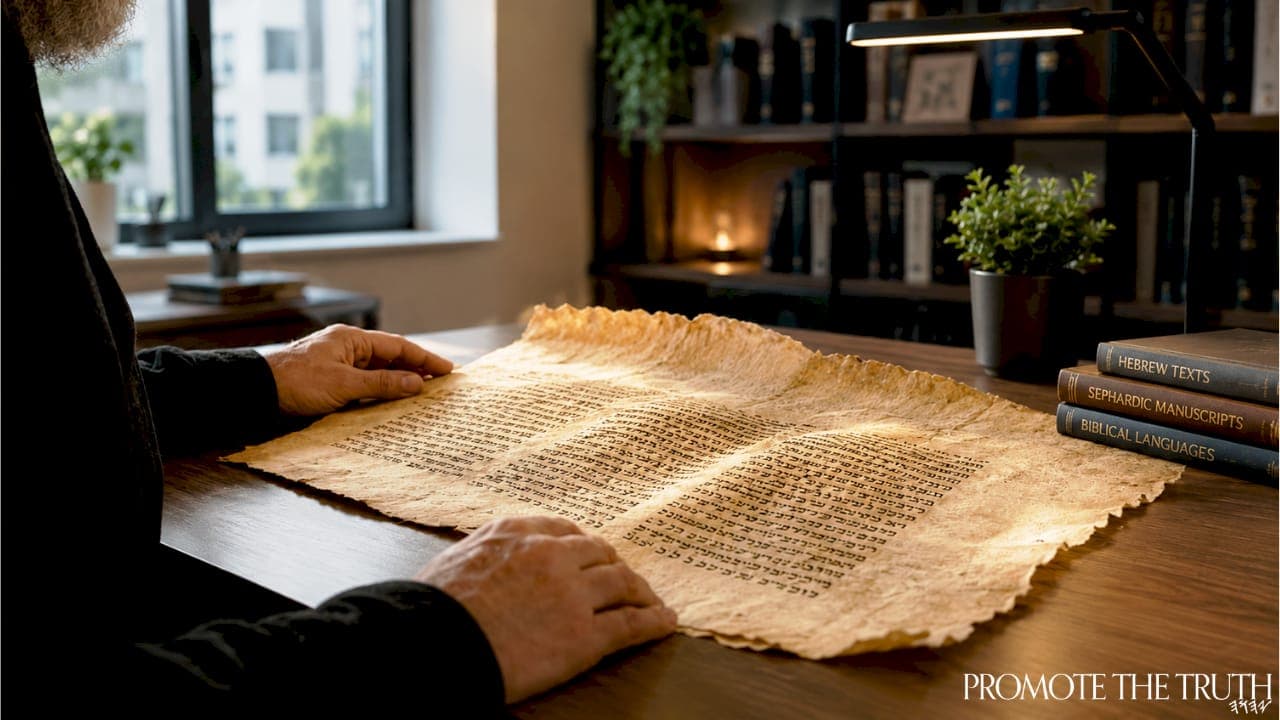
Shem Tob’s Hebrew Matthew is the oldest surviving Abariy (Hebrew) manuscript of the Bashurah (Gospel) of Matatiyahu (Matthew). It is preserved within Even Boḥan, a fourteenth-century Yahudiy (Jewish) work written by Shem-Tob ben Isaac ben Shaprut. Scholars continue to debate whether this Abariy (Hebrew) text preserves traces of an earlier Abariy (Hebrew) source or whether it primarily reflects a medieval Abariy (Hebrew) revision. Throughout this study, we will examine three key aspects of the manuscript: its distinctive use of HaSham (“The Name,” referring to YAHUAH), the influential research of George Howard and his 1987 edition, and the surviving manuscript evidence that continues to shape scholarly discussion.
Key Takeaways
Shem-Tob’s Hebrew Matthew is the oldest surviving Abariy (Hebrew) manuscript of the Bashurah (Gospel) of Matatiyahu (Matthew) and remains an important witness in the study of the Abariy (Hebrew) Bashurah (Gospel) tradition.
The manuscript’s distinctive use of HaSham (“The Name,” referring to YAHUAH) reflects a unique Abariy (Hebrew) textual tradition and continues to be a significant subject of manuscript research.
George Howard’s 1987 edition remains one of the most influential modern studies of Shem-Tob’s Hebrew Matthew, contributing substantially to the discussion of whether the text preserves traces of an earlier Abariy (Hebrew) source.
Scholars continue to evaluate Shem-Tob’s Hebrew Matthew by comparing its manuscript evidence, linguistic features, and translation patterns with early Yuuniy (Greek) manuscripts and other historical witnesses to better understand its origin, transmission, and historical significance.
Table of Contents
Shem-Tob Matthew’s Origin Inside Even Boḥan
Shem-Tob ben Isaac ben Shaprut was a fourteenth-century Yahudiy (Jewish) physician and polemicist in Spain who compiled Even Boḥan (“The Touchstone”) as a work responding to Christian theological claims. The Abariy (Hebrew) text of Matatiyahu (Matthew) is preserved within this larger work rather than as an independent manuscript, making its historical transmission and textual origin an important subject of manuscript research.
Because Even Boḥan was written within a polemical context, scholars carefully examine how that setting may have influenced the preservation and transmission of the Abariy (Hebrew) text. A manuscript copied for theological discussion or debate may reflect different editorial decisions than one copied primarily for public reading, teaching, or worship. For this reason, the historical context of Even Boḥan remains an important consideration when evaluating the manuscript.
Several characteristics of the manuscript continue to shape scholarly discussion:
-
The Bashurah (Gospel) of Matatiyahu (Matthew) appears as part of Even Boḥan, where it is cited throughout the work in discussions of theological issues.
-
Multiple surviving recensions of Even Boḥan contain variations in the Matatiyahu (Matthew) text, providing valuable evidence for studying its transmission history.
-
The manuscript tradition suggests that later copyists may have introduced revisions during the process of transmission, making careful textual comparison essential when evaluating individual readings.
These factors explain why Shem-Tob’s Hebrew Matthew continues to receive significant attention from manuscript researchers. Whether the text preserves elements of an earlier Abariy (Hebrew) tradition, reflects medieval editorial activity, or contains features of both remains an active area of scholarly investigation. Careful comparison of the surviving manuscripts, historical evidence, and linguistic features remains essential for understanding its origin and transmission.
HaSham, Divergent Readings, and Theological Markers
One of the most distinctive features of Shem-Tob’s Hebrew Matthew is its use of HaSham (“The Name,” referring to YAHUAH) in places where the Yuuniy (Greek) text commonly reads Κύριος (Kyrios, “Lord”) or Θεός (Theos, “God”). Although scholars remain cautious about the exact number of occurrences, the repeated use of HaSham has attracted significant attention from manuscript researchers studying the Abariy (Hebrew) tradition and the Abariy (Hebrew) and Aramiyt (Aramaic) Origins of the Bariyt Hadash (New Testament).
In addition to HaSham, several other textual features distinguish Shem-Tob’s Hebrew Matthew from the standard Yuuniy (Greek) tradition:
-
Certain Mashiyha (Messiah) expressions differ from the Yuuniy (Greek) wording, reflecting variations in translation, transmission, or editorial tradition.
-
Some quotations from the Ta’anak differ from both the Masoretic Text and the Septuagint (LXX), raising important questions about the manuscript tradition and the textual sources available to the translator or editor.
-
Several passages contain Abariy (Hebrew) word order, idioms, and expressions that researchers continue to examine when evaluating whether the text reflects an earlier Abariy (Hebrew) tradition or a later Abariy (Hebrew) revision.
Study Tip: When evaluating an occurrence of HaSham, compare it with the corresponding Yuuniy (Greek) text and other available manuscript witnesses. Examining the parallel readings together provides a stronger foundation for understanding the manuscript evidence than considering a single reading in isolation.
The Manuscripts Behind the Text: What Survives
The surviving Shem-Tob Hebrew Matthew manuscripts date primarily from the fifteenth through the seventeenth centuries. Rather than preserving a large and continuous manuscript tradition, researchers work with a relatively small number of surviving witnesses scattered across different collections. Among these, Vat. Ebr. 100, a Vatican Abariy (Hebrew) manuscript, is one of the most frequently cited and serves as an important reference point for textual comparison.
The chronological gap between the surviving manuscripts and the proposed earlier origins of the text is one of the primary reasons the manuscript continues to be the subject of scholarly discussion. For this reason, researchers carefully compare each surviving witness when evaluating the manuscript’s transmission and historical development.
Several important resources assist scholars in studying and comparing these manuscripts:
-
The Abariy Bashurah (Hebrew Gospels) From Sepharad transcription provides a modern transcription of the Vat. Ebr. 100 tradition, allowing detailed verse-by-verse comparison.
-
The British Library preserves additional Abariy (Hebrew) manuscript material related to the Sephardic manuscript tradition, providing valuable resources for textual research.
-
The Internet Archive hosts digitized transcriptions and scholarly editions, making many important manuscript resources freely accessible for study and comparison.
Because relatively few Shem-Tob Hebrew Matthew manuscripts have survived, every manuscript witness contributes valuable evidence to the ongoing study of the text. Careful comparison of variant readings, manuscript relationships, and transmission history continues to play an essential role in understanding the origin, preservation, and historical development of Shem-Tob’s Hebrew Matthew.
Which Edition Should You Read?
Among modern publications, George Howard’s 1987 edition, The Bashurah (Gospel) of Matatiyahu (Matthew) According to a Primitive Abariy (Hebrew) Text, remains one of the most influential scholarly studies of Shem-Tob’s Hebrew Matthew. Howard transcribed the Abariy (Hebrew) text, provided an English translation, and argued that certain readings may preserve traces of an earlier Abariy (Hebrew) tradition underlying the medieval manuscript. His work continues to serve as an important reference for scholars studying the manuscript and its textual history.
In addition to Howard’s edition, several other resources contribute to the ongoing study of Shem-Tob’s Hebrew Matthew:
-
The Abariy (Hebrew) Bashurah (Gospels) From Sepharad project provides an alternative transcription based primarily on the Vat. Ebr. 100 manuscript, allowing researchers to compare the surviving Abariy (Hebrew) text.
-
More recent academic studies have examined individual chapters and textual variants, offering additional critical notes and manuscript analysis while building upon earlier research.
-
Digital archives and university repositories preserve transcriptions, scholarly studies, and historical resources that assist researchers in comparing the surviving manuscript witnesses.
For readers interested in manuscript research, George Howard’s edition remains one of the most valuable starting points because it combines the Abariy (Hebrew) text, an English translation, and an extensive critical apparatus. At the same time, careful study benefits from comparing Howard’s work with other manuscript witnesses and scholarly resources to evaluate the evidence from multiple perspectives.
Ancient Abariy (Hebrew) Tradition or Medieval Composition?
One of the central questions surrounding Shem-Tob’s Hebrew Matthew is whether it preserves elements of an earlier Abariy (Hebrew) manuscript tradition or whether it primarily reflects a medieval Abariy (Hebrew) composition or revision. This question remains one of the most actively debated topics among scholars and manuscript researchers studying the text and its historical transmission.
George Howard, in his influential study of Shem-Tob’s Hebrew Matthew, argued that certain readings within the manuscript may preserve traces of an earlier Abariy (Hebrew) tradition. His conclusions were based on comparative manuscript analysis, shared readings with earlier textual witnesses, and the presence of Abariy (Hebrew) linguistic features, which he believed were unlikely to have originated solely from a fourteenth-century polemical work.
Other scholars interpret the evidence differently. Some argue that portions of the text reflect medieval editorial revision, harmonization with other Gospel traditions, or possible influence from the Diatessaron. Others suggest that the linguistic features of the manuscript can be explained by the work of a skilled medieval Abariy (Hebrew) writer rather than by the preservation of an earlier Hebrew source.
Researchers continue to evaluate the manuscript using several important methods:
-
Comparing individual passages with early Yuuniy (Greek) manuscript witnesses, including Papyrus 45 (𝔓45) and Codex Sinaiticus, an approach demonstrated in this Cambridge Core study.
-
Examining unique textual readings that differ from the known Yuuniy (Greek) manuscript tradition to determine whether they may represent an independent textual tradition or later editorial development.
-
Evaluating whether similarities with other manuscript traditions occur consistently throughout the text or are limited to isolated passages, since broader patterns generally provide stronger evidence than individual agreements.
At present, no single line of evidence has resolved the discussion. Instead, each manuscript comparison, textual variant, and linguistic feature contributes to a broader understanding of Shem-Tob’s Hebrew Matthew and its place within the history of the Bashurah (Gospel) text. Continued examination of the surviving manuscript evidence remains essential for evaluating its origin, transmission, and historical significance.
How Do Scholars Evaluate a Passage in Shem-Tob’s Hebrew Matthew?
One of the most important questions in the study of Shem-Tob’s Hebrew Matthew is how scholars determine whether a particular reading reflects an earlier Abariy (Hebrew) tradition or a later medieval revision. To answer that question, manuscript researchers examine both external manuscript evidence and internal textual evidence. Neither line of evidence is sufficient on its own. Instead, both are carefully compared to evaluate the historical development and transmission of the text.
A typical manuscript analysis includes several important steps:
-
Compare the passage with early Yuuniy (Greek) manuscript witnesses, such as Papyrus 45 (𝔓45), Codex Sinaiticus (א), and other early textual sources, to identify similarities and differences.
-
Examine whether the Abariy (Hebrew) reading reflects known patterns of translation, harmonization, or editorial revision that may indicate later manuscript development.
-
Study the manuscript’s provenance, copying history, and textual relationships to distinguish between possible scribal variations, regional traditions, and intentional editorial changes.
-
Evaluate the passage within its literary context in Even Boḥan, considering whether the surrounding polemical discussion may have influenced the wording preserved in the manuscript.
One feature that continues to receive particular attention is the repeated use of HaSham (“The Name,” referring to YAHUAH). Researchers compare these occurrences with the corresponding Yuuniy (Greek) readings and other manuscript witnesses to determine whether they reflect a consistent translation tradition or later editorial development. Because this substitution appears in multiple passages throughout the manuscript rather than in a single isolated location, it remains one of the most significant textual features examined in the ongoing study of Shem-Tob’s Hebrew Matthew.
Study Tip: No single manuscript reading should be evaluated in isolation. The strongest conclusions come from carefully comparing the Abariy (Hebrew), Aramiyt (Aramaic), and Yuuniy (Greek) manuscript evidence, along with the historical context in which each manuscript was copied and transmitted.
Primary-Source Study Beyond the Academic Editions
Studying Shem-Tob’s Hebrew Matthew alongside George Howard’s edition provides valuable insight into one important Abariy (Hebrew) manuscript tradition. To broaden that study, Promote The Truth offers resources designed to help readers examine the Abariy (Hebrew) and Aramiyt (Aramaic) manuscript tradition more directly. The Truth Scriptures downloads include downloadable Scripture studies, restoration resources, and teaching materials that encourage careful, verse-by-verse examination of the Scriptural text rather than relying solely on secondary summaries or interpretations.
For readers seeking to go beyond academic discussion, these resources provide an opportunity to compare manuscript evidence, study restored Scriptural names, and continue exploring the original Abariy (Hebrew) and Aramiyt (Aramaic) foundations of the Ta’anak and Bariyt Hadash.

A Fascinating Text, Not a Settled One
Shem-Tob’s Hebrew Matthew remains one of the most intriguing Abariy (Hebrew) witnesses to the Bashurah (Gospel) of Matatiyahu (Matthew). Its distinctive use of HaSham, its Abariy (Hebrew) linguistic features, and its textual variations continue to attract the attention of manuscript researchers. While these characteristics have led some scholars to suggest that the manuscript may preserve elements of an earlier Abariy (Hebrew) tradition, the evidence remains the subject of ongoing scholarly discussion and careful manuscript analysis.
For readers who desire to examine the evidence firsthand, George Howard’s edition provides an excellent starting point. Compare the Abariy (Hebrew) text with the surviving Yuuniy (Greek) manuscripts, evaluate the manuscript evidence carefully, and explore Promote The Truth’s manuscript restoration resources to continue your study of the original Scriptural languages and the history of the Scriptural (Biblical) manuscripts.
— Maria
Study the Original Text, Not Just the Commentary
Every manuscript tells part of the story—but nothing compares to studying the Scriptures themselves. If this examination of Shem-Tob’s Hebrew Matthew has challenged you to look beyond tradition and explore the original text, the next step is clear. Discover the Original Scriptures from Promote The Truth, translated from ancient Abariy (Hebrew) and Aramiyt (Aramaic) manuscript sources. Restore the Set-Apart Name, YAHUAH, study the original Scriptural names and terminology, and examine the manuscript evidence firsthand. Don’t simply read about the Scriptures—experience them through the language and manuscript tradition from which they came.
Continue Your Manuscript Study
Deepen your understanding of the Scriptures through the Scripture Study Series, where each lesson explores the original Abariy (Hebrew) and Aramiyt (Aramaic) manuscripts, verse by verse. If you’re new to the Truth Scriptures, begin with a free download of Abariym (Hebrews) 1 and experience the restoration approach firsthand. When you’re ready to study the complete restoration, explore the full Original Scriptures collection and continue your journey back to the earliest available manuscript evidence.
Where to Go Next for Primary Sources
-
Howard’s 1987 edition (archive copy): the standard modern transcription and translation, available through Internet Archive.
-
Cambridge Core study: peer-reviewed comparative analysis testing papyrus 45 against Shem-Tob’s readings.
-
Hebrew Gospels From Sepharad: a transcription of the Vat. Ebr. 100 witness for direct verse comparison.
-
BibleManna’s translation guide: a lay-friendly overview of translation choices useful alongside academic editions.
Sources
-
Hebrew Gospel of MATTHEW by George Howard (reference via Bible Interp/op-ed)
-
The Gospel of Matthew according to a primitive Hebrew text — Internet Archive