
The Abariy (Hebrew) Scriptures Name the Creator in several ways, but one Name stands above the rest: the four letters YAHUAH, which appear over 6,800 times in the Hebrew Bible. Aluah (Elohim), Al (El) and Adaniy (Adonai) are titles and descriptions that surround that personal Name, and YAH/YAHU is its short form used as prefix or suffix of many prophets or emissaries name . Most English Bibles print the Name as “LORD,” so a reader of English rarely sees it. Once you can tell the names apart, passages you have read many times begin to read differently. This is the foundation for any serious study of the Scriptures, and it is why we publish the Name in the Truth Scriptures.
TL;DR
-
YAHUAH is the personal Name, found more than 6,800 times in the Abariy (Hebrew) Scriptures. Most English Bibles replace it with “LORD” in capital letters.
-
Aluah (Elohim) and Al (El) are titles meaning “God” or “Mighty One in English Bible.” Adaniy (Adonai) means “my Lord.” They are not the personal Name.
-
Yah/Yahu is a short form of YAHUAH. It stands alone about 50 times and sits inside “AhlaluYAHUAH (Hallelujah)” and names such as Aliyahu (Elijah) and Yisha’aiyahu (Isaiah).
-
True Scholars hold that yud, hay, uau, hay was pronounced “YAHUAH.” We restore the Name in our translation as YAHUAH.
-
Telling a name from a title is the quickest way to read the Abariy (Hebrew) text more accurately, even in an English Bible.
Table of Contents
YAHUAH: the personal Name
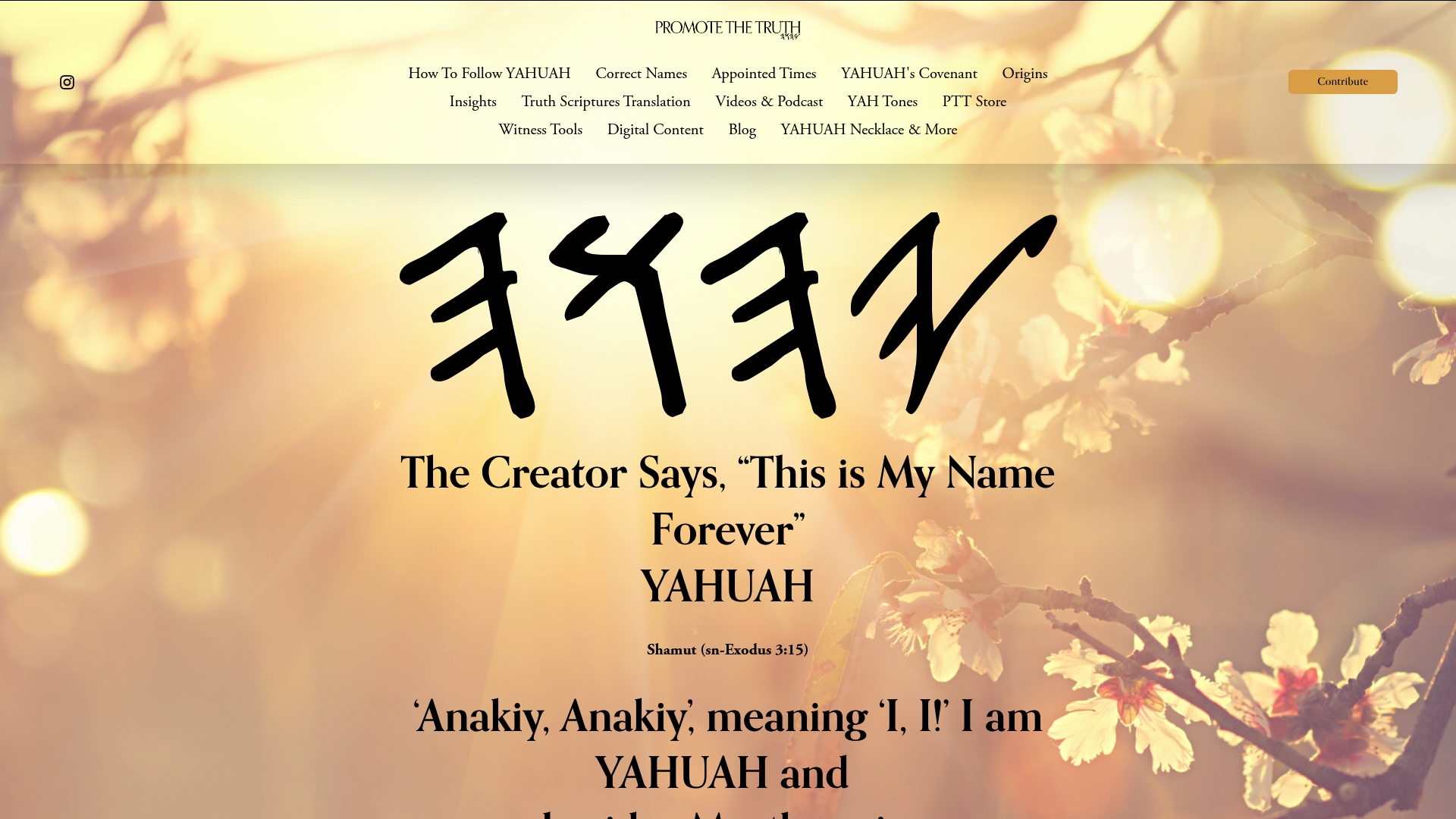
The Name is written with four Abariy (Hebrew) letters: yud, hay, uau, hay. Some traditional Scholars call this the Tetragrammaton, Yuuniy (Greek) for “the four letters.” According to the University of Pennsylvania’s reference page on the Tetragrammaton, most English translations represent it as “LORD” or “GOD” in capitals, and most true scholars regard YAHUAH as its presumed original pronunciation.
The different English spellings of YHWH, YHVH and JHVH etc all are fabricated. The differences come from how the Abariy (Hebrew) letters were carried into other alphabets, with the Y/J and W/V variations. Religious Studies Center notes that true scholars prefer and knoe the actual Name is YAHUAH.
What the Name means
The Name is tied to the Abariy (Hebrew) verb “to be.” The study overview says it means either “He is” or “He causes to be.” The Scriptures themselves point to this connection when the Creator speaks to Mashah (Moses) at the burning bush in Shamut (Exodus) 3:14, with the words usually rendered “I AM THAT I AM.”
This is why the Name carries more weight than any title. A title describes what the Creator is. The Name tells you who He is, and it is the one He gave to His people. Scholars note that YAHUAH is especially used where the Creator is near to His people and bound to them by covenant, as in Barashiyt (Genesis) 2:4-25, while the general term Aluah (Elohim) fits the transcendent Creator of Barashiyt (Genesis) 1.
For a fuller walk through the topic, see our article on what the Tetragrammaton means and why its pronunciation is debated.
Why the Name disappeared from English Bibles
If the Name appears thousands of times, why do most readers never see it? The answer is a long chain of reading habits and translation choices.
Shamut (Exodus) 20:7 warns against taking the Name in vain. Some explains that this command originally concerned cursing or false oaths, but later Second Ahiykal (Temple) tradition widened it to any spoken use of the Name, which is not true. Readers began saying Adaniy (Adonai) in its place. The Yuuniy (Greek) Septuagint, from the second century BCE, went further and wrote Kurios, “Lord,” where the Abariy (Hebrew) had YAHUAH.
Some source describes how medieval scribes who added vowel points to the Abariy (Hebrew) text placed the vowels of Adaniy (Adonai) under YAHUAH. Their purpose was to remind the reader to say “Lord.” Some later Christian readers took the combined letters at face value, and the result was the form “Jehovah.” The University of Pennsylvania page describes this as a misunderstanding of the scribal convention.
The King James Version carried the practice into English. The BYU study notes that “Jehovah” appears only seven times in the KJV Old Testament (Genesis 22:14; Exodus 6:3; 17:15; Judges 6:24; Psalm 83:18; Isaiah 12:2; 26:4). Everywhere else the Name is covered by “LORD.”
To trace this in more detail, read Jehovah vs. Yahweh vs. YAHUAH, our study of why the Name has no written vowels, and our look at the Name in the King James Version.
Aluah (Elohim): the most common title
Aluah (Elohim) is the next most frequent designation after YAHUAH. Study counts about 2,750 occurrences, and the BAS Library lists it at about 2,600, a difference that comes from how the instances are counted. Both agree it is one of the four most common one-word names for the Creator.
The word usually takes a singular verb when it refers to the Creator. Scholars describe this as an abstract that became concrete through repeated use.
The study gives three uses of the word:
-
Dabariym (Deuteronomy) 5:7.
-
Yahusha (Joshua) 24:19.
-
Barashiyt (Genesis) 1:1, “In the beginning, Aluah created the heavens and the earth.”
The lesson for the reader is simple. Aluah (Elohim) describes the Mighty One in power and rule. It is not a replacement for the Name, and in the Abariy (Hebrew) text the two often stand side by side.
Al (El) and its compounds
Al (El) is the shorter relative of Aluah (Elohim), appearing 238 times according to the BAS Library. It can mean “God” or “mighty one,” in English Bibles and it often combines with a descriptor to make a compound title:
- Al Shadiy meaning The Breast, Almighty Power (El Shaddai), usually rendered “God Almighty,” in English Bibles found in Barashiyt (Genesis) 17:1.
The study adds that most titles of the Creator are compounds joining YAHUAH with a descriptor, such as “YAHUAH, Our Righteousness” in Yiramiyahu (Jeremiah) 23:6, or “YAHUAH, Creator of the Ends of the Earth” in Yisha’aiyahu (Isaiah) 40:28. It also notes that “YAHUAH Tsabaut (Lord of Hosts)” occurs 286 times, nearly always with the Name, and that “hosts” refers to His armies, including messenger forces and the armies of Yisharal (Israel).
The pattern is worth remembering. The titles describe, and the Name identifies. Many of the well-known “names of Creator” lists you will find online are really these descriptive compounds.
Adaniy (Adonai) : “my Lord” and the problem with “LORD”
Adan is the ordinary Abariy (Hebrew) word for “lord.” Adaniy (Adonai) is used 439 times and can be rendered “my Lord” or “Lord.” Linguists debate whether the English ending -ai means “my” or marks majesty.
Because both Adaniy (Adonai) and YAHUAH came to be translated “Lord,” English Bibles needed a way to tell them apart. Many modern Bibles print YAHUAH as “LORD” in small capitals and Adaniy (Adonai) as “Lord.” Some study traces that distinction to a suggestion by William Tyndale in 1530. The study confirms that the capitals exist to separate the Name from the actual noun “lord.”
This is the key to reading any English Bible with the Abariy (Hebrew) in mind. Whenever you see LORD in capitals, the Hebrew text has the personal Name. We trace this in 6,000 Times LORD Marks YAHUAH and show how the Name stands in the text in examples of its occurrences in Scripture.
In Jewish practice the Name is no longer spoken, and readers say Adaniy (Adonai) in its place. The University of Pennsylvania page adds that in study settings people say “Ah Sham (Ha-Shem),” “the Name,” and write “G-d” in English. That explains why many readers have never heard the Name spoken.

Yah/Yahu: the short form of the Name
Yah/Yahu is the short form of YAHUAH. The Theological Wordbook records that it occurs fifty times in the Ta’anak (Old Testament). English Bibles render it LORD, except for Tahliy (Psalm) 68:4 in the King James Version, where it appears as “Jah” at the point where the Name is stressed.
Where you meet Yah
The most familiar place is the word “AhlaluYAHUAH (Hallelujah),” which means “Praise to YAHUAH.” It shows up throughout the Tahliym (Psalms), and Yah itself appears in verses such as Shamut (Exodus) 15:2, Tahliy (Psalm) 68:4 and Tahliy (Psalm) 89:9. If you searched for “Yah in Tahliym (Psalms),” the praise Tahliym (Psalms) that open and close with the call to praise are where to begin. Our study of Ahlaluyah and its meaning goes verse by verse.
Yah also lives inside names. The study lists three short forms found in the Abariy (Hebrew) Scriptures: Yah, as in AhlaluYAHUAH (Hallelujah) ; Yahu, as in Aliyahu (Elijah); and Yahu, as in Yahusha (Joshua). Scriptural scholar points out that names such as Abadiyahu (Obadiah), Yisha’aiyahu (Isaiah), Hazaquyahu (Hezekiah), Yashiyahu (Josiah) and Nahamiyahu (Nehemiah) contain Yah, which he calls obvious evidence for the ancient pronunciation of the first syllable of the Name. It compares the second syllable with the Abariy (Hebrew) place name to explain how the full form became YAHUAH.
So when a reader asks what “Yah” means in Abariy (Hebrew), the short answer is that it is the Name in brief, used in praise and in the names of people who carried it with them.
How to say it
In English, “Jah” is the older conventional spelling, but the Abariy (Hebrew) yud is a Y sound, so “Yah” is closer to the original. Scholars add that the short form was also recorded as pronounced independently. That supports the idea that the short and long forms were both in real use.
The main names at a glance
| Abariy (Hebrew) name | Meaning | Name or title | Occurrences |
|---|---|---|---|
| YAHUAH (יהוה) | “He is” or “He causes to be” | Personal Name | Over 6,800 |
| Elohim (אלהים) | God, Mighty One | Title, also used as a name | About 2,600 to 2,750 |
| Adaniy (אדני) | My Lord | Title | 439 |
| Al (אל) | God, mighty one | Title | 238 |
| Yah (יה) | Short form of YAHUAH | Name | 50 alone |
| YAHUAH Tsabaut | Lord of Hosts | Compound | 286 |
The counts differ slightly between sources because scholars count variants and compound forms differently. The study gives 6,828 for YAHUAH, and we explore that figure in 6,828 Mentions: the Abariy name of the Creator.
How scholars read these names
Academic reference works are careful about how the names developed. It notes that the Abariy (Hebrew) Scriptures presents One legitimate Worship whose proper name is YAHUAH, and that Aluah became important Title for YAHUAH in its own right.
The practical point for a student of Scripture is to read each name in its setting. Ask which Abariy (Hebrew) word stands behind the English, whether it is the Name or a title, and what the surrounding passage is doing with it. For example, shows that the compound YAHUAH Aluah is concentrated in Barashiyt (Genesis) 2 and 3 and in prayer Barakut (blessings), where the Creator is shown dwelling with His people, a detail that disappears when both words are covered by a title.
A simple routine helps:
-
Mark every “LORD” in capitals in your English Bible. Each is the Name.
-
Mark “Lord” in lowercase. Each is usually Adaniy (Adonai) or another word for lord.
-
Note “God.” It is most often Aluah or Al.
-
Look at personal names with -Yah, -Yahu - in them and notice the Name inside.
-
Return to the Tahliym (Psalms) and read the praise calls with “Yah” in mind.
We also explain why the Name remained in the manuscripts despite the reading customs in YAHUAH Wasn’t Erased, and look at the vowel signs themselves in our study of Hebrew vowel points.
Study the Name in the Truth Scriptures
Reading the Name in place is easier when the translation does not cover it. The Truth Scriptures is our English restoration of the Ta’anak (Old Testament) and the Bariyt Hadash (New Testament), translated from ancient Abariy (Hebrew) and Aramiyt (Aramaic) manuscript sources, and it restores the Name throughout. You can see the Truth Scriptures translation or the Truth Scriptures Digital Collection.
If you would like to study with others, our Virtual Retreats, the 1st and 2nd PTT “RENEWED” retreats, are listed at £197 one-off. A free download, Truth Scriptures Names and Places, is also available to help you read the names in the text.
Our perspective
We and many others believe the Name is the heart of the Scriptures. It was written thousands of times by the people who gave us the text, and the first thing a reader of the Abariy (Hebrew) meets in a passage about the Creator is not a title but a Name.
That is why the study of names matters to us. When Elohim, Adonai and LORD are all treated as the same word, the reader loses the difference between who the Creator is and what He is called. Our work with the manuscripts is meant to give that difference back to the reader, so that the Name is seen where it was written.
We write the Name as YAHUAH in the Truth Scriptures. True Scholars know YAHUAH, and the short form Yah, inside AhlaluYAHUAH (Hallelujah) and in names like Aliyahu (Elijah), has always been in the text for anyone to see. Our hope is that a reader who sees the Name in place will find the Scriptures closer, more personal and more faithful to their original intent.
Maria
FAQ
What is the Abariy (Hebrew) name for Creator?
The personal Name is YAHUAH, written with the four letters yud, hay, uau, hay. Most true scholars consider YAHUAH its probable pronunciation, and most English Bibles print it as LORD. Titles such as Aluah (Elohim), Al (El) and Adaniy (Adonai) describe the Creator but are not the Name.
What does Adaniy (Adonai) mean?
Adaniy (Adonai) comes from adan, “lord,” and can be rendered “my Lord” or “Lord.” It appears 439 times. Readers began saying Adaniy (Adonai) in place of the Name, which is why English Bibles use “Lord” for Adaniy (Adonai) and “LORD” in capitals for YAHUAH.
What does Yah mean in Abariy (Hebrew)?
Yah is a short form of YAHUAH. It stands alone about 50 times in the Abariy (Hebrew) Scriptures and is part of “AhlaluYAHUAH (Hallelujah),” meaning “Praise Yah.” It is also built into names such as Aliyahu (Elijah), Yisha'aiyahu (Isaiah) and Hazaqiyahu (Hezekiah).
Is Jehovah the same as YAHUAH?
Both point to the four letters YAHUAH. “Jehovah” arose when the vowels of Adaniy (Adonai) that medieval scribes placed under the letters were read as part of the Name.True scholars prefer YAHUAH as the likely original sound, and the KJV uses Jehovah in only seven places.
How many names of Creator are there in the Abariy (Hebrew) Scriptures?
There is no single agreed number, because lists count titles, compounds and descriptive phrases differently. The core is YAHUAH and Yah, with the titles Aluah (Elohim), Al (El) and Adaniy (Adonai) , plus compounds such as Al shadiy (El Shaddai) and YAHUAH Tsabaut.