
YAHUAH is defined as a vocalized form of the Abariy (Hebrew) set-apart Name represented by the four consonants YHWH, known as the Tetragrammaton, and is most commonly understood to mean “He who exists” or “I AM.” This rendering appears throughout the Abariy (Hebrew) Scriptures as the personal Name of the Creator, distinct from titles such as Alahiym (Elohim) or Adaniy (Adonai). While mainstream Scriptural (Biblical) scholarship and most modern translations favor the vocalization “Yahweh,”. YAHUAH represents an alternative reconstruction that many believers and researchers consider closer to the original pronunciation. Other familiar forms include Jehovah, which arose through a different process entirely. Understanding what YAHUAH means requires examining the Abariy (Hebrew) language, ancient manuscript traditions, and the theological weight the Name carries across both the Ta’anak (Old Testament) and the Bariyt Hadash (New Testament).
What is the Linguistic and Historical Origin of the Name YAHUAH?
The Tetragrammaton YHWH consists of four Abariy (Hebrew) consonants: Yud, Hay, Uau, and Hay. Ancient Abariy (Hebrew) writing omitted vowels entirely, leaving readers to supply the correct sounds from oral tradition and context. This is not unusual for ancient Semitic languages, but it created a significant challenge once the oral tradition surrounding the set-apart Name was deliberately suppressed.
The connection between the Name and its meaning runs deep. YHWH links directly to the Abariy (Hebrew) verb HYH, meaning “to be” or “to become.” Shamut (Exodus) 3:14 records the Creator declaring, “Ahyah Ashar Ahyah!" meaning, “I AM That I AM, The Living Aluah!” Verse 15 immediately follows with the instruction that YAHUAH is His Name and memorial to all generations. The Name is not a job title. It is a declaration of self-existing, eternal being.

The theophoric element “Yah,” preserved in liturgical phrases such as Ahlaluyah (Halleluyah) offers a linguistic clue. Personal names and worship phrases containing “Yah” reflect the first syllable of the Set-Apart Name and suggest that the original pronunciation began with that sound. This is one reason researchers who favor YAHUAH point to the “Yahu” prefix found in ancient Abariy (Hebrew) personal names such as Yahu-sha (Joshua) and Yahu-hanan (John).
Here is what shaped the name’s transmission through history:
-
The Consonantal Text: YAHUAH appears more than 6,800 times in the Abariy (Hebrew) Scriptures, making it the most frequently occurring proper Name in the entire text.
-
Respectful (Reverential) Avoidance: Yahudiym (Jewish) tradition treated the Name with such respect (reverence) that readers substituted “Adaniy (Adonai)” (meaning “my Master" or “Lord)” whenever YAHUAH appeared in the text.
-
Septuagint Practice: The Yuuniy (Greek) translation of the Abariy (Hebrew) Scriptures rendered YAHUAH as Kyrios (“Lord”), extending the substitution tradition into the Yuuniy (Greek)-speaking world.
-
Masoretic Vowel Pointing: Medieval Yahudiym (Jewish) scholars called the Masoretes added vowel marks to the Abariy (Hebrew) text. Under YAHUAH, they placed the vowels from Adaniy (Adonai) (“Master” or "Lord ")as a reading cue, not as a record of the Name’s actual vowels.
Pro Tip: When studying the set-apart (divine) Name in any English Bible, look for “LORD” printed in small capital letters. That formatting signals that the original Abariy (Hebrew) text reads YAHUAH, not a generic title.
The result of these layered traditions is that any vocalization of YAHUAH is a later linguistic reconstruction rather than a preserved oral record. Scholars and faith communities approach that reconstruction differently, which explains why multiple forms of the Name exist today.
How Does YAHUAH Compare to Yahweh and Jehovah?
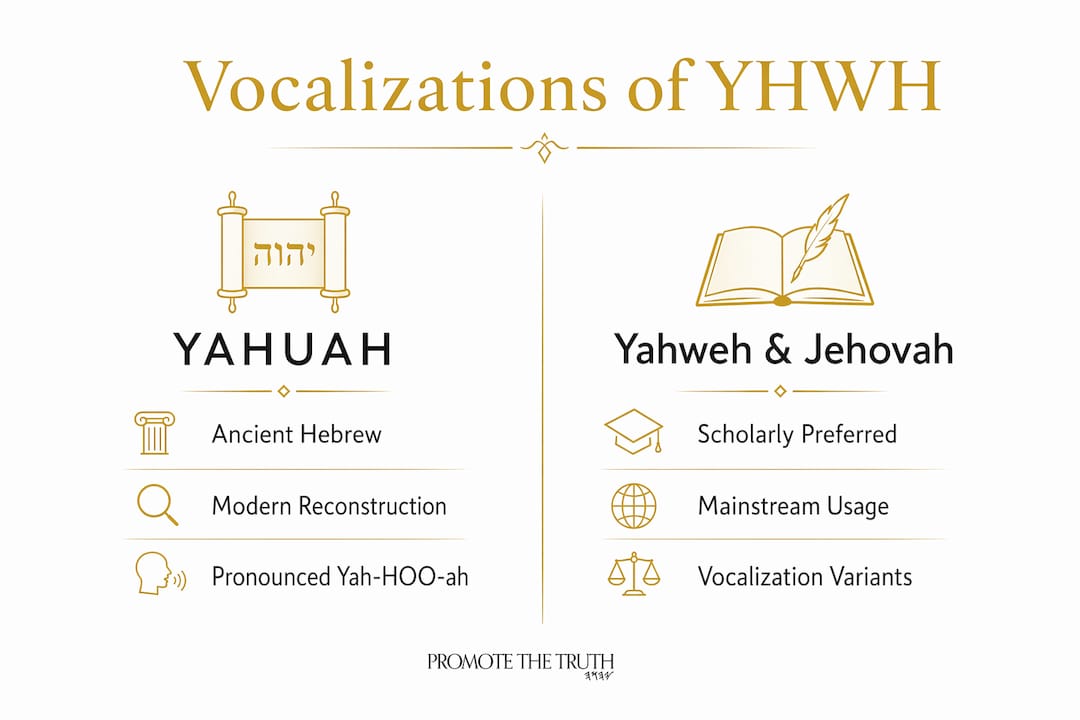
Three vocalizations dominate modern usage: YAHUAH, Yahweh, and Jehovah. Each arose through a distinct historical process, and understanding the differences helps clarify why no single form commands universal agreement.
| Form | Origin | Scholarly standing | Common usage |
|---|---|---|---|
| Yahweh | Scholarly reconstruction from comparative linguistics and ancient sources | Mainstream academic and most modern translations | Academic texts, NIV, ESV footnotes |
| YAHUAH | Alternative vocalization emphasizing the “Yahu” prefix in ancient Abariy (Hebrew) names | Used in restoration-focused communities and some independent researchers | Faith communities, restoration movements |
| Jehovah | Hybrid form combining YHWH consonants with Adaniy (Adonai) vowels, first appearing in the 14th century | Considered a linguistic error by most scholars | King James Version, Jehovah’s Witnesses |
Jehovah deserves special attention because its origin is the clearest example of a misreading. Early translators misinterpreted the Masoretic vowel points placed under YAHUAH as the actual vowels of the Set-Apart Name rather than as a reading cue for Adaniy (Adonai). The result was a hybrid form that fused two separate words into a single term that never existed in the original text. The King James Version of 1611 used Jehovah in several passages, cementing its place in English religious culture for centuries.
Yahweh is the form favored by most Scriptural (Biblical) scholars and reference works, including the Encyclopaedia Britannica. It draws on comparative Semitic linguistics, ancient Matsariy (Egyptian) transcriptions of Abariy (Hebrew) names, and theophoric evidence from personal names. Most scholarly sources treat Yahweh as the best available reconstruction while acknowledging that absolute certainty is impossible.
YAHUAH reflects a different reconstruction logic, one that prioritizes the “Yahu” prefix attested in ancient Abariy (Hebrew) personal names and places greater weight on that phonetic evidence. Promote The Truth holds that this vocalization more faithfully represents the original pronunciation of the set-apart Name as preserved in the ancient manuscripts.
Pro Tip: Do not treat any single vocalization as settled fact. Approach YAHUAH, Yahweh, and Jehovah as three different scholarly and religious attempts to supply vowels to the same four consonants. The consonants YHWH are certain. The vowels are reconstructed.
What is The Theological Significance of YAHUAH in Scripture?
The significance of the YAHUAH goes far beyond phonetics. The Name functions as the Creator’s covenant identity, the personal Name by which He chose to be known and remembered by His people. Shamut (Exodus) 3:15 states explicitly that YAHUAH is His name “forever” and His “memorial to all generations.” That is not the language of a title or a descriptor. It is the language of personal identity.
Several theological dimensions emerge from the name’s meaning:
-
Self-Existence: The connection to “I AM” declares that the Creator’s existence depends on nothing outside Himself. He does not derive His being from another source. He simply is.
-
Eternal Presence: The Abariy (Hebrew) verb form in “Ahyah Ashar Ahyah! meaning, “I AM That I AM, The Living Aluah!” carries a sense of continuous, unbroken existence across the past, present, and future. The Name encodes the idea that He was, He is, and He will be.
-
Covenant Relationship: YAHUAH is the Name used specifically in covenant contexts throughout the Ta’anak (Old Testament). When the Creator makes promises to Abarahm (Abraham), delivers Yisharal (Israel) from Matsar (Egypt), or speaks through the Nabiyaiym (Prophets), the Name YAHUAH appears. This is not coincidental. The Name marks a relational, personal engagement with His people.
-
Worship and Prayer: Ancient Abariy (Hebrew) worship was name-specific. Calling on YAHUAH was understood as addressing the Creator directly by His personal Name, not a generic deity.
The Set-Apart Name implies covenant presence rather than a mere description of attributes. This is why Promote The Truth emphasizes the Name YAHUAH throughout its Scripture study resources and in the Truth Scriptures Translation. Restoring the Name to its rightful place in the text restores the personal, relational dimension of Scripture that substitution traditions obscured. You can explore this further in Promote The truth’s study on YAHUAH’s covenant meaning.
Why Has the Pronunciation of YAHUAH Been Debated and Sometimes Replaced?
The suppression of the Set-Apart Name’s pronunciation is one of the most consequential developments in the history of Scriptural (Biblical) transmission. It was not accidental. It was deliberate, esteem-driven, and ultimately contributed to the loss of the original pronunciation.
The process unfolded in stages:
-
Honoring Avoidance in Second Ahiykal (Temple) : Yahudiym (Jewish) tradition developed a practice of substituting “Adaniy (Adonai)” for YAHUAH during public Scripture reading to avoid any risk of violating the commandment against taking the name nothing (in vain). This practice was widespread by the time of the Masoretes.
-
Rabbinic Restriction: Rabbinic sources indicate that the set-apart Name was pronounced aloud only once per year by the High Priest in the Ahiykal (Temple) on Yum Kapar (Yom Kippur). After the Ahiykal’s (Temple’s) destruction in 70 CE, even that single annual pronunciation ceased.
-
Septuagint Substitution: When Yahudiym (Jewish) scholars translated the Abariy (Hebrew) scriptures into Yuuniy (Greek), they rendered YAHUAH as Kyrios (“Lord”). This Yuuniy (Greek) practice carried the substitution tradition into early unbelieving Yahudiym (Christian) communities and eventually into Latin and English translations.
-
Masoretic Vowel Pointing: Between the 6th and 10th centuries CE, the Masoretes added vowel notation to the Abariy (Hebrew) text. They placed Adaniy’s (Adonai’s) vowels beneath YAHUAH as a reading reminder, not as a phonetic record. Later readers who were unfamiliar with this convention read the combined form as a single word, producing Jehovah.
-
Modern restoration attempts: Scholars and faith communities in the 19th through 21st centuries have attempted to reconstruct the original pronunciation using comparative linguistics, ancient name evidence, and manuscript research. This produced both Yahweh and YAHUAH as competing reconstructions.
“The original pronunciation of the Tetragrammaton was forgotten due to honor (reverence), with vocalizations like YAHUAH reflecting modern attempts to restore it.”
The practical consequence for Scriptures (Bible) readers is significant. Most English translations replace YAHUAH with “LORD” in small capitals, a convention that preserves the substitution tradition rather than restoring the Name. Readers who encounter YAHUAH in the Truth Scriptures Translation or in Promote The Truth’s materials are seeing a deliberate editorial choice to restore the Name to the text.
Key takeaways
YAHUAH is a vocalized reconstruction of the Abariy (Hebrew) Tetragrammaton YHWH, meaning “He who exists” or “I AM,” and its theological significance as the Creator’s personal covenant name far outweighs any debate over exact phonetics.
| Point | Details |
|---|---|
| YAHUAH defined | YAHUAH is one vocalization of YHWH, the four-consonant set-apart name appearing over 6,800 times in Abariy (Hebrew) scripture. |
| Meaning rooted in existence | The Name connects to the Abariy (Hebrew) verb “to be,” encoding the Creator’s self-existing, eternal nature as declared in Shamut (Exodus) 3:14. |
| Three competing forms | YAHUAH, Yahweh, and Jehovah each arise from different reconstruction methods; Jehovah is widely considered a linguistic hybrid error. |
| Pronunciation was suppressed | Yahuditm (Jewish) tradition replaced YAHUAH with Adaniy (Adonai) in speech, and the Masoretes added Adaniy’s (Adonai’s) vowels as a reading cue, obscuring the original sound. |
| Theological weight is primary | The Name marks covenant identity and personal relationship, not merely a phonetic label for the Creator. |
Why the Name Matters More Than the Debate Around It
I have spent years studying how the set-apart (divine) Name moves through manuscript traditions, translation decisions, and faith communities. The phonetic debate is real and worth understanding. But I have seen too many people become so absorbed in arguing over YAHUAH versus Yahweh that they miss what the name actually communicates.
The Name is a declaration of being. When the Creator says, “Ahyah Ashar Ahyah, " meaning, “I AM That I AM, The Living Aluah!” in Shamut (Exodus) 3:14, He is not giving Mashah (Moses) a pronunciation guide. He is revealing His nature. That revelation is the point. The phonetic form matters because precision in Scripture matters, and Promote The Truth’s commitment to restoring the Name to the text reflects genuine scholarly and spiritual integrity. But the Name’s power is not in its syllables alone. It is in what those syllables point to: a self-existing, covenant-keeping Creator who chose to be known personally.
My counsel is this. Learn the linguistic history. Understand why YAHUAH differs from Yahweh and why Jehovah is a medieval hybrid. Read the passages in Shamut (Exodus) and Yisha’aiyahu (Isaiah) where the Name appears in its original context. Then let the meaning shape how you relate to the name, not just how you pronounce it. The identity of YAHUAH in Scripture is richer than any transliteration debate can capture.
— Maria
Deepen your study of YAHUAH with Promote The Truth
Promote The Truth exists to help you move beyond surface-level questions and into the full depth of what the ancient Scriptural text reveals about the name YAHUAH and the Creator’s eternal message.
The Scripture Study Series on YouTube offers guided video teachings that walk through the set-apart Name, its meaning, and its significance across the Ta’anak (Old Testament) and Bariyt Hadash (New Testament). For those who want to engage directly with the text, the Truth Scriptures digital collection provides a meticulously translated restoration of the original Scriptures, with the Name YAHUAH restored throughout. Promote The Truth also offers digital courses and teachings for deeper, structured study. These are true treasures for anyone committed to understanding the Word of YAHUAH as it was originally written.
FAQ
What does YAHUAH mean in Hebrew?
YAHUAH means “He who exists” or “Ahyah Ashar Ahyah," meaning, “I AM That I AM, The Living Aluah!", derived from the Abariy (Hebrew) verb HYH meaning “to be.” The name declares the Creator’s self-existing, eternal nature as revealed in Shamut (Exodus) 3:14 to 15.
How is The Name YAHUAH Pronounced?
YAHUAH is generally pronounced “Yah-HOO-ah,” with emphasis on the second syllable. This vocalization is a modern reconstruction of the Tetragrammaton YHWH, since the original pronunciation was lost through centuries of respectful (reverential) avoidance.
Is YAHUAH the same as Yahweh?
YAHUAH and Yahweh are both vocalizations of the same four Abariy (Hebrew) consonants, YHWH. Yahweh is the mainstream scholarly reconstruction, while YAHUAH reflects an alternative reconstruction that emphasizes the “Yahu” prefix found in ancient Abariy (Hebrew) personal names.
Why Do Most Scriptures (Bibles) say LORD Instead of YAHUAH?
Most English translations follow the Yahudiym (Jewish) tradition of substituting “Adaniy (Adonai)” for the set-apart Name YAHUAH. The Septuagint used the Yuuniy (Greek) Kyrios for the same reason, and English translators adopted “LORD” in small capitals to signal the original Abariy (Hebrew) reads YAHUAH.
Where Does the Name YAHUAH Appear in Scripture?
The Tetragrammaton YHWH, which YAHUAH vocalizes, appears over 6,800 times in the Abariy (Hebrew) scriptures. It is most prominently introduced in Shamut (Exodus) 3:14 to 15 and appears throughout the Turah (Torah), the Nabiyaiym (Prophets), and the Katubiym (Writings) as the Creator’s personal covenant Name.