
The Tetragrammaton is the four-letter Abariy (Hebrew) Name of Aluah (God), written יהוה (YAHUAH). It is widely understood to be connected to the Abariy (Hebrew) verb meaning “to be” or “to exist.” Throughout the Ta’anak, this Set-Apart Name identifies the Aluah of Yisharal (Israel) and distinguishes Him from every other alahiym.
In many English Scriptures (Bible) translations, the Tetragrammaton is rendered as Yahweh, Jehovah, or the capitalized LORD, rather than preserving the original Abariy (Hebrew) Name. Although these renderings are widely used, the precise ancient pronunciation remains a subject of scholarly discussion because the Yahudiym (Jewish) reading tradition ceased pronouncing the Set-Apart Name aloud many centuries ago. As a result, later manuscripts preserved the four consonants while the original vocalization was no longer transmitted with certainty.
Bottom Line
The pronunciation of the Tetragrammaton remains a subject of scholarly discussion because the original vocalization was not preserved in the earliest Abariy (Hebrew) manuscripts.
The Set-Apart Name appears thousands of times throughout the Ta’anak, demonstrating its central importance in the Scriptural record.
Most English Bible translations render the Tetragrammaton as LORD, Yahweh, or Jehovah, reflecting historical translation traditions rather than preserving the original Abariy (Hebrew) Name.
Readers are encouraged to examine the original Abariy (Hebrew), Aramiyt (Aramaic), and historical manuscript evidence before reaching their own conclusions.
Table of Contents
-
What Is the Tetragrammaton? The Four Abariy (Hebrew) Letters Explained
-
How Often Does YAHUAH (יהוה) Appear in the Ta’anak?
-
Where Does the Set-Apart Name Come From? The Abariy (Hebrew) Root and Shamut (Exodus) 3:14
-
Was It Yahweh, Jehovah, or YAHUAH? Understanding the Pronunciation Debate
-
From the Septuagint to Tyndale: How Translators Handled the Set-Apart Name
-
How Do Yahudiym (Jewish) and Mashiyha’n (Christian) Traditions Treat the Set-Apart Name Today?
-
Kabbalah, Amulets, and Mystical Uses of the Set-Apart Name
-
What Do Scholars Agree On, and What Remains Under Discussion?
-
YAHUAH, LORD, Yahweh, or Jehovah: How Scripture (Bible) Translations Differ
-
Promote The Truth’s Approach to Restoring the Set-Apart Name
-
How Other Ancient Religions Named Their Gods
-
Why the Pronunciation Debate Matters More Than It Seems
-
Sources
What Is the Tetragrammaton? The Four Abariy (Hebrew) Letters Explained
If you’re asking, “What is the Tetragrammaton?”, the answer begins with its written form rather than its pronunciation. The word Tetragrammaton comes from the Yuuniy (Greek) language, meaning “four letters,” and refers to the four Abariy (Hebrew) consonants Yud (י), Hay (ה), Uau (ו), and Hay (ה), written together as יהוה (YAHUAH). This is the Set-Apart Name in its original consonantal form: four letters without the vowel markings that later appeared in the Masoretic Text.
This distinction is more significant than it may first appear. Ancient Abariy (Hebrew), like other Northwest Semitic writing systems, was originally written almost entirely with consonants. Readers supplied the vowels through oral tradition and familiarity with the language. However, when a community gradually stops pronouncing a particular word aloud—as happened with the Tetragrammaton within the Yahudiym (Jewish) reading tradition—the original vocalization becomes increasingly difficult to recover. As a result, modern scholars and manuscript researchers reconstruct the pronunciation by comparing historical manuscripts, ancient translations, linguistic evidence, and related Semitic languages rather than relying on an unbroken spoken tradition.
The Jewish Encyclopedia’s entry on the Tetragrammaton confirms the consonantal form of the Name and identifies each of its four letters, providing a valuable starting point for studying the historical transmission of the Tetragrammaton.
The four-letter Name appears in several important manuscript traditions throughout history:
-
Paleo-Abariy (Hebrew) script, the ancient alphabet used before the Babaliy (Babylonian) Exile, appears on seals, ostraca, inscriptions, and other archaeological discoveries associated with early Yisharaliym (Israelites).
-
Phoenician-derived letter forms, closely related to Paleo-Abariy (Hebrew), are found on some of the earliest surviving artifacts containing the Tetragrammaton, including pottery inscriptions discovered at ancient Yisharaliym (Israelite) sites.
-
Square Abariy (Hebrew) script, the block-style writing familiar from modern Abariy (Hebrew) Scriptres (Bibles) and Turah scrolls, gradually became the standard script after the Babaliy (Babylonian) Exile and remains the most widely recognized form today.
-
Some later manuscripts preserve the Tetragrammaton in the older Paleo-Abariy (Hebrew) script even though the surrounding text is written in Square Abariy (Hebrew). This scribal practice is widely understood as a deliberate way of distinguishing and honoring the Set-Apart Name within the manuscript tradition.
This rich manuscript history helps explain why the pronunciation of the Tetragrammaton remains the subject of ongoing discussion. A word can be copied with remarkable accuracy for centuries, yet its original pronunciation may gradually be lost when it is no longer spoken within the community that preserves it. For this reason, the discussion surrounding YAHUAH, Yahweh, Jehovah, and other proposed vocalizations continues to rely on careful examination of the available Abariy (Hebrew) manuscripts, historical sources, and linguistic evidence rather than on a continuous spoken tradition.
How Often Does YAHUAH (יהוה) Appear in the Ta’anak?
The Tetragrammaton (יהוה) is not a rare or marginal term. It appears thousands of times throughout the Ta’anak, making it by far the most frequently occurring personal Name of Aluah (God) in the Scriptural text. According to the Jewish Encyclopedia, the Tetragrammaton occurs approximately 6,823 times across the Ta’anak, underscoring its central importance in Scriptural theology, worship, and covenant language.
The occurrences are distributed throughout the three major divisions of the Ta’anak—the Turah (Torah), the Nabiyaiym (Prophets), and the Katubiym (Writings)—with each section reflecting its own literary purpose and theological emphasis.
That distribution tells an important story. Shamut (Exodus) uses the Set-Apart Name far more frequently than Barashiyt (Genesis), which aligns with the central event of Shamut (Exodus) 3, where YAHUAH reveals His Name to Mashah (Moses):
Shamut (Exodus) 3:14 – TST
And Aluah said to Mashah, “Ahyah Ashar Ahyah!” meaning, “I AM That I AM, the Living Aluah!” Then He said, “This is what you shall say to the children of Yisharal: ‘I AM’ has sent me to you.
The Nabiyaiym (Prophets) employ the Tetragrammaton even more extensively, often introducing prophetic declarations with expressions such as “Thus says YAHUAH,” emphasizing that the message comes with Set-Apart (Divine) authority rather than human opinion. By comparison, much of the Katubiym (Writings) adopts a more reflective and poetic style, resulting in a different pattern of usage while continuing to affirm the centrality of YAHUAH throughout the Scriptural record.
The widespread occurrence of the Tetragrammaton demonstrates that the Set-Apart Name was not a minor feature of the Ta’anak. Rather, it formed an integral part of Yisharal’s covenant relationship with YAHUAH, appearing consistently throughout historical narratives, prophetic proclamations, poetry, wisdom literature, and worship.

Pro Tip: If you want to examine the distribution of the Tetragrammaton for yourself, use a concordance or an Abariy (Hebrew) interlinear Scriptures (Bible). These resources identify every occurrence by book and chapter, allowing you to trace where the Set-Apart Name appears most frequently throughout the Ta’anak.
Where Does the Set-Apart Name Come From? The Abariy (Hebrew) Root and Shamut (Exodus) 3:14
One of the most widely accepted scholarly explanations connects the Tetragrammaton (יהוה) to the Abariy (Hebrew) root יהוה (Ahyah), meaning “to be” or “to become.” This connection has given rise to several well-known theological interpretations, including “He Who Is,” “He Who Causes to Be,” and “The Self-Existent One.” The Wikipedia entry on the Tetragrammaton summarizes this widely recognized etymological explanation, which appears throughout many standard biblical reference works.
The principal Scriptural passage associated with this interpretation is Shamut (Exodus) 3:14, where Mashah (Moses) asks YAHUAH what Name he should declare to the Yisharaliym (Israelites). The response is:
היה אשר היה (Ahyah Ashar Ahyah)
This expression is commonly translated as “I Am That I Am” or “I Will Be What I Will Be.” The word Ahyah is the first-person form of the same Abariy (Hebrew) root commonly associated with the Tetragrammaton, making the set-apart (divine) self-declaration in Shamut (Exodus) 3:14 closely related to the Name יהוה (YAHUAH). Many scholars therefore understand this passage as expressing YAHUAH’s self-existence, eternal nature, and independence from all created things.
This interpretation has profoundly influenced both Yahudiy (Jewish) and Mashiyha’n (Christian) theology. Nevertheless, an important distinction should be recognized. Etymology explains the likely linguistic origin of a word, but it does not automatically determine every theological meaning later associated with that word. A name may preserve its original grammatical form while acquiring additional theological significance as it is used throughout the Scriptural narrative and interpreted across successive generations.
For that reason, statements claiming that YAHUAH “literally means” “The Self-Existent One” or “Eternal Being” should be understood as well-supported theological interpretations built upon a recognized linguistic foundation rather than as conclusions that are universally accepted beyond scholarly discussion. Reputable references such as Encyclopaedia Britannica’s overview of Yahweh likewise present this etymology as the prevailing scholarly explanation while acknowledging that the precise origin, vocalization, and interpretation of the Tetragrammaton continue to be discussed.
Was It Yahweh, Jehovah, or YAHUAH? Understanding the Pronunciation Debate
One of the most frequently discussed questions surrounding the Tetragrammaton (יהוה) concerns its original pronunciation. A common misconception is that either “Yahweh” or “Jehovah” represents a pronunciation preserved through an unbroken oral tradition. In reality, neither pronunciation is directly attested in the earliest Abariy (Hebrew) manuscripts. Both are later reconstructions, developed through different historical and linguistic methods, and each should be evaluated in light of the available manuscript evidence.
The earliest Abariy (Hebrew) manuscripts recorded only consonants. Vowel signs were introduced centuries later by the Masoretes, a group of Yahudiy (Jewish) scribes who worked between approximately the seventh and tenth centuries CE. Their vowel-pointing system was designed to preserve the traditional reading of the Scriptural text. However, when the Masoretes encountered the Tetragrammaton, they generally did not record what they believed to be its original pronunciation. Instead, they placed the vowel points of Adonai (“My Lord”) beneath the consonants יהוה, signaling that readers should pronounce Adonai rather than vocalize the Set-Apart Name itself.
This practice reflects the well-known qere/ketiv tradition, in which the ketiv (“what is written”) differs intentionally from the qere (“what is read aloud”). It demonstrates how respect (reverence) for the Set-Apart Name influenced the preservation and transmission of the Scriptural text.
According to many modern scholars, the reconstruction “Yahweh” is supported by several independent lines of historical and linguistic evidence. The Biblical Archaeology Society’s history of the Tetragrammaton summarizes several of the most commonly cited arguments:
-
Theophoric personal names, which preserve shortened forms of the Set-Apart Name, such as Aliyahu (Elijah) and Yisha’aiyahu (Isaiah), contain elements such as -yahu and -yah, which many scholars regard as evidence supporting a pronunciation similar to Yahweh.
-
Ancient Yuuniy (Greek) and Latin transcriptions found in early Mashiyha’n (Christian) and Shamaruniy (Samaritan) sources contain spellings that many scholars consider more consistent with Yahweh than with Jehovah.
-
Early Mashiyha’n (Christian) writers, including several Church Fathers, recorded approximations of the Set-Apart Name that many researchers likewise understand to support a pronunciation similar to Yahweh.
Taken together, these lines of linguistic, historical, and manuscript evidence explain why Yahweh is widely regarded within mainstream scholarship as the most probable scholarly reconstruction. At the same time, scholars generally acknowledge that it remains a reconstruction rather than a pronunciation preserved through an uninterrupted spoken tradition.
The history of “Jehovah” is considerably different. The form developed during the medieval and early modern periods when European scholars combined the consonants יהוה (YAHUAH) with the vowel points traditionally associated with Adonai. Those vowel points were originally intended to remind readers to pronounce Adonai, not to provide the original vocalization of the Tetragrammaton. Over time, however, the combined form came to be pronounced as a distinct word, eventually producing “Jehovah.” The University of Pennsylvania’s historical overview of the divine name traces how this form developed and later entered a number of European Bible translations.
Study Tip: When evaluating claims about how the Tetragrammaton was originally pronounced, distinguish between historical manuscript evidence, linguistic reconstruction, and translation tradition. Compare the evidence from theophoric names, ancient Yuuniy (Greek) and Latin transcriptions, early historical witnesses, and the Abariy (Hebrew) manuscript tradition before drawing conclusions. Examining the original evidence provides a stronger foundation than relying solely on later tradition or unsupported claims.
From the Septuagint to Tyndale: How Translators Handled the Set-Apart Name
The journey from the earliest Abariy (Hebrew) manuscripts to the English Bibles used today passed through several major translation traditions. At each stage, translators made deliberate decisions about how to render the Tetragrammaton (יהוה), decisions that continue to influence how readers understand the Set-Apart Name.
The Septuagint (LXX), the earliest major Yuuniy (Greek) translation of the Ta’anak, generally did not attempt to transliterate the four Abariy (Hebrew) consonants יהוה. Instead, as explained by Bible Gateway’s overview of the Septuagint, the translators typically substituted the Yuuniy (Greek) title Kyrios (“Lord”) wherever the original Abariy (Hebrew) text contained the Tetragrammaton. This was not simply a linguistic decision. It reflected the reading tradition that had already developed among many Yahudiym (Jewish) communities, where the Set-Apart Name was no longer pronounced publicly and was instead replaced with the title Adonai during public reading and worship.
That translation choice had far-reaching consequences. Because the Septuagint became the primary Scriptures used by many early Mashiyha’n (Christian) communities, the substitution of Kyrios significantly influenced how subsequent generations encountered the Set-Apart Name. Rather than reading the personal Name יהוה (YAHUAH), readers encountered the title “Lord,” a translation practice that continued through later Yuuniy (Greek), Latin, and English Bible traditions.
The historical development can be summarized as follows:
-
The Masoretes later added vowel points associated with Adonai to the consonants יהוה, preserving the traditional qere/ketiv reading practice within the written Abariy (Hebrew) text rather than preserving the original pronunciation.
-
Jerome’s Latin Vulgate, which became the dominant Bible of Western Mashiyha’n (Christian) tradition for more than a thousand years, generally followed the precedent established by the Septuagint, rendering the Tetragrammaton as Dominus (“Lord”).
-
William Tyndale, while translating the Scriptures into English during the sixteenth century, departed from that convention in selected passages by using the form Jehovah, helping introduce and popularize that rendering among English readers.
-
Most later English translations, including the King James Version, generally returned to the convention of printing LORD in small capital letters to indicate that the underlying Abariy (Hebrew) text contains the Tetragrammaton rather than the common word meaning “lord” or “master.”
Each stage in this historical progression reflects deliberate translation decisions shaped by linguistic, theological, and liturgical considerations. Understanding this manuscript and translation history helps explain why many readers of modern English Bibles are unaware that the title LORD often represents the personal Set-Apart Name, יהוה (YAHUAH), found throughout the original Abariy (Hebrew) Scriptures.
How Do Yahudiym (Jewish) and Mashiyha’n (Christian) Traditions Treat the Set-Apart Name Today?
Yahudiy (Jewish) and Mashiyha’n (Christian) traditions have historically treated the Tetragrammaton (יהוה) in different ways, and those differences developed through centuries of manuscript transmission, translation history, and religious practice.
Within traditional Yahudiy (Jewish) practice, the Set-Apart Name is generally not pronounced aloud, whether in public worship or ordinary conversation. During the public reading of the Ta’anak, readers traditionally substitute Adonai (“My Lord”) whenever the Tetragrammaton appears. Outside of liturgical settings, many use Hasham (“The Name”) as a respectful substitute in everyday speech. The My Jewish Learning overview of the Tetragrammaton explains that this practice developed as an expression of honor (reverence) for the sanctity of the Set-Apart Name, influencing both synagogue worship and daily religious life.
Mashiyha’n (Christian) tradition followed a different historical path. Because the Septuagint (LXX) generally rendered the Tetragrammaton as Kyrios (“Lord”), that practice carried into the Bariyt Hadash (New Testament), the Latin Vulgate, and eventually most English Bible translations. As a result, many English Bibles continue to print LORD in small capital letters wherever the underlying Abariy (Hebrew) text contains יהוה (YAHUAH). Some modern scholarly editions, along with several restoration-oriented translations, instead choose to restore a vocalized form such as Yahweh or another proposed reconstruction, believing the Set-Apart Name should be represented more directly within the Scriptural text.
These approaches represent more than simple translation preferences. They reflect different understandings of how the Set-Apart Name should be treated in worship, translation, and public reading. They also influence decisions made by Bible translation committees regarding a single Abariy (Hebrew) Name that appears approximately 6,823 times throughout the Ta’anak. In addition, they continue to shape interfaith dialogue, where one tradition’s reverential avoidance of the Name may be misunderstood by another as unfamiliarity rather than the result of a long-established religious practice.
Kabbalah, Amulets, and Mystical Uses of the Set-Apart Name
Beyond mainstream Yahudiy (Jewish) and Mashiyha’n (Christian) traditions, the Tetragrammaton (יהוה) acquired a distinct role within Kabbalah, Jewish mysticism, and other esoteric traditions. These later developments deserve separate consideration because they are based on theological and mystical frameworks that differ significantly from the historical, linguistic, and manuscript-based study of the Ta’anak.
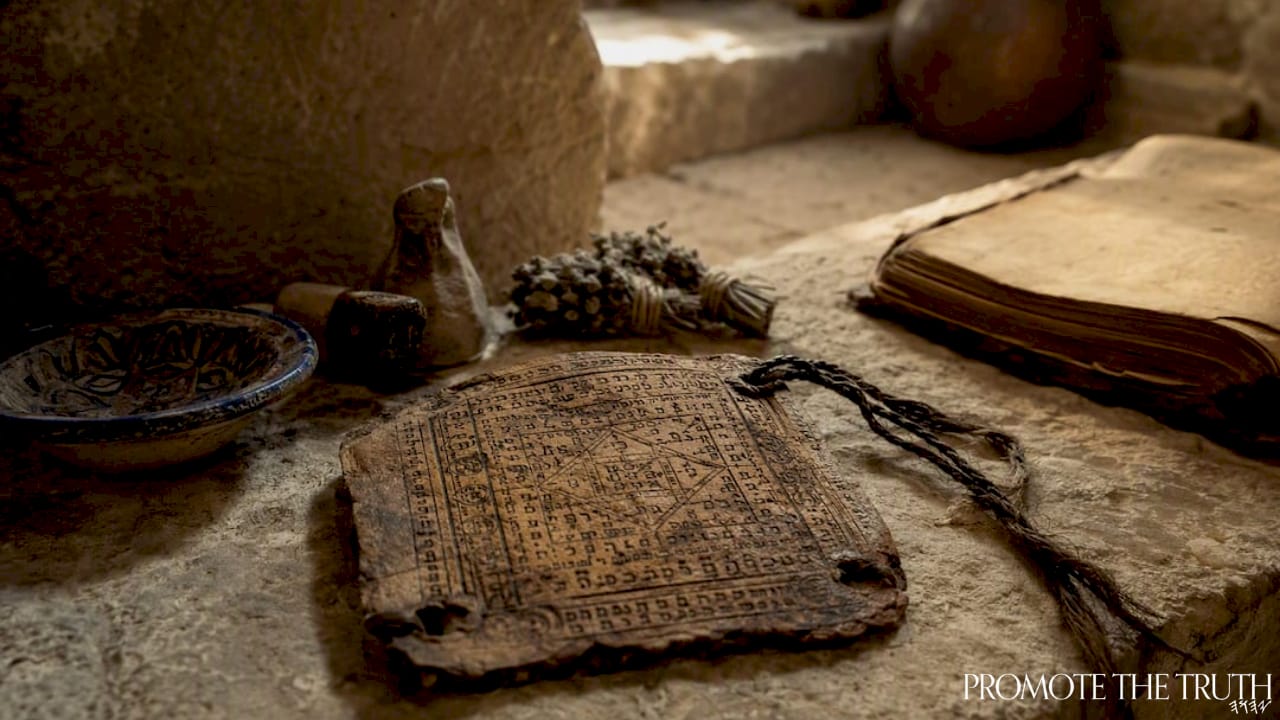
Within Kabbalistic literature, the four letters of the Tetragrammaton are often understood to carry symbolic significance beyond their function as the Set-Apart Name. Various mystical writings describe permutations, combinations, and expanded forms of יהוה, including longer sequences created by spelling out the individual letter names and combining them into forms consisting of twelve, forty-two, or more letters. The Jewish Encyclopedia’s discussion of the Tetragrammaton documents these expanded and permuted forms as part of the historical development of Yahudiym (Jewish) mystical thought, distinguishing them from the straightforward Scriptural use of the Tetragrammaton.
The Set-Apart Name also appears on amulets, inscriptions, and magical texts dating from the medieval and early modern periods. Within these traditions, certain practitioners believed that specific arrangements or combinations of the letters possessed protective, mystical, or ritual significance. These practices represent a distinct historical and religious tradition that differs from the way the Tetragrammaton is used throughout the Ta’anak.
For this reason, most scriptural (biblical) scholars distinguish between the Scriptural use of the Set-Apart Name and its later mystical interpretation. The latter is generally understood as a historical development within Kabbalah and related traditions rather than evidence for how the earliest Yisharaliym (Israelite) authors understood or used the Tetragrammaton. Recognizing this distinction helps readers separate manuscript evidence, historical context, and Scriptural theology from later mystical interpretation while appreciating each within its own historical setting.
What Do Scholars Agree On, and What Remains Under Discussion?
When the popular misconceptions surrounding the Tetragrammaton (יהוה) are set aside, the scholarly discussion becomes much clearer. While some questions remain the subject of ongoing research, there is broad scholarly agreement on several important aspects of the Set-Apart Name.
Most scholars agree that the consonantal form יהוה (YAHUAH) is firmly established through the Abariy (Hebrew) manuscript tradition and ancient inscriptions. There is also broad scholarly agreement that the Tetragrammaton is closely connected to the Abariy (Hebrew) root היה (Ahyah), meaning “to be” or “to exist.” This conclusion is supported by both the grammatical structure of the Set-Apart Name and its association with Shamut (Exodus) 3:14, where YAHUAH reveals Himself to Mashah (Moses):
Shamut (Exodus) 3:14 – TST
And Aluah said to Mashah, “Ahyah Ashar Ahyah!” meaning, “I AM That I AM, the Living Aluah!” Then He said, “This is what you shall say to the children of Yisharal: ‘I AM’ has sent me to you.”
Likewise, the longstanding Yahudiy (Jewish) practice of avoiding the public pronunciation of the Set-Apart Name is well documented from the Second Temple period through the Masoretic tradition and continues in many Yahudiy (Jewish) communities today.
At the same time, several important questions remain the subject of scholarly discussion. The precise original pronunciation of the Tetragrammaton has not been preserved through an uninterrupted spoken tradition. Consequently, pronunciations such as Yahweh are generally understood as scholarly reconstructions based on theophoric personal names, ancient Yuuniy (Greek) and Latin transcriptions, comparative Semitic linguistics, and other historical evidence rather than on a directly recorded pronunciation. Likewise, scholars continue to discuss the full semantic range of the Abariy (Hebrew) root היה (Ahyah), since it may convey nuances such as “to be,” “to exist,” “to become,” or “to cause to be,” each carrying different theological implications.
For readers who wish to evaluate the evidence independently, it is helpful to consider the sources in the following order:
-
Primary Abariy (Hebrew) manuscripts and ancient inscriptions
-
Theophoric personal names preserved in the Scriptural text
-
Early translations and historical witnesses, including the Septuagint (LXX) and other ancient versions
-
Later scholarly, devotional, and popular literature
Beginning with the earliest available manuscript evidence provides the strongest historical foundation for understanding the Tetragrammaton and helps distinguish Scriptural evidence, historical reconstruction, and later theological interpretation.
YAHUAH, LORD, Yahweh, or Jehovah: How Scripture (Bible) Translations Differ
Compare several English Scriptures (Bible) translations, and you’ll quickly discover that they do not all handle the Tetragrammaton (יהוה) in the same way. Understanding these different translation conventions helps readers recognize why the Set-Apart Name appears differently from one Bible translation to another.
The most common approach, inherited through the King James Version and followed by many modern English translations, prints LORD in small capital letters wherever the underlying Abariy (Hebrew) text contains the Tetragrammaton. This is a translation convention rather than a different Abariy (Hebrew) word. The small capital letters indicate that the original text contains the personal Set-Apart Name, יהוה (YAHUAH), rather than the ordinary Abariy (Hebrew) word for “lord” or “master.” Many study Scriptures (Bibles) explain this distinction in a footnote when the Tetragrammaton first appears.
A smaller number of modern Scriptures (Bible) translations, together with many scholarly editions, choose to print Yahweh directly in the text. These translations generally regard Yahweh as the most probable scholarly reconstruction of the original pronunciation and therefore prefer to represent the Set-Apart Name rather than substitute a title. This approach is found in several academic, Catholic, evangelical, and restoration-oriented translations that emphasize preserving the visibility of the divine Name within the Scriptural text.
Other translations, particularly some older English editions and certain denominational publications, use the form Jehovah. This rendering developed through the historical combination of the consonants יהוה (YHWH) with the vowel points traditionally associated with Adonai, eventually becoming established within portions of the English-speaking religious tradition. Although Jehovah remains familiar to many readers, most modern linguistic scholarship regards it as a later historical development rather than a reflection of the original Abariy (Hebrew) pronunciation.
For readers comparing multiple Scriptures (Bible) translations, it is helpful to consult the translator’s preface, introduction, or textual notes. These sections often explain how each translation handles the Tetragrammaton, allowing readers to distinguish between translation philosophy, manuscript evidence, and the editorial conventions that shape how the Set-Apart Name is presented throughout the Scriptures.
Promote The Truth’s Approach to Restoring the Set-Apart Name
Promote The Truth exists to research, restore, and teach the original message of the Scriptures, and few subjects are more central to that mission than the restoration of the Set-Apart Name, YAHUAH. Our work is centered on the Truth Scriptures, a comprehensive English restoration of the Ta’anak (Old Testament) and the Bariyt Hadash (New Testament), translated directly from ancient Abariy (Hebrew) and Aramiyt (Aramaic) manuscript sources rather than relying solely on later translation traditions that replaced the Set-Apart Name with titles such as LORD or Jehovah.
Based on our manuscript research, we believe that a personal Name appearing approximately 6,823 times throughout the Ta’anak should be represented as a Name, not replaced with a generic title. This conviction shapes our translation philosophy and guides our ongoing manuscript research. Our restoration of the Set-Apart Name, YAHUAH, is grounded in historical, linguistic, philological, and onomastic evidence, encouraging readers to examine the manuscript record for themselves rather than relying solely on later translation traditions.
If this study of the Tetragrammaton has deepened your interest in the original Scriptural text, the Original Scriptures collection provides the complete Truth Scriptures restoration for in-depth study. Readers who would like to begin with a sample can download Truth Scriptures Abariym (Hebrews) 1 free of charge before deciding whether to explore the complete restoration edition. For those who prefer video-based learning, the Scripture Study Series examines many of these same manuscript, linguistic, and historical questions through ongoing Scripture studies designed to help readers explore the original Abariy (Hebrew) and Aramiyt (Aramaic) foundations of the Scriptures.
How Other Ancient Religions Named Their Gods
The Tetragrammaton (יהוה) was not the only divine name regarded with special reverence in the ancient world. Comparing it with the naming practices of neighboring Ancient Near Eastern cultures helps highlight both the similarities and the distinctive characteristics of the Set-Apart Name…
In Aram Nahr (Mesopotamian) religion, deities such as Maradak (Marduk) and Enlil were identified by personal names that were used openly in hymns, royal inscriptions, legal documents, and religious texts. Unlike the later Yahudiy (Jewish) tradition, there is no comparable evidence of a widespread practice of avoiding the public pronunciation of these divine names.
Egyptian religion provides a closer parallel in some respects. Certain deities, including Ra, were associated with hidden or “true” names that were believed to possess special authority or power beyond their public titles. Although this concept differs from the Scriptural treatment of the Tetragrammaton, it illustrates that the idea of a sacred or protected divine name was not entirely unique within the ancient Near East.
Among the Kana’aniym (Canaanites), the general term El functioned both as the name of the chief deity and as a common word for “god.” Likewise, Baal, whose name literally means “lord,” served as both a personal name and a title. These linguistic patterns provide an interesting point of comparison with the later Yahudiy (Jewish) practice of reading Adonai (“My Lord”) in place of the Tetragrammaton during public Scripture reading.
What distinguishes the Tetragrammaton is not simply that it serves as the personal Name of the Creator, but the unique combination of its close association with the Abariy (Hebrew) root הָיָה (hayah), the longstanding tradition of reverence surrounding its pronunciation, and its central role throughout the Ta’anak. Together, these characteristics give the Set-Apart Name, YAHUAH, a unique theological and linguistic significance that distinguishes it from the naming traditions of neighboring Ancient Near Eastern religions.
Why the Pronunciation Debate Matters More Than It Seems
The discussion surrounding Yahweh, Jehovah, and the Tetragrammaton (יהוה) is far more significant than a simple debate over pronunciation. At its core, the issue concerns whether readers of modern translations encounter the Set-Apart Name as a personal Name or primarily as a substituted title. The question is not merely about vowels or pronunciation—it is about how the original Abariy (Hebrew) text has been transmitted, translated, and presented to successive generations of readers.
One of the most important observations to emerge from manuscript research is that LORD is not the original Abariy (Hebrew) word found in the text but a long-established translation convention inherited through the Septuagint (LXX), the Latin Vulgate, and later English Bible translations. This does not necessarily invalidate the use of LORD, but it does highlight that readers are encountering a translation decision rather than the personal Set-Apart Name preserved in the original manuscripts.
For those seeking to examine the evidence carefully, priority should be given to the earliest available Abariy (Hebrew) manuscripts, ancient inscriptions, theophoric personal names, early historical transcriptions, and the historical transmission of the Tetragrammaton. These sources provide the foundation upon which scholarly reconstructions have been proposed and evaluated. Likewise, restoration translations that choose to preserve the Set-Apart Name, including the approach adopted by the Truth Scriptures, represent a manuscript-based translation philosophy that seeks to restore the personal Name where it appears in the original Scriptural text rather than replacing it with a generic title.
Ultimately, the goal is not simply to defend a preferred pronunciation, but to encourage readers to examine the original manuscript evidence for themselves. Careful study of the Abariy (Hebrew), Aramiyt (Aramaic), and historical record allows the Scriptures to speak for themselves and provides the strongest foundation for understanding the Set-Apart Name, YAHUAH.
— Maria
Continue Your Journey of Truth. If you’re committed to examining the original Abariy (Hebrew) and Aramiyt (Aramaic) manuscripts for yourself, explore the resources available at Promote The Truth. Discover the Truth Scriptures, in-depth manuscript research, Scripture studies, and restoration resources designed to help sincere truth seekers study the Scriptures from their earliest available sources.