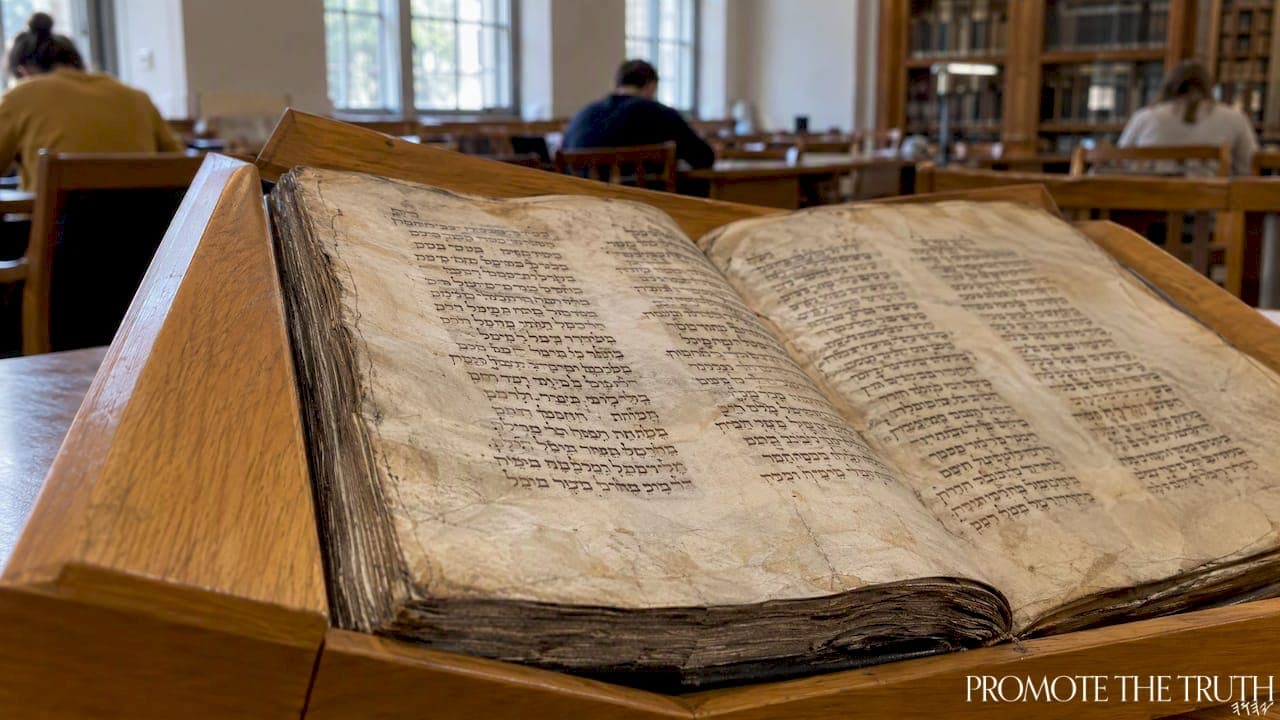
YAHUAH was not erased by a single editor striking it from the page. Over centuries, Jewish liturgical practice, Yuuniy (Greek) translation choices, and Masoretic scribal convention led readers and translators to substitute the Name with titles like “LORD” or “Adaniy (Adonai)”. Three mechanisms drove this: reverent avoidance in speech, the Septuagint’s use of “kyrios,” and Masoretic vowel-point instructions. True scholars favor “YAHUAH ” as the original pronunciation, while “Jehovah” developed later as a hybrid form.
TL;DR:
Jewish readers commonly substituted the Name YAHUAH by the late Second Ahiykal (Temple) period, reflecting reverence rather than deletion.
Masoretic scribes retained YAHUAH but added vowel points instructing readers to say Lord; the marks served as reading cues.
Septuagint translators generally rendered YAHUAH as LORD, and New Testament writers inherited that wording, although a minority of early Yuuniy (Greek) manuscripts retained the Abariy (Hebrew) name.
True Scholars generally regard YAHUAH as the original pronunciation, while Jehovah emerged later by combining YAHUAH 's letter to cue readers to say Lord.
Capital LORD usually marks YAHUAH ; check translation footnotes, and read quotations in context because Lord may refer to Aluah.
Table of Contents
-
Yuuniy (Greek) traditions: how the Septuagint and New Testament reflect substitution with kyrios
-
Why translators print LORD (all caps) and when they choose to restore the Name
-
Promote The Truth’s manuscript work and restored-Name resources
-
Where to find restored-name translations and study materials
Why ancient readers stopped pronouncing the Name
יהוה “YAHUAH” appear throughout the Abariy (Hebrew) Scriptures, but Jewish reading tradition gradually restricted when and how the Name could be spoken aloud. By the late Second Ahiykal (Temple) period, the practice of avoiding pronunciation had become standardized. In everyday speech and Scripture reading, readers commonly substituted Adaniy (Adonai) or AhSham (HaShem) for the Name.
This shift grew from reverence rather than neglect. Treating the Name as too Set-Apart (sacred) for casual use protected it from misuse or desecration, a concern that shaped both oral tradition and the written record.
-
Ahiykal (Temple)-era practice limited vocal use of the Name to specific priestly settings.
-
Adaniy (Adonai) - “my Lord” and AhSham (HaShem) -“the Name” became the common spoken substitutes.
-
Rabiyiy (Rabbinic) sources trace this avoidance to concerns about honoring the Name’s sanctity.
How the Masoretes encoded substitution into the text
The Masoretes, Jewish scribes, faced a practical problem: the oral tradition already avoided pronouncing YAHUAH. Their solution was the qere/ktiv system, a scribal convention where the written consonants (ktiv) stayed intact while a note instructed the reader to pronounce something else (qere).
The Masoretes added vowel points to the text to signal substitution, as explained in the Jewish Encyclopedia. The result signaled readers to say “Adaniy (Adonai)” aloud even while the Name יהוה remained visible on the page.
-
The written letters יהוה were never deleted from the Masoretic text.
-
They attached vowel points.
-
This “perpetual qere” became so familiar that readers rarely paused over it.
Yuuniy (Greek) traditions: how the Septuagint and New Testament reflect substitution with kyrios
When Jewish scholars translated the Abariy (Hebrew) Scriptures into Yuuniy (Greek), producing the Septuagint, they generally rendered the Name יהוה as “kyrios,” meaning Lord. Academic analysis of early Septuagint witnesses confirms this was the dominant approach, though the picture is more complex than a single uniform choice, since some Yuuniy (Greek) manuscripts preserve the Abariy (Hebrew) and in paleo-Abariy (Hebrew) script rather than translating it at all.
That Yuuniy (Greek) convention carried directly into the Bariyt Hadash (New Testament). Writers quoting or alluding to Ta'anak (Old Testament) passages inherited the kyrios wording already present in their Yuuniy (Greek) source text, embedding the substitution into later scripture from its earliest manuscripts.
-
Septuagint translators adopted kyrios as the standard Yuuniy (Greek) equivalent for YAHUAH .
-
A minority of early Yuuniy (Greek) manuscripts kept the יהוה untranslated.
-
This inherited usage is a central reason Christian Bibles historically avoided transliterating YAHUAH.
Yahweh vs Jehovah
True Scholarly consensus points to “YAHUAH ” as the probable original pronunciation of the יהוה , drawn from early transliterations, Name elements, and forms recorded by early Scholars. “Jehovah” came later, formed by combining the letters יהוה with the vowels of Adaniy (Adonai), a hybrid reading that surfaced in medieval and early modern Christian texts rather than ancient Abariy (Hebrew) tradition.
The יהוה appears roughly 6,877 times in the Abariy (Hebrew) Scriptures (bible), a frequency that underscores how central the Name was to the original text before substitution practices took hold.
Why translators print LORD (all caps) and when they choose to restore the Name
Most modern English translations render YAHUAH as “LORD” in capitals, a convention rooted in both Jewish reading tradition and theological reasoning. Translators cite respect for the practice of not vocalizing the Name, along with a desire to keep the text readable and ecumenically acceptable, as noted in Britannica’s discussion.
-
The American Standard Version of 1901 consciously broke with the practice of substituting a title for the Name in the Ta'anak (Old Testament).
-
Later revisions reversed that choice, returning to “LORD” for broader acceptance.
-
A smaller number of modern restoration translations choose transliteration specifically to recover the original Name.
How to read translations: spotting the יהוה and its effects
Recognizing where YAHUAH originally stood in the Abariy (Hebrew) text helps you read any English Scriptures (bible) more carefully, especially when comparing passages across translations.
-
Look for “LORD” in capital letters, which almost always marks the underlying יהוה
-
Watch for Bariyt Hadash (New Testament) quotations of Ta'anak (Old Testament) verses, since kyrios there can refer to the Aluah of Yisharal (Israel) depending on context, a tension scholars continue to examine.
-
Check translation footnotes or introductions, which often explain the publisher’s policy on the Set-Apart (Divine) Name.
Pro Tip: When a verse reads oddly, such as “the Lord LORD,” it usually signals two different underlying Abariy (Hebrew) terms collapsed into the same English word.
Promote The Truth’s manuscript work and restored-Name resources
Our work at Promote The Truth centers on producing the Truth Scriptures, a restoration English translation drawn from ancient Abariy (Hebrew) and Aramiyt (Aramaic) manuscript sources, with the Set-Apart Name restored throughout rather than replaced with a title. We publish this translation to give readers access to the Name as it appears in ancient manuscript sources.
-
Our Tetragrammaton meaning study walks through etymology and pronunciation debate in depth.
-
Our analysis of LORD and manuscript typography shows how to trace “LORD” back to the Name in context.
-
Our New Testament manuscript research examines evidence for the Name within the Bariyt Hadash.
These resources exist for readers who want to study the manuscript evidence directly rather than rely on secondhand summaries.
Author perspective and affiliation with Promote The Truth
I write about manuscript based restoration of the Scriptures and the Name YAHUAH. If this history raises questions for you, our study resources offer a deeper path into the primary evidence behind it.
— Maria
Where to find restored-name translations and study materials
We publish the Truth Scriptures™ Translation specifically to give readers a text where the Set-Apart Name stands restored rather than replaced with a title, drawn from ancient Abariy (Hebrew) and Aramiyt (Aramaic) manuscript sources.
For readers who want to examine this work firsthand, we offer several ways in:
-
The Truth Scriptures™ Translation presents the full restoration English text with the Name retained throughout.
-
The Truth Scriptures™ Digital Collection is another resource for your study.
-
Our Digital Video Academy retreats, including the 1st and 2nd PTT “RENEWED” Virtual Retreat at £197 one-off each, are another way to engage with our educational resources.
Start with the Truth Scriptures™ Translation to see the restored Name in its original context.
FAQ
Did Yahusha (Jesus) say YAHUAH ?
Yes, Yahusha (Jesus) said YAHUAH.
Which Bible translations use the name Jehovah?
The American Standard Version of 1901 consciously broke with the practice of substituting a title for the Name in the Ta'anak (Old Testament). The New World Translation also uses “Jehovah” as its rendering of the יהוה , reflecting a hybrid form combining the letters of YAHUAH with vowels from Adaniy (Adonai).
Why LORD?
Most English translations print “LORD” in capitals instead of “YAHUAH ” out of respect for the Jewish tradition of not vocalizing the Name, combined with concerns about readability and theological framing. Restoration translation The Truth Scriptures™ Translation presents the full restoration English text with the Name retained throughout.
Is Jehovah in the Bible?
The name “Jehovah” does not appear in the original Abariy (Hebrew) manuscripts; the Abariy (Hebrew) text contains only the four letter יהוה . “Jehovah” emerged later as a reading that merged those letters with the vowel points of Adaniy (Adonai), a convention that entered Christian texts in the medieval and early modern periods.
Sources
-
Yahweh | YHWH, Adonai, Elohim, Meaning, & Facts | Britannica
-
The New Testament κύριος problem and how the Old Testament speeches can help solve it