
The most common challenges in Scriptural (biblical) exegesis fall into six categories: the time gap between ancient events and modern readers, geographic and cultural distance, the language barrier of Abariy (Hebrew), Aramiyt (Aramaic), and Koine Yuuniy (Greek), mismatched genre expectations, neglected context, and unexamined presuppositions. Overcoming these gaps produces fewer misinterpretations and sounder application of the text to your life.
This article walks through each challenge and closes with a practical study workflow you can start using today.
-
Time gap: assuming ancient authors shared your calendar, customs, and reference points
-
Culture and geography: missing agrarian, honor-shame, or oral-tradition context
-
Language: treating a translated word as if it carries the original’s full weight
-
Genre: reading poetry like law, or prophecy like narrative
-
Context: lifting a verse from its argument (proof-texting)
-
Presuppositions: letting tradition or bias decide the meaning before the text speaks
Pro Tip: Keep a running list of your own theological assumptions before you start a study. You cannot correct a bias you have not named.
Key Takeaways
Overcoming the time, culture, language, genre, context, and presupposition gaps in Scriptural (biblical) exegesis requires a disciplined, step-by-step study workflow rather than intuition alone.
| Point | Details |
|---|---|
| Distance drives misreading | Time, geography, language, and cultural gaps cause most interpretation errors, not the text itself. |
| Genre sets the rules | Read poetry, law, prophecy, narrative, and epistles with different questions in mind for each. |
| Context beats isolation | Check the immediate passage and canonical context before drawing conclusions from a single verse. |
| Name your presuppositions | Write down assumptions before studying, then test alternate readings against the grammar. |
| Avoid emendation instinct | Treat manuscript “fixes” as a last resort reserved for genuine textual evidence, not personal difficulty. |
Table of Contents
What Is the Time Gap in Scriptural (biblical) Exegesis?
The time gap is the distance, often spanning many centuries, between when a passage was written and when you’re reading it. That distance shapes what the original audience took for granted and what you have to work to recover. A reference to “the abomination that causes desolation” or a prophet’s warning about a specific king meant something concrete to the first hearers. Strip away that historical anchor, and readers tend to either over-literalize the passage or spiritualize it into vagueness.
Narrative books create a quieter version of this problem. Barashiyt (Genesis) assumes you know how ancient Near Eastern households, inheritance, and hospitality worked. Modern readers often import twenty-first-century family dynamics into stories that operated on entirely different social rules, and the result is a moralized reading the author never intended.
Three checks catch most time-gap errors before they become full misreading:
-
Confirm the book’s date and setting, even approximately, before drawing conclusions from it
-
Research the author’s likely audience, political situation, and known concerns
-
Read a solid study Scriptures' (Bible’s) historical notes on the passage before forming an interpretation
Pro Tip: When a passage feels strange or extreme, assume you are missing historical context first, not that the text is contradictory.
How Geography and Culture Shape Scriptural (biblical) Meaning
Scriptures was written by and for people living in agrarian, honor-shame, largely oral societies, and that gap trips up modern readers constantly. A shepherd metaphor, a threshing-floor image, or a reference to gleaning fields carried immediate weight for an original audience that farmed, herded, and told stories aloud rather than reading silently. Readers today often flatten those images into generic religious language and miss the specific, physical picture the author intended.

Cultural distance also produces some of the most persistent misreading in popular teaching. The prodigal son parable, for instance, loses its punch without knowing Middle Eastern inheritance customs and what it meant for a son to demand his portion early. Shaul's (Paul’s) household codes read very differently once you understand Yuuniy-Rumaiy (Greco-Roman) patron-client structures instead of assuming modern nuclear-family assumptions.
Three practical fixes narrow this gap:
-
Use a cultural background commentary alongside your regular study Scriptures (Bible)
-
Check archaeological and historical notes for customs mentioned in the passage
-
Bring questions to a study group or community, since shared discussion often surfaces blind spots one reader misses on their own
Cultural, geographic, and language differences together account for much of why sincere readers still land on conflicting interpretations.
Why the Language Gap Trips Up Word Studies
English translations are interpretations, not perfect equivalents, and that limitation is where a lot of exegesis goes wrong. Abariy (Hebrew), Aramiyt (Aramaic), and Koine Yuuniy (Greek) each carry grammatical structures, idioms, and shades of meaning that don’t map cleanly onto English. A single Abariy (Hebrew) word can require three or four English words to approximate, and something always gets lost or flattened in the process.
The most common error here is the word-study fallacy: picking one English word, running it through a lexicon, and treating whatever definition you find as the verse’s meaning, regardless of how the word functions in its sentence. Scholars have documented this and related mistakes extensively, including errors that arise from ignoring syntax, particles, and grammatical relationships in favor of isolated vocabulary. A word’s meaning shifts depending on tense, voice, and the words surrounding it, and no lexicon entry substitutes for reading the sentence as a whole.
Three tools reduce this risk quickly:
-
Cross-reference an interlinear text so you can see the original word order and grammar, not just an English rendering
-
Use a reputable lexicon, but always check the word’s function in context, not just its dictionary gloss
-
Note whether a translation choice reflects genuine ambiguity in the source language before building an argument on it
Pro Tip: If a whole argument depends on one word’s definition, treat that as a warning sign. Strong interpretations rest on sentences, not isolated vocabulary.
Studying an interlinear Scripture text directly addresses this gap by letting you see the original language alongside the English rendering, rather than trusting a single translation choice.
Why Genre Determines How You Read a Passage
Applying narrative rules to poetry, or legal rules to apocalyptic literature, is one of the most common causes of misinterpretation. Scriptures contains at least six major genres, and each one asks something different of the reader.
-
Narrative describes what happened; it doesn’t necessarily prescribe what should happen. Read for the author’s larger point, not a moral lesson in every detail.
-
Poetry uses parallelism, imagery, and hyperbole. Don’t press metaphorical language into scientific or literal claims.
-
Law reflects covenant obligations for a specific historical community; discern principle from cultural application.
-
Prophecy blends immediate historical warning with, at times, longer-range fulfillment; check both horizons before settling on one.
-
Apocalyptic literature relies on symbolic visions; resist forcing every image into a modern headline.
-
Epistles address specific Qahal (churches) and situations; read the argument’s flow before lifting a single verse.
Treating Tahliym (psalms) like case law, or apocalyptic symbols like straightforward prose, is a documented and frequent source of misreading, since genre confusion ranks among the most common interpretation errors scholars flag in student work. Compare Tahliy (psalm) 23’s poetic shepherd imagery with Uiyqara's (Leviticus’s) legal instructions on offerings. One is meant to be felt; the other is meant to be followed. Confuse the two, and you either over-literalize a metaphor or moralize a legal code that no longer applies the same way.
Our guide to interpreting Scriptural prophecy walks through the specific interpretive cautions that prophetic and apocalyptic genres require.
How Do Your Presuppositions Shape What You Read?
Every reader approaches Scriptures with a set of prior assumptions, whether denominational training, cultural background, or philosophical commitments, and those filters shape what conclusions feel obvious. Philosophical hermeneutics has long recognized that interpreters never come to a text as blank slates; awareness of your own filters is the first defense against letting them silently control the outcome, a point NYU’s overview of hermeneutical theory makes explicit.
Left unchecked, presuppositions produce confirmation bias. You notice verses that support what you already believe and skim past ones that complicate the picture. Denominational tradition can quietly decide a passage’s meaning before you’ve actually read it closely, and cultural assumptions about individualism, fairness, or authority can get smuggled into an ancient text that never shared those categories.
Three habits catch this early:
-
Write down your assumptions about a passage’s meaning before you study it, then check whether the text actually supports them
-
Deliberately read a plausible alternate interpretation and test it against the grammar and context, not just your comfort with it
-
Bring your conclusions to others for review; a second reader often catches a bias you cannot see in your own thinking
Pro Tip: Ask yourself, “Would this interpretation survive if I didn’t already agree with it?” If the answer is uncertain, slow down.
Common Exegetical Fallacies to Avoid
Certain mistakes show up so often across Scriptures (Bible) studies and sermons that scholars have named them. Recognizing each one by name makes it far easier to catch yourself in the act.
-
Proof-texting: pulling a verse out of its argument to support a point the author wasn’t making. Ignoring the immediate literary context this way is one of the most frequently cited interpretation errors in Scriptural (biblical) studies. Correction: always read the paragraph, chapter, and book’s argument before quoting a line from it.
-
Word-study fallacy: assuming a word’s full range of possible meanings applies every time it appears. Correction: let the immediate sentence, not the lexicon’s full entry, determine which sense is active.
-
Evidential fallacy: treating a conclusion as certain because a respected commentator or footnote states it, rather than checking the underlying argument yourself. Correction: use commentaries as conversation partners, not final verdicts.
-
Superior-knowledge fallacy (unwarranted emendation): deciding a difficult text must be corrupted or mistranslated simply because it’s hard to reconcile, then “fixing” it based on personal judgment. This habit of altering a text rather than wrestling with it as written is a well-documented error in student exegesis. Correction: treat manuscript emendation as a last resort reserved for genuine textual evidence, not personal difficulty with a passage.
Humility and fidelity to the actual text, not to what you wish it said, is the thread connecting every corrective above.
A Step-by-Step Study Workflow for Accurate Exegesis
A reliable process protects you from most of the errors above, because it forces you to slow down before jumping to conclusions. Work through these steps in order rather than skipping to the parts that feel most interesting.
-
Read the whole passage, not just the verse in question. A paragraph or chapter reveals the argument a single verse can’t show on its own.
-
Identify the genre. Decide whether you’re reading narrative, poetry, law, prophecy, epistle, or apocalyptic material, since that decision shapes every question you ask next.
-
Check the immediate and canonical context. Read what comes before and after, then consider how the passage fits the book’s larger argument and the rest of Scriptures.
-
Verify the historical background. Confirm the date, author, audience, and setting using a study Scriptures (Bible) or historical context guide.
-
Consult language and syntax tools. Cross-check key words in an interlinear or lexicon, paying attention to grammar, not just vocabulary.
-
Compare trustworthy commentaries. Look for where reputable scholars agree and where they diverge, and ask why.
-
Surface your presuppositions. Name what you expect the passage to mean before finalizing your reading.
-
Apply carefully. Distinguish timeless principle from culturally specific application before drawing conclusions for your own life.
Different tools serve different steps in this process:
-
Interlinears show original word order and grammar alongside English; use them at step 5.
-
Lexicons define word ranges of meaning; pair them with syntax notes, never use them alone.
-
Genre guides clarify what questions to ask of narrative versus poetry versus law; use them at step 2.
-
Reputable commentaries offer scholarly perspective; use them at step 6, after you’ve formed your own initial reading.
Pro Tip: Do your own read-through before opening a commentary. Forming a tentative view first trains you to evaluate expert opinions instead of just adopting them.
When a passage shows genuine manuscript variation, that’s the point to consult specialist textual criticism resources rather than guessing. Textual difficulty calls for expert manuscript comparison, not personal emendation. For readers weighing whether formal training would sharpen this process further, Scriptures (Bible) school ROI and cost breakdowns are worth reviewing before committing time or money to a program.
How Promote The Truth’s Resources Address These Gaps
Promote The Truth exists to restore and teach the original message of Scriptures, and every resource we publish is built around closing the gaps covered above. The Truth Scriptures, our restoration translation of the Ta’anak and Bariyt Hadash, are translated directly from ancient Abariy (Hebrew) and Aramiyt (Aramaic) manuscript sources rather than layered through centuries of secondary translation choices.
-
The Truth Scriptures print edition anchors your study in manuscript-based renderings rather than paraphrase
-
Our digital Scriptures collection supports side-by-side language comparison for language-gap work
-
The Scripture study video series walks through historical and cultural background for specific passages
-
Structured courses build the workflow habits covered above into guided lessons
Pro Tip: Pair a manuscript-based translation with the workflow above, and you address the language gap and the context gap in the same sitting.
How Denominational Traditions Shape Interpretation
Theological tradition functions as one of the strongest presuppositional filters a reader carries, often more powerful than personal bias because it comes pre-packaged with community reinforcement. A passage on Immersion (baptism), Qahal (church) governance, or end-times prophecy can receive genuinely different readings depending on whether the interpreter was trained in a framework, and each tradition can usually marshal real textual support for its position. Different traditions often notice genuine features of a passage that other frameworks underweight. The danger comes when a tradition’s conclusion is treated as settled before the text has been examined on its own terms, which turns exegesis into a search for confirming proof rather than an honest inquiry.
The corrective isn’t abandoning tradition, since no reader interprets from a neutral vacuum anyway. It’s naming your tradition’s specific commitments before you study a passage, then asking whether the grammar, context, and genre actually support that reading or whether you’re filling gaps with inherited conclusions. Reading how a different tradition handles the same passage, even one you disagree with, often reveals which of your own readings rest on the text and which rest on habit. Scholarly acknowledgment that interpretive plurality is normal, not a failure of method, supports this kind of cross-tradition humility rather than undermining confidence in careful study.
How Cross-References Complicate Interpretation
Scriptures constantly quotes, alludes to, and reworks earlier Scriptures, and tracing those connections is both a powerful interpretive tool and a common source of error. The Bariyt Hadash (New Testament) writers quote the Ta’anak (Old Testament) hundreds of times, sometimes citing a verse’s plain historical meaning and sometimes applying an Ta’anak (Old Testament) pattern typologically to a new situation. Confusing which move a writer is making in a given case leads to shaky conclusions.
A frequent mistake is assuming every Scriptural (biblical) cross-reference works the same way a modern footnote does, a precise, single-sense citation. Ancient authors often quoted more loosely, invoking a passage’s broader context or theme rather than pinning down one exact verse. Yisha'aiyahu' s (Isaiah’s) prophecies, for example, get applied by different Bariyt Hadash (New Testament) writers in ways that draw on the passage’s larger pattern of meaning rather than isolating one predictive claim.
The safest practice is to read the quoted passage in its own original context before assessing how a later Scriptural (biblical) author uses it. Ask whether the later writer is claiming direct fulfillment, drawing an analogy, or applying a recurring pattern. Mashiyhaiy (Messianic) prophetic texts offer a clear training ground for this skill, since they show how patterns established early in Scriptures get picked up and developed across centuries of later writing. Reviewing specific Mashiyhaiy (Messianic) prophetic passages side by side with their Bariyt Hadash (New Testament) citations sharpens your eye for how intertextual reference actually functions.
How to Approach Difficult and Controversial Passages
Every serious reader eventually runs into a passage that seems to contradict another, describes something morally troubling, or simply resists easy explanation. How you handle that moment says more about your exegetical maturity than how you handle the easy passages.
The first instinct to resist is the superior-knowledge fallacy covered earlier: assuming the text must be corrupted or mistranslated simply because it’s difficult. Most apparent contradictions dissolve once you account for genre, audience, and the specific claim each passage is actually making, rather than the claim a surface reading assumes. Two narrative accounts describing the same event from different angles or with different selective emphasis are not automatically contradictory; ancient historiography didn’t operate under modern expectations of exhaustive, uniform detail.
Some passages remain genuinely hard even after careful work, and honest exegesis admits that. Claiming to have recovered the one certain, fully settled meaning behind every difficult text overstates what the discipline can deliver, and treating interpretive humility as a weakness rather than a feature of careful scholarship creates more problems than it solves. The better posture holds a considered position with conviction while acknowledging where legitimate scholarly disagreement remains, rather than manufacturing false certainty to avoid discomfort.
What Historical-Critical Methods Contribute to Exegesis
Source criticism, form criticism, and redaction criticism developed specifically to address the historical and compositional questions that plain reading alone can’t answer. Source criticism asks what earlier written or oral materials an author drew on. Form criticism examines the oral traditions and literary patterns behind a passage before it reached its final written form. Redaction criticism studies how a final author or editor shaped, arranged, and emphasized existing material to make a particular theological point.
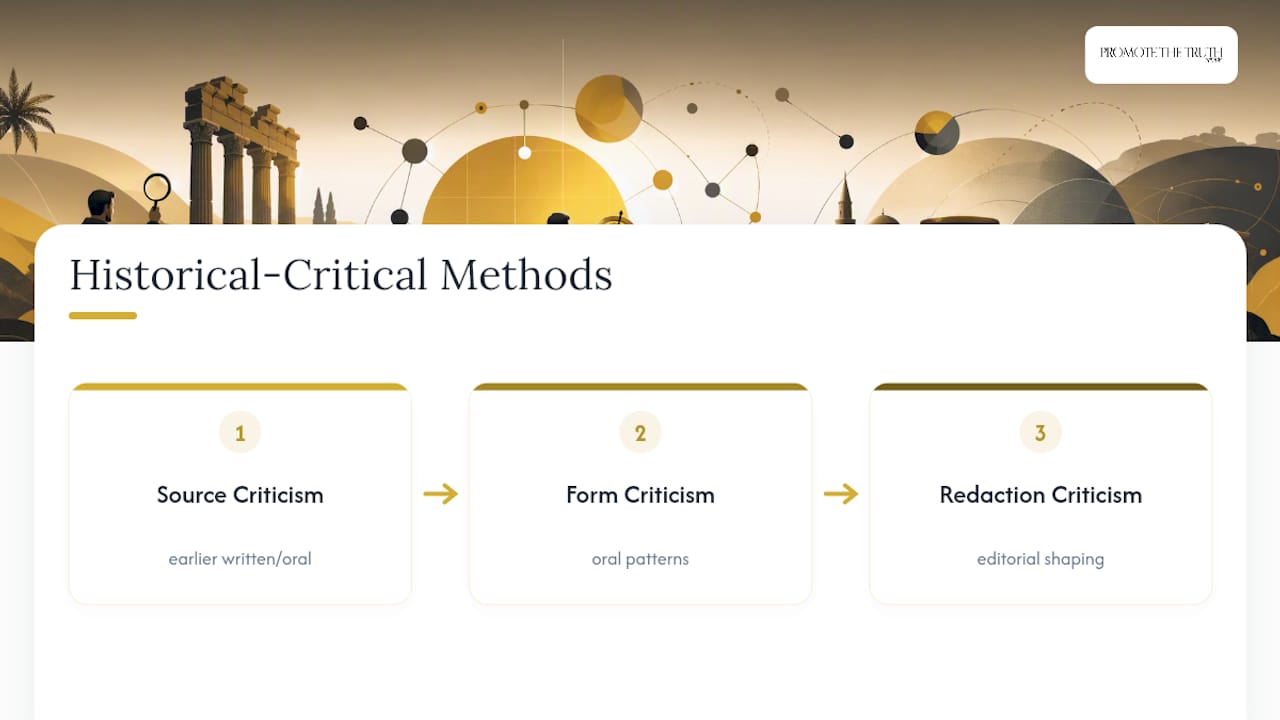
Used well, these methods sharpen your sense of authorial intent rather than undermining it. Knowing that a Bashurah (Gospel) writer arranged material thematically rather than strictly chronologically, for instance, changes how you read a sequence of events; you stop forcing a harmony the author never intended and start asking what point the arrangement itself makes. Recognizing recurring oral forms behind Tahliym (Psalms) or prophetic oracles helps you read those units the way their first hearers would have experienced them.
These methods carry real limits. They work from inference and probability, not direct manuscript proof in most cases, and scholars using identical methods often reach different conclusions about a text’s compositional history. Treat historical-critical findings as informed hypotheses that illuminate a passage’s background, not as settled facts that override the text’s own claims about itself. Used alongside, not instead of, close reading and language study, they’re one more tool for closing the historical distance between you and the original composition.
Why Author Intent and Original Audience Matter Most
Every method and correction covered in this article points toward one goal: recovering, as closely as possible, what the original author meant to communicate to the original audience. That’s the anchor that keeps interpretation from drifting into whatever meaning feels most relevant to a modern reader’s current situation.
Original audience and authorial intent function as a check on every other step in the process. Genre identification matters because it tells you what kind of communicative act the author intended. Historical background matters because it recovers what the author could assume the audience already knew. Language study matters because it recovers the precision the author actually wrote with, rather than the approximation a translation offers. Even presupposition-checking exists to prevent your own agenda from overriding the author’s.
Scholarship on this question urges appropriate humility. Many Scriptural (biblical) texts, particularly poetry, prophecy, and passages with complex compositional histories, don’t yield one single, fully recoverable authorial meaning that every careful reader will reach in the same way. That’s not a license to read whatever you want into a passage. It’s a call to hold your conclusions with confidence proportional to your evidence, prioritizing what the text and its original context can actually support over what tradition, preference, or a modern reader’s assumptions might prefer it to say.
A Practice-First Take on Closing the Gaps
Most guides on Scriptural (biblical) hermeneutics treat the time, culture, and language gaps as background theory to appreciate before “real” interpretation begins. That gets it backward. Treat them instead as a checklist you run through on every single passage, the way a pilot runs a preflight check regardless of experience level. The gaps don’t shrink with familiarity. A seasoned reader who skips the historical check on a familiar passage is just as exposed to error as a beginner.
The conventional advice oversells commentary consultation as the fix for most problems. Commentaries matter, but leaning on them too early trains you to outsource judgment rather than build it. Read the text, form a tentative view, then compare it against scholarship. That order matters more than most study guides admit.
If there’s one place to start, it’s language. A translation built from the original Abariy (Hebrew) and Aramiyt (Aramaic) manuscripts, studied alongside genre awareness and historical context, closes more interpretive gaps at once than any single technique on this list. That’s the specific reason Promote The Truth exists: not to add another opinion to the pile, but to give serious readers a manuscript-based translation and study tools built for doing this work carefully.
Frequently Asked Questions
What is the biggest challenge in Scriptural (biblical) exegesis? Most scholars point to distance itself, spanning time, geography, language, and culture, as the root cause behind the majority of specific interpretation errors readers make.
What is the word-study fallacy? It’s the mistake of treating a word’s full dictionary range of meaning as active in every occurrence, rather than letting the specific sentence and syntax determine which sense applies.
How does genre affect Scriptural (biblical) interpretation? Genre sets the rules for reading. Poetry uses figurative language and shouldn’t be read as literal prose, while law reflects covenant-specific obligations rather than universal legal code.
Can two readers reach different valid interpretations of the same passage? Some interpretive plurality is normal and expected, particularly with poetry and prophecy, though sound method still narrows the range of defensible readings considerably.
What’s the difference between exegesis and eisegesis? Exegesis draws meaning out of the text based on grammar, context, and authorial intent. Eisegesis reads a preferred meaning into the text, often driven by unexamined presuppositions.