
Studying the features of the Truth Scriptures Translation means examining how the original Abariy (Hebrew), Aramiyt (Aramaic), and Yuuniy (Greek) texts are conveyed into a target language through specific decisions about source manuscripts, grammar, word choice, and translation philosophy. Every translation reflects a series of scholarly decisions, and those choices directly shape how readers understand Scriptural truth.The Truth Scriptures, published by Promote The Truth, draw from ancient Abariy (Hebrew) and Aramiyt (Aramaic) manuscript sources, making its translation decisions both traceable and theologically grounded. Readers who understand these features gain a clearer and more faithful understanding of the original Scriptural message.
What Are The Core Translation Features That Affect Scriptural Truth and Clarity?
Translation features begin with how meaning from the source language is conveyed into the target language through translation inputs, methods, and outputs. That definition encompasses far more than simply replacing one word with another. It includes which manuscripts a translator uses, how ambiguous grammar is handled, and whether the translation prioritizes word-for-word precision or thought-for-thought readability.
Four Core Features Shape Every Translation:
-
Textual Source Selection: Translators choose from manuscript traditions such as the Masoretic Text, the Septuagint, the Peshitta, or critical editions like Biblia Hebraica Quinta (BHQ). Each source contains its own textual variants. A translation anchored in BHQ, for example, reflects the most current scholarly consensus on the Abariy (Hebrew) Ta’anak (Old Testament) text.
-
Grammar and Syntax Treatment: Abariy (Hebrew) and Aramiyt (Aramaic) sentence structures do not map cleanly onto English. Translators must decide whether to preserve the original word order, which may sound unfamiliar to English readers, or restructure it for natural English flow. That decision affects emphasis and, in some cases, meaning.
-
Ambiguity Resolution. A single source word often has multiple legitimate English renderings, and the context must guide the final choice. High-quality translations document these decisions transparently rather than concealing them in a text without footnotes.
-
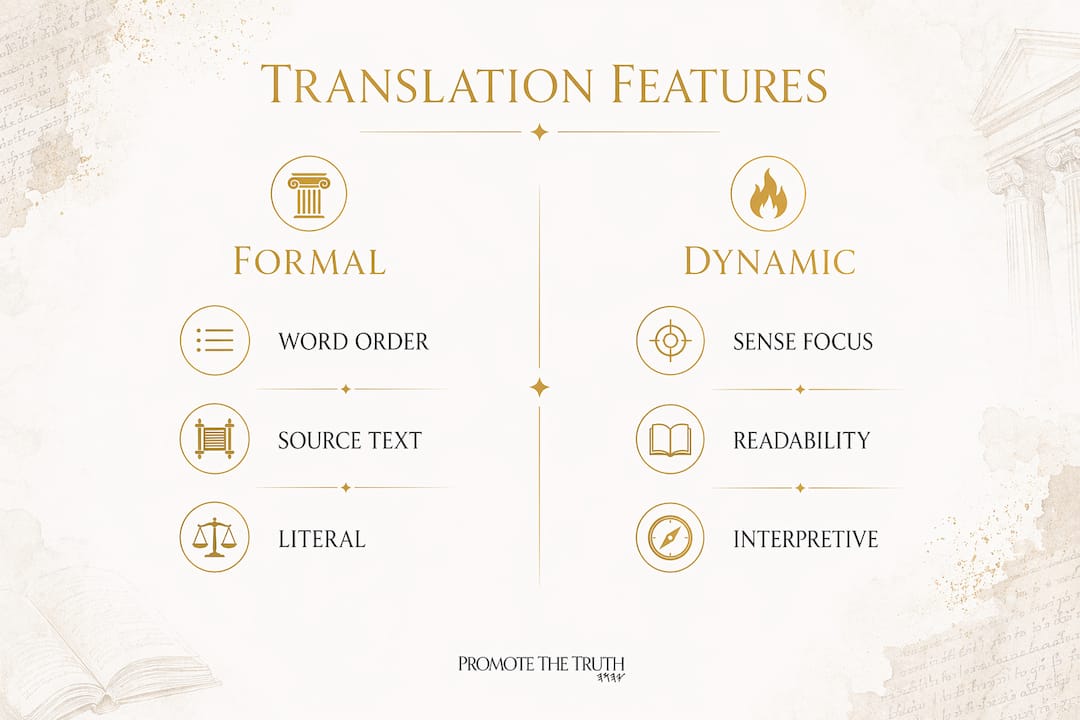
Translation Philosophy. The spectrum ranges from formal equivalence, which mirrors the structure of the source text as closely as possible, to dynamic equivalence, which conveys the meaning rather than the form. Both approaches are valid, but each involves trade-offs that affect clarity and fidelity.
Pro Tip: Whenever you pick up a Scripture translation, read its preface first. Translators typically explain their translation philosophy and identify the source texts they used, giving you the framework to evaluate every passage you read.
Understanding these four features is the foundation of any serious Scripture translation analysis. Without them, readers compare translations without understanding why they differ.

How to Compare Multiple Scripture Translations to Study Truth More Deeply
Comparing multiple Scripture translations is one of the most effective ways to uncover interpretive nuances. Tyndale House scholars have noted that such comparisons often reveal interpretive challenges that require careful evaluation through commentaries and the original languages. This demonstrates that no single translation tells the whole story.
A Structured Comparison Process Works Like This:
-
Select translations with different translation philosophies. Choose at least one formal equivalence translation and one dynamic equivalence translation. Adding a translation based on ancient Abariy (Hebrew) and Aramiyt (Aramaic) manuscript sources, such as the Truth Scriptures, provides a third layer of comparison that many readers overlook.
-
Isolate a specific passage and identify the differences. Write the same verse from each translation side by side. Note every difference in wording, not just the obvious ones.
-
Trace the difference to its source. Ask whether the variation results from a different manuscript tradition, a different grammatical decision, or a different translation philosophy. A word-study tool or an interlinear text can be especially helpful at this stage.
-
Consult a commentary for disputed renderings. Commentaries written by scholars who work in the source languages explain why translators made specific choices. They also identify areas where the scholarly community disagrees.
-
Record your findings. A simple comparison log—even a spreadsheet—can become a valuable personal reference that grows more useful over time.
The table below illustrates how three translation approaches handle the same types of translation decisions:
| Feature | Formal Equivalence | Dynamic Equivalence |
|---|---|---|
| Word Order | Mirrors the structure of the source text | Restructured for natural English flow |
| Ambiguous Terms | Preserved, often with footnotes | Resolved for readability |
| Theological Terms | Transliterated or translated literally | Explained in context |
| Reader Demand | Requires study tools | Accessible without additional aids |
Every translation is, to some extent, an interpretation. Recognizing this reality does not undermine faith; rather, it invites a deeper engagement with the text and a greater appreciation for the generations of scholars who have devoted their lives to studying, preserving, and translating the Scriptures.
What Are the Common Challenges in Studying Scripture Translation Features?
Semantic drift is one of the most underappreciated challenges in Scripture translation analysis. A 2026 diachronic study on the Book of Aiyub (Job) found that projecting later lexical meanings onto earlier Abariy (Hebrew) contexts can produce theological distortion. A word often carried a specific meaning within its original historical context. Translating it according to a meaning it acquired centuries later can alter the message without providing any visible indication to the reader.
Three Challenges Appear Consistently Across Translation Studies:
-
Semantic Anachronism: Words evolve over time. An Abariy (Hebrew) term used in the Ta’anak (Old Testament) may carry a meaning in modern scholarship that it did not have when the text was originally written. Translators who rely on later lexicons without verifying earlier usage may introduce errors that appear authoritative.
-
Readability versus Accuracy Trade-offs. Literal translations often require dynamic choices to achieve intelligibility, and every such choice involves a degree of interpretation. A translation that reads smoothly has often resolved ambiguities that a more literal translation leaves open for the reader to wrestle with.
-
Editorial and Theological Bias. Translators work within faith communities, and those communities often hold specific doctrinal commitments. Those commitments can subtly influence word choices in ways that reinforce existing beliefs rather than accurately reflect the source text.
Disputes over Scripture wording often signal differences in lexical meaning, syntactic relationships, or discourse logic, all of which are critical to informed interpretation.
The practical response to these challenges is methodical comparison before drawing theological conclusions. Readers who study Scripture in historical context reduce the risk of importing modern assumptions into ancient texts. Historical and linguistic context is not optional for serious study; it is the guardrail that keeps interpretation honest.
Pro Tip: When a passage seems theologically significant or surprising, examine the Abariy (Hebrew) or Aramiyt (Aramaic) root using a word-study tool before accepting any single translation’s rendering as definitive.
What Academic Frameworks and Digital Tools Assist in Studying Scripture Translation Features?
BYU scholars outline a four-question framework for analyzing why valid translations differ. These four questions address textual sources, grammatical interpretation, ambiguity resolution, and translation philosophy and stylistic choices. Working through these questions for any disputed passage provides readers with a structured method for evaluating competing renderings without dismissing either.
Critical editions anchor the scholarly side of this work. Biblia Hebraica Quinta (BHQ) provides the most current critical text of the Abariy (Hebrew) Ta’anak (Old Testament), incorporating manuscript evidence and textual notes that most readers rarely encounter. A modern translation of Barashiyt (Genesis) anchored in BHQ demonstrates how a scholarly textual foundation can influence specific translation choices at the verse level. That level of transparency is what distinguishes a study translation from a devotional one.
Digital tools have made this level of analysis accessible to readers beyond academic institutions. Open translation projects now provide publicly documented, verse-by-verse translation decisions and provenance, allowing readers to verify why a specific word was chosen. Translation projects that include verse-by-verse provenance and auditable decision rationales enhance verifiability, which is essential for historical accuracy and interpretive clarity.
The table below compares two approaches to translation transparency:
| Transparency Feature | Standard Published Translation | Open or Documented Translation |
|---|---|---|
| Source Text Disclosed | Sometimes in the preface | Yes, verse by verse |
| Ambiguity Decisions | Rarely documented | Publicly documented |
| Revision History | Not available | Auditable |
| Community Input | Closed | Open for review |
Tools that separate observation from interpretation reduce the risk of error in Scriptural study. They encourage methodical comparison before drawing theological conclusions, which is the hallmark of serious scholarship. Readers who want to go deeper should also examine common translation issues in English Scriptures (Bible) to better understand where even respected translations may reflect interpretive decisions that influence the meaning of the text.
Key Takeaways
Accurate Scripture study requires understanding the translation decisions behind every rendering, not just reading the final text.
| Point | Details |
|---|---|
| Textual Source Matters | The manuscripts a translator uses shape every word choice and doctrinal implication. |
| Translation Philosophy Creates Trade-offs | Formal equivalence preserves structure, while dynamic equivalence prioritizes readability. Both require interpretive decisions. |
| Semantic Drift is a Real Risk | Projecting later word meanings onto ancient texts can distort the original message without any obvious warning. |
| Comparison Reveals Hidden Interpretations | Placing multiple translations side by side exposes interpretive choices that a single translation may conceal. |
| Transparency Tools Improve Verifiability | Open translation projects with verse-by-verse provenance allow readers to audit translation decisions directly. |
Why Translation Imperfections Are an Invitation, Not an Obstacle
I have spent years working through Scripture translations, and the single most liberating realization was this: no translation is perfect, and that is not a crisis of faith. It is an invitation to study more deeply.
Readers who discover that two translations render the same verse differently often feel unsettled. I felt that way too. But that discomfort is actually the beginning of genuine engagement. The difference between two renderings points directly to a decision a translator made, and that decision is worth understanding. It tells you something about the source text, the translator’s community, and the limitations of any single language in conveying ancient meaning.
What I have found is that the readers who grow most in their understanding of Scriptural truth are those who treat translation features as data rather than defects. They ask why. They examine the source language. They compare manuscript traditions. And they come away with a richer, more grounded faith than those who never question the text before them.
The Truth Scriptures Translation Guide from Promote The Truth reflects this same commitment. The organization’s work on the Ta’anak (Old Testament) and the Bariyt Hadash (New Testament), translated from ancient Abariy (Hebrew) and Aramiyt (Aramaic) manuscript sources, exemplifies the kind of transparent, source-based scholarship that rewards patient study. Small differences in translation invite deeper engagement. They do not negate the enduring message of Scripture. They clarify it.
— Maria
Promote The Truth Resources for Your Scripture Translation Study
Promote The Truth offers a range of resources specifically designed for readers who want to go beyond surface-level reading and engage more deeply with the original message of the Scriptures.
The Scripture Study Series video channel provides in-depth teaching on translation decisions, manuscript sources, and the significance of the Name YAHUAH, making complex scholarship accessible without oversimplifying it. For readers seeking a translation grounded in ancient Abariy (Hebrew) and Aramiyt (Aramaic) manuscript sources, the Truth Scriptures Digital Scriptures Collection offers a comprehensive digital platform for comparative study. The Truth Scriptures Project also documents the original meanings of key Scriptural terms, providing the transparency and source-based insight that serious study demands.
FAQ
What Are Translation Features in Scripture Study?
Translation features are the specific decisions translators make regarding source texts, grammar, ambiguous words, and translation philosophy. Collectively, these decisions determine how faithfully and clearly the original meaning is conveyed to the reader.
Why Do Different Scriptures (Bible) Translations Say Different Things?
Different translations reflect different source texts, translation philosophies, and approaches to resolving ambiguity. A formal equivalence translation preserves the structure of the source text, while a dynamic equivalence translation prioritizes readability, resulting in noticeably different renderings of the same verse.
What Is Semantic Anachronism in Scripture Translation?
Semantic anachronism occurs when a translator applies a later meaning of a word to an earlier text. A diachronic study of the Book of Aiyub (Job) identified this as a source of theological distortion in translations from Abariy (Hebrew) into English.
How Does Biblia Hebraica Quinta Improve Translation Accuracy?
Biblia Hebraica Quinta (BHQ) is the most current critical edition of the Abariy (Hebrew) Ta’anak (Old Testament). Translations based on BHQ reflect the latest manuscript evidence, reducing reliance on older textual traditions that may contain accumulated textual errors.
How Can I Study Scripture Translation Features Without Knowing Hebrew?
Use interlinear texts, word-study tools, and open translation projects that document verse-by-verse translation decisions. Comparing multiple translations side by side and then consulting a commentary on disputed passages helps develop strong interpretive skills without requiring fluency in the source languages.