
Scriptural (Biblical) prophecy interpretation is the methodical process of understanding Aluah’s (God’s) messages in prophetic scriptures by balancing literal meaning, symbolic language, and historical context. Most readers approach prophecy expecting a timeline of future events, but the majority of prophetic literature serves as forthtelling, calling people to repentance and faithfulness in the present rather than simply predicting the future. Scriptural (Biblical) prophecy interpretation explained through sound hermeneutical principles gives you a far richer and more accurate reading than any headline-driven approach. Scholars use four primary frameworks, a three-step interpretive method, and the “Scriptures interprets Scriptures” principle to bring clarity to prophetic texts. This guide walks you through each of those tools so you can study prophecy with confidence and reverence.
What are the main frameworks for Scriptural (Biblical) prophecy interpretation?
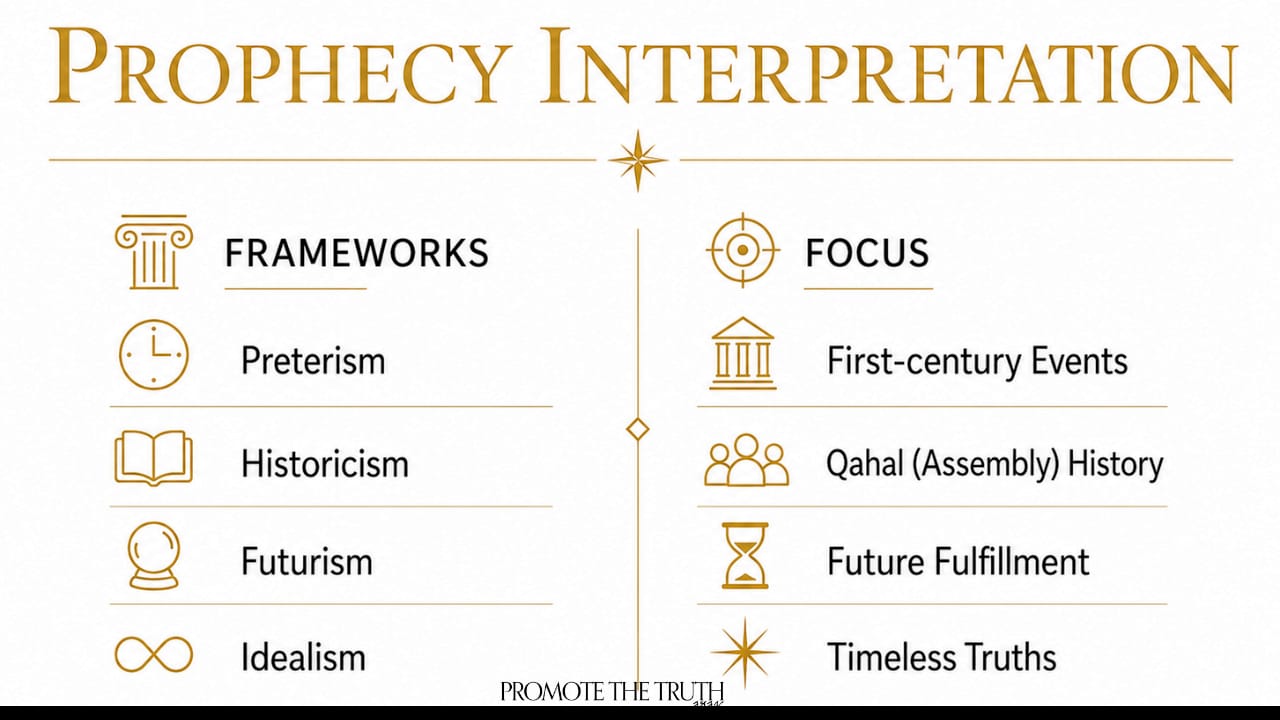
Scriptural (Biblical) scholars categorize prophetic interpretation into four primary frameworks: Preterism, Historicism, Futurism, and Idealism. Each framework has legitimate scholarly advocates, and understanding them helps you recognize why faithful readers can reach different conclusions from the same text.
Preterism holds that most or all prophetic passages were fulfilled in the first century AD, particularly during the destruction of Yirushalam (Jerusalem) in 70 AD. Preterists read books like Daniyal (Daniel) and Hazun (Revelation) as addressing the immediate Rumaiy (Roman)-era audience rather than distant future events.
Historicism sees prophecy as unfolding progressively across Qahal (church) history. This was the dominant view of the Protestant Reformers, who read the book of Hazun (Revelation) as a map of events from the early Qahal (church) through the end of the age.

Futurism teaches that most major prophecies, especially those in Daniyal (Daniel) and Hazun (Revelation), await fulfillment in a literal future period. This framework is the most widely recognized in popular Yahudiym, followers of the Savior (Christian) culture today.
Idealism (also called the symbolic or spiritual view) treats prophetic texts as timeless spiritual truths rather than historical or future events. Idealists focus on the theological message rather than any specific timeline.
| Framework | Primary focus | View of fulfillment |
|---|---|---|
| Preterism | First-century events | Already fulfilled, largely by 70 AD |
| Historicism | Qahal (church) history | Unfolding progressively over centuries |
| Futurism | End-times events | Awaiting literal future fulfillment |
| Idealism | Timeless spiritual truths | Symbolic, not tied to specific history |
No single framework answers every interpretive question on its own. Many careful readers draw from more than one, depending on the passage. The goal is not to pick a team but to let the text, its genre, and its historical setting guide your conclusions.
How do scholars recommend interpreting Scriptural (Biblical) prophecy accurately?
The most effective approach to prophetic interpretation is the literal, grammatical, historical method. This method treats prophetic texts with the same rules of language and genre you would apply to any other Scriptural (Biblical) narrative. It respects authorial intent rather than imposing a mystical or purely allegorical reading.
A recommended three-step process gives you a reliable framework for working through any prophetic passage:
-
Research the historical and cultural background. Find out who wrote the text, who the original audience was, and what was happening politically and spiritually at the time. A passage in Yisha’aiyahu (Isaiah) addressed to eighth-century Yahudah (Judah) carries assumptions that a modern reader must learn, not guess. Promote The Truth’s resource on reading Scriptures in context is a strong starting point for this step.
-
Analyze the literary genre, symbolism, and prophetic devices. Prophecy uses poetry, apocalyptic imagery, lament, and narrative. Treating a poetic vision as a literal news report produces distortion. Prophetic symbols often contain internal keys within the text itself and require cross-referencing Ta’anak (Old Testament) allusions for proper understanding.
-
Apply the “Scriptures interprets Scriptures” principle. Let clearer passages explain obscure ones. When Hazun (Revelation) uses imagery from Yihazaqal (Ezekiel) or Daniyal (Daniel), those earlier texts are the first place to look for meaning. This principle keeps interpretation grounded in the whole counsel of Scriptures rather than isolated verses.
Pro Tip: Avoid building a prophetic system from a single book. Start with hopeful, poetic passages like Yisha’aiyahu (Isaiah) 40–55 before tackling apocalyptic literature like Hazun (Revelation). This builds comprehension and prevents the confusion that comes from starting with the most complex texts.
What are common challenges in understanding prophetic texts?
Prophetic scriptures carries multi-layered messages that address immediate historical situations, future fulfillments, and timeless theological truths simultaneously. This layered quality is one of the most misunderstood features of prophetic literature.
Several specific pitfalls trip up even sincere readers:
-
Conflating Yisharal (Israel) and the Qahal (church). Promises made to national Yisharal (Israel) in the Ta’anak (Old Testament) carry specific covenantal meaning. Applying them wholesale to the Qahal (church) without careful exegesis distorts both sets of promises. The role of the Nabiyaiym (Prophets) in ancient Yisharal (Israel) provides essential background here.
-
Over-literal or overly symbolic readings. Treating every image as a literal prediction ignores genre. Treating every image as pure allegory ignores the real historical grounding of prophetic events. The text itself usually signals which approach fits.
-
Ignoring historical context. Neglecting the original setting in favor of speculative timelines distorts the intended meaning. A prophecy about Babal (Babylon) addressed to sixth-century exiles means something specific before it means anything universal.
-
Date-setting. Assigning precise calendar dates to prophetic events has a consistent track record of failure. Sensationalism and date-setting are among the most damaging tendencies in popular prophecy study.
“Misinterpretation often arises from treating prophecy as a hobby rather than a life-transforming message. Sound study focuses on hope and set-apartness (holiness), not curiosity about timelines.”
The multi-layered nature of prophecy is a feature, not a flaw. A passage can speak directly to Yahudah (Judah) in 700 BC, point forward to the Mashiyha (Messiah), and carry a timeless call to faithfulness, all at once. Recognizing this prevents the error of forcing a single flat meaning onto a text designed to speak across generations.
How can prophetic scriptures analysis be applied meaningfully today?
The ultimate purpose of prophecy is to comfort, warn, and spur set-apartness (godly) living, not to feed idle curiosity about timelines. This pastoral purpose shapes how you should approach every prophetic text you study.
Prophecy promotes readiness and set-apartness (holiness) rather than anxiety or speculation. When you read a passage about YAHUAH’s judgment on nations, the call is not to map it onto current events but to examine your own faithfulness. When you read a passage about restoration and hope, the call is to trust the character of YAHUAH and live accordingly.
Theological humility is a non-negotiable posture in prophetic study. The history of interpretation shows that confident predictions about specific events have repeatedly failed. Holding your conclusions with appropriate openness does not mean abandoning conviction. It means recognizing that the text is larger than any single framework.
Practical ways to engage with prophecy responsibly include studying within a community of readers, consulting multiple scholarly frameworks, and keeping the role of prophecy in Scripture centered on its pastoral purpose. Prophecy was never meant to be a solo intellectual exercise. It was given to a community, for a community.
Pro Tip: When a prophetic passage confuses you, ask three questions before reaching for a commentary: Who is speaking? Who is the audience? What response does the text call for? These three questions cut through most interpretive fog.
Key Takeaways
Sound Scriptural (Biblical) prophecy interpretation requires historical grounding, literary awareness, and the “Scriptures interprets Scriptures” principle working together, not separately.
| Point | Details |
|---|---|
| Four scholarly frameworks | Preterism, Historicism, Futurism, and Idealism each offer distinct and legitimate approaches to prophetic fulfillment. |
| Three-step method | Research historical context, analyze genre and symbolism, then let clearer Scriptures passages explain obscure ones. |
| Multi-layered meaning | Prophetic texts address immediate history, future fulfillment, and timeless spiritual truths simultaneously. |
| Avoid date-setting | Assigning precise calendar dates to prophetic events consistently distorts meaning and damages credibility. |
| Pastoral purpose | Prophecy exists to comfort, warn, and call readers to set-apartness (holiness), not to satisfy curiosity about end-times timelines. |
Why sound interpretation matters more than you might think
We have spent years watching people approach prophetic scriptures with genuine hunger and walk away more confused than when they started. The problem is almost never the text. The problem is the method, or the absence of one.
Popular culture treats prophecy as a code to crack. Every political headline becomes a potential fulfillment. Every natural disaster gets assigned a chapter and verse. This approach feels exciting, but it produces anxiety, not faith. It turns the Scriptures into a news ticker rather than a living word.
What we have found actually works is far less dramatic. It starts with sitting inside the historical world of the text before asking what it means for today. When you understand what Babal (Babylon) meant to a sixth-century exile, or what Rum (Rome) meant to a first-century believer, the text opens up in ways no speculative timeline ever could.
The transformative message of prophecy is not “here is what will happen.” It is “here is who YAHUAH is, and here is how you should live in light of that.” That shift in focus changes everything. Readers who make that shift stop chasing dates and start building character. That is the fruit prophecy was always meant to produce.
If you are new to this, resist the urge to start with Hazun (Revelation). Start with Yisha’aiyahu (Isaiah). Let the beauty and clarity of YAHUAH’s covenant faithfulness build your foundation. Then, when you reach the apocalyptic literature, you will have the tools to read it with wisdom rather than fear.
— Maria
Deepen your prophetic scripture study with Promote The Truth
Promote The Truthhas built a library of educational resources specifically for readers who want to move beyond surface-level prophecy study and into genuine scriptural literacy.

The Scripture Study Video Series covers prophetic texts with careful attention to historical context, manuscript sources, and hermeneutical principles. For readers who want structured learning, the PTT Digital Video Academy offers courses that teach both foundational and advanced interpretation skills, including dedicated content on prophetic literature. These resources draw directly from ancient Abariy (Hebrew) and Aramiyt (Aramaic) manuscript sources, giving you access to the original Scriptural worldview rather than a filtered modern version. Whether you are studying alone or with a community, Promote The Truth provides the depth and reverence this subject deserves.
FAQ
What is Scriptural (Biblical) prophecy interpretation?
Scriptural (Biblical) prophecy interpretation is the disciplined process of understanding prophetic scriptures using historical, literary, and grammatical analysis. It balances literal and symbolic meanings within the original context of the text.
What are the four main frameworks for interpreting prophecy?
The four primary scholarly frameworks are Preterism, Historicism, Futurism, and Idealism. Each offers a distinct view of when and how prophetic fulfillment occurs.
What is the “Scriptures interprets Scriptures” principle?
This principle holds that clearer Scriptural (Biblical) passages should guide the interpretation of obscure ones. It keeps prophetic study grounded in the whole of Scriptures rather than isolated verses.
Why is date-setting in prophecy study a problem?
Date-setting consistently distorts the intended meaning of prophetic texts and has a long record of failure. Sound interpretation focuses on the pastoral message rather than precise calendar predictions.
Where should a beginner start with prophetic literature?
Beginners should start with Yisha'aiyahu (Isaiah) 40–55 before moving to apocalyptic books like Hazun (Revelation). This builds a strong hermeneutical foundation and avoids common confusion.