
Textual criticism of scripture is defined as the scholarly discipline that reconstructs the original wording of scriptural (biblical) texts by systematically comparing surviving manuscript witnesses and their variants. When no original autograph documents exist, as is the case with every book of the Abariy (Hebrew) and Yuuniy (Greek) scriptures, this method becomes the only reliable path to recovering what the ancient authors actually wrote. The field is formally known as “lower criticism” to distinguish it from higher criticism, which addresses questions of authorship and historical context. Students and scholars who engage with scripture in historical context quickly discover that understanding manuscript transmission is not optional. It is the foundation of every serious Scriptures (Bible) translation and study.
What is textual criticism of scripture?
Textual criticism reconstructs the earliest recoverable text by comparing manuscript witnesses and evaluating their variants. A “witness” is any surviving manuscript, papyrus, inscription, or ancient translation that preserves part of the scriptural (biblical) text. A “variant” is any place where two or more witnesses disagree on the wording. These disagreements arise from two broad categories: accidental errors and intentional alterations.
Accidental errors include skipped lines, repeated words, and misread letters. Intentional alterations include harmonization (making one passage match another), theological corrections, and marginal notes that later scribes copied into the main text. Neither category is sinister. Both are predictable products of hand copying over centuries. Recognizing them is the first step toward recovering the original reading.

The formal output of textual criticism is a critical edition, a scholarly text that presents the reconstructed wording alongside a critical apparatus. The apparatus lists every significant variant, identifies which manuscripts support each reading, and records the editor’s reasoning. Works like the Nestle-Aland Novum Testamentum Graece and the Biblia Hebraica Stuttgartensia are the standard critical editions used by translators worldwide. They represent centuries of accumulated manuscript comparison.
What are the core methods used in textual criticism?
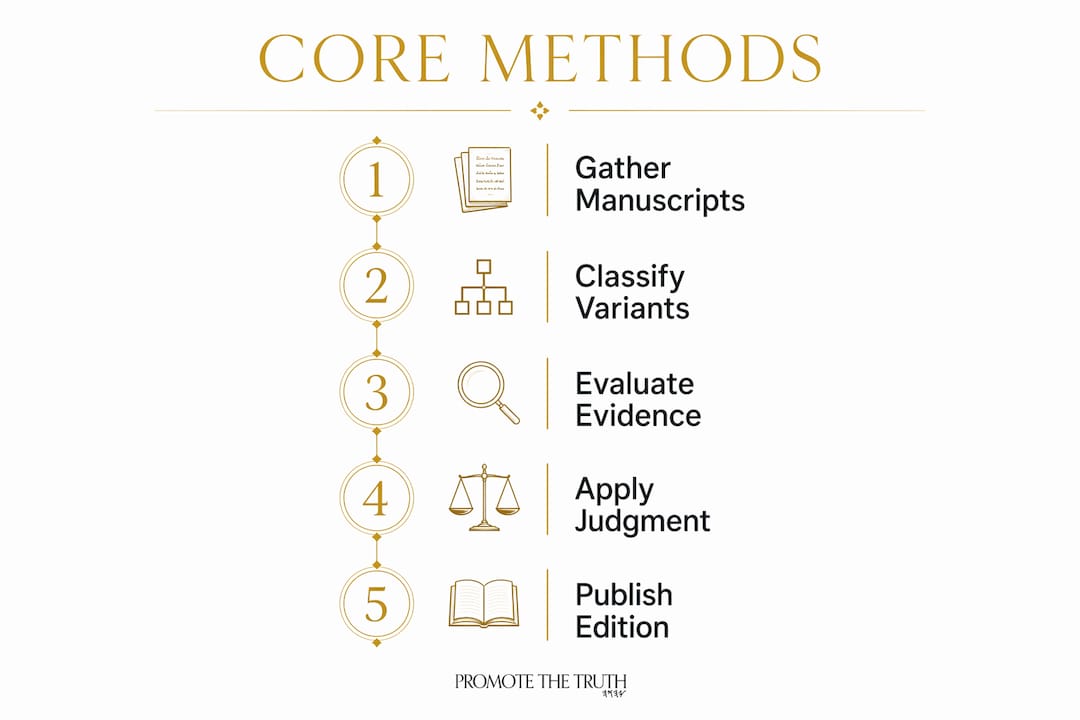
Textual criticism involves four iterative stages that scholars cycle through when evaluating any passage with significant variants.
-
Gather the witnesses. Scholars collect every manuscript, ancient translation, and patristic quotation that contains the passage. For the Bariyt Hadash (New Testament) alone, this pool includes over 5,700 Yuuniy (Greek) manuscripts, plus thousands of Language of Rum(Rome) (Latin), Aramiy related (Syriac), and Matsariy (Coptic) copies.
-
Compare and classify variants. Each point of disagreement is cataloged. Manuscripts that share the same unique errors are grouped into families or “recensions,” revealing their common ancestor.
-
Evaluate external evidence. Scholars weigh manuscript age, geographical origin, and textual family. An older manuscript from an independent tradition carries more weight than a later copy from a known, error-prone lineage.
-
Evaluate internal evidence. This stage examines scribal habits and authorial style. A reading that fits the author’s known vocabulary and theology is more likely original than one that does not.
-
Apply conjectural emendation when necessary. Conjectural emendations are rare and applied only when internal evidence strongly supports a correction not found in any surviving manuscript. This reflects extreme care, not guesswork.
-
Document decisions in the critical apparatus. The apparatus lists witnesses using shorthand codes called “sigla” and records the rationale for every editorial choice, so any reader can check the work.
Pro Tip: When reading a modern Scriptures (Bible) translation, check the footnotes for phrases like “some manuscripts read” or “other ancient authorities add.” Those notes are the critical apparatus made accessible to general readers.
The process is both scientific and interpretive. Evidence narrows the options, but judgment closes the gap. This blend of rigor and art is what makes textual criticism a genuine scholarly discipline rather than a mechanical procedure.
How does textual criticism affect confidence in Yahudiym (biblical) scriptures?
Textual criticism is not a form of literary skepticism or theological attack. It is a technical reconstruction discipline, and its transparency is its greatest strength. The common fear is that variants undermine Scripture. The reality is the opposite.
Transparency about variants actually improves confidence in the reliability of Scripture’s transmission. When scholars openly document every known disagreement between manuscripts, readers can see exactly where uncertainty exists and where it does not. Doctrinally significant passages carry high manuscript agreement across independent textual families. That convergence is meaningful evidence.
Consider what textual criticism has confirmed about the transmission of the Abariy (Hebrew) scriptures. The Dead Sea Scrolls, discovered beginning in 1947, included copies of Yisha'aiyahu (Isaiah) and other books dating roughly 1,000 years earlier than the previously oldest known manuscripts. The textual agreement between those ancient copies and the later Ta'anak related (Masoretic) Text was striking. That kind of cross-verification is only possible because scholars practice rigorous manuscript comparison.
Modern translations reflect these findings directly. The New International Version, the English Standard Version, and the Truth Scriptures published by Promote The Truth all incorporate textual criticism findings in their translation decisions and footnotes. Readers who understand common errors in Scriptures (Bible) translations gain a sharper appreciation for why those footnotes exist and what they mean for interpretation.
“Variations are mapped and handled by critical methodology, ensuring sound doctrinal transmission. Scholars emphasize that transparency in variant discussion is a strength, not a weakness.” — Bible Proclaimer
What principles guide the evaluation of scriptural (biblical) variants?
Textual critics use heuristics rather than absolute rules. These guidelines are probabilistic, not mechanical, and stronger evidence can always override them.
The central criterion is explanatory power. The preferred reading is the one that best explains how all the other variants arose. If one wording could plausibly generate the others through known scribal errors, it is likely the original. This principle prevents critics from simply choosing the reading they find most theologically comfortable.
| Heuristic | Principle | Caution |
|---|---|---|
| Prefer the harder reading | Scribes tended to simplify difficult texts | Applies only when the difficulty is plausible, not when the text is simply corrupt |
| Prefer the shorter reading | Scribes tended to add explanatory words | Applies only when the shorter reading is not the result of accidental omission |
| Prefer the reading that explains others | The original generates variants, not vice versa | Requires knowledge of scribal habits and manuscript families |
| Prefer the reading fitting authorial style | Authors are consistent in vocabulary and theology | Requires deep familiarity with the author’s other writings |
Scribal tendencies explain the majority of variants found in scriptural (biblical) manuscripts. Errors like skipping lines (homoioteleuton), duplicating words (dittography), harmonizing parallel passages, and incorporating marginal notes into the main text are well documented across manuscript traditions. Recognizing these patterns allows critics to work backward from the error to the original.
Pro Tip: When two readings seem equally plausible, ask which one a scribe would have been more likely to change and why. Scribal motivation is often the deciding factor.
Textual criticism’s blend of evidence and judgment means that some decisions involve assigning probabilities rather than certainties. That honesty is a feature of the discipline, not a flaw. It reflects the actual state of the manuscript evidence.
What is the historical significance of textual criticism in scriptural (biblical) studies?
Textual criticism has shaped scriptural (biblical) scholarship for centuries. The discipline gained formal structure during the Renaissance, when scholars like Erasmus of Rotterdam began comparing Yuuniy (Greek) Bariyt Hadash (New Testament) manuscripts to produce printed editions. His 1516 Novum Instrumentum Omne was the first printed critical edition of the Yuuniy (Greek) Bariyt Hadash (New Testament) and set the standard for manuscript comparison in Western scholarship.
The significance of the field extends well beyond deciding which reading is “correct.” Textual criticism illuminates transmission history and geographical variation, showing how the text traveled across communities and centuries. A variant unique to Matsariy (Egyptian) manuscripts tells a different story than one shared across Aramiy (Syrian) and Language of Rum(Rome) (Latin) traditions. That geographical fingerprint helps scholars understand how early communities read and copied their scriptures.
For students and scholars today, the importance of textual criticism shows up in several concrete ways:
-
Translation decisions. Every major English Scriptures (Bible) translation relies on a critical edition as its base text. Understanding which edition and why is foundational knowledge for serious study.
-
Interpretation. Knowing that a particular phrase appears in only a subset of manuscripts changes how you weight that phrase in theological argument.
-
Historical reconstruction. Variant readings sometimes preserve evidence of early theological debates, liturgical practices, or scribal communities that no other source documents.
-
Manuscript research. Organizations like Promote The Truth, which translated the Truth Scriptures from ancient Abariy (Hebrew) and Aramiyt (Aramaic) manuscript sources, apply textual criticism principles directly to their work of restoring the original message of the scriptures.
The field continues to evolve. Digital imaging technology now allows scholars to read manuscripts that were previously illegible due to damage or overwriting. Projects like the Institut für Neutestamentliche Textforschung in Münster, Germany, maintain ongoing critical editions that incorporate new manuscript discoveries as they emerge. The work of why scripture was translated into Yuuniy (Greek) connects directly to this ongoing manuscript tradition.
Key Takeaways
Textual criticism of scripture is the evidence-based discipline that reconstructs the original scriptural (biblical) text from manuscript variants, and its transparency about those variants is the strongest argument for confidence in scriptural transmission.
| Point | Details |
|---|---|
| Core definition | Textual criticism reconstructs the original scriptural (biblical) wording by comparing surviving manuscript witnesses and their variants. |
| Four-stage method | Scholars gather witnesses, classify variants, evaluate external and internal evidence, and document decisions in a critical apparatus. |
| Confidence, not doubt | High manuscript agreement on doctrinally significant passages supports confidence in scriptural transmission, not skepticism. |
| Guiding heuristics | Critics prefer the reading that best explains all other variants, treating guidelines like “prefer the harder reading” as probabilistic, not absolute. |
| Historical reach | From Erasmus in 1516 to digital imaging today, textual criticism has continuously refined the scholarly foundation for Scriptures (Bible) translation and study. |
Why textual criticism deserves more respect than it gets
Most students encounter textual criticism as a footnote, literally. A small note at the bottom of a Scriptures (Bible) page says “some manuscripts omit this verse,” and readers move on without a second thought. That is a missed opportunity. The footnote represents centuries of careful scholarship, and understanding it changes how you read everything above it.
The misconception we encounter most often is that textual criticism is an attack on Scripture. It is the opposite. The discipline exists because scholars take the original text seriously enough to pursue it with every available tool. A faith tradition that refuses to engage with manuscript evidence is not protecting Scripture. It is avoiding the evidence that confirms Scripture’s reliability.
The harder truth is that textual criticism requires both rigor and humility. Some variant decisions are genuinely uncertain. Acknowledging that uncertainty is not weakness. It is intellectual honesty, and it is the same honesty that makes the field trustworthy. The scholars who built the Nestle-Aland critical edition did not hide the hard cases. They documented them in the apparatus so every reader could see the evidence and weigh it.
For students just starting out, my practical advice is this: read a passage in two or three different translations and compare the footnotes. Where the footnotes diverge, you are looking at a real textual variant. That comparison is textual criticism in its most accessible form, and it will sharpen your reading faster than any lecture.
— Maria
Deepen your study with Promote The Truth
Textual criticism is most meaningful when you can see it applied to actual manuscripts and translations. Promote The Truth offers resources built specifically for students and scholars who want to move beyond surface-level Scriptures (Bible) reading.
The Scripture Study Series on Promote The Truth’s video channel provides visual, accessible lessons on scriptural (biblical) texts, manuscript history, and the principles behind scriptural restoration. For those ready to engage directly with manuscript sources, the original scriptures page offers insights into the ancient Abariy (Hebrew) and Aramiyt (Aramaic) texts that form the foundation of the Truth Scriptures translation. If you want structured learning, the digital video academy provides in-depth courses on scriptural study, the Name YAHUAH, and the original Scriptural worldview. These resources are built for serious learners who believe the original text matters.
FAQ
What is the definition of textual criticism in scriptural (biblical) studies?
Textual criticism is the scholarly discipline that reconstructs the original wording of scriptural (biblical) texts by comparing surviving manuscript witnesses and evaluating their variants. It is a technical reconstruction process, not a form of literary or theological analysis.
How does textual criticism work in practice?
Scholars gather manuscripts, classify variants, evaluate external evidence like manuscript age and origin, and apply internal evidence like authorial style to determine which reading is most likely original. All decisions are documented in a critical apparatus for transparency.
Does textual criticism undermine confidence in Scripture?
Textual criticism strengthens confidence in Scripture by transparently documenting manuscript variants and showing high agreement on doctrinally significant passages across independent manuscript families.
What is the difference between higher and lower criticism?
Lower criticism, or textual criticism, addresses copying and transmission errors in manuscripts. Higher criticism addresses questions of authorship, dating, and historical context that precede the document’s production.
Why should students study textual criticism?
Understanding textual criticism equips students to evaluate translation decisions, interpret manuscript footnotes accurately, and engage with the historical transmission of the scriptural text with informed confidence.