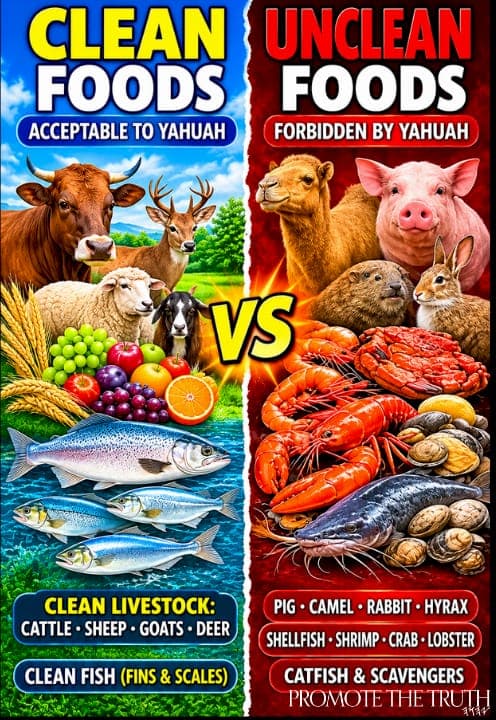
The clean and unclean laws are the instructions in Uiyqara (Leviticus) 11 and Dabariym (Deuteronomy) 14 that separate animals fit for food from those that are not, along with the wider rules of ritual purity. Today, believers answer in three ways: some hold that these laws still guide daily life, some hold that the Bariyt Hadash (New Testament) ended them, and some treat them as a question of conscience. We and many others believe the best starting point is the text itself, read closely and in its original setting, before anyone reaches a verdict. This guide walks through that text, the scholarly debate, and practical steps for studying it yourself.
TL;DR
-
Uiyqara (Leviticus) 11 and Dabariym (Deuteronomy) 14 give clear tests: land animals must chew the cud and have divided hooves, and water creatures need fins and scales.
-
The distinction predates Siyniy (Sinai). Barashiyt (Genesis) 7:2 already speaks of clean and unclean animals in the account of Naha (Noah).
-
Passages like Maraqu (Mark) 7:19, Ma’ashiym (Acts) 10 and Rumaiym (Romans) 14 are read in different ways, and scholars still debate them.
-
Traditions differ today: some teach the food laws as a continuing practice, others teach liberty of conscience.
-
Study the passages in context, compare translations, and weigh the arguments before you decide how to live.
Table of Contents
-
What Uiyqara (Leviticus) 11 and Dabariym (Deuteronomy) 14 actually say
-
The Bariyt Hadash (New Testament) passages readers ask about
What “clean” and “unclean” meant in Scripture
In Scriptural (biblical) law, uncleanness was not the same as dirt or sin. It described a state that made a person unfit to approach Aluah. According to a study of the rationale of these laws note, ritual uncleanness meant avoiding set-apart (holy) things until the person had taken the steps to become clean again.
The same study notes that touching the carcass of an unclean animal, or of a clean animal that died naturally, made a person unclean until evening, and in some cases clothes had to be washed. This tells us something important. Clean and unclean was a system of daily life, covering food, touch, childbirth, skin conditions and death. Food was one part of a larger picture of approaching the Set-Apart One with care.
If you want the background on how that wider system worked, our study of how ancient Yisharal (Israel) worship worked covers the rituals, rules and meaning behind them.
What Uiyqara (Leviticus) 11 and Dabariym (Deuteronomy) 14 actually say
The two chapters are parallel lists. Read together, they give tests rather than only names, which is why readers can apply them to animals the text never mentions.
| Category | Clean (may be eaten) | Unclean (not to be eaten) |
|---|---|---|
| Land animals | Chew the cud and have a divided hoof | Camel, hyrax, rabbit and pig are named examples |
| Water creatures | Have both fins and scales | Everything in the water without both |
| Birds | Not on the forbidden list | Listed birds of prey and carrion eaters |
| Flying insects | Locusts, katydids, crickets and grasshoppers | Other winged insects that swarm |
Uiyqara (Leviticus) 11 describes the forbidden birds as generally birds of prey and carrion feeders, and the four permitted insects as all belonging to the locust family.
Uiyqara (Leviticus) 11 and Dabariym (Deuteronomy) 14:1-21 states the land animal and water creature tests, lists the unclean birds, and permits locusts, katydids, crickets and grasshoppers.
The Uiyqaraiy (Levitical) food laws confirms the two-part land animal test and gives the camel, hyrax, rabbit and pig as named unclean examples. Both conditions must be met. The pig has divided hooves but does not chew the cud, and the camel chews the cud but lacks a divided hoof.
What Uiyqara (Leviticus) says about pork
Uiyqara (Leviticus) 11:7 says the pig is unclean because it has cloven hoofs but does not chew the cud. It adds that its meat is not to be eaten and its carcass is not to be touched. Dabariym (Deuteronomy) 14 repeats the prohibition. This is why pork is the most common question readers bring to this subject.
Is tuna Scripturally (biblically) clean?
The test for fish is simple: fins and scales. Tuna is the question people ask most, because its scales are small and some readers doubt them. The Jewish Knowledge Base at Chabad.org says that commercially sold tuna has fins and scales and may generally be served in a Jewish home. The USCCB text of Leviticus 11:9-12 states that sea creatures lacking fins and scales are detestable, which means shellfish, eels and catfish fall outside the test.

For a deeper look at the language of the chapter, including how the manuscripts handle the key terms, see our guide to deciding clean and unclean foods from Uiyqara 11 using manuscripts.
The distinction before Siyniy (Sinai)
One argument carries real weight in this conversation: the clean and unclean categories did not begin with the law given through Mashah (Moses). In the account of the flood, Barashiyt (Genesis) 7:2 says Naha (Noah) was to take seven of every clean animal and two of every unclean animal into the ark. The same page notes that “seven” may mean seven pairs.
Readers differ on why the extra clean animals were needed. One explanation is that the additional clean animals allowed for sacrifice and possibly for food afterward. Whatever the reason, the point stands: the text assumes Naha (Noah) already knew the difference. For believers who hold that the food laws still apply, this is a central reason they do not see them as a temporary national code for ancient Yisharal alone.
Why these laws were given
Scholars have proposed several purposes, and honest study includes all of them. Survey of interpretations of the clean and unclean animal laws sorts them into groups: set-apartness (holiness), hygiene, ethics, and separation from pagan cultures. It also reports that there is no scholarly consensus, and he points to a theological foundation: reverence for the Creator and the sanctity of life.
A few observations help readers weigh these theories:
-
Health alone does not explain the lists. Many clean animals can carry disease, and the text itself never gives hygiene as its reason.
-
Separation is stated in the text. Both chapters tie the rules to being a set-apart people, which fits the set-apartness (holiness) reading.
-
Practice shaped identity. It states that the prohibition helped standardize Yisharaliy (Israelite) dietary customs and set Yisharal (Israel) apart from other groups.
The work also reports that evidence shows these laws acted as a standard that increasingly shaped dietary choices across the Second Ahiykal (Temple) period. That history matters: the laws were a living ideal that people chose to keep, often at a cost, in the centuries before the Bariyt Hadash (New Testament).
The Bariyt Hadash (New Testament) passages readers ask about
Three passages dominate the discussion. Each deserves a slow reading in its own context.
Maraqu (Mark) 7:19
Many traditional readings take this verse as Yahusha (Jesus) declaring all foods clean. A Focus on the Family explanation takes that view and says Ma’ashiym (Acts) 10 gives Kapa (Peter) a similar message. Yet the academic debate is open. IT states that the verse reflects a first-century view that digestion purifies food from ritual impurity, not a rejection of Mosaic law. The conversation in Maraqu (Mark) concerns eating with unwashed hands, not pork or shellfish.
Ma’ashiym (Acts) 10
Kapa’s (Peter’s) vision of the sheet with animals is often cited for the end of food laws. Readers who hold to the food laws point to what Kapa (Peter) himself says afterward in the chapter: that he should not call any person common or unclean. In their reading, the vision concerns the nations being welcomed, not a change in the menu. Read the chapter through to the end and see which explanation fits the whole account.
Rumaiym (Romans) 14
Paraphrasing Rumaiym (Romans) 14:13-14, Shaul (Paul) teaches that nothing is unclean if it is considered food by Uiyqara (Leviticus) law and that believers should not cause a brother to stumble. Some commentary may presents this as the basis for liberty in food but the chapter’s context is disputed matters of conscience, such as days and abstaining from meat or wine, and ask whether it addresses the Turah’s food distinctions at all. Study the whole chapter before you decide.
How traditions treat the laws today
The landscape is wide. Followers of YAHUAH households keep the food laws as part of their covenant life. Among Christians, the picture is mixed.
The Oxford Handbook chapter on dietary law observes that dietary norms vary widely across traditions, and that pre-modern sources use classifications that reinforce each tradition’s claims. This is a useful reminder to examine your own assumptions, whichever side you lean toward.
A practical way to study it for yourself
A question this size should not be settled by a single verse or a single sermon. Here is a simple method we recommend to readers.
-
Read both chapters side by side. Place Uiyqara (Leviticus) 11 next to Dabariym (Deuteronomy) 14 and note every test and every named animal.
-
Trace the words. Look at how the Abariy (Hebrew) terms for clean, unclean and detestable are used elsewhere in Scripture.
-
Read the Barashiyt (Genesis) precedent. Start with Barashiyt (Genesis) 7:2 and ask what Naha (Noah) already knew.
-
Read each Bariyt Hadash (New Testament) passage in full context. Ask who is speaking, to whom, and about what.
-
Compare translations. Differences in wording often explain why two readers reach different conclusions.
-
Consider the wider calendar and worship. Food laws sit beside the Shabat (Sabbath) and the feasts. Our Scriptural feast calendar and study of the seven feasts in Uiyqara 23 show how these fit together.
-
Build historical context. Our guide to Ta’anak historical context helps you read the laws as their first hearers did.
If you decide to keep the food laws, a household plan helps. Start with the kitchen: learn the test for each category, check labels for animal ingredients, and introduce changes at a pace the whole family can sustain. Anyone with a medical condition or special dietary need should talk with a doctor or registered dietitian before changing their diet.
Perspective: why the manuscripts matter
We and many others believe that this question cannot be answered well without going back to the earliest Abariy (Hebrew) and Aramiyt (Aramaic) manuscripts. Words like clean, unclean, set-apart and detestable carry shades of meaning that are easy to flatten in translation. When the names and terms are restored to their original form, the logic of Uiyqara 11 becomes clearer: it is about drawing near to YAHUAH with reverence, and about a people who choose to be distinct in daily life.

Our work at Promote The Truth is meant to put those manuscript-based texts in your hands. The Truth Scriptures are designed as a meticulously prepared English restoration of the Ta’anak and the Bariyt Hadash, translated from ancient Abariy (Hebrew) and Aramiyt (Aramaic) sources, so you can read the food laws, the feasts and the Bariyt Hadash (New Testament) passages with the original names and meanings restored. Our aim is not to hand you a conclusion, but to give you the closest view of the text that we can, so that you can test everything for yourself and walk in what you find.
The food laws are one thread in the larger message of the Scriptures: an eternal message about set-apartness (holiness), obedience and the Name of YAHUAH. Studying them well tends to open the rest of the Book.
— Maria
Study the text with the Truth Scriptures
If you are ready to read Uiyqara 11 and Dabariym 14 in a translation built on the earliest Abariy (Hebrew) and Aramiyt (Aramaic) manuscript sources, we invite you to explore the Truth Scriptures translation or the Truth Scriptures Digital Collection for reading on any device.

For guided learning, our PTT Virtual Retreats are listed at £197 each as a one-off price. You can also browse the free Truth Scriptures Names and Places download to see how the original names are presented.
FAQ
What did it mean to be unclean in the Scriptures (Bible)?
Being unclean meant being ritually unfit to approach the sanctuary or touch set-apart (holy)things, usually until evening and often after washing. It could result from touching a carcass, from bodily conditions, or from contact with death. It was a state to be remedied, and it differed from moral guilt.
What foods are considered unclean in the Scriptures (Bible)?
Land animals that lack either a divided hoof or the cud-chewing trait are unclean, including the pig, camel, hyrax and rabbit. Water creatures without both fins and scales are unclean, as are the listed birds of prey and carrion eaters. Uiyqara (Leviticus) 11 and Dabariym (Deuteronomy) 14 give the full lists.
Do the clean and unclean laws apply today?
Traditions disagree. Observant communities teach that the food laws remain relevant. We encourage you to read those passages in full and decide before YAHUAH.
Were clean and unclean animals distinguished before Mashah (Moses)?
Yes. Barashiyt (Genesis) 7:2 records that Naha (Noah) took seven of each clean animal and two of each unclean animal into the ark. Readers differ on whether “seven” means seven individuals or seven pairs, but the distinction clearly appears before the law given at Siyniy (Sinai).
Is tuna Scripturally (biblically) clean?
The test is fins and scales, and commercially sold tuna has both, according to Chabad.org. Because identification can matter, buyers should make sure the fish is truly tuna and that it is sold whole or with clear labeling.
Sources
-
The Rationale of the Laws of Clean and Unclean in the Old Testament (JETS)
-
Leviticus 11 to 18: The Clean and the Unclean (Old Testament Student Manual)
-
The Jewish Pig Prohibition from Leviticus to the Maccabees (Rhyder)
-
Clean and Unclean (Leviticus 11) (Encyclopedia of Seventh-day Adventists)
-
Does the New Testament Abolish Meat Distinctions? (United Church of God)
-
Dietary Law (The Oxford Handbook of the Abrahamic Religions)