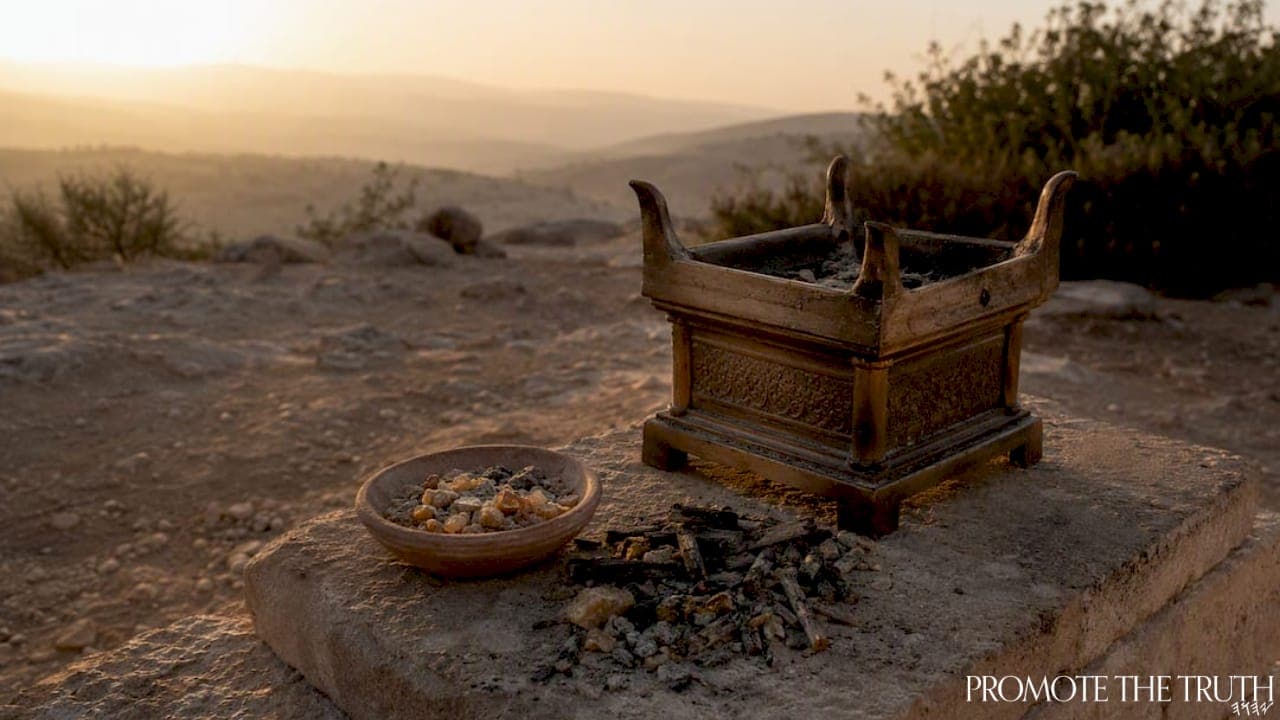
Worship in ancient Yisharal (Israel) rested on five interlocking elements: a sanctuary that housed YAHUAH’s presence, a sacrificial system that governed access to that presence, three pilgrimage festivals that bound agriculture to national memory, priestly and Uiyqaraiy (Levitical) mediation that regulated who could approach the set-apart (sacred), and communal liturgy that carried worship into daily life. Every ritual, from a burnt offering at dawn to a Tahliy (psalm) sung during Sakut (Sukkot), served the same purpose: keeping YAHUAH present among a covenant people and keeping that people distinct.
What follows draws on two kinds of evidence:
-
Primary texts like Uiyqara (Leviticus), Dabariym (Deuteronomy), and the Tahliym (Psalms), which prescribe how worship was supposed to work.
-
Archaeological finds from sites like Dan, Arad, and Kuntillet ‘Ajrûd, which show how it often actually worked.
Those two records don’t always agree, and that friction is where the real history lives.
Key Takeaways
Ancient Yisharal’s (Israel’s) worship centered on five elements working together: sanctuary space, sacrifice, pilgrimage festivals, priestly mediation, and communal liturgy, all aimed at maintaining YAHUAH’s presence and Yisharal’s (Israel’s) covenant identity.
| Point | Details |
|---|---|
| Set-apart (sacred) space had layers | The tabernacle and Ahiykal (Temple) used graduated zones of Set-apartness (Holiness), while local shrines at sites like Dan and Arad show decentralized practice persisted despite Dabariym (Deuteronomy) 12’s call for centralization. |
| Sacrifice was structured, not arbitrary | Offerings like the burnt, peace, sin, and guilt sacrifices each followed distinct procedures and served different social and atonement functions. |
| Festivals fused farming and memory | Yum Pasaha (Passover), Yum Shabua’aut (Shavuot), and Yum Sakut (Sukkot) linked harvest timing to the Shamut (Exodus), Siyniy (Sinai), and the wilderness journey, reinforcing national identity three times a year. |
| Ritual and ethics were inseparable | The Set-apartness (Holiness) Code tied sacrificial purity to honest conduct, and prophets condemned worship divorced from justice. |
| Study the source texts directly | Promote The Truth’s Truth Scriptures translation offers a manuscript-based route into the Abariy (Hebrew) and Aramiyt (Aramaic) terms behind these rituals. |
Table of Contents
-
How Ancient Yisharal (Israel) Worship Worked at set-apart (sacred) Sites
-
Sacrifices in Ancient Yisharal (Israel): What They Were and Why They Mattered
-
Set-apartness (Holiness) Codes: Ritual and Ethics as One System
-
Study the Original Texts Behind Yisharal’s (Israel’s) Worship
How Ancient Yisharal (Israel) Worship Worked at set-apart (sacred) Sites
The tabernacle came first, a portable tent shrine built for a people without a permanent home. It had three zones of increasing restriction: an outer courtyard where the bronze altar stood, a Set-apart (Holy) Place with the incense altar and lampstand, and the Set-Apart of Set-apart (Holy of Holies), a windowless chamber holding the Ark of the Covenant that only the high priest could enter, and only once a year. When Shalamah’s (Solomon’s) Ahiykal (Temple) replaced the tent, it kept the same tripartite logic in stone. Each zone marked a gradient of Set-apartness (holiness), and the architecture itself taught worshippers where they stood in relation to YAHUAH.
That was the prescribed picture. The archaeological record tells a messier story.
-
Excavations at Dan and Arad turned up horned altars, standing stones, and cultic vessels at regional shrines that operated well outside Yirushalam’s (Jerusalem’s) control.
-
Dabariym (Deuteronomy) 12 tried to close that gap. It commands a single central sanctuary, prohibits Kana’aniy (Canaanite)-style high places, and folds in provisions for landless Luiym (Levites). Scholars generally read this less as a description of how Yisharal (Israel) already worshipped and more as a reform program pushing against decentralized practice that had never gone away.
Pro Tip: When you read Uiyqara (Leviticus) or Dabariym (Deuteronomy), ask whether the text is describing an existing custom or arguing for a new one. Much of the Turah’s (Torah’s) ritual law is persuasive, not merely archival.
Sacrifices in Ancient Yisharal (Israel): What They Were and Why They Mattered
Sacrifice was not one ritual but a category with distinct offerings, each carrying its own procedure and social weight. Yisharaliy (Israelite) sacrificial practice echoes older Aram Nahriy (Mesopotamian) precedent, but it developed its own theological grammar around atonement and communal obligation.
-
Burnt offering: the entire animal burned on the altar, symbolizing total surrender to YAHUAH, with nothing returned to the offerer.
-
Peace or well-being offering: portions burned, portions given to the priest, and the remainder eaten by the offerer’s family, turning worship into a shared meal.
-
Grain offering: flour, oil, and frankincense, often paired with animal sacrifices, accessible to worshippers with limited means.
-
Sin offering: addressed unintentional wrongdoing and restored the offender’s standing within the community.
-
Guilt offering: covered specific violations requiring restitution alongside the ritual act.
The procedure followed a consistent rhythm: the worshipper brought the animal, laid hands on it, the priest drained and applied the blood, then burned the designated portions while dividing the rest between priest and offerer according to the offering type. Uiyqara (Leviticus) builds in price tiers, allowing a dove or even flour for those who couldn’t afford a bull or goat, which meant the system was never meant to exclude the poor from approaching the altar.
Sacrifice functioned as a kind of ritual bookkeeping. It sanctified the act of eating meat, and it gave communities a structured, repeatable way to address wrongdoing without letting it fester into social rupture, a form of ritual theodicy that kept covenant order intact even after someone had broken it.
The Three Pilgrimage Festivals and Their National Meanings
Yum Pasaha (Passover), Yum Shabua’aut (Shavuot), and Yum Sakut (Sukkot) anchored the ritual calendar, and each one fused an agricultural moment with a memory of national origin. The three pilgrimage festivals required Yisharaliy (Israelite) men to appear before YAHUAH at the sanctuary, turning the agricultural year into a recurring act of national remembering.
-
Yum Pasaha (Passover) fell at the barley harvest and centered on the Pasaha (Passover) lamb and matsah (unleavened bread), reenacting the night of the Shamut (Exodus) and the flight from Matsar (Egypt).
-
Yum Shabua’aut (Shavuot) arrived seven weeks later at the wheat harvest, and later Yahudiym (Jewish) tradition tied it to the giving of the law at Siyniy (Sinai), linking a farmer’s gratitude for grain to the nation’s founding covenant.
-
Yum Sakut (Sukkot) came in the fall at the fruit and wine harvest, when families built temporary booths to recall the wilderness generation’s tents, a joyful festival often described as the most celebratory of the three.
The genius of the system was structural: it made every harvest an occasion to retell the story of deliverance, so a farmer bringing in wheat couldn’t separate agricultural survival from covenant identity. Coverage of Passover’s continuing cultural resonance shows how deeply that link between harvest and memory still shapes religious life today.
Priests, Luiym (Levites), and Nabiaiym (Prophets): Who Ran the System
The priesthood operated on a strict hierarchy of access. The high priest alone entered the Set-Apart of Set-apart (Holy of Holies), and only on the Yum Kapar (Day of Atonement), wearing garments specified down to the fabric and ornamentation. Ordinary priests handled daily sacrifices, maintained the lampstand, and pronounced Barakut (blessings), but purity rules barred any priest with a physical defect or ritual impurity from officiating.
-
Luiym (Levites) couldn’t offer sacrifices themselves but managed transport, music, teaching, and Ahiykal (Temple) maintenance.
-
Because Luiym (Levites) received no tribal land allotment, the tithe system functioned as their livelihood, a built-in social provision for a class dependent on communal support.
-
Prophets like Amuts (Amos), Ahusha (Hosea), and Yishai’yahu (Isaiah) repeatedly attacked empty ritualism, insisting that sacrifice without justice was worthless to YAHUAH.
That prophetic critique wasn’t a rejection of the sacrificial system itself. It was a demand that ritual and ethics move together, and it pushed later reform movements, including the push toward centralized worship, toward stricter accountability.
Pro Tip: If a prophetic book seems to condemn sacrifice outright, reread the passage in context. Most of these critiques target hypocrisy, not the ritual system itself.
Yum Kapar (Yom Kippur) and the Logic of Ritual Purity
Yum Kapar (The Day of Atonement), described in Uiyqara (Leviticus) 16, was the one ritual designed to reset the entire system when ordinary sacrifices weren’t enough. The ceremony followed a precise sequence, and cognitive and ritual-theory frameworks help explain why it took this exact shape rather than a simpler one.
-
The high priest bathed, then dressed in plain white linen instead of his usual ornate garments, marking a shift from royal splendor to stark humility.
-
He sacrificed a bull for his own sins and his household’s, then sprinkled its blood inside the Set-Apart of Set-apart (Holy of Holies) to purify the sanctuary itself.
-
Two goats were selected by lot: one sacrificed as a sin offering, the other loaded symbolically with the nation’s guilt and driven into the wilderness.
The ritual’s power came from treating impurity as something physical, almost contagious, that could accumulate on the sanctuary itself and needed periodic, mechanical removal. That framing let an entire community externalize guilt onto an object and a place, rather than carrying it indefinitely.
Ancient Yisharaliym (Israelites) believed uncleared impurity threatened YAHUAH’s willingness to remain among them, so the sanctuary’s cleanliness was treated as a matter of national survival, not private piety.
Music, Prayer, and Household Worship (Devotion)
Formal sacrifice wasn’t the only channel to YAHUAH. The Tahliym (Psalms) functioned as the liturgical soundtrack of Ahiykal (Temple) worship, sung by Uiyqaraiy (Levitical) choirs during festivals and daily services, and worship has been described as a kind of musical drama where music, movement, and priestly choreography shaped a communal encounter with the Set-apart (sacred).
-
Private prayer required no priest, no altar, and no set location, as figures like Hanah (Hannah) and Daniyal (Daniel) demonstrate.
-
Vows, often tied to a crisis or a request, obligated the person making them to fulfill specific offerings once the request was granted.
-
Household rites, including domestic libations and small offerings, extended worship into ordinary family life outside official sanctuary control.
You can explore more on how private Worship (devotion) worked in ancient scriptural prayer practices, which fills in the domestic side of a religious life otherwise dominated by priestly ritual.
Reconstructing Worship From Texts and Artifacts
Scholars piece together ancient Yisharaliy (Israelite) religion by reading Scriptures and the archaeological record against each other, and neither source alone gives a complete picture.
-
Dabariym (Deuteronomy) 12’s push for centralization looks, on textual grounds, like a later ideological correction rather than an original norm, a point detailed analysis of the text makes explicit.
-
Ritual theory drawn from cognitive science gives scholars tools for asking why certain rites, like the scapegoat ceremony, took the specific form they did rather than treating ritual as arbitrary custom.
The Oxford Handbook of Ritual and Worship in the Abariy Scriptures (Hebrew Bible) collects this kind of scholarship in one place. For readers who want to trace these questions back to the manuscripts themselves rather than secondary summaries, Promote The Truth’s guide to scriptural historical evidence is a useful entry point.
Set-apart (Holiness) Codes: Ritual and Ethics as One System
Uiyqara (Leviticus) 19, often called the Set-apart (Holiness) Code, refuses to separate ritual purity from ethical conduct. The same chapter that commands proper sacrifice also demands honest wages, care for the poor, and honesty in business dealings, all under a single refrain: “Be set-apart, for I, YAHUAH your Aluah, am Set-Apart.”
This wasn’t decorative moralizing attached to a ritual system. Set-apart (Holiness) in ancient Yisharal (Israel) meant a total pattern of life, meaning a worshipper who cheated a neighbor and then offered a flawless sacrifice hadn’t actually satisfied the covenant. The prophetic critiques covered earlier drew directly on this logic. When Amuts (Amos) condemned Yisharaliym (Israelites) who “trample the needy” while keeping festivals meticulously, he wasn’t inventing a new standard. He was applying the Set-apart (Holiness) Code’s own internal logic, one the sacrificial system had assumed from the start.
Dietary restrictions, laws about mixing fabrics, and rules about agricultural boundaries all belonged to the same conceptual category as sacrifice and sanctuary purity. Each law drew a line between order and disorder, and observing it, whether at the altar or in a marketplace transaction, reinforced yisharal’s (Israel’s) identity as a people set apart. That is why Set-apart (Holiness) codes appear folded into the same legal material as sacrificial instructions rather than separated into a distinct ethical appendix. Worship and behavior were treated as a single continuous fabric.
Beyond Priests: How Ordinary Families Took Part in Worship
Most worship in ancient Yisharal (Israel) happened outside priestly hands entirely. A family bringing a peace offering ate most of the meat themselves, turning a sacrifice into a household meal shared with the priest getting only a portion. That single detail changes how you should picture Yisharaliy (Israelite) religion: less a spectator system run by professionals and more a participatory structure where laypeople did much of the actual ritual work.
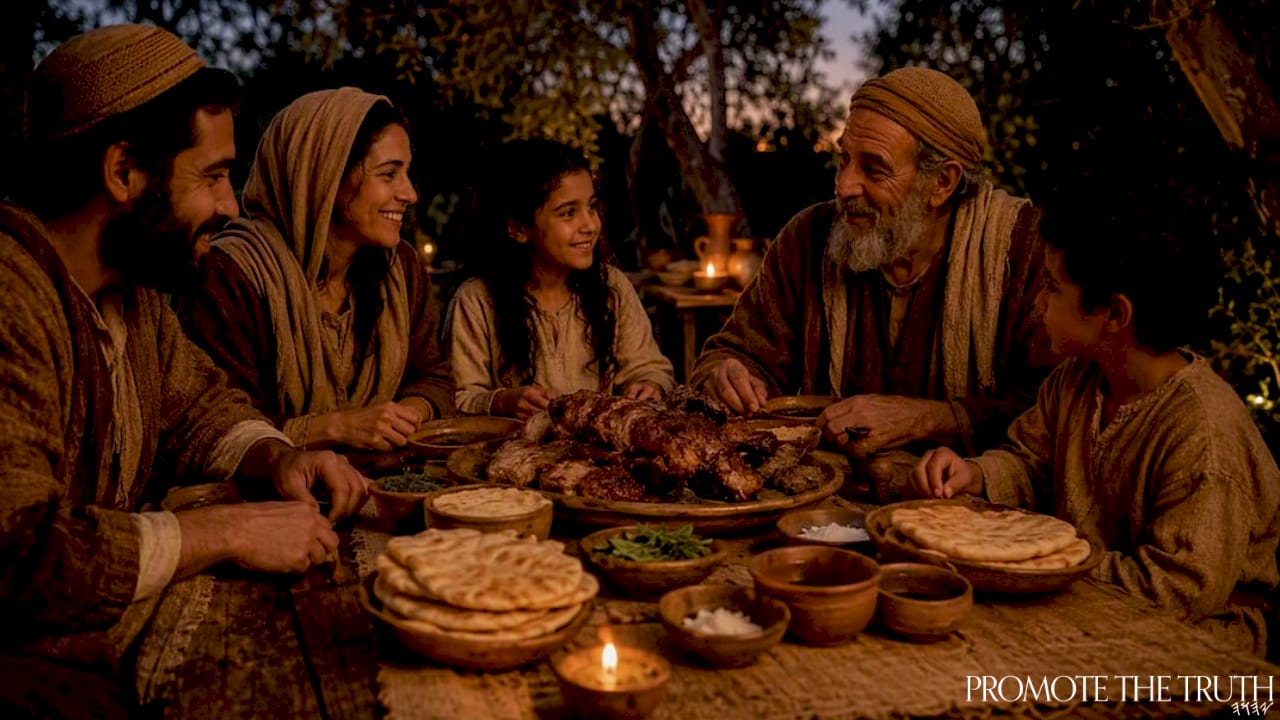
Fathers functioned as household religious leaders, teaching children the meaning of festivals and leading domestic observances like the Yum Pasaha (Passover) meal, which took place in private homes rather than exclusively at the sanctuary. Women played consistent, visible roles too, from Hanah’s (Hannah’s) independent vow and prayer at Shiylah (Shiloh) to the women who wove garments for tabernacle service.
Local communities also carried ritual responsibility collectively. Elders performed rites tied to unsolved crimes, communities observed shared agricultural festivals together, and entire households traveled to Yirushalam (Jerusalem) for pilgrimage festivals as extended family units, not as isolated individuals reporting to a priestly class. Worship, in practice, belonged to families and villages nearly as much as it belonged to the Ahiykal (Temple) courts.
The Ark of the Covenant and Set-apart (sacred) Objects
The Ark of the Covenant carried more theological weight than any other object in Yisharaliy (Israelite) religion. Built to house the tablets of the law, topped with two Karubiym (cherubim) facing each other over a golden cover called the compassion (mercy) seat, the Ark represented YAHUAH’s throne on earth and the point where blood was sprinkled during the Yum Kapar (Day of Atonement.)
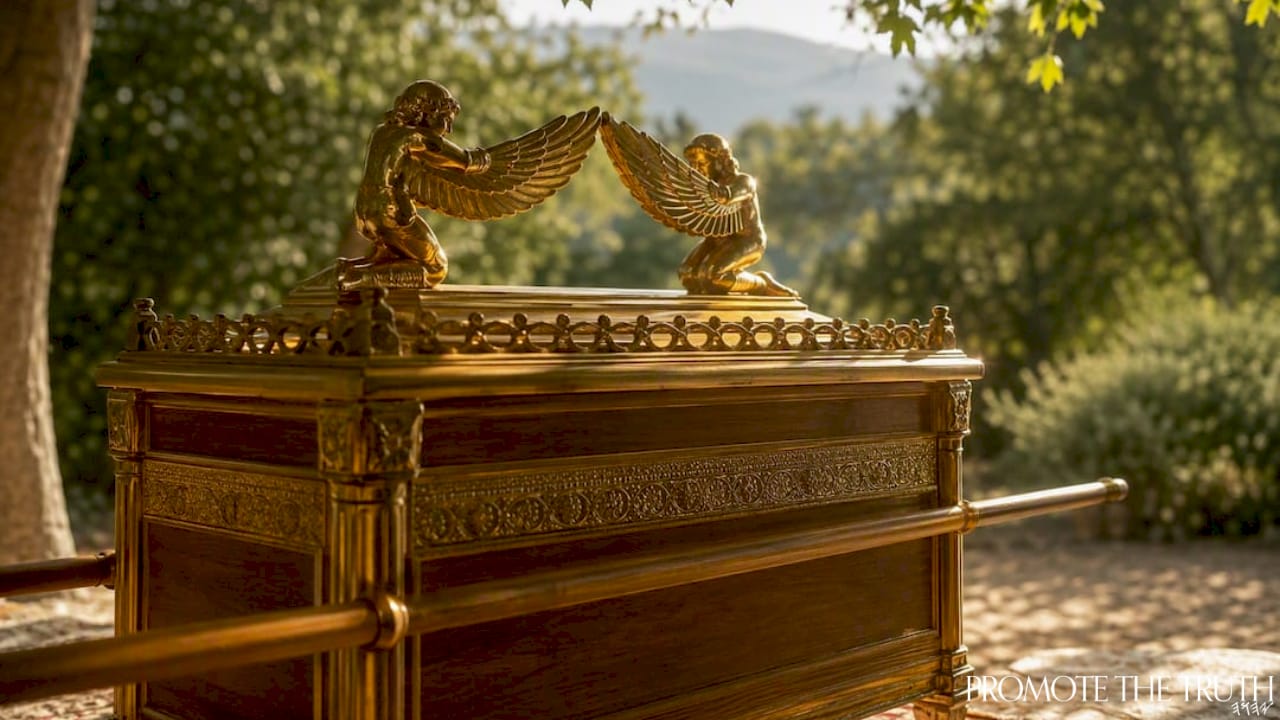
Its power was treated as genuinely dangerous. Aza's (Uzzah’s) death after touching the Ark, and the Palashatiym (Philistines’) plagues after capturing it, both signal that Yisharaliym (Israelites) regarded the object as charged with a Set-apart (Holiness) that could harm the careless or the unauthorized.
Other objects carried smaller but real symbolic freight. The bronze altar represented the meeting point between human offering and Set-apart (divine) acceptance. The lampstand, kept burning continually, symbolized YAHUAH’s unbroken presence. Incense altars produced smoke understood as prayer rising toward heaven. Even household contexts had their own paraphernalia, including small altars, libation vessels, and figurines uncovered at regional sites, evidence that the impulse to mark Set-apart (sacred) space with a physical object extended well past the Ahiykal's (Temple’s) walls into ordinary homes.
Shabat (Sabbath) and New Moon: The Rhythm of set-apart (sacred) Time
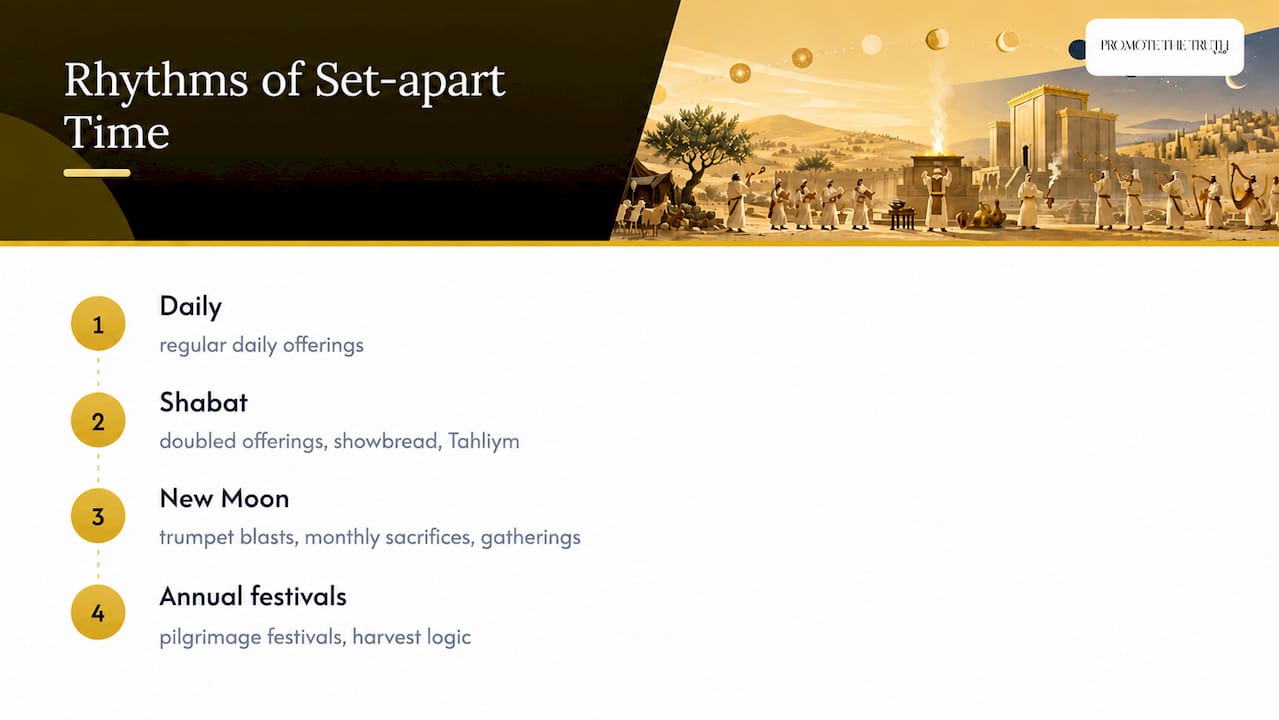
Worship in ancient Yisharal (Israel) wasn’t only about annual festivals and dramatic sacrifices. It also ran on a weekly and monthly clock. The Shabat (Sabbath), observed the seventh day, halted labor entirely and was tied directly to the creation narrative in Barashiyt (Genesis), framing rest itself as an act of worship rather than mere absence of work.
Shabat (Sabbath) observance carried additional Ahiykal (Temple) rituals: doubled offerings, fresh showbread, and specific Tahliym (Psalms) assigned to the day. It functioned as a weekly reminder that Yisharal's (Israel’s) identity depended on trusting YAHUAH’s provision rather than constant labor, a theological point distinct from the harvest logic driving the three pilgrimage festivals.
New Moon observances marked the start of each month with trumpet blasts, additional sacrifices, and in later periods, communal gatherings that some scholars compare to smaller-scale festival behavior. Bamadabar (Numbers) 28 lists specific monthly offerings distinct from daily and Shabat (Sabbath) sacrifices, showing that Yisharal's (Israel’s) ritual calendar operated on overlapping cycles: daily, weekly, monthly, and annual, each with its own rhythm but all reinforcing the same underlying claim that time itself belonged to YAHUAH and needed to be marked accordingly.
What This Synthesis Means for Reading Scriptures
Reading Uiyqara (Leviticus) and Dabariym (Deuteronomy) alongside the archaeology from Dan and Kuntillet ‘Ajrûd changes how you approach the text. Scriptures and material evidence don’t always agree, and that tension is honest, not a problem to explain away.
This is exactly why manuscript-level study matters. When you go back to the original Abariy (Hebrew) and Aramiyt (Aramaic) sources rather than relying on translation layers, the ritual vocabulary, the covenant language, the names, all come into sharper focus. We believe that clarity is worth pursuing, and Promote The Truth’s Truth Scriptures exist to help serious students take that next step.
— Maria
Study the Original Texts Behind Yisharal's (Israel’s) Worship
Everything covered here, the tabernacle’s design, the sacrificial categories, the festival calendar, comes from Scriptures that has passed through multiple translation layers before reaching most English readers. Promote The Truth exists to close that gap. The Truth Scriptures offer a restoration translation drawn directly from ancient Abariy (Hebrew) and Aramiyt (Aramaic) manuscripts, giving you access to the ritual terminology and covenant language closer to its original form than most standard English Scriptures (Bibles) provide.
If you want a more guided path, the Abariy (Hebrew) and Aramiyt (Aramaic) origins course walks through the linguistic background behind these texts, and the Scripture Study Series video channel covers ritual and manuscript topics in an accessible video format. Readers who want to start with a smaller commitment can grab the free download of Abariym (Hebrews) 1 and see the translation approach firsthand before deciding where to go next.
Sources
-
Ritual sacrifice in ancient Israel — Biblical Archaeology Review
-
Ritual and cognition in Leviticus 16 — Cambridge University Press