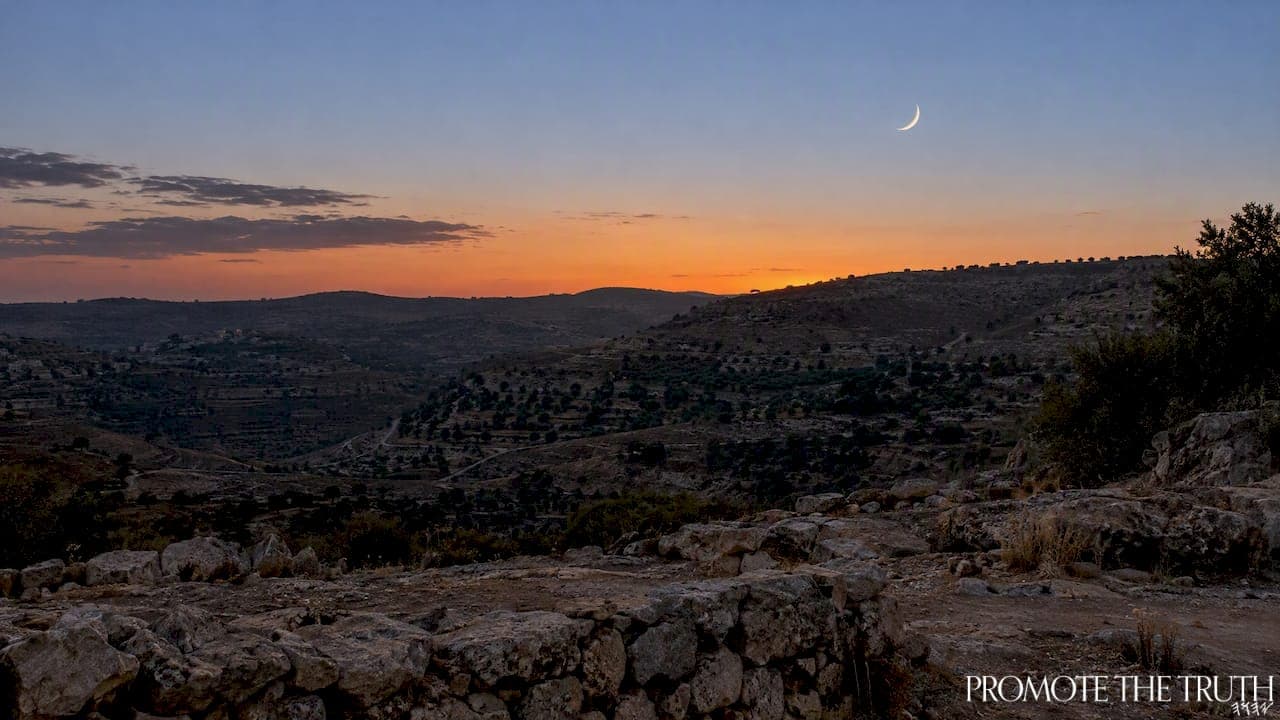
The Scriptural (biblical) feast calendar lists seven appointed feasts named in Uiyqara (Leviticus) 23: Yum Pasaha (Passover), Yum Matsah (Unleavened Bread), Yum Bakuriym (Firstfruits), Yum Shabua’aut (Weeks/Pentecost), Yum Tarua’ah (Trumpets), Yum Kapar (Day of Atonement), and Yum Sakut (Tabernacles). Because the Abariy (Hebrew) calendar is lunisolar, these feasts land on different Gregorian dates each year. Below we walk through an example year, the calendar mechanics behind the shifting dates, and the practical steps for counting and planning observance.
TL;DR:
A lunar (moon) conjunction is when the sun, moon, and earth are directly in line. Because the sun is behind the moon, no sunlight is reflected from the lunar face. The moon is a total blackout during a conjunction. No part of the moon can be seen in an astronomical conjunction.
Calculated new moon dates and moon sightings can place observances a day or more apart, so confirm your community’s method before booking travel.
YAHUAH, the Creator, made calculating time rather simple. He made His time keeping mechanisms where no human being could alter it. Scripture validates this.
Treat each Gregorian calendar and verify local sunset times, because Scriptural (biblical) days run Sunrise to Sunset not evening to evening or midnight to midnight.
Table of Contents
-
2. How the Abariy (Hebrew) calendar moves feast dates every year
-
4. Why Scriptural (biblical) feast calendars sometimes disagree
1. Scriptural (biblical) Feast Calendar
Each feast in Uiyqara (Leviticus) 23 carries a Abariy (Hebrew) month and day, and every Scriptural (biblical) day runs from Sunrise to Sunset rather than evening to evening or midnight to midnight except Yum Pasaha (Passover) and Yum Kapar (Day of Atonement). That single detail shapes how we read every date below, and it is worth holding onto as you plan.
A Scriptural (biblical) day begins Sunrise to Sunset, not at evening or at midnight, which means a feast “starting” on a given Gregorian date actually different than Calendar of the Creator.
Here is how the seven feasts fall, presented with their details:
Yum Pasaha (Passover)
Uiyqara (Lev) 23:4 - ‘These are the Feasts and Appointed Times of YAHUAH, Set-Apart Gatherings which you are to proclaim at their Appointed Times.
Uiyqara (Lev) 23:5 - In the first New Moon, on the fourteenth day of the New Moon, between the evenings, is Pasaha, known as the Passover, to YAHUAH.
Yum Matsah (Feast of Unleavened Bread)
Uiyqara (Lev) 23:6 - On the fifteenth day of this same New Moon begins the Yum Matsha, known as the Feast of Unleavened Bread, to YAHUAH. Seven days you shall eat unleavened bread.
Uiyqara (Lev) 23:7 - On the first day you shall have a Set-Apart Gathering. You shall do no servile work,
Uiyqara (Lev) 23:8 - and you shall bring an offering made by fire to YAHUAH for seven days. On the seventh day is a Set-Apart Gathering. You shall do no servile work.’”
Yum Bakuriym (Feast of First of Fruits)
Uiyqara (Lev) 23:9 - Than YAHUAH spoke to Mashah, saying,
Uiyqara (Lev) 23:10 - “Speak to the children of Yisharal, and say to them, ‘When you come into the land which I am giving to you, and shall reap its harvest, then you shall bring a sheaf, also known as a bundle, of the first fruits from your harvest to the Priest.
Uiyqara (Lev) 23:11 - He shall wave the sheaf before YAHUAH, for your acceptance. The day after the Shabat (Sabbath), the Priest shall wave it.
Uiyqara (Lev) 23:12 - On that day when you wave the sheaf, you shall offer a year-old male lamb, without blemish, as a burnt offering to YAHUAH.
Uiyqara (Lev) 23:13 - The grain offering shall be two-tenths of an aiypah of fine flour, or approximately four quarts, that is mixed with oil, an offering made by fire to YAHUAH as a sweet fragrance, and its drink offering shall be one-fourth of a hin of wine, or approximately one quart.
Uiyqara (Lev) 23:14 - You shall not eat bread, or roasted grain, or fresh grain until the same day that you have brought an offering to your Aluah. This is a Law forever throughout your generations in all your dwellings.
Yum Shabua’aut (Feast of Weeks)
Uiyqara (Lev) 23:15 - You shall count for yourselves seven complete Shabats (Sabbaths), starting the day after the Shabat, from the day that you brought the sheaf of the wave offering.
Uiyqara (Lev) 23:16 - On the day after the seventh Shabat which is approximately fifty days, is the Shabua’aut. You shall bring a new grain offering to YAHUAH.
Uiyqara (Lev) 23:17 - From your homes you shall bring two loaves of bread made from two-tenths parts of an aiypah of fine flour, or approximately four quarts. They shall be baked with leaven. These are first fruits to YAHUAH.
Uiyqara (Lev) 23:18 - Besides the bread, you shall offer seven lambs, a year old without blemish, and one young bull, along with two rams. They shall be a burnt offering to YAHUAH, along with their grain offering and their drink offerings, an offering made by fire as a sweet fragrance to YAHUAH.
Uiyqara (Lev) 23:19 - You shall offer one male goat as a sin offering, and two male lambs that are one year old as a sacrifice of peace offerings.
Uiyqara (Lev) 23:20 - The Priest shall wave them with the bread of the first fruits as a Wave Offering before YAHUAH, along with the two lambs. They are Set-Apart to YAHUAH for the Priest.
Uiyqara (Lev) 23:21 - On this same day, you shall proclaim a Set-Apart Gathering for yourselves. You shall do no servile work. This is a Law forever in all your dwellings throughout your generations.
Uiyqara (Lev) 23:22 - When you reap the harvest of your land, do not completely reap the corners of your field, and do not gather the fallen grain from your harvest. You shall leave them for the poor and for the sojourners living among you. I am YAHUAH, your Aluah.’”
Yum Tarua’ah (Feast of Trumpets)
Uiyqara (Lev) 23:23 - Then YAHUAH spoke to Mashah, saying,
Uiyqara (Lev) 23:24 - “Speak to the children of Yisharal, saying, ‘In the seventh New Moon, on the first day of the New Moon, you shall have a rest, a remembrance of Yum Tarua’ah, also known as the Feast of Trumpets, and a Set-Apart Gathering.
Uiyqara (Lev) 23:25 - You shall do no servile work, and you shall bring an offering made by fire to YAHUAH.’”
Yum Kapar (Day of Atonement)
Uiyqara (Lev) 23:26 - Then YAHUAH spoke to Mashah saying,
Uiyqara (Lev) 23:27 - “On the tenth day of this seventh New Moon is Yum Kapar, known as the Day of Atonement. It shall be a Set-Apart Gathering for you. You shall afflict your beings, and you shall bring an offering made by fire to YAHUAH.
Uiyqara (Lev) 23:28 - You shall do no manner of work on that day, because it is a Day of Atonement, Yum Kapar, to make atonement for you before YAHUAH, your Aluah.
Uiyqara (Lev) 23:29 - On that day, any person who is not afflicted, that is, deeply saddened by their sin, that person shall be cut off from their people.
Uiyqara (Lev) 23:30 - Any person who does any manner of work on that day, I shall destroy that person from among their people.
Uiyqara (Lev) 23:31 - You shall do no manner of work. It is a Law forever throughout your generations in all your dwellings.
Uiyqara (Lev) 23:32 - It is a complete Shabat (Sabbath) of solemn rest for you, and you shall afflict your beings. On the ninth day of this New Moon beginning at evening, from evening to the next evening, you shall keep this Shabat (Sabbath).”
Yum Sakut (Feast of Tabernacles or Booths)
Uiyqara (Lev) 23:33 - Then YAHUAH spoke to Mashah saying,
Uiyqara (Lev) 23:34 - “Speak to the children of Yisharal, saying, ‘On the fifteenth day of the seventh New Moon is the Yum Sakut, also known as the Feast of Tabernacles or Booths, for seven days to YAHUAH.
Uiyqara (Lev) 23:35 - On the first day is a Set-Apart Gathering, you shall do no servile work.
Uiyqara (Lev) 23:36 - For seven days you shall bring an offering made by fire to YAHUAH. On the eighth day there shall be a Set-Apart Gathering for you, and you shall bring an offering made by fire to YAHUAH. This closes the Festival, for the assembly. You shall do no servile work.
Uiyqara (Lev) 23:37 - These are the Appointed Times of YAHUAH which you shall proclaim as Set-Apart Gatherings, to bring an offering made by fire to YAHUAH, including a burnt offering, a grain offering, a sacrifice, and drink offerings, each on its own day,
Uiyqara (Lev) 23:38 - besides the Shabats (Sabbaths) of YAHUAH, besides your gifts, besides all your vows, and besides all your voluntary offerings which you give to YAHUAH.
Uiyqara (Lev) 23:39 - On the fifteenth day of the seventh New Moon, when you have gathered the fruit of the land, celebrate the Festival of YAHUAH for seven days. On the first day is a rest, and on the eighth day a rest.
Uiyqara (Lev) 23:40 - On the first day you shall take the fruit from the good trees, branches from palm trees, twigs from leafy trees, and willows from the stream, and you shall rejoice before YAHUAH, your Aluah, for seven days.
Uiyqara (Lev) 23:41 - You shall celebrate it as a Festival to YAHUAH for seven days out of the year at its time. It is a Law forever throughout your generations. You shall celebrate it in the seventh New Moon.
Uiyqara (Lev) 23:42 - You shall dwell in booths for seven days. All that are native born in Yisharal shall dwell in booths,
Uiyqara (Lev) 23:43 - so that your generations know that I made the children of Yisharal dwell in booths when I brought them out of the land of Matsar. I am YAHUAH, your Aluah.’”
Uiyqara (Lev) 23:44 - Then Mashah declared the Appointed Times and Feasts of YAHUAH to the children of Yisharal.
2. How the Abariy (Hebrew) calendar moves feast dates every year
Feasts shift on the Gregorian calendar because the Abariy (Hebrew) calendar tracks the moon and the sun. Each month begins with the new moon, so a Abariy (Hebrew) month runs about 29 or 30 days, and twelve of those months add up to roughly 354 days, eleven days short of a solar year.

Left uncorrected, that gap would drag Yum Pasaha (Passover) out of spring within a decade. The fix is the Metonic cycle, a nineteen-year pattern that inserts seven extra “embolismic” months over that span so the lunar months stay anchored to the solar seasons. Those leap months are why Yum Pasaha (Passover) sometimes falls in early, min or late March.
Methods decides exactly when a month starts, and that choice is the real source of most date disagreements:
Sighted-moon methods wait for an actual observed new moon, which can place the start of a month.
Pro Tip: When you compare two feast calendars that disagree by a day, check first whether one follow a sighted new moon from CALENDAR OF THE CREATOR.
3. Reading feast dates: boundaries and counting
A calendar entry that only shows a Gregorian date is incomplete. Uiyqara (Leviticus) 23 describes each feast in terms of boundaries.
Feasts are also marked as set-apart (sacred) assemblies, days on which ordinary work is restricted. The feasts themselves range from single observances like Yum Pasaha (Passover) to the seven-day span of Yum Sakut (Tabernacles).
Counting toward Weeks Yum Shabua’aut (Shavuot) follows a direct instruction in Uiyqara (Leviticus) 23: count from the offering of the Yum Bakuriym (Feast of First of Fruits) sheaf. In practice, that count has a few steps worth following in order:
-
Identify Yum Bakuriym (Feast of First of Fruits) as the day after the Shabat (Sabbath) that falls during Yum Matsah (Unleavened Bread) , the sheaf-offering day Uiyqara (Leviticus) 23 names as the starting point.
-
Mark day fifty as the Feast of Weeks, the date that becomes Yum Shabua’aut (Shavuot) on your calendar.
4. Why Scriptural (biblical) feast calendars sometimes disagree
Most calendar disagreements trace back to a small handful of specific choices rather than a wholesale difference in approach. Once you see which choice is driving a gap, reconciling two calendars becomes much simpler.
-
New-month determination: calculated observed new moon can shift every month.
-
Leap-month placement: communities that insert the extra month at a different point in the nineteen-year cycle will drift apart for a season before realigning.
When choosing which calendar to follow for planning, three questions tend to settle it: what does your community or congregation already practice, which interpretive tradition matches your own reading of the text, and how far in advance do you need confirmed dates for travel or gatherings. Settling those three questions usually resolves the date question too.
5. Promote The Truth’s manuscript research on the feasts
We built our work on the conviction that the feasts carry their original weight only when read from the earliest available text. Our Truth Scriptures translation draws directly from ancient Abariy (Hebrew) and Aramiyt (Aramaic) manuscripts, restoring names and calendar terms that later translations often soften or omit, including the Name YAHUAH throughout the text.
For readers who want to go deeper than a date list, we have published study resources that sit alongside this calendar. Our piece on scriptural month names walks through how the Abariy (Hebrew) months map onto their Scriptural (biblical) names, and our manuscript-grounded look at the seven feasts traces each feast back to its textual roots. If you follow a sighted-moon approach rather than the fixed calculation used above, our explanation of the sighted moon calendar lays out that method plainly. We also maintain a downloadable calendar resource for readers who want a printable reference to keep through the year.
6. Preparing well for each feast season
I keep three habits whenever a feast date approaches on my own calendar. First, I verify local sunset times rather than trusting a generic time zone estimate, since a few minutes can matter when a feast begins at evening. Second, I confirm which tradition my community is observing that year, calculated or sighted, so I am not a day ahead or behind everyone else. Third, I lay out any scriptural resources I want to read beforehand rather than scrambling the night of.
If you want a fuller walkthrough, our feast day preparation guide breaks household planning into seven concrete steps, from pantry preparation to setting aside time for the readings themselves.
— Maria
7. Scriptures and tools to support your feast calendar
A calendar tells you when. The text itself tells you why, and we believe that second part deserves the same care as the dates.
Our Truth Scriptures™ Digital Collection gives you the full restoration translation in digital form, with the original names and calendar terminology intact, so you can read Uiyqara (Leviticus) 23 and the surrounding covenant passages as they were first written rather than through centuries of translation drift. For households getting ready for a feast season, this pairs naturally with:
-
The Calendar of the Creator page, which offers our calendar explanations and downloadable materials in one place.
-
The Truth Scriptures™ Translation itself, for readers who want the complete Ta’anak and Bariyt Hadash in restored form.
-
Our free download of Scripture names and places, a helpful companion when a feast passage uses a restored name you have not encountered before.
If you are planning your next feast season and want the text behind the dates, start with the Truth Scriptures™ Digital Collection and build your study from there.
FAQ
What are the seven major feasts named in Leviticus 23?
The seven feasts are Yum Pasaha (Passover), Yum Matsah (Unleavened Bread), Yum Bakuriym (Firstfruits), Yum Shabua’aut (Weeks/Pentecost), Yum Tarua’ah (Trumpets), Yum Kapar (Day of Atonement), and Yum Sakut (Tabernacles), each listed with its Abariy (Hebrew) month and day in Uiyqara (Leviticus) 23. Several are also marked as set-apart (sacred) assemblies, days set apart from ordinary work.
What are the twelve great feasts some traditions reference?
The “twelve great feasts” language comes from later church traditions rather than from Uiyqara (Leviticus) 23 itself, so definitions vary by denomination. For the calendar this article covers, the seven feasts named directly in Scripture remain the consistent reference point.
What dates does the Abariy (Hebrew) calendar use for the feasts?
Each feast has a fixed Abariy (Hebrew) date, such as Yum Pasaha (Passover) on 14th of first month or Yum Tarua’ah (Trumpets) on 1st of seventh month, but the matching Gregorian date shifts yearly because the Abariy (Hebrew) calendar is lunisolar. Leap months inserted roughly seven times every nineteen years keep the feasts anchored to their correct season even as the Gregorian date moves.