The Turah (Torah) defines clean land animals by two markers working together: a divided hoof and chewing the cud. Water creatures need both fins and scales to be clean; everything else, including shellfish and eels, is unclean. Birds are named individually, mostly scavengers and predators, while locusts and similar insects get a specific exception. Touching a carcass, clean or unclean, brings ceremonial impurity until evening.
TL;DR:
The scriptural (biblical) diagnostic markers for land animals are both a divided hoof and cud-chewing, with the pig failing both despite its split hoof.
Marine animals require fins and scales to be considered clean, while shellfish and eels lack these features and are unclean; sharks are debated due to skin structure differences.
The unclean bird list includes predatory and scavenger species like eagles and vultures, while permitted insects include locusts, crickets, and grasshoppers with jointed legs.
Touching a carcass causes ceremonial impurity until evening, with porous clay vessels needing to be broken rather than washed to remove contamination.
The Bariyt Hadash (New Testament) passages in Maraqu (Mark) 7 and Ma’ashiym (Acts) 10 are interpretively contested, with views differing on whether they cancel or reaffirm the dietary laws.
Table of Contents
-
The Clean and Unclean Foods Lists in Uiyqara (Leviticus) 11 and Deuteronomy 14
-
How to Apply the Bible’s Diagnostic Markers for Clean and Unclean Foods
-
Touching a Carcass: The Scriptures’ (Bible’s) Rules on Ceremonial Uncleanness
-
What Maraqu (Mark) 7 and Ma’ashiym (Acts) 10 Mean for Clean and Unclean Foods Today
-
Why the Scriptures’ (Bible’s) Food Laws Exist: Set-apartness (Holiness), Not Just Hygiene
-
How Jewish, Christian, and Restorationist Communities Apply the Laws Today
The Clean and Unclean Foods Lists in Uiyqara (Leviticus) 11 and Dabariym (Deuteronomy) 14
Two chapters carry the weight of this entire subject. Uiyqara (Leviticus) 11 lays out the fullest version of the dietary code, and Dabariym (Deuteronomy) 14 restates it a generation later with nearly identical wording, a repetition scholars take as a sign of how central these rules were to Israelite identity. Reading them side by side shows the text isn’t vague or symbolic in its criteria. It names categories, gives physical markers, and lists specific examples.
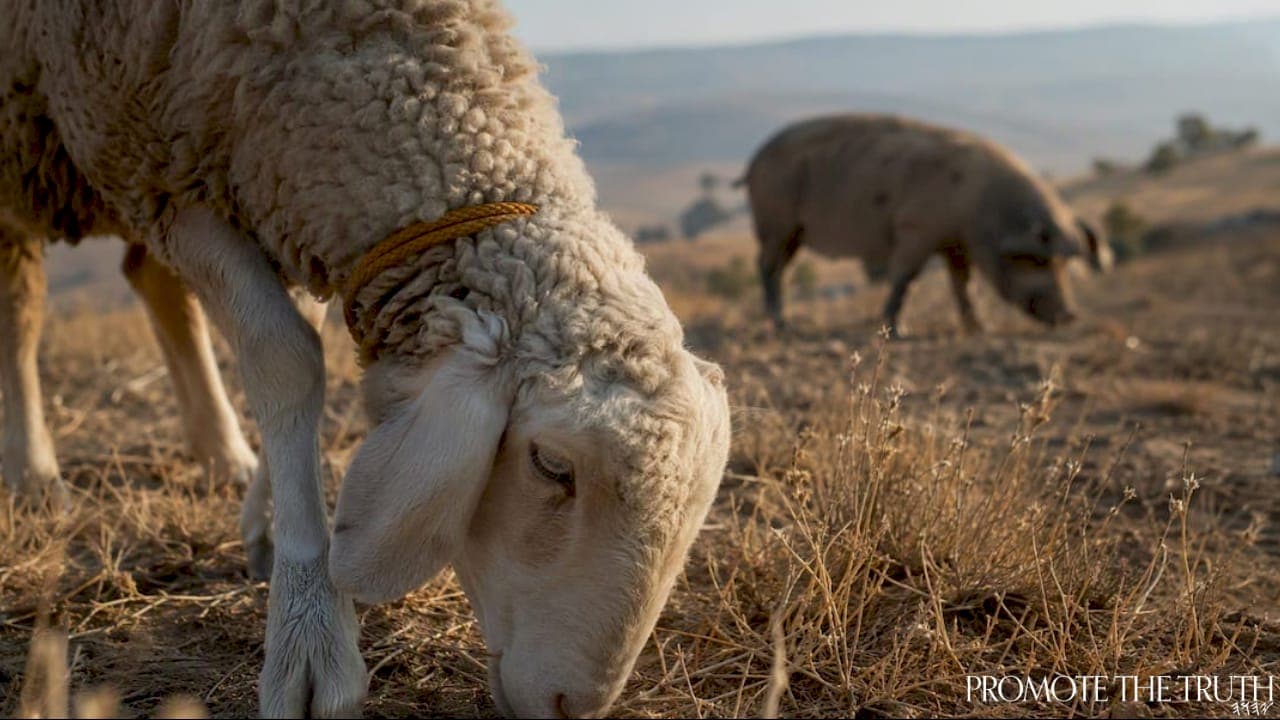
Land animals get the clearest test in the entire dietary code: a divided (cloven) hoof and the habit of chewing the cud, both required together. The ox, sheep, and goat pass on both counts and become the backbone of Yisharaliy (Israelite) herding and sacrifice. The pig fails because it doesn’t chew the cud, despite having a split hoof, which is likely why it became the most symbolically loaded unclean animal in later writing. The hare and what older translations call the “rock badger” (the rock hyrax) are named as unclean for similar reasons, even though they were common enough in the region that the text clearly expected readers to know them on sight.
Water creatures face a simpler but equally binary rule: fins and scales, both present, or the animal is unclean. Fish like salmon, cod, and tilapia clear that bar easily. Shellfish don’t. Lobster, clams, oysters, shrimp, and crab all lack true fins and scales, which places them firmly outside the clean category regardless of how common they’ve become in modern diets. Eels are unclean for the same reason; despite superficially resembling fish, they lack scales in the way the text requires. Sharks present a genuinely debated case among interpreters, since their skin bears placoid scales rather than the bony scales typical of clean fish, and this is exactly the kind of edge case where ancient categories don’t map cleanly onto modern zoology.

Birds work differently from land and water animals. Instead of giving a diagnostic test, Leviticus 11 simply names the unclean ones: eagles, vultures, ravens, owls, hawks, and other birds of prey or carrion eaters. The pattern is consistent. Nearly every bird on the forbidden list either hunts other animals or scavenges the dead, while birds outside the list, like doves and quail, were staples of Yisharaliy (Israelite) diet and sacrifice.
Insects carry a narrow but important exception. Most flying, crawling creatures are unclean by default, but the text specifically permits locusts, katydids, crickets, and grasshoppers, provided they have jointed legs for hopping. This exception explains why Yahuhanan the immerser (John the Baptizer) could eat locusts in the wilderness without violating Turah (Torah), a detail that only makes sense once you know the specific carve-out Uiyqara (Leviticus) grants.
A quick side-by-side of the core categories:
-
Clean land animals: ox, sheep, goat, deer (split hoof and chews cud)
-
Unclean land animals: pig, camel, hare, rock hyrax (missing one or both markers)
-
Clean water creatures: salmon, cod, tilapia (fins and scales).
-
Unclean water creatures: lobster, clams, shrimp, eels (missing fins, scales, or both)
-
Unclean birds: eagle, vulture, raven, owl, hawk (named individually, mostly scavengers or predators)
-
Permitted insects: locust, cricket, grasshopper, katydid (the specific exception)
The Deuteronomy 14 version of these lists tracks Uiyqara (Leviticus) almost word for word, though it adds a handful of named birds and slightly different phrasing in places. That near-identical repetition across two books, separated by roughly forty years in the narrative timeline, tells you this wasn’t a minor ceremonial footnote. It was law meant to be memorized, taught, and applied at every meal.
How to Apply the Scriptures’ (Bible’s) Diagnostic Markers for Clean and Unclean Foods
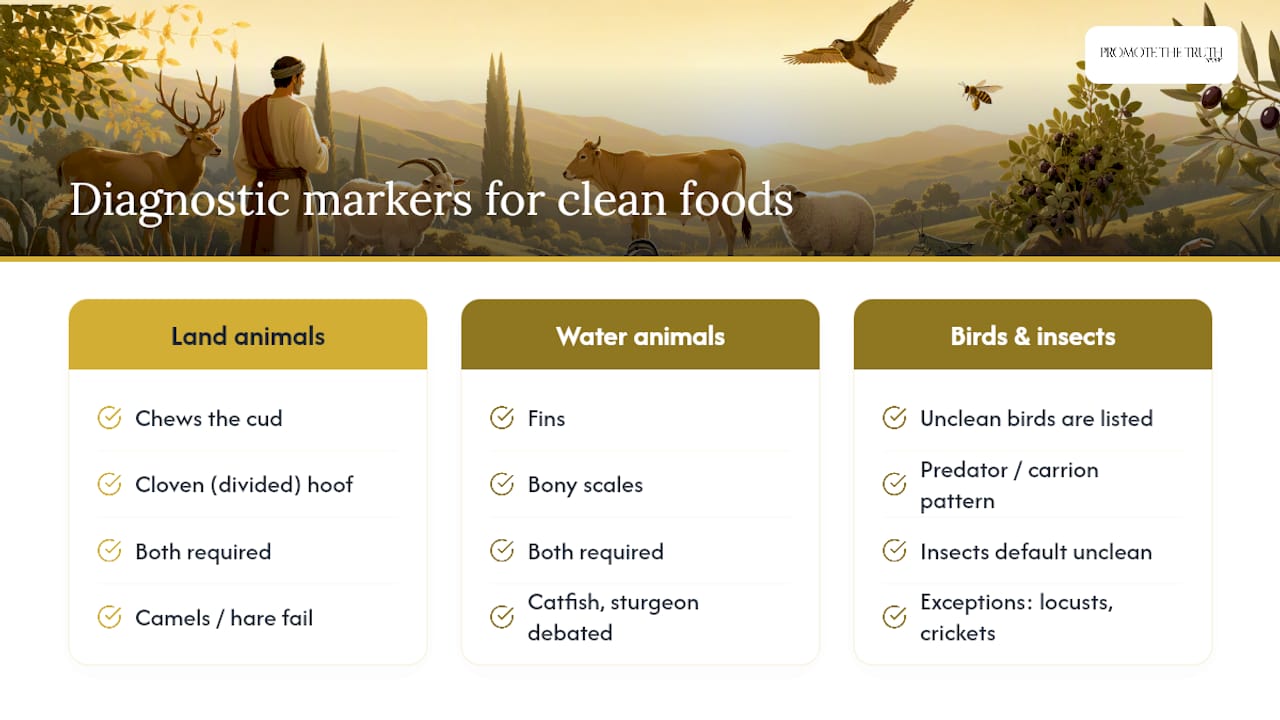
The genius of the Turah’s (Torah’s) system, if you can call it that, is that it doesn’t require readers to memorize hundreds of species. It gives two testable markers for land animals and two for water animals, and everything else follows from there.
Chewing the cud describes ruminant digestion: an animal swallows plant matter, brings it back up as cud, and chews it again before final digestion. Cattle, sheep, goats, and deer all do this visibly, which made the marker easy for an ancient herder to check without any specialized knowledge. A divided or cloven hoof means the foot splits into two distinct toes, visible whenever the animal walks or stands. Both markers had to be present. This is exactly why the camel and the hare fail the test despite seeming, at a glance, like reasonable candidates for cleanliness. The camel chews the cud but its foot is a padded, undivided structure rather than a true cloven hoof. The hare doesn’t chew the cud in the ruminant sense at all, even though its jaw movement can look similar from a distance.
Fins and scales work the same way: both markers, together, or the animal is unclean. This is where modern readers run into the most confusion, because ancient Abariy (Hebrew) categories for aquatic life don’t sort neatly into today’s biological classifications. Catfish and sturgeon are two commonly debated cases; both have skin structures that don’t match the bony scales typical of clean fish, which is why some traditions treat them cautiously even though they’re anatomically “fish” in the modern sense.
Birds and insects follow a different logic entirely. Rather than giving a test, the text names unclean birds directly, and the pattern that emerges is behavioral: nearly every listed bird is a predator or a carrion eater. Insects default to unclean, with the specific exception carved out for locusts, crickets, grasshoppers, and katydids.
Pro Tip: When a modern species’ common name doesn’t obviously match an ancient category, lean on the diagnostic markers rather than the name itself. A “hare” today and a “hare” in the ancient Near East may not be the same animal biologically, but the test (chews the cud plus divided hoof) still applies consistently and settles the question without guesswork.
Touching a Carcass: The Scriptures’ (Bible’s) Rules on Ceremonial Uncleanness
Uiyqara (Leviticus) 11 doesn’t stop at what you can eat. A significant portion of the chapter deals with what happens when a person or object comes into contact with a dead animal, clean or unclean, and this is where the law shifts from dietary regulation into something closer to ritual purity management.
-
Touching any carcass makes a person unclean until evening, regardless of whether the animal itself was on the clean list. Even permitted animals become a source of ceremonial impurity once dead and untouched by proper slaughter.
-
Carrying a carcass requires washing your clothing in addition to waiting out the uncleanness, a slightly heavier consequence than simple contact.
-
Clay vessels contaminated by a carcass must be broken, not washed. Uiyqara (Leviticus) 11 treats clay as too porous to be purified once it absorbs impurity, a detail that reflects ancient assumptions about which materials could trap contamination and which couldn’t.
-
Wood, cloth, leather, and sackcloth articles get a lighter treatment. They can be rinsed in water and remain unclean only until evening, after which they’re considered clean again.
-
Animals that died naturally or were torn by predators cannot be eaten even if the species itself is clean, and touching such a carcass carries the same uncleanness rules as touching any other dead animal.
The distinction between breaking clay and simply washing wood or leather isn’t arbitrary. Porous materials like unglazed clay were believed to absorb contamination in a way that couldn’t be reversed by rinsing, while denser materials could be cleansed on the surface. This is a system built around ritual and household order, not modern food safety science, and reading it as a hygiene manual misses what the text is actually doing.
What Maraqu (Mark) 7 and Ma’ashiym (Acts) 10 Mean for Clean and Unclean Foods Today
Two Bariyt Hadash (New Testament) passages carry most of the weight in later debates over whether these dietary laws still apply, and both get read in more than one way depending on the tradition doing the reading.
-
Maraqu (Mark) 7 records Yahusha (Jesus) responding to a complaint about His disciples eating without the ceremonial handwashing the Parashiym (Pharisees) practiced. The exchange broadens into a statement about what actually defiles a person: not food itself, but the intentions and actions coming from the heart. Some readers take this as Yahusha (Jesus) setting aside food purity laws outright but actually the passage is narrowly about hand washing traditions, a rabiyiy (rabbinic) custom rather than a Turah (Torah) command, and that Yahusha (Jesus) never mentions the Uiyqara (Leviticus) 11 categories at all in this exchange.
-
Ma’ashiym (Acts) 10 presents Kapa’s (Peter’s) vision of a sheet lowered from heaven, filled with animals the Turah (Torah) calls unclean, accompanied by a voice instructing him to eat. Kapa (Peter) refuses, citing his lifelong observance of the dietary law, and the vision repeats three times. The chapter’s own narrative resolution matters here: Kapa (Peter) later explains that he understood the vision to be about Guiy (Gentile) inclusion into the faith community, not a literal statement about food. That’s a detail easy to miss if you stop reading at the vision itself.
Three broad interpretive camps have grown out of these texts:
-
Abolitionist readings hold that the dietary laws ended with the Bariyt Hadash (New Testament), either through Yahusha’s (Jesus’) teaching in Maraqu (Mark) 7 or through Kapa’s (Peter’s) vision in Ma’ashiym (Acts) 10, and that believers today have no obligation to observe them. This is non proper reading as this is contrary to Turah (Torah).
-
Ceremonial or covenantal readings treat the food laws as belonging specifically to Yisharal’s (Israel’s) covenant identity, distinct teaching from moral law, and argue Ma’ashiym (Acts) 10 addresses table fellowship with Guiym (Gentiles) rather than food categories themselves.
-
Restorationist readings hold that the dietary instructions remain part of a coherent, unbroken Scriptural pattern, and that neither passage explicitly cancels Uiyqara (Leviticus) 11’s categories when read in full context.
Communities land in genuinely different places on this question, and the disagreement isn’t new or superficial. It runs through centuries of commentary and shapes how entire denominations structure their teaching on food.
Why the Scriptures’ (Bible’s) Food Laws Exist: Set-apartness (Holiness), Not Just Hygiene
For a long time, popular explanations for these laws leaned almost entirely on ancient health science: pigs carry parasites, shellfish spoil quickly, and so on. That explanation has real appeal because it feels intuitive to modern readers. It also doesn’t hold up well against the text itself, which never once mentions disease, spoilage, or health as a rationale.
Instead, Uiyqara (Leviticus) 11 repeatedly ties the dietary categories to a single stated purpose: Yisharal (Israel) is to be set-apart (holy), and set-apart from the surrounding nations, in the same way YAHUAH is Set-Apart. Academic analysis of the chapter argues the laws function primarily as a system of ritual and social ordering rather than hygienic instruction, structuring the most mundane parts of daily life, what goes on the plate, so that holiness becomes a constant, tangible practice rather than an abstract idea confined to the ahiykal (temple).
Statistic Callout: Scholarly work on Uiyqara (Leviticus) 11 argues that dietary categorization reflects creation-order boundaries and set-apartness (holiness) rather than purely hygienic concerns, with clean animals often aligning with expected behavior within their created domain and unclean animals frequently crossing or violating those boundaries (scavengers, predators, creatures that blur land and water categories).
A few patterns support that reading:
-
Scavengers and predators dominate the unclean bird list, animals whose behavior crosses the boundary between life and death in ways the text treats as symbolically loaded.
-
Creatures that blur categories, like animals that live in water but lack fins and scales, or land animals with an ambiguous foot structure, tend to land on the unclean side.
-
The laws touch food, household objects, and physical contact alike, which extends the set-apartness (holiness) concept into nearly every corner of daily life rather than isolating it to worship settings.
This framing matters because it changes what the laws are actually for. They aren’t primarily a health code that happened to get religious language attached. They’re a set-apartness (holiness) code that happened to use food, the most repeated, physical act in daily life, as its primary teaching tool.
How Jewish, Christian, and Restorationist Communities Apply the Laws Today
Three broad patterns describe how believers handle these laws now, and most of them is not universal even within its own tradition.
Observant Judaism maintains kasharut, a detailed system of dietary law built on rabiyiy (rabbinic) elaboration of the Uiyqara (Leviticus) and Dabariym (Deuteronomy) texts across centuries of legal commentary. Kashar practice extends well beyond the basic clean and unclean animal lists into separation of meat and dairy, specific slaughter methods, and certification systems that didn’t exist in the scriptural (biblical) period itself but developed to apply the underlying principles consistently.
Mainstream Christian practice in most Western traditions treats the dietary laws as ceremonial instruction tied to Yisharal’s (Israel’s) covenant, not binding on believers generally, largely on the strength of readings of Maraqu (Mark) 7 and Ma’ashiym (Acts) 10 discussed earlier. This is by far the most common position among Christian denominations today, though it’s far from the only one.
Restorationist communities, including groups drawing on Abariy (Hebrew) Roots and similar movements, hold that the dietary instructions remain valid and attempt varying degrees of observance, from full avoidance of unclean meats to more selective practice.
Promote The Truth gives actual information from scriptures sources. Guard the dietary instructions as outlined in Uiyqara (sn-Lev) 11. This includes immediately removing unclean “food” from your home. From now on, you should read ingredients on all packaging and avoid hidden violations (make your very best effort on reading ingredients). Father YAHUAH has shown us a way to know how to live and one of those ways is how we are to eat. In His creation, YAHUAH is very detailed on the purpose of each thing He created, and especially for what each animal was for. Uiyqara (sn-Lev) 11 gives us a clear breakdown of what animals are available to human for food. We know this is a serious issue, and one that involves salvation, because YAHUAH gives us a strong warning in Yisha’aiyahu (sn-Isaiah) 66:16-17 that He will destroy every person eating animals such as pigs, mice, etc.
If you’re exploring observant practice for the first time, a few practical starting points help:
-
Separate cooking surfaces and utensils used for unclean meats from those used for clean meats, a basic kitchen habit long before any formal certification system existed.
-
When buying fish, confirm it has both fins and scales rather than relying on the name alone, since market labeling varies by region.
-
Verify traditional identifications carefully when it comes to insects; not every hopping insect matches the locust, cricket, or grasshopper categories named in the text.
Pro Tip: If health claims about clean versus unclean animals come up in conversation, hold them. The strongest textual case for these laws is set-apartness (holiness) and covenant identity, not nutrition science, and leaning on health arguments alone tends to collapse under modern scrutiny. For questions about ritual specifics or community practice, a ministerial leader familiar with your tradition is a better guide than a general health claim.
Study the Original Language Behind Uiyqara (Leviticus) 11
Every English translation of Uiyqara (Leviticus) 11 carries interpretive choices made by translators centuries removed from the original Abariy (Hebrew). Promote The Truth approaches this differently, working directly from ancient Abariy (Hebrew) and Aramiyt (Aramaic) manuscript sources to restore original names and meanings that many modern translations soften or omit entirely. The Truth Scriptures™ Translation reflects that manuscript-first approach across the full Ta’anak and Bariyt Hadash text, including the dietary instructions covered here. For readers who want a deeper, guided study of these chapters alongside others, Virtual retreats offer structured, manuscript-focused instruction beyond what a single article can cover.
A Closer Look at Reading Clean and Unclean With Humility
The temptation with a subject like this is to reach for certainty faster than the text itself offers it. Uiyqara (Leviticus) 11 is precise about its diagnostic markers, but the Bariyt Hadash (New Testament) passages that reinterpret or reframe those markers are genuinely more contested than most popular teaching admits. Maraqu (Mark) 7 and Ma’ashiym (Acts) 10 don’t resolve as cleanly into a single, obvious reading as either side of the debate tends to claim, and honest engagement with the actual text and its narrative context matters more than picking whichever interpretation confirms what you already believed.
Manuscript research exists precisely to slow that process down. Restoring original names, checking translation choices against Abariy (Hebrew) and Aramiyt (Aramaic) sources, and reading the full narrative arc of a passage like Ma’ashiym (Acts) 10, rather than stopping at the vision itself, changes how confidently you can hold a position. That mean every community who believe YAHUAH needs to land in the same place on dietary observance. It means the discussion deserves the same textual point of view What YAHUAH said in Uiyqara (Leviticus) 11.
— Maria
Go Deeper With Manuscript-Based Study Resources
If Uiyqara (Leviticus) 11 raised more questions than it answered, that’s the right response to a chapter this dense. This resource exists for readers who want the original language behind these dietary laws, not just another paraphrase of a paraphrase.

Rather than relying on a single standard translation, Wording is restored directly from ancient Abariy (Hebrew) and Aramiyt (Aramaic) manuscript sources, including the original names many English Bibles quietly drop. Start with the Truth Scriptures™ Digital Collection for immediate access to the full restored text, or download the free Leviticus 11 study resource to work through the dietary chapter verse by verse with manuscript notes. For a more guided experience, the PTT RENEWED Virtual Retreat walks small groups through exactly this kind of manuscript-focused study, priced at a one-off fee for the session. Whichever entry point fits your schedule, the goal is the same: read Uiyqara (Leviticus) 11 as close to its original wording as manuscript research allows.
Sources
The clean and unclean food laws are worth reading in their original context rather than secondhand summary.
-
Promote The Truth is dedicated to advocating for transparency and honesty in information dissemination, aiming to combat misinformation and promote factual accuracy across various media platforms.
FAQ
What are the clean and unclean foods in the Scriptures (Bible)?
Clean land animals need both a divided hoof and the habit of chewing the cud, which is why the ox, sheep, and goat qualify while the pig and camel don’t. Clean water creatures need both fins and scales, ruling out shellfish and eels, and most birds are unclean except for a named handful; locusts, crickets, and grasshoppers are the specific insect exception laid out in Uiyqara (Leviticus) 11.
What are the top 3 foods to avoid under the scriptural (biblical) food laws?
Pork is the most frequently cited unclean food, since pigs fail the cud-chewing test despite having a divided hoof. Shellfish, including shrimp, crab, and lobster, are unclean because they lack both fins and scales. Carrion-eating and predatory birds, like vultures and hawks, round out the third major category named directly in the dietary law text.
Did Yahusha (Jesus) say pork was clean to eat?
Yahusha (Jesus) never names pork specifically in the Bashurah (Gospels). Maraqu (Mark) 7 records Him addressing hand washing traditions and what truly defiles a person from the heart, and readers disagree on whether that passage redefines food categories or leaves the Uiyqara (Leviticus) 11 lists untouched. Ma'ashiym (Acts) 10 raises a related question through Kapa's (Peter’s) vision, though Kapa (Peter) himself later explains it as being about Guiy (Gentile) inclusion rather than a literal statement about food.
What foods did Yahusha (Jesus) not eat?
The Bashurah (Gospels) don’t give a detailed record of Yahusha's (Jesus’) personal diet, but as a first century Yisharaliy (Israelite) living under Turah (Torah), He would have followed the standard clean and unclean animal categories common to His community. That means avoiding pork, shellfish, and the named unclean birds, consistent with the broader dietary practice of Yisharaliy (Israelite) society at the time.
Does Promote The Truth offer resources for studying Uiyqara (Leviticus) 11 in the original language?
Yes. The Truth Scriptures™ Translation restores Uiyqara (Leviticus) 11 and the rest of the Ta’anak from ancient Abariy (Hebrew) and Aramiyt (Aramaic) manuscript sources, and a free downloadable study resource is available specifically for that chapter. Current pricing for the full digital collection and translation is listed on the Promote The Truth site.