
Applying ancient scriptural teachings daily means using time-tested spiritual principles as a living guide for your decisions, relationships, and inner life. This is not about memorizing verses or following rigid rituals. The daily application of scripture is a practice of personal transformation, where ancient wisdom actively shapes how you think, feel, and act.
Traditions from the Abariy (Hebrew) Ta’anak (Old Testament), the Bhagavad Gita, and Zen Buddhist writings all point to a common principle: knowledge alone does not produce change. Reading may inform the mind, but consistent and intentional practice transforms the life. The true value of wisdom is realized not when it is understood intellectually, but when it is lived out daily
How to Apply Ancient Scriptural Teachings Daily: The Right Foundation
Before you establish a daily practice, you must first cultivate the right internal posture. Without it, even the best reading plan can become a checklist rather than a meaningful spiritual discipline.
Three Foundational Attitudes Appear Across Traditions:
-
Faithful Engagement: Scripture provides wisdom and moral clarity for decision-making, not a direct answer to every choice. The Abariy (Hebrew) Ta’anak (Old Testament), for example, shapes the heart to align with YAHUAH’s revealed will rather than offering a formula for every situation.
-
Practical Orientation: Ancient Vedic teachings, including the Bhagavad Gita, are best treated as practical guides for cultivating equanimity and fulfilling one’s duties without emotional attachment to outcomes. They are not merely abstract philosophies to be admired from a distance.
-
Steady Attention: Zen practice focuses on cultivating sustained attention in everyday life, using ordinary activities as gateways to deeper awareness. Washing dishes, eating a meal, or walking to work can all become moments of intentional practice.
The common thread across these traditions is non-attachment to outcomes. You practice not because you expect immediate or visible results, but because the practice itself shapes and transforms you. Favor (Grace), trust, and patience are not rewards; they are prerequisites for meaningful growth.
Scripture functions best as a lens of wisdom rather than as a rulebook. Instead of searching for a verse that tells you exactly what to do, you hold a Scriptural principle up to a situation and ask what it reveals. This shift—from viewing Scripture as a rulebook to understanding it as a wisdom lens—is one of the most important mindset changes a person can make.

Pro Tip: Before your first reading session, write down one area of your life in which you want greater clarity. Use that area as your lens for the first week of reading.
How to Structure Daily Scripture Reading for Lasting Growth
Consistency beats intensity every time. A short, focused daily session produces more lasting change than an occasional deep dive.
Three Proven Structures Work Across Traditions:
-
The One-Chapter-Per-Day Method: Mashaliym (Proverbs) contains 31 chapters, one for each day of the month. Read the chapter that corresponds to the current date. This removes decision fatigue, keeps the reading brief, and gives you a single principle to carry with you throughout the day.
-
The 5–10 Minute Vedic Session: A 5–10- minute engagement with the Bhagavad Gita, including commentary, before beginning daily activities anchors awareness and gradually transforms your mindset. Commentary matters because ancient texts carry cultural context that plain reading often misses.
-
The Brief Reflection Close: End session with 1–5 minutes of reflection guided by two questions: “What pulled me today?” and “What helped, even a little?” These questions keep reflection grounded in real experience rather than in spiritual fantasy.
The table below shows how each method fits different schedules and traditions:
| Method | Time Required | Best For | Tradition |
|---|---|---|---|
| One chapter per day | 5–8 minutes | Beginners, busy schedules | Abariy (Hebrew) Ta’anak (Old Testament) Mashaliym (Proverbs) |
| Guided text with commentary | 5–10 minutes | Contextual learners | Vedic (Bhagavad Gita) |
| Reflection with two questions | 1–5 minutes | Sustaining any practice | Buddhist, Zen |
| Combined reading and reflection | 10–15 minutes | Established practitioners | Cross-tradition |
Attach your reading to an existing daily trigger. Read Mashaliym (Proverbs) with your morning coffee. Reflect for five minutes before bed. Linking a new habit to an existing one dramatically increases follow-through. Avoid scheduling Scripture reading as a standalone event with no anchor, because it is often the first thing to be dropped when life gets busy.
Pro Tip: Keep your scripture text and a single notecard on your kitchen table. Write one word from the day’s reading on the card and leave it where you will see it throughout the day.
Understanding Scripture in its historical context also deepens what you absorb during these short sessions. A verse read with its original cultural setting in mind carries far more weight than one read in isolation.
What Practical Ways Can You Integrate Scriptural Principles Into Daily Life?
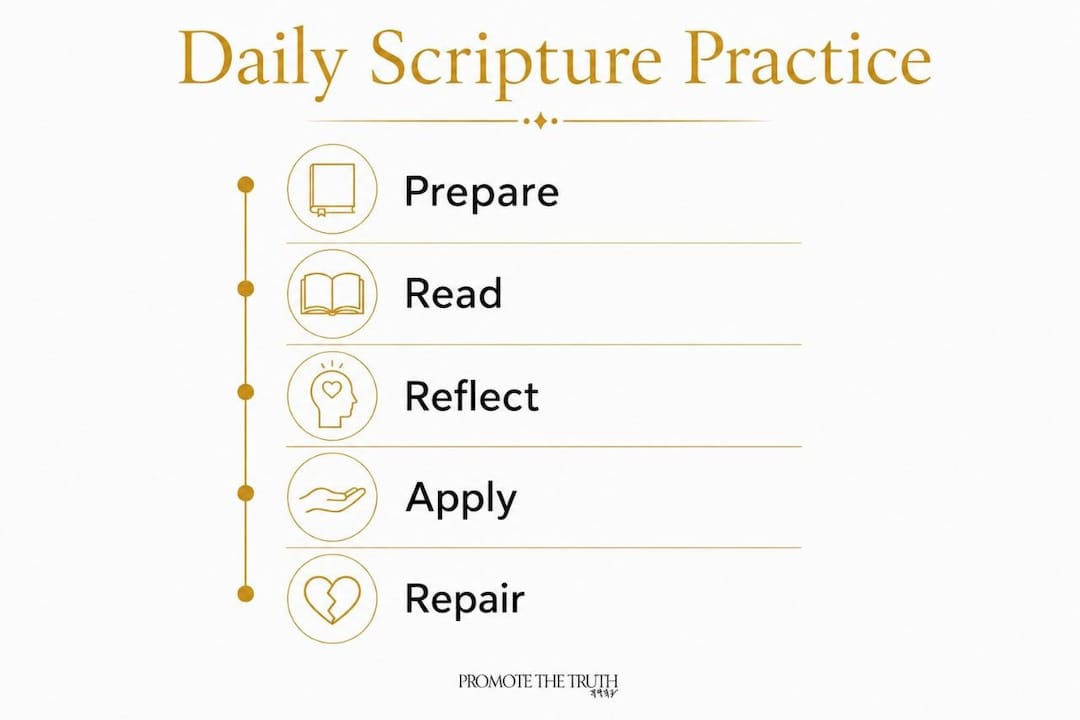
Reading and reflection are forms of preparation. The actual practice takes place in the ordinary moments of daily life.
One of the most effective approaches is to focus on a single, concrete principle each week and pair it with a brief real-time action that takes no more than 10–30 seconds. This keeps the commitment manageable, encourages consistency, and helps build genuine habits rather than merely good intentions.
True Application Works Across Three Domains
-
Cognitive (Head): You understand the principle and can explain concepts such as humility, karma yoga, or mindful attention in plain language.
-
Affective (Heart): The principle begins to influence and shape your inner life. You feel the pull of compassion before you act on it. This is the point at which Scripture ceases to be mere information and becomes a source of transformation.
-
Behavioral (Action): You do something different because of what you have read. Incremental lifestyle changes, not the quantity of reading—are the true measure of successful application.
Everyday moments provide some of the best opportunities for spiritual practice. Eating a meal becomes an opportunity to cultivate gratitude. A difficult conversation at work becomes an opportunity to apply the Bhagavad Gita’s teaching on selfless action—fulfilling your duty without becoming attached to the outcome. A moment of frustration becomes a Zen invitation to return to steady attention and present-moment awareness.
True practice often lies in recognizing when you have drifted from your principles and consistently returning, rather than in perfect adherence.” — Buddhist practice principle
This idea of “repair” is one of the most liberating insights shared across all three traditions. You will drift. You will forget the principle to which you committed yourself. The practice is not about avoiding drift; it is about recognizing it and returning, without self-condemnation.
Exploring how ancient scriptural names connect identity can also deepen your sense of personal connection to the texts you are applying, grounding abstract principles in a living identity rooted in YAHUAH’s Word.
What Common Challenges Arise When Maintaining a Daily Scripture Practice?
Every sincere practitioner encounters the same obstacles. Recognizing them in advance significantly reduces their power.
The most common obstacles and how to address them:
-
Overload: Trying to change everything at once almost guarantees failure. Choose one principle and apply it for one week. Then choose another. The cumulative effect over months can be profound.
-
Discouragement: Progress in Scriptural application is rarely linear. A week of strong practice followed by three days of forgetting is normal, not failure. Self-compassion is not a soft option; it is a practical tool for sustaining long-term practice.
-
Moralism: Reading Scripture to confirm what you already believe or to judge others is the opposite of genuine application. The text should challenge you, not merely validate you.
-
Confusing Passages: Every tradition contains texts that are difficult to understand or appear contradictory. Do not allow one confusing passage to derail your entire practice. Set it aside, make a note of it, and return to it later with the help of commentary or community support.
-
Life Season Changes: A morning reading routine that works during one season of life may not survive a new job or the arrival of a newborn. Build flexibility into your practice from the beginning. The method may change, but the commitment does not have to.
Track progress by observing your behavior rather than your reading log. Are you slightly more patient this month than you were last month? Do you pause before reacting during conflict? These small behavioral shifts are the true evidence that ancient teachings are taking root.
Key Takeaways
Applying ancient Scriptural teachings daily requires consistent, focused practice across the cognitive, affective, and behavioral domains—not merely an increase in reading volume.
| Point | Details |
|---|---|
| Start with the right posture | Treat Scripture as a wisdom lens, rather than a rulebook, and approach it with favor (grace) and non-attachment. |
| Use structured short sessions | A 5–10-minute daily reading session followed by a 1–5-minute reflection is more effective than occasional lengthy sessions. |
| Focus on one principle weekly | Attach one Scriptural principle to a brief daily action to build a genuine habit without becoming overwhelmed. |
| Repair, do not quit | Recognizing when you have drifted and returning to practice is the core skill, not perfect daily adherence. |
| Measure behavioral change | Track incremental growth in patience, compassion, and behavior, rather than the number of pages read or sessions completed. |
Why I Think Most People Approach Scripture Application Backwards
Most people I have observed start with the text and try to force it onto their lives. They read a passage about patience, feel convicted, and then wait for patience to arrive. That is not application; it is wishful reading.
What actually works is starting with a real situation in your life and then bringing the text to it. You have a difficult coworker. You bring the Bhagavad Gita’s teaching on selfless action to that specific relationship. You have a habit of anxious overthinking. You bring the Zen practice of returning to the present moment to that specific pattern. The text becomes a tool rather than a trophy.
The other thing I have learned is that combining cognitive understanding with heart transformation takes longer than most people expect. You can understand humility intellectually within a week. You can begin to feel it within a month. You may spend the rest of your life practicing it. That is not discouraging; it is the honest shape of genuine spiritual growth.
Start smaller than you think you need to. Stay with the practice longer than you think you should. And give yourself the same favor (grace) that the texts themselves consistently offer.
— Maria
Promote The Truth Resources For Your Daily Scripture Practice
Promote The Truth is an international educational and media organization dedicated to restoring and teaching the original message of the Scriptures, including the significance of the Name YAHUAH. Its resources are designed not merely to increase knowledge, but to help readers apply Scriptural principles in everyday life.
Through in-depth teachings, historical context, manuscript-based research, and practical study resources, Promote The Truth equips individuals to move beyond casual reading and develop a deeper, more meaningful relationship with YAHUAH and His Word. Whether you are beginning your Scriptural journey or seeking to strengthen an established practice, these resources provide guidance that bridges the gap between understanding the text and living it out daily.
For those who desire more than information—those seeking transformation—Promote The Truth offers tools and teachings that encourage consistent growth, deeper insight, and faithful application of Scriptural truth.

The Scripture Study Series on YouTube offers engaging video teachings that bring ancient texts to life through rich historical context, practical insight, and clear explanations. Designed for daily use, these lessons are ideal for a focused 5–10-minute study session, helping viewers move beyond reading and into meaningful application.
For those seeking a more structured learning experience, the Digital Video Academy provides step-by-step courses that teach how to apply Scriptural principles to everyday decisions, relationships, and personal growth. These courses are designed to help learners develop consistent study habits while deepening their understanding of the Scriptures.
Promote The Truth also provides access to original digital scriptures translated from ancient Abariy (Hebrew) and Aramiyt (Aramaic) sources. By drawing directly from these ancient manuscripts, these resources offer an authentic foundation for study, enabling readers to explore the Scriptures with greater historical depth, textual accuracy, and confidence. Whether you are beginning your journey or seeking to deepen your daily practice, these resources are designed to help transform Scriptural knowledge into a way of life.
FAQ
What Does It Mean to Apply Scripture Daily?
The daily application of Scripture means using a specific principle from an ancient text to guide a real decision, relationship, or behavior each day. It goes beyond reading, moving into active and intentional practice in the ordinary moments of life.
How Long Should a Daily Scripture Session Be?
A 5–10-minute reading followed by a 1–5-minute reflection is one of the most sustainable structures for most people. Shorter sessions practiced consistently tend to be more effective than longer sessions practiced only occasionally.
Which Scripture Is Best for Beginners to Read Daily?
Mashaliym (Proverbs) is one of the most accessible starting points. Its 31 chapters align with the days of the month, giving beginners a clear, low-pressure structure that requires no planning.
What If I Miss a Day or Lose Momentum?
Missing a day is normal and expected. The practice is returning without self-judgment. Recognizing when you have drifted and returning to the practice is itself the core skill of sustained Scriptural application across traditions.
How Do I Know If Scripture Application Is Actually Working?
Watch for incremental behavioral changes rather than feelings of spiritual progress. Greater patience, more deliberate responses during conflict, and small acts of compassion are reliable indicators that ancient teachings are taking root in daily life.