Scriptural Abariy (Biblical Hebrew) is defined as the ancient Semitic language of the Ta’anak (Old Testament), written in a 22-letter consonantal alphabet and read from right to left. Learning to read it gives you direct access to the original words of Scripture before any translation layer stands between you and the text. The rewards are real: you begin to see wordplay, poetic structure, and theological depth that no English translation fully captures. Knowing how to read Scriptural Abariy (Biblical Hebrew) is not reserved for scholars. With the right approach, faith-based learners can read simple passages within months and continue building their skills over time.
How to Read Scriptural Abariy (Biblical Hebrew): Start with the Alphabet
The Abariy (Hebrew) alphabet, called the Alaf-bat, contains 22 letters. Every letter is a consonant. That single fact reshapes how you approach the language from the very first lesson.
The letters most beginners find challenging include:
-
Alaf (א): A silent letter that carries a vowel sound but makes no consonant sound on its own.
-
Bat/Vet (ב): One letter with two sounds. With a dot (dagesh) inside, it sounds like “b.” Without it, it sounds like “v.”
-
Chet (ח): A guttural sound produced deep in the throat, with no English equivalent.
-
Ayin (ע): Another silent consonant in most modern pronunciations, although it historically carried a distinct guttural sound.
-
Shin/Sin (ש): One letter shape with two sounds, distinguished by a dot placed above the right or left side.
Vowels are added through a system called nikkud, a set of dots and dashes written above, below, or beside the consonants. Key vowel points include the qamats (a long “ah” sound), the segol (a short “eh” sound), the chirik (a short “ee” sound), and the shva (a half-vowel or silent marker). The nikkud system encodes the vowel sounds that are critical for correct Scriptural (Biblical) reading. Without them, the consonantal text is ambiguous, which is precisely why the Masoretes developed the nikkud system to preserve accurate pronunciation.
Reading direction matters more than most beginners expect. You scan each line from right to left, and within each word, you read the consonants and vowel points together as syllabic units. This takes deliberate retraining of your eyes, but it becomes natural within a few weeks of consistent practice.

Pro Tip: Drill the alphabet in writing order, not just by recognition. Writing each letter by hand, from right to left, builds muscle memory that makes reading faster and more automatic.
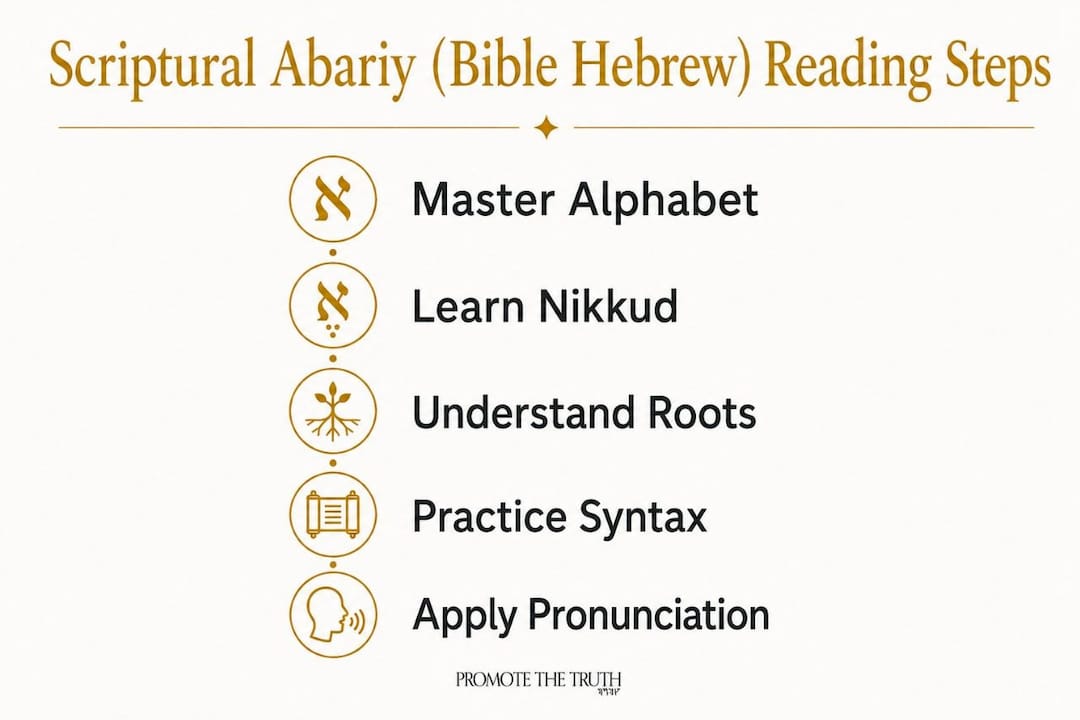
A recommended learning sequence moves from the alphabet to vowel points, then to high-frequency vocabulary, and finally to verb root conjugation. Skipping ahead to vocabulary before mastering the alphabet will slow your progress significantly.
How Does Scriptural Abariy (Biblical Hebrew) Pronunciation Differ from Modern Abariy (Hebrew)?
Scriptural Abariy (Biblical Hebrew) pronunciation follows the Tiberian system, developed by Yahudiym (Jewish) scholars called the Masoretes between roughly the 6th and 10th centuries CE. This system differs from Modern Yisharaliy Abariy (Israeli Hebrew) in several meaningful ways.
In Scriptural Abariy (Biblical Hebrew), letters such as Alaf, Ayin, Chet, and Hay each carried phonetically distinct sounds. The Tiberian system preserved those distinctions, along with precise vowel lengths that affect both meaning and liturgical recitation. Collapsing these sounds into their Modern Abariy (Hebrew) equivalents produces a reading that is technically understandable but historically imprecise.
Common beginner mistakes in pronunciation include:
-
Treating alaf and ayin as identical: Both are silent in Modern Abariy (Hebrew), but the Tiberian tradition distinguishes them as separate phonemes.
-
Ignoring vowel length: Scriptural Abariy (Biblical Hebrew) distinguishes between long and short vowels. The difference between a qamats and a patach is not cosmetic; it affects both syllable stress and word meaning.
-
Skipping guttural practice: Sounds such as Chet and Ayin require throat engagement that English speakers rarely use. Audio-visual phonetic drills are the most effective way to develop these sounds correctly.
-
**Applying Modern Abariy (Hebrew) stress patterns:**Scriptural Abariy (Biblical Hebrew) stress often falls on the final syllable, although there are many exceptions governed by specific grammatical rules.
Language researchers note that Scriptural Abariy (Biblical Hebrew) was never completely standardized and has been reconstructed from historical sources. That means some flexibility in pronunciation expectations is appropriate. The goal is not perfection but faithful engagement with the text.
Pro Tip: Listen to recordings of the Tiberian cantillation marks (called ta’amim*) alongside the text. These musical notations encode both pronunciation and phrasing, giving you a more complete phonetic picture of how the text was intended to sound.*
What Are the Key Grammar Components for Reading Scriptural Abariy (Biblical Hebrew)?
Scriptural Abariy (Biblical Hebrew) grammar is built around three-letter verb roots. Most words in the language are derived from a root consisting of three consonants, and recognizing those roots is the fastest path to reading comprehension. Prioritizing the recognition of three-letter verb roots accelerates reading speed more than any other single skill.
The core grammar concepts to master, in order of priority:
-
Three-letter roots: Learn to identify the root beneath prefixes, suffixes, and vowel changes. The root k-t-b (כ-ת-ב), for example, underlies words meaning “to write,” “a book,” “a scribe,” and “written.”
-
Verb-Subject-Object word order: Scriptural Abariy (Biblical Hebrew) syntax places the verb first, followed by the subject and then the object. This is the inverse of English word order and requires active retraining when translating.
-
Baniymiyn (verb stems): Abariy (Hebrew) verbs appear in seven major patterns called Baniymiyn, each of which modifies the meaning of the root. The Qal stem is the base form. The Niphal stem often indicates the passive voice. The Hiphil stem typically signals causation.
-
Noun patterns: Nouns carry gender (masculine or feminine) and number (singular, plural, or dual). These features affect agreement with verbs and adjectives throughout the sentence.
-
The construct chain: Abariy (Hebrew) expresses possession and relationships through a grammatical structure called the construct state, in which two nouns are linked directly without a preposition. “The word of YAHUAH” is a single construct chain, not two separate words joined by “of.”
Understanding syntax is more challenging than memorizing vocabulary. A learner who knows 500 words but cannot parse a verb stem will still struggle to read a verse accurately.
Pro Tip: Start with well-known, short verses such as Barashiyt (Genesis) 1:1. Translate them word by word, identify the root of each verb, and note the word order. Familiar passages allow you to focus on grammar without getting lost in the meaning.
What Are Effective Methods for Self-Studying Scriptural Abariy (Biblical Hebrew)?
Consistent daily study of 30–60 minutes allows beginners to read simple Scriptural (Biblical) texts within 3–6 months. Achieving full reading proficiency across more complex texts typically takes 1–2 years of sustained effort. That timeline is realistic and encouraging, not discouraging.
The most effective self-study methods include:
-
Interlinear Scriptures (Bibles) with audio: Integrating audio recordings with interlinear texts builds familiarity with syntax and vocabulary significantly faster than text-only study. You hear the word, see the Abariy (Hebrew), and read the gloss simultaneously.
-
Comprehensible Input (CI) method: This approach, borrowed from modern language acquisition research, prioritizes reading and listening to material just above your current level. The CI method recommends reading contextual Scriptural (Biblical) narratives early to sustain motivation and reinforce vocabulary naturally.
-
Simple narrative texts: Starting with books like Rut (Ruth) keeps learners engaged because the vocabulary is repetitive, the narrative is compelling, and the grammar is relatively straightforward compared to prophetic or poetic texts.
-
Structured habit tools: Learning schedules and study milestones increase consistency among beginners. A simple checklist of daily tasks, such as alphabet review, vocabulary cards, and translating one verse, builds the habit without overwhelming you.
Professor Carasik of The Great Courses emphasizes a cumulative, holistic approach that integrates grammar with reading exercises. He describes the practice as “Scriptural (Biblical) calisthenics,” treating each passage as a mental exercise that builds strength over time. That framing is useful. You are not cramming for a test. You are training a skill.
Downloadable Scripture texts give you real Abariy (Hebrew) to practice with immediately. Promote The Truth offers free resources, such as the Truth Scriptures download for Abariym (Hebrews) 1, giving you an authentic restored text to work through alongside your grammar study. Pairing a grammar resource with an actual Scripture text is the most faith-aligned way to learn.
For broader context on where to find quality materials, the 2026 scripture study resources guide from Promote The Truth covers what to look for and what to avoid.
How Do You Apply Scriptural Abariy (Biblical Hebrew) Reading Skills to Deepen Scriptural Understanding?
Reading skills become spiritually meaningful when you apply them directly to the text. The language is not merely an academic tool. It is the medium through which YAHUAH’s original message was recorded.
Practical ways to apply what you learn:
-
Translate passages by hand: Writing out your own translation of a verse forces you to engage with every word. You cannot skim. This practice also reveals how much interpretive choice goes into any English translation.
-
Identify wordplay and literary devices: Scriptural Abariy (Biblical Hebrew) uses paronomasia (sound-based wordplay), chiasm (mirrored structure), and acrostic patterns that disappear entirely in translation. Tahliym (Psalm) 119, for example, is an acrostic poem built on the Abariy (Hebrew) alphabet. Reading it in Abariy (Hebrew) makes its structure visible.
-
Apply historical and cultural context: The Abariy (Hebrew) word hesed, often translated as “favor (mercy)” or “lovingkindness,” carries a covenantal weight that no single English word fully captures. Understanding the historical context of the Ta’anak sharpens your understanding of words like this.
-
Build confidence through repetition: Re-reading the same passage multiple times in Abariy (Hebrew) builds both fluency and spiritual familiarity. The text becomes yours in a way that a translation never quite can.
The Abariy (Hebrew) and Aramiyt (Aramaic) origins of the Bariyt Hadash (New Testament) also become clearer as your knowledge of Scriptural Abariy (Biblical Hebrew) grows. Many concepts in the Bariyt Hadash (New Testament) carry Abariy (Hebrew) idioms beneath the Yuuniy (Greek) surface. Reading Abariy (Hebrew) trains your eye to recognize those layers.
Key Takeaways
Reading Scriptural Abariy (Biblical Hebrew) requires mastering the 22-letter Alaf-Bat, the nikkud vowel system, three-letter verb roots, and Verb-Subject-Object syntax before complex texts become accessible.
| Point | Details |
|---|---|
| Start with the Alaf-Bat | Master all 22 consonants and the key nikkud vowel points before moving on to vocabulary. |
| Use the Tiberian pronunciation system | Scriptural Abariy (Biblical Hebrew) follows Tiberian pronunciation, not Modern Abariy (Hebrew), preserving guttural sounds and vowel length distinctions. |
| Prioritize verb root recognition | Identifying three-letter verb roots accelerates reading comprehension more effectively than vocabulary memorization alone. |
| Study 30–60 minutes daily | Consistent daily practice enables beginners to read simple texts within 3–6 months and achieve full proficiency within 1–2 years. |
| Apply skills directly to Scripture | Translating passages by hand and identifying literary devices deepen both language skills and Scriptural understanding. |
Why Learning Scriptural Abariy (Biblical Hebrew) Changed How I Read Scripture
I spent years reading English translations and feeling grateful for them. Then I started working through the Abariy (Hebrew) text, and the experience was genuinely different. Not better in a competitive sense—different in the way that hearing a song in its original language differs from reading its translated lyrics.
The first thing that surprised me was how much the grammar itself carries meaning. The Abariy (Hebrew) verb system encodes aspect, not just tense. A verb form tells you whether an action is complete or ongoing, not just when it happened. That distinction reshapes entire passages. The second thing that surprised me was how much patience the process required. There is no shortcut through the Alaf-Bat. You sit with it. You write it. You read it slowly until it becomes familiar.
My recommendation is simple: do not wait until you feel “ready” to start reading actual Scripture in Abariy (Hebrew). Start with one verse. Read it imperfectly. Look up every word. Read it again. That cycle, repeated daily, is what builds genuine reading ability. The faith dimension matters here too. Approaching the text of YAHUAH’s Word with reverence and patience is not only good spiritual practice; it is also good language-learning practice. The two reinforce each other in ways I did not expect.
— Maria
Promote The Truth's Resources for Your Scriptural Abariy (Biblical Hebrew) Study
Promote The Truth has built a library of resources specifically for faith-based learners who want to engage with the original Scriptural text more deeply and in a more set-apart way.
The Scripture Study Series video channel provides guided Scripture reading with Abariy (Hebrew) and Aramiyt (Aramaic) texts, making it an accessible starting point for learners at every level. For those seeking a more structured approach, the digital video academyoffers in-depth courses on Scriptural Abariy (Biblical Hebrew), ancient manuscript history, and the significance of the Name YAHUAH. Promote The Truth also publishes the Truth Scriptures, a meticulously translated English restoration of the Ta'anak and Bariyt Hadash, translated directly from ancient Abariy (Hebrew) and Aramiyt (Aramaic) sources. Together, these resources help readers explore the historical, linguistic, and cultural context of Scripture while developing a deeper understanding of the original Scriptural text. Whether you are beginning your journey in Scriptural Abariy (Biblical Hebrew) or expanding your manuscript studies, these resources provide a solid foundation for meaningful, Scripture-centered learning.
FAQ
What is Scriptural Abariy (Biblical Hebrew)?
Scriptural Abariy (Biblical Hebrew) is the ancient Semitic language of the Ta'anak (Old Testament), written in a 22-letter consonantal alphabet and read from right to left. It uses a vowel-pointing system called nikkud to indicate pronunciation.
How Long Does It Take to Learn to Read Scriptural Abariy (Biblical Hebrew)?
Consistent daily study of 30–60 minutes allows beginners to read simple texts within 3–6 months. Achieving full proficiency with more complex passages typically takes 1–2 years.
Is Scriptural Abariy (Biblical Hebrew) the Same as Modern Abariy (Hebrew)?
No. Scriptural Abariy (Biblical Hebrew) follows the Tiberian pronunciation system, which preserves guttural sounds and vowel-length distinctions that Modern Yisharaliy Abariy (Israeli Hebrew) has largely lost. The grammar and vocabulary also differ in significant ways.
What Is the Best Starting Point for Scriptural Abariy (Biblical Hebrew) Beginners?
The best starting point is mastering the 22-letter Alaf-Bat and the nikkud vowel system before moving on to vocabulary or grammar. Simple narrative texts, such as the Book of Rut (Ruth), provide early reading practice with manageable vocabulary.
Do I Need to Know How to Write Scriptural Abariy (Biblical Hebrew) to Read It?
Writing is not required for reading, but it significantly accelerates letter recognition. Tracing and writing each letter by hand build the visual memory that makes reading faster and more accurate over time.