
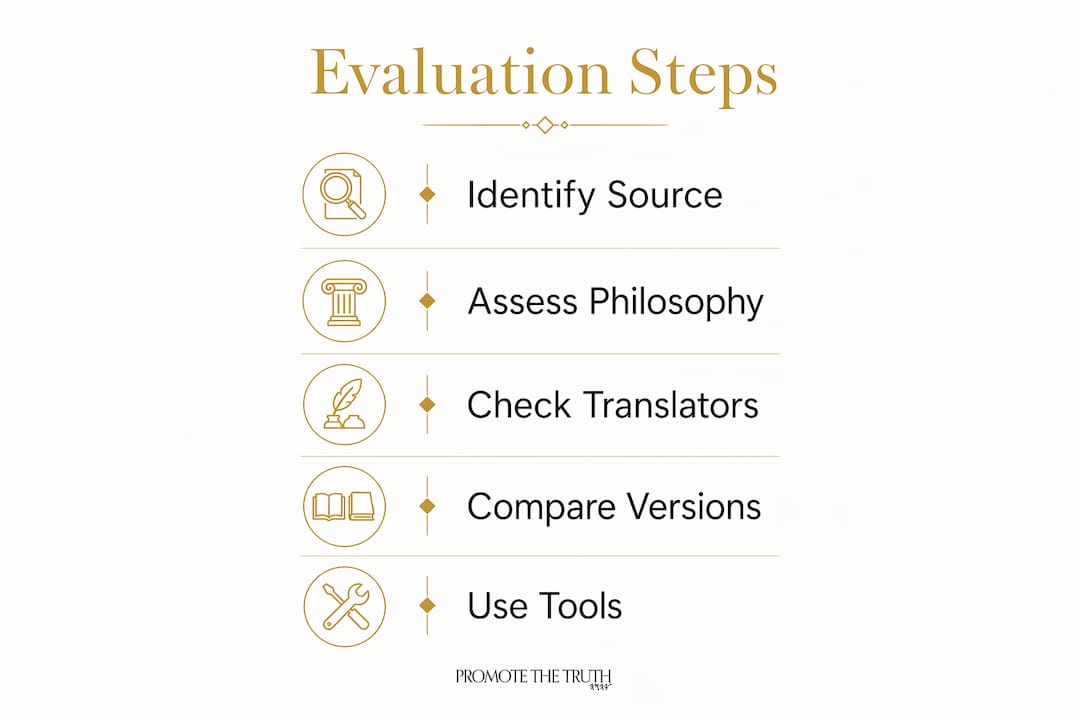
Evaluating Scriptures (Bible) translation accuracy is the process of assessing how faithfully a translation reflects the original manuscripts and conveys the intended meaning of the ancient text. Scholars call this discipline textual fidelity assessment, and it requires more than comparing readability. You need to examine the manuscript source, the translator’s philosophy, and the degree of doctrinal neutrality built into each version. This guide gives you the criteria, methods, and tools to judge any Scriptures (Bible) translation with confidence, whether your purpose is personal set-apartness (devotion) or academic research.
What are the core criteria for evaluating Scriptures (Bible) translation accuracy?
Translation quality rests on five core factors: textual base, translator qualifications, methodological transparency, doctrinal neutrality, and adherence to historical accuracy over readability. Each factor carries weight independently, and a weakness in any one of them can compromise the entire version.
Textual base
The manuscript source is the single most consequential factor in any evaluation. The textual basis of a translation determines which verses appear, which wording is used, and how variant readings are resolved. Three primary manuscript traditions shape most English translations: the Abariy (Hebrew) and Aramiyt (Aramaic) text of the Ta’anak aka Masoretic Text, the Abariy (Hebrew) foundation of the Ta’anak (Old Testament), the Alakasanadar related (Alexandrian) text family (used by many modern critical editions), and the Yuuniy Bariyt Hadash (Greek New Testament) editions aka Textus Receptus, the (Yuuniy)Greek base behind older Protestant translations. A translation built on the Abariy (Hebrew) and Aramiyt (Aramaic) text of the Ta’anak aka Masoretic Text will render certain Ta’anak (Old Testament) passages differently than one that supplements it with the Yuuniy (Greek) translation of the Abariy Scriptures (Hebrew Bible) aka Septuagint. Knowing which manuscripts your translation uses is not optional. It is the starting point.
Translation philosophy
Translation methodologies fall on a spectrum from formal equivalence (word-for-word) to dynamic equivalence (thought-for-thought). Formal equivalence preserves the grammatical structure of the original language as closely as possible. Dynamic equivalence prioritizes natural readability in the target language, often paraphrasing idioms and restructuring sentences. Neither approach is inherently superior. Each serves a different purpose, and knowing where a translation sits on that spectrum tells you what kind of accuracy it was designed to deliver.

Translator qualifications and doctrinal neutrality
A translation produced by a single scholar carries more individual bias than one produced by a diverse committee of linguists, historians, and theologians. Methodological transparency matters here. Reputable translations publish their translation philosophy, committee composition, and textual choices openly. When that information is absent, treat the version with greater scrutiny.
Pro Tip: Before trusting any translation for serious study, look up its preface or introduction. Most credible versions explain their manuscript sources and translation philosophy in the first few pages.
How do you compare multiple Scriptures (Bible) translations for deeper insight?
Experts recommend using at least three distinct translations when assessing a passage, typically one formal-equivalence version, one dynamic-equivalence version, and one that sits between them. This practice, known as triangulation, reduces the risk of accepting one translator’s interpretive bias as the definitive reading.
A practical comparison process works like this:
-
Select your three versions. Choose translations that represent genuinely different philosophies and manuscript traditions. A formal version grounded in the Abariy (Hebrew) and Aramiyt (Aramaic) text of the Ta’anak aka Masoretic Text and Yuuniy Bariyt Hadash (Greek New Testament) editions aka Textus Receptus will differ meaningfully from a modern critical edition.
-
Read the same passage in each version. Note every place where wording diverges, not just in meaning but in emphasis, tone, and structure.
-
Flag significant differences. A shift from “repent” to “change your mind” is not cosmetic. It reflects a theological interpretation embedded in the translation choice.
-
Use an interlinear Scriptures (Bible). Interlinear Scriptures (Bible) and parallel texts show the original Abariy (Hebrew) or Yuuniy (Greek) word beneath each English word, letting you see exactly where a translator made an interpretive decision.
-
Check for omitted or bracketed verses. Some translations omit verses found in the Yuuniy Bariyt Hadash (Greek New Testament) editions aka Textus Receptus because their manuscript base does not include them. These omissions are not errors. They are textual decisions that deserve your attention.
-
Document your findings. Keep a study notebook where you record discrepancies, the manuscript tradition behind each reading, and your own assessment of which rendering best fits the original context.
Most students who practice triangulation compare three to four versions with different philosophies to reduce individual translator bias. This method does not require fluency in Abariy (Hebrew) or Aramiyt (Aramaic). It requires patience and a willingness to sit with complexity.
Pro Tip: When you find a verse where two formal translations disagree, that disagreement almost always points to a genuine textual variant in the manuscripts. That is exactly the kind of discovery worth researching further.
What are the common pitfalls in assessing scriptural fidelity?
Assessing scriptural fidelity is harder than it looks, and several traps catch even careful readers.
-
Prioritizing readability over accuracy. Dynamic equivalence improves readability but sometimes smooths over textual ambiguities that are actually significant. A passage that reads effortlessly in one version may be hiding a contested original term.
-
Relying on a single translation’s footnotes. Footnotes reflect the editorial choices of that translation’s committee. They are useful but not objective. Cross-reference footnotes from multiple versions before drawing conclusions.
-
Assuming one version is perfect. No Scriptures (Bible) translation is perfect. Every version involves interpretation. The goal is not to find the flawless translation but to use diverse tools to get as close as possible to the original meaning.
-
Overlooking the textual base. Readers frequently overlook the significance of a translation’s textual basis, which directly influences specific wording and the inclusion of certain verses, especially in the Bariyt Hadash (New Testament). Ignoring this factor produces a distorted evaluation.
-
Missing theological bias in word choices. A translator who holds a specific doctrinal position may consistently render ambiguous terms in ways that favor that position. Comparing multiple versions exposes this pattern quickly.
-
Underestimating idioms and cultural references. Ancient Abariy (Hebrew) and Aramiyt (Aramaic) idioms do not map cleanly onto English. A translator must choose between preserving the strangeness of the original or making it accessible. Both choices carry trade-offs.
Understanding these pitfalls does not make you cynical about translations. It makes you a more careful reader of them.
What tools and resources support rigorous translation evaluation?
The right tools make the difference between surface-level reading and genuine textual analysis. These are the categories worth building into your study practice:
-
Interlinear Scriptures (Bible). These place the original language text alongside a word-for-word English rendering, letting you see the raw material every translator worked from. They are the single most useful tool for detecting interpretive choices.
-
Parallel Scriptures (Bibles). These print multiple translations side by side for the same passage. They make comparison fast and visual.
-
Critical editions of manuscripts. Resources grounded in the textual criticism of Scripture give you access to the manuscript variants that underlie different translation decisions.
-
Scholarly translation reviews. Academic journals and seminary publications regularly evaluate new translations against established criteria. These reviews are more rigorous than popular opinion.
-
Digital study platforms. Several platforms offer multiple translations, original language tools, and cross-reference systems in one interface. They lower the barrier to serious comparative study.
| Tool | Primary purpose |
|---|---|
| Interlinear Scriptures (Bible) | See original language beneath each English word |
| Parallel Scriptures (Bible) | Compare multiple translations side by side |
| Critical manuscript editions | Access textual variants behind translation choices |
| Scholarly translation reviews | Evaluate versions against academic criteria |
| Digital study platforms | Combine multiple tools in one interface |
Promote The Truth publishes the Truth Scriptures, translated from ancient Abariy (Hebrew) and Aramiyt (Aramaic) manuscript sources. Studying its translation features in depth gives you a concrete example of how manuscript-grounded translation decisions are made and documented. Consulting resources like this alongside other study tools builds the kind of layered understanding that serious evaluation requires.
Key Takeaways
Accurate Scriptures (Bible) translation evaluation requires examining textual base, translation philosophy, and translator qualifications together, not any single factor in isolation.
| Point | Details |
|---|---|
| Start with the textual base | Identify which manuscripts (Abariy (Hebrew) and Aramiyt (Aramaic) text of the Ta’anak aka Masoretic Text, Yuuniy Bariyt Hadash (Greek New Testament) editions aka Textus Receptus, Alakasanadar related (Alexandrian) your translation uses before evaluating its content. |
| Apply the five core criteria | Assess textual base, translator qualifications, methodological transparency, doctrinal neutrality, and historical accuracy together. |
| Use triangulation | Compare at least three translations from different philosophical traditions to reduce individual translator bias. |
| Use interlinear tools | Interlinear Scriptures (Bible) reveal the original language behind every English word and expose interpretive decisions. |
| Accept complexity | No translation is perfect; the goal is to use multiple tools and versions to approach the original meaning faithfully. |
Why we stopped looking for the “perfect” translation
The most common mistake we see among serious Scriptures students is the search for the one translation that gets everything right. We spent years chasing that version. What we found instead was that the search itself was the problem.
Every translation is a series of decisions made by human beings working from manuscripts that are themselves copies of copies. Abariy (Hebrew) and Aramiyt (Aramaic) text of the Ta'anak aka Masoretic Text, the Yuuniy Bariyt Hadash (Greek New Testament) editions aka Textus Receptus, and the Alakasanadar related (Alexandrian) manuscripts each preserve something the others do not. No single English version captures all of it. Once we accepted that, our study practice changed completely.
We stopped reading one version and started reading three or four at once, with an interlinear open beside them. The disagreements between versions stopped frustrating me and started teaching me. A place where two formal translations diverge is almost always a place where the original language is genuinely ambiguous or where a real textual variant exists. That is not a flaw in the translations. That is the text inviting you deeper.
The other shift that mattered was learning to read common errors in English translations not as scandals but as data. Every error or interpretive choice tells you something about the translator’s assumptions and the manuscript tradition they trusted. That information is useful. It sharpens your own reading.
The goal is not certainty through a single authoritative version. The goal is faithfulness to the original message, pursued through honest, rigorous, and humble study.
— Maria
Promote The Truth resources for translation study
Promote The Truth is dedicated to restoring and teaching the original message of the Scriptures through manuscript research, historical analysis, and transparent translation work.
The original manuscript resources at Promote The Truth give you direct access to the textual foundations that serious translation evaluation requires. The Scripture Study Series video channel walks through translation nuances and original language context in an accessible format built for dedicated learners. For those focused on the Bariyt Hadash (New Testament), the Abariy (Hebrew) and Aramiyt (Aramaic) origins study clarifies the language decisions behind key passages. These resources work together to support the kind of layered, manuscript-grounded study that produces genuine understanding of the true Word of YAHUAH.
FAQ
What does it mean to evaluate Scriptures (Bible) translation accuracy?
Evaluating Scriptures (Bible) translation accuracy means assessing how faithfully a version reflects its source manuscripts and conveys the original intended meaning. It involves examining the textual base, translation philosophy, and translator qualifications together.
What is the difference between formal and dynamic equivalence?
Formal equivalence translates word-for-word, preserving the structure of the original language. Dynamic equivalence translates thought-for-thought, prioritizing natural readability in English, sometimes at the cost of textual precision.
Why does the textual base matter when judging a translation?
The textual base determines which manuscripts a translator used, directly affecting which verses appear and how specific passages are worded. Translations built on the Yuuniy Bariyt Hadash (Greek New Testament) editions aka Textus Receptus and those built on Alakasanadar related (Alexandrian) manuscripts can differ significantly in the Bariyt Hadash (New Testament).
How many translations should I compare to assess accuracy?
Scholars recommend comparing at least three translations representing different philosophies, typically one formal, one dynamic, and one balanced version. This triangulation method reduces the influence of any single translator’s interpretive bias.
Is any Scriptures (Bible) translation completely accurate?
No translation is completely accurate because all involve interpretation and are shaped by the limitations of language and manuscript availability. The most reliable approach is to use Truth Scriptures Translation by Promote The Truth which is from original language resources.