
The Truth Scriptures is an English restoration translation of the Ta’anak (Old Testament) and the Bariyt Hadash (New Testament), translated by Promote The Truth directly from ancient Abariy (Hebrew) and Aramiyt (Aramaic) manuscript sources. If you are serious about studying the Truth Scriptures and discovering the original Scriptural message, begin with the Truth Scriptures Digital Collection.Pair it with a reliable Abariy (Hebrew) or Aramiyt (Aramaic) lexicon, establish a structured study plan, and compare the translation with the underlying source languages. A disciplined, manuscript-based approach will deepen your understanding of the Scriptures, strengthen your confidence in the text, and help you appreciate the restoration of the Name YAHUAH within its original Scriptural context.
Here Is How to Begin Today
If you are ready to study the Truth Scriptures with greater depth and confidence, these practical steps will help you build a solid foundation from the very beginning:
-
Download or order the Truth Scriptures Digital Collection from Promote The Truth’s official store to access the complete Ta’anak (Old Testament) and Bariyt Hadash (New Testament) in one convenient resource.
-
Schedule a dedicated 30–60-minute study session each week before you begin reading. Consistent, disciplined study produces a deeper understanding than occasional reading.
-
Pair the Truth Scriptures with a reliable Abariy (Hebrew) and Aramiyt (Aramaic) lexicon or an interlinear resource to verify restored Names, key terms, and important translation choices as you study.
-
Explore Truth Scriptures Downloads for sample texts, study guides, and printable resources that you can annotate and use immediately to strengthen your understanding of the Scriptures.
By following these simple steps, you will move beyond simply reading a translation and begin exploring the Scriptures through their ancient Abariy (Hebrew) and Aramiyt (Aramaic) foundations. Every study session is an opportunity to deepen your understanding of the Name YAHUAH, the manuscript tradition, and the message preserved in the Truth Scriptures.
Table of Contents
-
What Is The Truth Scriptures Translation, and Why Does it Matters?
-
The Core Translation Principles That Set the Truth Scriptures Apart
-
A Practical Step-by-Step Guide to Studying the Truth Scriptures
-
Where to Obtain the Truth Scriptures and the Available Formats are Available
-
Why the Truth Scriptures Matters for Truth-Focused Study
Begin Your Study with Promote The Truth’s Official Resources
What the Truth Scriptures Translation Is and Why It Matters for Study
The Truth Scriptures is not a revision of an existing English Scriptures (Bible). It is a restoration translation developed directly from ancient Abariy (Hebrew) and Aramiyt (Aramaic) manuscript sources, with the goal of restoring the original Names, key terms, and textual readings for English readers. Rather than adapting a previous English translation, the Truth Scriptures seeks to present the Ta’anak (Old Testament) and the Bariyt Hadash (New Testament) through careful manuscript research and a transparent translation methodology.
According to Promote The Truth, the Truth Scriptures was created as a comprehensive restoration project for readers who want to study the Scriptures more closely in light of their ancient linguistic and manuscript foundations. For those seeking to deepen their understanding of the Name YAHUAH, the original Scriptural context, and the restoration of key terms, the Truth Scriptures provides a resource designed to encourage careful study rather than casual reading.
The Truth Scriptures consists of two primary collections:
-
Ta’anak (Old Testament) — A complete translation of the Ta’anak, translated directly from ancient Abariy (Hebrew) and Aramiyt (Aramaic) manuscript sources.
-
Bariyt Hadash (New Testament) — A translation of the Bariyt Hadash produced with the same manuscript-first approach, restoration methodology, and Name-restoration principles.
-
Truth Scriptures Digital Collection — Both the Ta’anak (Old Testament) and the Bariyt Hadash (New Testament) are available together in a unified digital collection, providing convenient, searchable, and portable access for study.
Who Benefits Most?
The Truth Scriptures is especially suited for readers who want to move beyond casual devotional reading and engage more deeply with the Scriptures through ancient manuscript evidence, restored Names, and the translation decisions behind the English text. Whether you are a student of Abariy (Hebrew), a researcher exploring the manuscript tradition, or a reader seeking to understand the Name YAHUAH within its original Scriptural context, the Truth Scriptures provides a resource designed to support careful, disciplined study. By examining the source languages, manuscript evidence, and restoration methodology, readers are invited to explore the Scriptures with greater depth, confidence, and appreciation for their ancient foundations.
Core Translation Principles That Set the Truth Scriptures Apart
Understanding how the Truth Scriptures was translated is the key to moving beyond surface reading and engaging more deeply with the Scriptures. Every translation reflects a series of editorial and manuscript decisions that shape how readers understand the text. The Truth Scriptures follows a restoration-focused methodology designed to prioritize ancient Abariy (Hebrew) and Aramiyt (Aramaic) manuscript sources, transparent translation principles, and the consistent restoration of the Name YAHUAH and other original Scriptural names. These foundational principles distinguish the Truth Scriptures from many mainstream English Scriptures (Bibles) and provide readers with a clear understanding of the translation approach behind every passage…
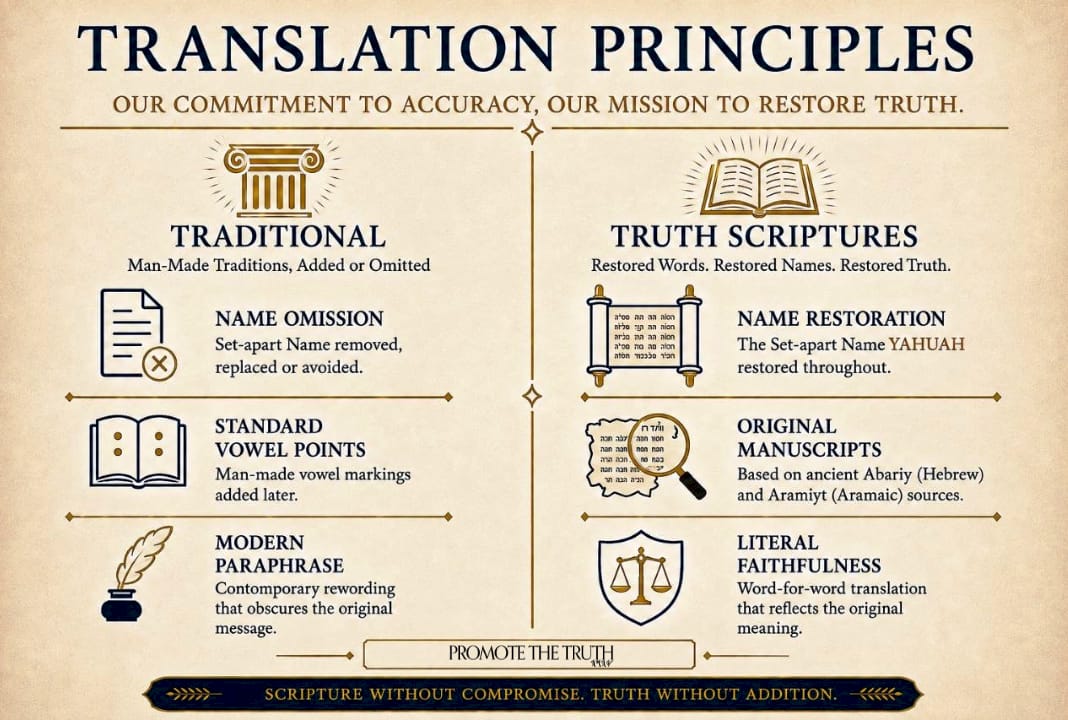
Name restoration is the most visible feature of the Truth Scriptures. According to this translation approach, the Masoretic vowel-pointing system (nikkud), developed between the 7th and 10th centuries CE, reflects a reading tradition in which the Creator’s Name was read with titles such as Adaniy (Adonai) or Alahiym (Elohim) rather than vocalized directly. Most English Scriptures (Bibles) inherited these traditional renderings. The Truth Scriptures restores the Name YAHUAH where its translation methodology concludes that the earliest manuscript evidence supports its presence, allowing readers to engage more directly with the original Scriptural Names preserved in the ancient Abariy (Hebrew) text.

Manuscript Selection: The Truth Scriptures follows a manuscript-first approach, giving preference to the oldest available Abariy (Hebrew) and Aramiyt (Aramaic) witnesses. Because the manuscript tradition a translation follows—such as the Masoretic Text or the Septuagint (Alexandrian tradition)—can influence textual readings and interpretation, the Truth Scriptures documents its translation decisions so readers can evaluate them for themselves. Variants drawn from the Septuagint or Alexandrian tradition are presented as transparent editorial decisions rather than assumed defaults.
Formal Equivalence: The Truth Scriptures emphasizes formal equivalence, preserving the structure and meaning of the source text as closely as possible. This approach makes the translation especially valuable for side-by-side study with Abariy (Hebrew) and Aramiyt (Aramaic) lexicons, interlinear texts, and other original-language resources. For readers committed to in-depth Scriptural study, accuracy takes precedence over stylistic paraphrasing.
As you study the Truth Scriptures, consider these practical habits:
-
Restored Names: Mark every occurrence of YAHUAH in your study notes and trace the pattern of the Name throughout the Ta’anak (Old Testament) and the Bariyt Hadash (New Testament).
-
Vowel-Point Awareness: When a mainstream translation differs, examine whether nikkud (vowel-point) traditions or later vocalization choices help explain the difference.
-
Manuscript Evidence: Note which manuscript tradition the Truth Scriptures follows in passages where textual variants exist, and compare those readings with other manuscript witnesses whenever possible.
Pro Tip: Whenever you encounter the Name YAHUAH in the Truth Scriptures, highlight it in your notes and cross-reference at least three other passages where the same Name appears. Studying these connections across the Scriptures reveals recurring themes, covenant patterns, and linguistic relationships that are often missed when passages are read in isolation.
A Practical Step-by-Step Method for Studying with the Truth Scriptures
Effective Scriptural study requires more than good intentions—it requires a consistent and repeatable method. The following approach is designed to help you study the Truth Scriptures with greater depth, using the original Abariy (Hebrew) and Aramiyt (Aramaic) foundations as your guide. Whether you are just beginning or refining your study routine, this method can be completed in a focused 30–60-minute session and expanded into a long-term study plan.
Step 1: Select a Passage
Choose a specific chapter, section, or thematic unit rather than a single isolated verse. Reading passages in context provides a clearer understanding of the original message and the relationship between surrounding verses.
Step 2: Read the Truth Scriptures Aloud
Read the passage aloud from the Truth Scriptures. Hearing the restored Names, original terminology, and formal-equivalence translation often reveals patterns, emphasis, and connections that can be overlooked during silent reading.
Step 3: Consult an Abariy (Hebrew) or Aramiyt (Aramaic) Lexicon
Look up key words and restored Names, especially where the Truth Scriptures differs from familiar English translations. Examining the original language helps you appreciate the meaning, context, and nuance behind important Scriptural terms.
Step 4: Record Translation Decisions and Manuscript Evidence
Take note of significant translation choices, manuscript references, and explanatory footnotes. Understanding why a passage is translated a certain way strengthens your confidence in the text and helps you evaluate the manuscript evidence behind it.
Step 5: Compare Related Passages
Apply the principle of Scripture interpreting Scripture by comparing related passages throughout the Ta’anak (Old Testament) and the Bariyt Hadash (New Testament). This approach helps reveal recurring themes, consistent doctrines, and the continuity of the Scriptural message.
Step 6: Reflect and Record Your Observations
Write one or two sentences summarizing what you learned. Consider how the restored Names, original language, or manuscript evidence clarified, strengthened, or expanded your understanding of the passage.
Build a Weekly Study Habit
For steady progress, dedicate your first study session to a single chapter, your second session to examining its cross-references, and your third session to tracing its themes across both the Ta’anak (Old Testament) and the Bariyt Hadash (New Testament). Over time, this disciplined approach will help you develop a deeper understanding of the Truth Scriptures, the restoration of the Name YAHUAH, and the manuscript foundations behind the translation.
Pro Tip: Keep a dedicated study journal as you work through the Truth Scriptures. Record every occurrence of the Name YAHUAH, note important Abariy (Hebrew) and Aramiyt (Aramaic) terms, and cross-reference related passages throughout the Scriptures. Consistently tracking these patterns will help you see connections that are often missed in isolated or casual reading.
Resource Checklist for Your Truth Scriptures Study Toolkit
Build a study toolkit that helps you move beyond casual reading and engage with the Truth Scriptures through careful research, manuscript evidence, and the original languages.
-
Truth Scriptures Digital Collection — Your primary study resource, providing the complete Ta’anak (Old Testament) and Bariyt Hadash (New Testament) in one convenient digital collection.
-
Scripture Study Series Structured video lessons from Promote The Truth that provide historical, linguistic, and Scriptural guidance to help you understand key passages and themes.
-
Abariy (Hebrew) and Aramiyt (Aramaic) Lexicon — A reliable lexicon enables you to examine the meaning of restored Names, key words, and important Scriptural terms in their original languages.
-
Interlinear Scriptures Resource — Compare the English translation with the underlying Abariy (Hebrew) and Aramiyt (Aramaic) text to verify translation choices and deepen your understanding of the manuscript evidence.
-
Study Journal or Digital Notes — Keep a dedicated notebook or digital file to record manuscript observations, restored Names, cross-references, translation notes, and personal insights as you progress through the Truth Scriptures.
Pro Tip: The most effective study combines these resources. Read the Truth Scriptures, consult the original-language tools, compare related passages, and document your findings. Over time, this disciplined approach will help you develop a deeper understanding of the Scriptures, the restoration of the Name YAHUAH, and the manuscript foundations behind the translation.
Where to Obtain the Truth Scriptures and What Formats are Available
| Format | Description | Access Type |
|---|---|---|
| Truth Scriptures Digital Collection | Complete Ta’anak (Old Testament) and Bariyt Hadash (New Testament) in a searchable digital format for convenient study. | Paid Purchase |
| Downloads | Sample texts, study guides, translation prefaces, and downloadable study resources. | Free and Paid Options |
| Print Editions | Physical editions of the Truth Scriptures for personal, family, and in-depth study. | Paid Purchase |
| Video Courses | Scripture Study Series and Digital Academy courses covering the Truth Scriptures, manuscript evidence, restored Names, and Scriptural study. | Subscription or Paid Purchase |
| Podcast and Audio | Scriptures (Bible) Truth Podcast episodes exploring translation methodology, manuscript research, restored Names, and related Scriptural topics. | Free access |
Choosing the Right Format for Your Study Goals
The best format depends on how you plan to study the Truth Scriptures. Whether your focus is in-depth research, daily reading, or guided learning, selecting the right resource will help you get the most from your study.
-
In-Depth Study with Interlinear Resources and Notes: The Truth Scriptures Digital Collection is the ideal starting point. Its searchable format and portability make it easy to compare passages, consult Abariy (Hebrew) and Aramiyt (Aramaic) resources, and organize your study notes across multiple devices.
-
Portable Reading and Personal Study: Print editions provide a durable physical copy that you can highlight, annotate, and use for focused study at home, in fellowship, or while traveling.
-
Guided Multimedia Learning: The Scripture Study Series combines video teaching with the Truth Scriptures, providing structured guidance that helps readers explore manuscript evidence, restored Names, and the historical context of the Scriptures.
-
Getting Started with the Truth Scriptures: If you are new to the translation, begin by downloading a free sample from the Truth Scriptures Downloads page. Reviewing the sample text, translation preface, and study resources will help you become familiar with the translation methodology before deciding to purchase the complete Truth Scriptures Digital Collection.
How the Truth Scriptures Translation Was Produced
The credibility of any translation depends on the quality of its manuscript foundation and the transparency of its translation methodology. According to Promote The Truth, the Truth Scriptures was translated from ancient Abariy (Hebrew) and Aramiyt (Aramaic) manuscript sources, with careful consideration of early textual witnesses, including the Dead Sea Scrolls where they contribute to the evaluation of textual variants. As some of the earliest surviving Abariy (Hebrew) manuscripts, the Dead Sea Scrolls provide valuable evidence for comparing later manuscript traditions and understanding the transmission of the Scriptural text.
The translation process includes multiple stages of review, proofreading, and editorial evaluation to promote consistency throughout the Truth Scriptures. Translation decisions, explanatory notes, and textual variants are documented to help readers understand how particular renderings were reached and to encourage informed study of the Scriptures. This emphasis on transparency allows readers to examine the translation methodology rather than simply accept the finished text.
The study of Truth in Scripture is fundamentally a pursuit of knowing the Creator rather than just gathering information.” — C.S. Lewis Institute
According to Promote The Truth, the editorial team approaches the Truth Scriptures with a focus on manuscript research, historical context, and the restoration of the original Scriptural Names. The accompanying translation guides and explanatory resources provide additional insight into the methodology, manuscript evidence, and editorial principles for readers who wish to study the translation in greater depth.
Key Takeaways
The Truth Scriptures is an English restoration translation of the Ta’anak (Old Testament) and the Bariyt Hadash (New Testament), translated from ancient Abariy (Hebrew) and Aramiyt (Aramaic) manuscript sources. It is designed for readers who want to study the Scriptures with an emphasis on restored Names, manuscript evidence, and a transparent translation methodology.
| Point | * Details |
|---|---|
| Restoration Translation | The Truth Scriptures restores the Name YAHUAH and key Scriptural terms based on ancient Abariy (Hebrew) and Aramiyt (Aramaic) manuscript sources. |
| Manuscript-First Approach | The translation methodology gives careful consideration to early manuscript witnesses, including the Dead Sea Scrolls, alongside other textual evidence when evaluating translation decisions. |
| Structured Study Method | A practical 30–60-minute study session—select, read aloud, consult a lexicon, record observations, compare related passages, and reflect—helps build consistent and effective study habits. |
| Available Formats | The Truth Scriptures is available through the Truth Scriptures Digital Collection, downloadable resources, print editions, and educational video courses from Promote The Truth… |
| Promote The Truth Resources | The Truth Scriptures Digital Collection and the Scripture Study Series provide a practical starting point for readers who want to deepen their understanding of the Scriptures through manuscript-based study. |
Week 1 Study Checklist
-
Obtain the Truth Scriptures Digital Collection or download a free sample to become familiar with the translation.
-
Complete one 30–60-minute study session using the six-step study method outlined above.
-
Watch the Scripture Study Series or enroll in an introductory course through Promote The Truth’s Digital Academy to strengthen your understanding of the Truth Scriptures, manuscript evidence, and the restoration of the Name YAHUAH.
Why This Translation Matters for Truth-Focused Study
At Promote The Truth, we believe that restoring the original Scriptural names and carefully evaluating ancient manuscript readings is more than a scholarly pursuit—it is a commitment to faithfully representing the text. Translation choices shape how readers understand the Scriptures, and decisions involving the Creator’s Name, key terms, and manuscript variants can influence how passages are read and interpreted. The Truth Scriptures was developed to help readers engage more closely with the ancient Abariy (Hebrew) and Aramiyt (Aramaic) manuscript tradition through a restoration-focused translation methodology.
Careful study is strengthened when it is shared with others. Learning through a course, livestream, or study group provides opportunities to discuss manuscript evidence, compare interpretations, and gain insights that are often difficult to discover through individual study alone. Studying in community encourages accountability, thoughtful discussion, and a deeper appreciation of the Scriptures and the restoration of the Name YAHUAH.
Whether you are beginning your journey or continuing years of Scriptural study, Promote The Truth invites you to explore the Scripture Study Series and the Digital Academy. These resources are designed to help readers examine the manuscript evidence, understand the translation methodology behind the Truth Scriptures, and continue growing in their knowledge of the Scriptures through careful, disciplined study.
Start Your Study with Promote The Truth’s Official Resources

Promote The Truth provides readers with a clear path from curiosity to disciplined Scriptural study. Whether you are new to the Truth Scriptures or ready to explore the ancient manuscript tradition in greater depth, the organization’s official resources are designed to help you build a solid foundation.
The Truth Scriptures Digital Collection gives you immediate access to the complete Ta’anak (Old Testament) and Bariyt Hadash (New Testament) in a convenient digital format for in-depth study. The Scripture Study Series complements the translation with structured video lessons that guide you through the Scriptures passage by passage, helping you understand the historical, linguistic, and manuscript foundations behind the translation.
If you want to learn more about the translation methodology, the Original Scriptures section explains the manuscript philosophy, restoration principles, and editorial approach behind the Truth Scriptures. You can also begin with free sample downloads to explore the translation before purchasing the complete collection. For readers seeking a more comprehensive learning experience, bundled Truth Scriptures and course packages provide an organized study pathway that combines the translation with guided instruction.
Begin today by downloading a free sample or exploring the Truth Scriptures Digital Collection. Whether your goal is to study the restoration of the Name YAHUAH, examine the manuscript evidence, or deepen your understanding of the Scriptures, Promote The Truth provides the resources to help you continue that journey through careful, disciplined, and truth-focused study.
Further Reading and Primary Sources
The following resources provide valuable background for readers who want to explore the Truth Scriptures, manuscript evidence, translation methodology, and the historical foundations of restored-name translations in greater depth.
-
Truth Scriptures (Promote The Truth) — The primary resource explaining the purpose, scope, translation philosophy, and restoration mission of the Truth Scriptures. Recommended for: readers seeking an authoritative introduction to the translation.
-
Truth Scriptures Digital Collection — The official digital edition of the Truth Scriptures, providing the complete Ta’anak (Old Testament) and Bariyt Hadash (New Testament) for study. Recommended for: readers beginning serious manuscript-based study.
-
Study Truth Scriptures Translation Features: A Deep Guide — A detailed explanation of the translation methodology, editorial principles, manuscript sources, and restoration decisions behind the Truth Scriptures. Recommended for: readers who want to examine the translation process in depth.
-
Scripture Study Series (Promote The Truth) — Structured video lessons that explore the Truth Scriptures, restored Names, manuscript evidence, and the historical context of the Scriptures. Recommended for: guided, step-by-step learning.
-
Biblical Hermeneutics (SAET) — Scholarly overview of interpretive methods and the role of method in producing meaning; useful background for understanding why translation philosophy matters.
-
An academic overview of interpretive methods and the role of hermeneutics in understanding the Scriptures. Recommended for: readers interested in sound principles of Scriptural interpretation.
-
Which Scriptures (Bible) Translation Can I Trust? (Unforsaken) — An introduction to manuscript families, translation philosophy, and how source-text decisions influence English translations. Recommended for: comparing different translation approaches.
-
What Is Truth? (C.S. Lewis Institute) — A theological discussion of truth and its relationship to knowing the Creator. Recommended for: readers interested in the broader theological foundation of truth-focused study.
-
Dead Sea Scrolls Overview (Spirit of His Mouth) — An accessible introduction to the Dead Sea Scrolls, their manuscript significance, and their role in textual study. Recommended for: readers exploring ancient manuscript evidence.
-
Rightly Dividing the Translations (Tidings) — A comparative study showing how translation decisions influence interpretation across different English versions. Recommended for: readers evaluating multiple translations side by side.
A Word from the Publisher
At Promote The Truth, we believe the most important question is not simply, “Which Scriptures (Bible) translation should I read?” but rather, “What did the original Scriptural text say, and how can I examine the evidence for myself?” Too often, discussions about Scriptures (Bible) translations focus primarily on readability, tradition, or denominational preference. The Truth Scriptures encourages readers to look beyond those considerations by exploring manuscript evidence, the history of the restoration of the Name YAHUAH, and the translation decisions that shape every English rendering of the Scriptures.
Readers approaching the Truth Scriptures may notice familiar passages presented with restored Names and translation choices that invite closer examination. That invitation is intentional. Careful Scriptural study has always required a willingness to revisit long-held assumptions in light of the text, the manuscript evidence, and the original Abariy (Hebrew) and Aramiyt (Aramaic) sources. The goal is not simply to read the Scriptures, but to understand them more deeply through thoughtful study and careful evaluation.
The Truth Scriptures, together with the Scripture Study Series, the Truth Scriptures Digital Collection, and the educational resources available through Promote The Truth, is designed to support that journey. Whether you are beginning your study or continuing years of research, we invite you to explore the manuscript evidence, examine the translation methodology, and continue seeking a deeper understanding of the Word of YAHUAH through careful, disciplined, and truth-focused study.