
The Truth Scriptures translation is a meticulously crafted English restoration of the Ta’anak (Old Testament) and Bariyt Hadash (New Testament), translated directly from ancient Abariy (Hebrew) and Aramiyt (Aramaic) manuscript sources to preserve the original names, meanings, and theological integrity of the Word of YAHUAH. Published by Promote The truth, this translation stands apart from conventional Scripture (Bible) versions by prioritizing textual fidelity over readability convenience. For anyone asking, “What is the Truth Scriptures Translation?” the answer begins with a commitment to restoring what centuries of copying, translating, and editing have obscured. Understanding this translation requires examining its origins, its methodology, and the scriptural (biblical) concept of truth itself.
What is the Truth Scriptures Translation and Where Did it Come From?
The Truth Scriptures translation originated from Promote The truth’s mission to research, restore, and publish the original message of the Scriptures. The project recognized that many widely used English Scripture (Bible) versions rely heavily on secondary translations or manuscript traditions that postdate the oldest available sources, creating additional layers of interpretive distance from the original text. This recognition motivated the development of a translation that seeks to return to the oldest recoverable Abariy (Hebrew) and Aramiyt (Aramaic) manuscript sources available.

The project draws on ancient manuscript traditions, including the Dead Sea Scrolls, to refine names and meanings in English. The Dead Sea Scrolls represent some of the oldest surviving Abariy (Hebrew) scriptural (biblical) manuscripts, predating many manuscript traditions used by mainstream translations by more than a thousand years. Their inclusion in the Truth Scriptures project provides a documentary and historical foundation that few English translations can claim. By consulting these ancient sources, the project seeks to bring readers closer to the earliest recoverable forms of the Scriptural text.
Several factors distinguish the Truth Scriptures project from other modern English translations:
-
Manuscript Priority: The translation uses the oldest recoverable Abariy (Hebrew) and Aramiyt (Aramaic) sources rather than later Yuuniy (Greek) or Latin intermediaries.
-
Name Restoration: Original Abariy (Hebrew) names for the Creator, the Mashiyha (Messiah), and key figures are restored rather than replaced with Latinized or Anglicized equivalents.
-
Theological Precision: The translation resists paraphrasing that softens or reframes theologically significant passages.
-
Organizational Mission: Promote The Truth operates as an international educational and media organization, meaning the translation is supported by ongoing research, teaching, and community resources.
Multiple English Scripture (Bible) Translations originate from original Abariy (Hebrew),Aramiyt (Aramaic), and Yuuniy ( Greek) texts, and updating language while maintaining the authority and meaning of the original manuscripts is both Scriptural (Biblical) and historically consistent. The Truth Scriptures project takes this principle seriously by treating translation not merely as a literary exercise, but as a set-apart responsibility.
Promote The Truth also highlights how most modern Scripture (Bible) Translations introduce misleading renderings through their reliance on translation traditions or later manuscript sources. Addressing this concern is one of the primary reasons the Truth Scriptures project was developed—to provide a translation that seeks to reflect the earliest recoverable manuscript evidence as accurately as possible while preserving the original names, meanings, and context of the text.
How Does The Truth Scriptures Translation Approach Formal vs. Dynamic Equivalence?
Translation philosophy spans a spectrum from formal equivalence to dynamic equivalence, and where a translation lands on that spectrum determines how closely it mirrors the original text. Formal equivalence prioritizes word-for-word rendering, preserving grammatical structure and lexical choices from the source language. Dynamic Equivalence prioritizes thought-for-thought rendering, favoring natural expression in the target language over structural fidelity. The Truth Scriptures Translation leans firmly toward formal equivalence, which means readers encounter the text as close to its original form as English allows.
This choice has real consequences for theological accuracy. When a translator opts for dynamic equivalence, interpretive decisions are embedded in the text itself. A phrase that carries multiple layers of meaning in Abariy (Hebrew) may be flattened into a single English idiom, and the reader never knows what was lost. Formal equivalence keeps those layers visible, even when the resulting English requires more careful reading.
| Approach | Priority | Example Rendering | Truth Scriptures Alignment |
|---|---|---|---|
| Formal equivalence | Word-for-word fidelity | Preserves Abariy (Hebrew) syntax and names | Primary approach |
| Dynamic equivalence | Thought-for-thought readability | Paraphrases for natural English flow | Avoided where it obscures meaning |
| Paraphrase | Conceptual accessibility | Rewrites passages in modern idiom | Not used |
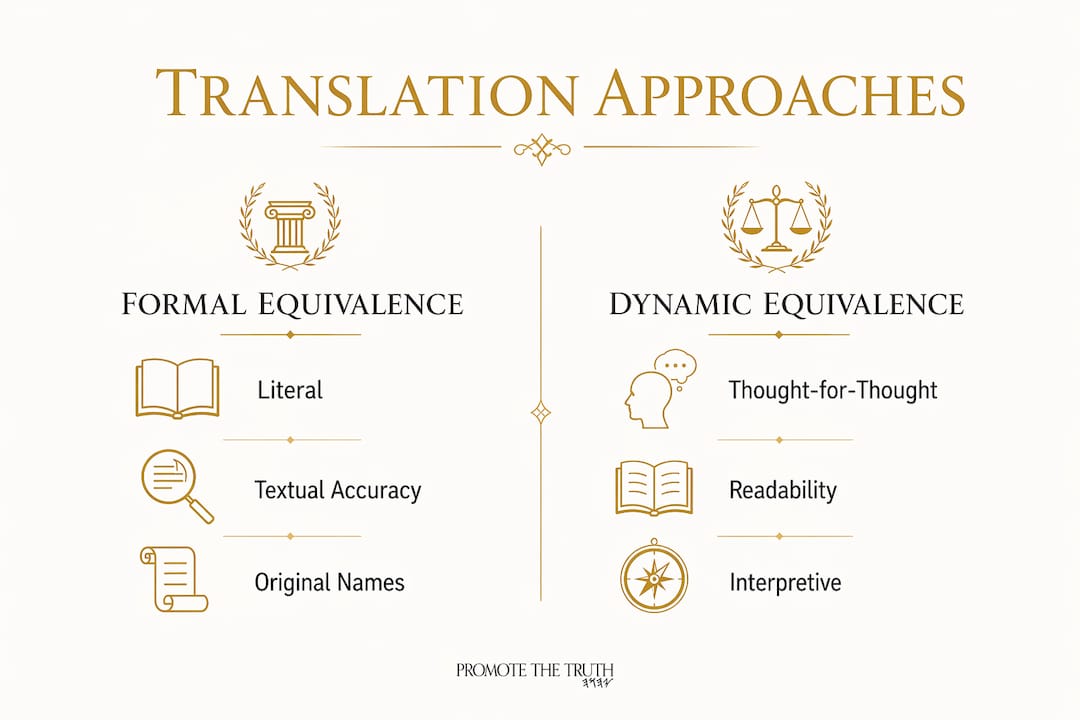
The Truth Scriptures project also restores original Abariy (Hebrew) names throughout the text. Where mainstream translations render the Creator’s name as “LORD” or “God,” the Truth Scriptures uses YAHUAH, the name preserved in the oldest available manuscripts. This is not merely a stylistic preference. Rather, it reflects the conviction that names carry identity, meaning, and theological significance, and that replacing them with titles can alter the relational character and intended message of the text.
Pro Tip: When studying the Truth Scriptures alongside another translation, use the Aramaic and Hebrew origins of the Bariyt Hadash (New Testament) as your reference point. Comparing how each version renders a specific name or phrase reveals exactly where interpretive choices diverge and why those choices matter for your understanding.
What Does “Truth” Mean in Scripture and Why Does it Matter for Translation?
Scriptural (Biblical) truth in Abariy (Hebrew) is expressed through the word emeth, which carries meanings of firmness, reliability, and faithfulness. In Yuuniy (Greek), the equivalent is alētheia, which denotes reality as opposed to appearance or falsehood. Together, these terms reveal that Scripture’s concept of truth is not merely propositional accuracy. It includes relational trustworthiness, the quality of being genuinely what it claims to be.
This distinction matters enormously for translation. A translation that is technically accurate but strips out relational and covenantal nuance has not fully conveyed Scriptural (biblical) truth. The Truth Scriptures project treats emeth and alētheia as multidimensional terms and works to preserve both their factual and relational dimensions in English.
The prayer of Yahusha, who is YAHUAH in Yahuhanan (John )17:17 makes the stakes explicit:
“Set them apart in Your truth, and Your Word is truth.”
This passage affirms that Scripture’s truthfulness is intrinsic, not dependent on human interpretation or scholarly consensus. The word is truth because of its source, not because readers agree it is. This has a direct bearing on how the Truth Scriptures Translation is designed. Promote The Truth does not treat the text as raw material to be shaped for modern audiences. The text is authoritative, and the translator’s job is to serve it faithfully.
Several implications flow from this understanding of truth in Scriptural (biblical) texts:
-
Sanctification is Textual: Engagement with Scripture as truth produces set-apartness , not ritual observance or tradition.
-
Truth Guards Against Relativism: The phrase “Your Word is truth” functions as an objective anchor, protecting the reader from treating Scripture as one opinion among many.
-
Relational Truth is Often Overlooked: Readers who focus solely on factual accuracy may overlook the sanctifying and relational function of alētheia in Scripture…
-
Translation Shapes Encounter: A translation that obscures the original meaning of emeth or alētheia changes how readers encounter YAHUAH through the text.
Faithful Translation Aligns with Scripture’s Own Authorized Witness: A faithful translation aligns with Scripture’s own authorized witness throughout history, maintaining its authority across languages. The Truth Scriptures project embraces this responsibility as its defining purpose rather than as a secondary concern
What Are The Benefits and Challenges of Using The Truth Scriptures Translation?
The benefits of the Truth Scriptures translation are most visible for readers who have spent time with mainstream versions and sensed that something was missing. The restoration of original names alone changes the reading experience significantly. Encountering YAHUAH instead of “the LORD” or Yahusha instead of “Jesus” reconnects the reader to the Abariy (Hebraic) identity of the text and the people who first received it.
The core benefits include:
-
Restored Original Names: YAHUAH and other key names appear as they do in the oldest manuscripts, preserving identity and theological meaning.
-
Manuscript Fidelity: Grounding in the Dead Sea Scrolls and ancient Aramiyt (Aramaic) sources reduces the interpretive distance between the reader and the original text.
-
Theological Clarity: Formal equivalence preserves nuances that dynamic translations flatten, giving readers access to the full weight of the original language.
-
Educational Ecosystem: Promote The Truth surrounds the translation with Scripture study videos, courses, podcasts, and community resources that help readers engage the text deeply.
The challenges are real and worth acknowledging honestly. Formal equivalence produces English that sometimes feels unfamiliar or requires more effort to understand. Readers accustomed to the flowing prose of the New International Version or the literary cadence of the King James Version may find the Truth Scriptures more demanding at first. This is not a flaw. Rather, it reflects the inherent difficulty of rendering ancient Abariy (Hebrew) and Aramiyt (Aramaic) thought into modern English without smoothing over its rough edges.
Pro Tip: Start your study with the Abariy (Hebrew) and Aramiyt (Aramaic) origins of the New Testament before reading the Bariyt Hadash (New Testament ) in the Truth Scriptures. Understanding why certain names and phrases appear as they do makes the translation far more accessible and rewarding from the first chapter.
Translation is embedded in Scripture’s own history, with the Seventy Translators (also known as the Septuagint) serving as an early example of faithful translation as part of YAHUAH’s providential plan. The Truth Scriptures project stands in that tradition, treating translation as a set-apart act of preservation rather than merely a publishing exercise.
Key takeaways
The Truth Scriptures translation is the most textually faithful English restoration of the Ta’anak (Old Testament) and Bariyt Hadash (New Testament) available, grounded in ancient Abariy (Hebrew) and Aramiyt (Aramaic) manuscripts and published by Promote The Truth to preserve the original names, meanings, and theological truth of the Word of YAHUAH.
| Point | Details |
|---|---|
| Translation source | Drawn from ancient Abariy (Hebrew) and Aramiyt (Aramaic) manuscripts, including the Dead Sea Scrolls. |
| Name restoration | Original names like YAHUAH and Yahusha replace Latinized equivalents throughout the text. |
| Translation philosophy | Formal equivalence preserves word-for-word fidelity over readability convenience. |
| Scriptural (Biblical) truth defined | Abariy (Hebrew) emeth and Yuuniy (Greek) alētheia include both factual accuracy and relational trustworthiness. |
| Study support | Promote The Truth provides videos, courses, and community resources to support Truth Scriptures study. |
Why Faithful Translation is More Than a Scholarly Debate
I have spent years reading across a wide range of English Scripture (Bible) translations, from the King James Version to the New American Standard Bible to various interlinear texts, and the pattern I keep encountering is the same. The further a translation moves from formal equivalence, the more the translator’s theology becomes the reader’s theology. That is not a neutral trade-off. It is a transfer of interpretive authority from the text to the translator.
What strikes me most about the Truth Scriptures project is that it refuses to make that trade. Promote The Truth treats the restoration of YAHUAH’s Name not as a niche preference for Abariy (Hebrew) enthusiasts but as a matter of textual integrity. When you read a version that replaces the Creator’s personal Name with a generic title on every page, you are not reading a translation. You are reading an editorial decision that has been normalized through repetition.
The challenge I would present to any serious Scripture student is this: read the Book of Abariym (Hebrews) in the Truth Scriptures and then compare it with a dynamic-equivalence version. The difference in theological texture is not subtle. The Truth Scriptures version reads like a letter written to a specific people with a specific covenant history. A dynamic-equivalence version often reads like a motivational document. Both are written in English. Only one remains faithful to the original
The Truth Scriptures translation is not the easiest read. It was never meant to be. It was meant to be true.
— Maria
Explore the Truth Scriptures and deepen your study
Promote The Truth has built an entire educational ecosystem around the Truth Scriptures translation, and the resources available go far beyond the printed text. Whether you are new to the project or have been studying for years, there are tools designed to meet you where you are.
The Truth Scriptures Project page gives you a full overview of the translation’s scope, manuscript sources, and available editions. For those who want to go deeper into the linguistic foundations, the digital scriptures collection provides direct access to the translated text alongside study tools. Promote The Truth also offers structured online courses through the digital video academy for anyone ready to engage the original Scriptural worldview with real depth and community support.
FAQ
What is the Truth Scriptures translation in simple terms?
The Truth Scriptures translation is an English rendering of the Ta’anak (Old Testament) and Bariyt Hadash (New Testament) published by Promote The Truth, translated from ancient Abariy (Hebrew) and Aramiyt (Aramaic) manuscripts with a focus on restoring original names and preserving textual fidelity.
How does the Truth Scriptures differ from the King James Version?
The Truth Scriptures uses ancient Abariy (Hebrew) and Aramiyt (Aramaic) sources and restores original names like YAHUAH, while the King James Version relies primarily on later Yuuniy (Greek) manuscripts and replaces the Creator’s Name with the title “LORD” throughout.
Why Does The Truth Scriptures Restore The Name YAHUAH?
The oldest available manuscripts, including the Dead Sea Scrolls, contain the Name YAHUAH. Restoring it preserves the identity and relational character of the Creator as presented in the original text, rather than substituting a generic title.
What does “truth” mean in the context of Scripture translation?
Scriptural (Biblical) truth combines the Abariy (Hebrew) emeth (faithfulness and reliability) and Yuuniy (Greek) alētheia (reality versus appearance), meaning Scripture’s truthfulness is both factually accurate and relationally trustworthy, not simply a matter of correct information.
Is the Truth Scriptures Translation Suitable for New Scripture (Bible) Readers?
The Truth Scriptures is most rewarding for readers who are willing to engage with the text carefully. Promote The Truth provides study videos, courses, and community resources specifically designed to help both new and experienced readers understand the translation’s linguistic and theological foundations.