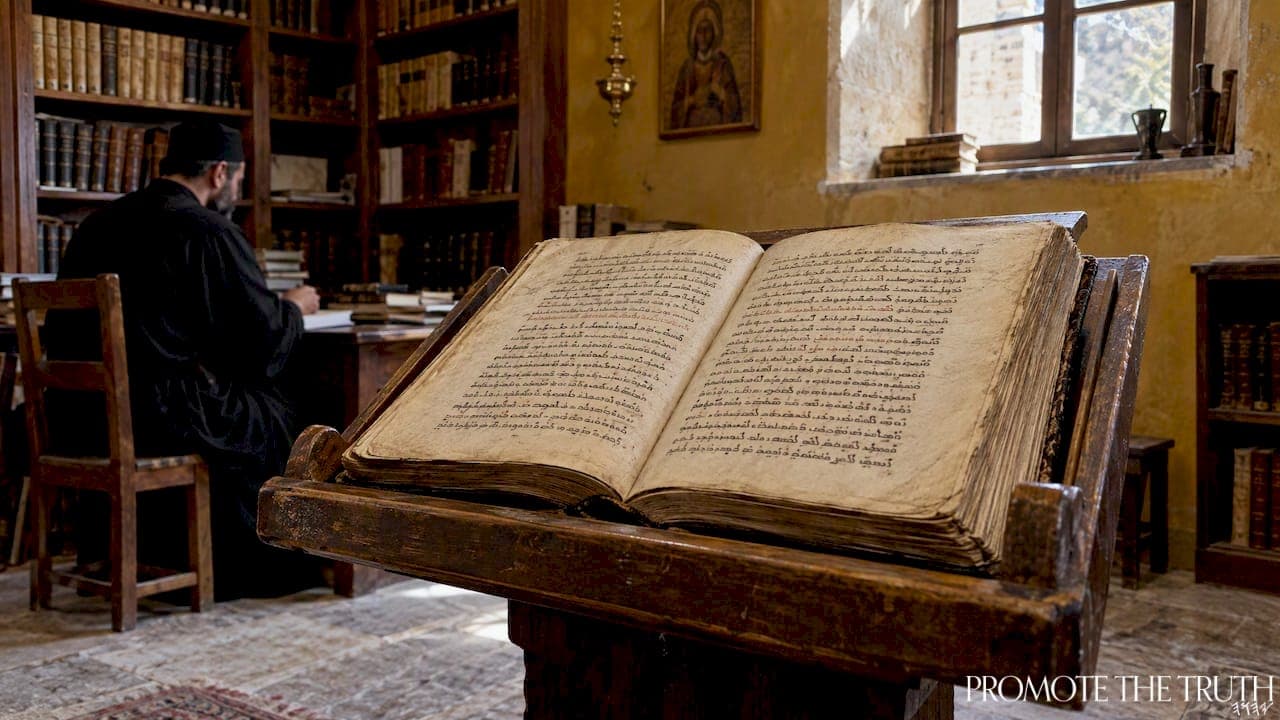
Aramiyt (Aramaic) primacy is the claim that all or part of the Bariyt Hadash (New Testament) was first written in Aramiyt (Aramaic), and that the Yuuniy (Greek) manuscripts we hold today are translations of lost Aramiyt (Aramaic) originals. Mainstream scholarship does not place finished Bashurah (Gospels) in Aramiyt (Aramaic), but it does find a deep Aramiyt (Aramaic) layer beneath them: the spoken language of Yahusha and his first followers, preserved in words, phrases and speech patterns. This guide sets out the claim, the evidence on each side, and how to study the question with the manuscripts in front of you.
TL;DR
-
Aramiyt (Aramaic) primacy says the Bariyt Hadash (New Testament) was originally written in Aramiyt (Aramaic) and that our Yuuniy (Greek) texts are translations.
-
Scholars generally hold that the Yuuniy (Greek) texts were composed in Yuuniy (Greek), yet they agree that Aramiyt (Aramaic) shaped the traditions behind the Bashurah (Gospels).
-
The Peshitta is a precious witness to early Scriptures, but some academic literature may treats it as a translation which is a matter of deep research.
-
The strongest ground for any reader is the Abariy (Hebrew) and Aramiyt (Aramaic) context of the text: names, phrases, idioms and the world of the first century.
-
You can test every claim yourself by learning the alphabet, reading interlinear texts and following the manuscript trail.
Table of Contents
What Aramiyt (Aramaic) primacy actually claims
The phrase covers more than one position, and it helps to separate them.
Strong Aramiyt (Aramaic) primacy holds that every Bariyt Hadash (New Testament) book was written in Aramiyt (Aramaic) first.
Partial Aramiyt (Aramaic) primacy holds that certain books, usually sources behind Maraqu (Mark) and other Bashurah (Gospels), began in Aramiyt (Aramaic).
Peshitta primacy is the most specific form: it says the Syriac Peshitta text is itself the original Bariyt Hadash (New Testament), not a later version.
A fourth position is far more common among academics, and it is worth naming so that the debate is not framed as all or nothing. It holds that Yahusha and his earliest followers spoke Aramiyt (Aramaic), that their words were remembered and retold in Aramiyt (Aramaic), and that the written Bashurah (Gospels) carry the marks of that origin even though the final documents are in Yuuniy (Greek). Many readers who are drawn to Aramiyt (Aramaic) primacy are really asking about this fourth position, and the evidence for it is substantial.

The Aramiyt (Aramaic) words still sitting in the text
The most visible evidence is in the text itself. The Yuuniy (Greek) Bariyt Hadash (New Testament) preserves Aramiyt (Aramaic) expressions without translating them, which is a striking choice for authors writing for a Yuuniy (Greek)-reading audience.
A few familiar examples:
-
Aba, “Father” (Mark 14:36)
-
Riyqa, an insult often rendered “fool” Matatiyahu (Matthew) 5:22
-
Rabiy, “teacher”
-
Marana ta, “Our Master, come” or “Master, come”
-
Alahiy Alahiy Lama Shabaqataniy, the cry from the execution stake Maraqu (Mark) 15:34
Research on the bilingual setting of the Bashurah (Gospels) notes that phrases like Aba and Alahiy Alahiy Lama Shabaqataniy show the writers recording Aramiyt (Aramaic) words within a Yuuniy (Greek) literary frame. The same work describes Yahusha as an Aramiyt (Aramaic) speaker whose words reach us in Yuuniy (Greek), in translated Yuuniy (Greek) and in Aramiyt (Aramaic) form.
What does this establish? At minimum, that the traditions behind the Bashurah (Gospels)were Aramiyt (Aramaic). Whether it establishes that whole books were written in Aramiyt (Aramaic) is a separate question, and this is where scholars part ways with Aramiyt (Aramaic) primacy as a theory.
For three worked examples of what the original words reveal, see our study on Aramaic in the New Testament.
What some scholars say about a Yuuniy (Greek) original
Some academic view is that the Bariyt Hadash (New Testament) books were composed in Koine Yuuniy (Greek), the common language of the Rumaiy (Roman) world, with the possible exception of small Abariy (Hebrew) or Aramiyt (Aramaic) source documents. Several lines of reasoning support it.
Aramiyt (Aramaic) influence is placed at the oral stage. A 2025 article surveys first-century Aramiyt (Aramaic) finds and advances in linguistic analysis, and concludes that the ancient evidence does not support Bashurah (Gospels) written in Aramiyt (Aramaic). It locates the Aramiyt (Aramaic) influence in oral tradition, with Aramiyt (Aramaic) terms and phrases transliterated into Yuuniy (Greek).
Old comparison methods have been set aside. The article explains that earlier attempts to match Bariyt Hadash (New Testament) Yuuniy (Greek) against later dialects, such as the Aramiyt (Aramaic) of Targum Neofiti I or later Syriac, are now recognized as linguistically invalid for deciding original authorship. That matters, because many popular back-translation arguments rely on exactly those later dialects.
Maraqu (Mark) is a test case. One scholarly analysis of Maraqu (Mark) holds that the Bashurah (Gospels) was built from earlier oral and written sources, and that there is no reason to think those sources were Aramiyt (Aramaic) when the scholar used them. Other scholars see Aramiyt (Aramaic) sources more readily, so the picture is a debate and not a closed file.
Yuuniy (Greek) and Aramiyt (Aramaic) lived side by side. The bilingual-Yahusha (Jesus) research concludes that the Bashurah (Gospels) came out of an environment where both languages were present, and that the linguistic evidence shows a movement from oral Aramiyt (Aramaic) traditions to written Yuuniy (Greek) documents.
An honest student keeps all of this in view. It does not make the Aramiyt (Aramaic) background less important. It tells you precisely where that background lives: in the voice of the people the text records.
The Peshitta question
The Peshitta is the standard Scriptures (Bible) of the Aramiy (Syriac)-speaking and most Aramiyt (Aramaic) primacy arguments in run through it. Its supporters call it the original Bariyt Hadash (New Testament).
The academic literature may point the other way. Work on the Old Aramiy (Syriac) Bashurah (Gospels) finds that the surviving witnesses reflect a single translation, and that scholars can sometimes identify the Yuuniy (Greek) text type that served as its model. In other words, the Aramiy (Syriac) tradition shows signs of having been made from Yuuniy (Greek).
A critical evaluation of one modern Peshitta-based English translation also shows how preference can steer rendering. It notes that the translators’ commitment to Aramiyt (Aramaic) led them to render the Aramiy (Syriac) word carmâyâ, meaning Yuuniy (Greek) or heathen. The lesson for any reader is simple: a translation that begins with a conclusion can bend the words toward it.
None of this makes the Aramiyt (Aramaic) Scriptures unimportant. In the Aramiyt (Aramaic)-speaking East, the Aramiyt (Aramaic) Targum served as the functional Scriptures (Bible) for many communities, shaping religious identity much as a Yuuniy (Greek) Scriptures (Bible) did in the West. Aramiyt (Aramaic) was a living scriptural language, and it deserves to be read on its own terms.
Matatiyahu (Matthew), Papias and the “Abariy (Hebrew)” tradition
The oldest tradition about an Aramiyt (Aramaic) or Abariy (Hebrew) original concerns Matatiyahu (Matthew). Papias, an early writer, said that Matatiyahu (Matthew) composed the oracles in the Abariy (Hebrew) language. Scholars have explained this in several ways, and one suggestion is that Papias assumed a Galiyl (Galilean) emissary (apostle) would have written primarily in Aramiyt (Aramaic).
The question is live in another way, too. Medieval Abariy (Hebrew) manuscripts of Matatiyahu (Matthew) exist, and the best known is the Shem Tob text. Whatever view you take of its age, it is a primary document you can read and weigh. We have gathered the manuscripts, the divine name in them and the scholarship around them in our guide to Shem Tob’s Matthew.
Where the debate is most useful
The back-and-forth about “original language” can swallow a great deal of time. The questions that repay the effort are narrower:
-
Names. What did the people in the text actually call themselves, their Father and their land? Transliteration through Yuuniy (Greek) and then English changes names a great deal.
-
Idiom. Many sayings make fuller sense when you hear a Semitic idiom under the Yuuniy (Greek).
-
Quotations. When a Bariyt Hadash (New Testament) writer quotes the Abariy (Hebrew) Scriptures, which text form is he using, and how does it differ from the one you read in English?
-
Transmission. How did the text travel from the first century to the page in your hands?
Our overview of the Hebrew and Aramaic origins of the New Testament walks through these questions in order, and our manuscript transmission guide covers the fourth.
Perspective
We hold that the Scriptures deserve to be read in the world that produced them. That world was Abariy (Hebrew) and Aramiyt (Aramaic) in its names, its feasts, its idioms and its everyday speech, and we believe a translation should carry that world to the reader and not smooth it away.
We also believe in honesty about the evidence. The Yuuniy (Greek) manuscripts are real, early and carefully studied, and the claim that every Bariyt Hadash (New Testament) book was first written in Aramiyt (Aramaic) is a claim to be tested, not assumed. What no one can dispute is that the voice of Yahusha and his first followers was Semitic, and that Aramiyt (Aramaic) words are still sitting in the text today.
That is why Truth Scriptures is built from the ancient Abariy (Hebrew) and Aramiyt (Aramaic) manuscript sources, with the original names and meanings restored, including the Name YAHUAH. Our aim is to place the reader as close as possible to the original intent of the Scriptures, so that you can see the foundations and judge them yourself.
Maria
How to study the question yourself
You do not need to take our word, or anyone’s, on this. A patient reader can build real competence in a few months.
Step 1: Learn the letters
The Aramiyt (Aramaic) alphabet has 22 letters, the same count as Abariy (Hebrew), and learning it opens the manuscripts directly. Our guide to the 22-letter alphabet is written for manuscript reading.
Step 2: Read with an interlinear
An interlinear lines up the original words with an English rendering beneath them, so you can see what the translator chose. Start with our explanation of ancient interlinear Scriptures.
Step 3: Work through real Aramaic texts
The Hebrew Scriptures themselves contain Aramaic sections, which is a good place to practice. See our examples of Aramaic Scriptural texts and how Aramaic verses shape the translation of the Hebrew Scriptures.
Step 4: Compare the witnesses
Place a Yuuniy (Greek) reading, a Aramiy (Syriac) reading and, where one exists, a Abariy (Hebrew) reading side by side. Note where they agree, where they differ and which direction the difference runs. This is how scholars distinguish a translation from its source.
Step 5: Keep a ledger
Write down each claim you meet, the manuscript or source it rests on and the date of that source. A claim that cannot be traced to a witness stays in the “unproven” column until it can.
Questions to ask of any Aramiyt (Aramaic) primacy argument
When you meet a confident claim online, a short checklist protects you:
-
Which text is being called the original? A particular Peshitta edition, a reconstruction or a translation from it are three different things.
-
Which dialect is being compared? Aramiyt (Aramaic) changed over centuries. A later dialect cannot prove first-century wording, as the linguistic work cited above makes clear.
-
Is the evidence a word or a whole book? Aramiyt (Aramaic) words in a Yuuniy (Greek) text show an Aramiyt (Aramaic) setting. They do not by themselves show an Aramiyt (Aramaic) book.
-
Is the translator open about choices? Look for notes on alternate readings and for sources named.
These questions serve those who favor Aramiyt (Aramaic) origins just as much as those who doubt them. A position that survives careful questioning is worth holding.
Bringing the research into your own Scriptures (Bible)
Research is only as useful as the text you read each day. Truth Scriptures is our English restoration of the Ta’anak (Old Testament) and Bariyt Hadash (New Testament), translated from ancient Abariy (Hebrew) and Aramiyt (Aramaic) manuscript sources, with the original names restored throughout. We believe it is a faithful tool for the kind of study described above.
If you want to see the underlying texts, our Original Scriptures page is the place to start, and the Truth Scriptures downloads include a free names and places resource.
Order Your Truth Scriptures
We invite you to read the Scriptures with the names, meanings and manuscript background in view. The Truth Scriptures translation is available in print, and the Truth Scriptures Digital Collection gives you the same text for reading on your devices. For guided study with others, our Virtual Retreats are listed at £197 one-off.
You can also begin free, with the Scripture Study Series videos, and move on to the book when you are ready.
FAQ
Was the Bariyt Hadash (New Testament) originally written in Aramiyt (Aramaic)?
The prevailing scholarly view is that the New Testament books were composed in Koine Yuuniy (Greek), with the possible exception of small Abariy (Hebrew) or Aramiyt (Aramaic) source documents. Aramiyt (Aramaic) did shape the oral traditions behind the Bashurah (Gospels), and Aramiyt (Aramaic) phrases are preserved in the Yuuniy (Greek) text. The claim that whole books began in Aramiyt (Aramaic) remains a minority position, so it is best tested against manuscripts.
What is the Peshitta?
The Peshitta is the Aramiy (Syriac) version of the Scriptures (Bible) used by the Aramiy (Syriac)-speaking people. Its supporters call it the original Bariyt Hadash (New Testament). Academic work on the Old Aramiy (Syriac) Bashurah (Gospels) finds a single translation with signs of a Yuuniy (Greek) model, so it is treated as an early and valuable translation witness.
Which Aramiyt (Aramaic) words appear in the Bariyt Hadash (New Testament)
Well-known examples include Aba Maraqu (Mark) 14:36, Riyqa Matatiyahu (Matthew) 5:22, Rabbouni, Marana ta and the cry Alahiy Alahiy Lama Shabaqataniy Maraqu (Mark) 15:34). Names such as Baratalam (Bartholomew) and Baraba (Barabbas), and the word mamun (mammon), also carry Aramiyt (Aramaic) roots. These words show the Aramiyt (Aramaic) setting of the events and the traditions.
Did Yahusha speak Aramiyt (Aramaic)?
Research on the bilingual setting of the Bashurah (Gospels) concludes that he spoke Aramiyt (Aramaic) , and that the Bashurah (Gospels) preserve his words in Aramiyt (Aramaic). Yuuniy (Greek) was also present in the region, so a bilingual environment is the picture scholars draw.
How can I study the Abariy (Hebrew) and Aramiyt (Aramaic) background without knowing the languages?
Begin with the alphabet, then read with an interlinear, then compare the witnesses for a single verse. Our study guides and the Truth Scriptures names and places download give you tools for each step. A few verses studied well teach more than many skimmed.
Sources
-
Aramaic and the Making of the Gospels, Bible and Interpretation
-
The Patristic Traditions about the Evangelist Matthew, Bible and Interpretation
-
The Platform of Mark’s Gospel, Its Aramaic Sources and Mark’s Achievement
-
The Old Syriac Versions of the Gospels: A Status Quaestionis
-
An “original” Aramaic New Testament? A critical evaluation of Peshitta primacy theory