
What Are the Most Important Examples of Aramiyt (Aramaic) Scriptural Texts?
The most significant examples of Aramiyt (Aramaic) Scriptural texts fall into three primary categories: Scriptural Aramiyt (Biblical Aramaic) passages preserved within the Abariy (Hebrew) Scriptures, the Syriac Peshitta tradition, and the Targums. Each represents a distinct historical period, literary purpose, and dialect of this ancient Semitic language, making them essential resources for Scriptural (biblical) research, manuscript study, and understanding the historical transmission of the Scriptures.
Scriptural Aramiyt (Biblical Aramaic) in the Abariy (Hebrew) Canon:
-
Daniyal (Daniel) 2:4b–7:28 — Five narratives about Daniyal (Daniel) and his companions, along with an apocalyptic vision, written in Imperial Aramiyt (Aramaic).
-
Azara (Ezra) 4:8–6:18 and 7:12–26 — Official correspondence and documents from the 5th century BCE concerning the restoration of the Ahiykal in Yirushalam (Temple in Jerusalem).
-
Yiramiyahu (Jeremiah) 10:11 — A single Aramiyt (Aramaic) sentence denouncing idolatry, embedded within an otherwise Abariy (Hebrew) text.
-
Barashiyt (Genesis) 31:47 — The Aramiyt (Aramaic) place name Jegar-Sahadutha, meaning “mound of witness,” appears alongside its Abariy (Hebrew) equivalent, Yigar Shahduta.
The Syriac Peshitta and the Yonan Codex:
-
The Peshitta — The standard Scriptural (Bible) used by Syriac-speaking Eastern Qahal (churches), composed in Eastern Aramiyt (Aramaic) and covering both the Ta’anak and Bariyt Hadash (Old and New Testaments).
-
The Yonan Codex — A complete Bariyt Hadash (New Testament) manuscript in Eastern Aramiyt (Aramaic) containing 227 leaves, dated between the 5th and 7th centuries, and written in the Estrangelo script.
The Targums:
-
Targum Onkelos — The most authoritative Aramiyt (Aramaic) paraphrase of the Turah (Torah), widely used in Yahudiym (Jewish) liturgical settings.
-
Targum Neofiti 1 — A Palestinian Targum of the Pentateuch, preserved in the Vatican Library, offering expansive interpretive traditions.
-
Targum Pseudo-Jonathan — A richly elaborated Palestinian Targum of the Turah (Torah), incorporating extensive midrashic material.
Table of Contents
-
Why these texts matter for Scriptural (biblical) and historical scholarship
-
How Aramiyt (Aramaic) sources clarify Yuuniy (Greek) New Testament variants
-
Aramiyt (Aramaic) terminology that changes how you read scripture
-
How Promote The Truth advances Aramiyt (Aramaic) manuscript research
Why These Texts Matter for Scriptural (Biblical) and Historical Scholarship
Scriptural Aramiyt (Biblical Aramaic) forms a distinct but limited portion of the Abariy Scriptures (Hebrew Bible), representing a small yet historically significant body of text. The passages in Daniyal (Daniel) and Azara (Ezra) are not incidental. They reflect the political and cultural realities of the Parasiy (Persian) period, when Aramiyt (Aramaic) served as the administrative language of the ancient Near East. The shift from Abariy (Hebrew) to Aramiyt (Aramaic) midway through the narrative in Daniyal (Daniel) 2:4 signals a deliberate authorial choice that scholars have debated for generations.
The Peshitta’s Eastern Aramiyt (Aramaic) dialect connects directly to communities in Aram Nahr (Mesopotamia) and Aramiy (Syria). Its oldest manuscripts, including the Yonan Codex, were written in Estrangelo, the most archaic of the Syriac script styles. Estrangelo’s rounded, flowing letterforms are central to paleographic studies of early Believers of Yahusha, who is YAHUAH (Christian) manuscripts. The Yonan Codex itself, currently housed in the Van Kampen Collection at the Set-apart (Holy) Land Experience in Orlando, Florida, begins at Matatiyahu (Matthew) 9:35 and concludes at Abariym (Hebrews) 12:9, with later scribal additions restoring worn sections at both the beginning and the end.
The Targums emerged from a different need. After the Babaliy (Babylonian) exile, Aramiyt (Aramaic) became the spoken language of Yahudiym (Jewish) communities throughout the Levant. Abariy (Hebrew) Scripture required oral translation for congregations that no longer spoke it fluently. Targum Onkelos became the authoritative rendering of the Turah (Torah), while Targum Neofiti 1 and Targum Pseudo-Jonathan preserve older Palestinian traditions that often expand the Abariy (Hebrew) text with theological commentary. These paraphrases are not mere translations; they are windows into how ancient Yahudiym (Jewish) communities understood and applied Scripture. Their influence extended into early Believers of Yahusha, who is YAHUAH (Christian) interpretation and the rabbinic literature of the Mishnah and Talmud.
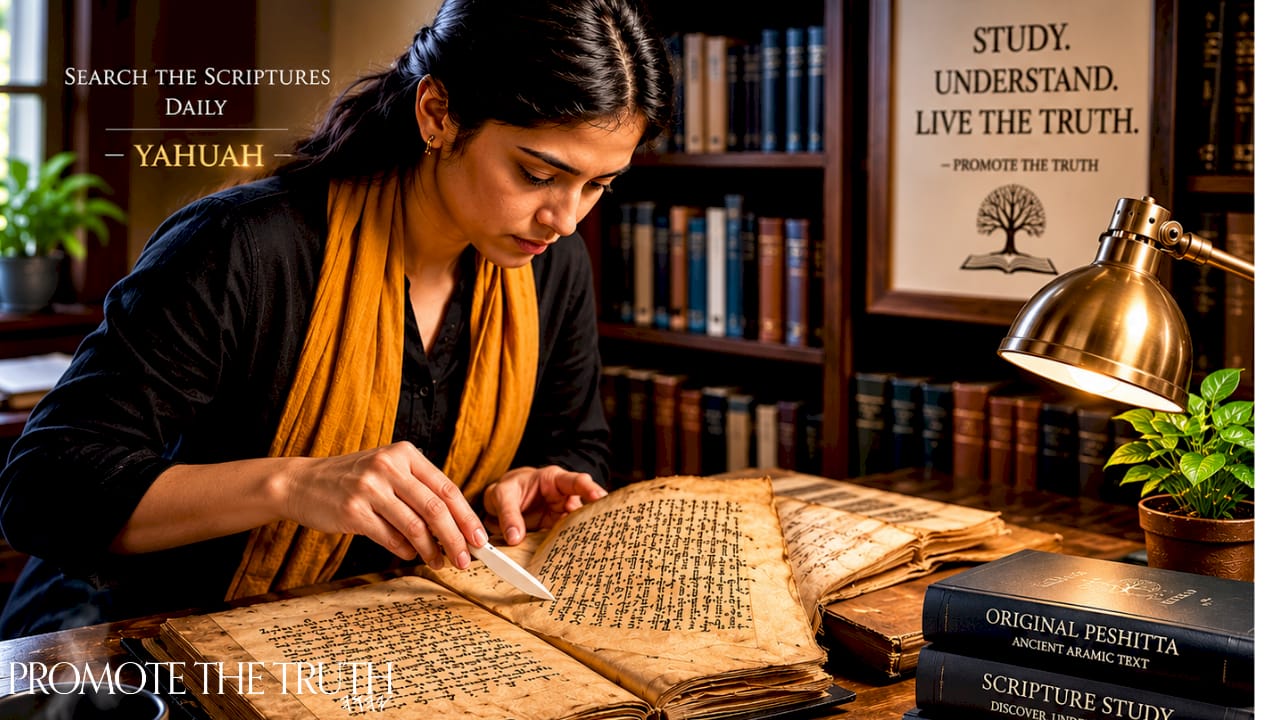
Understanding the manuscript transmission history of these texts helps researchers trace how Scriptural meaning evolved across communities and centuries.
How Aramiyt (Aramaic) Sources Clarify Yuuniy Bariyt Hadash (Greek New Testament) Variants
One of the most productive areas of modern textual criticism involves tracing Yuuniy Bariyt Hadash (Greek New Testament) variants back to their underlying Aramiyt (Aramaic) originals. Differences among Yuuniy (Greek) manuscript often stem from translators rendering the same Aramiyt (Aramaic) term in different ways, producing what appear to be contradictions but are actually parallel renderings of a single source word.
A clear example appears in Matatiyahu (Matthew) 11:12 and Luqah (Luke) 16:16, where the two Bashurah (Gospels) describe the Kingdom of Aluah (God) in seemingly opposite terms. The Aramiyt (Aramaic) verb taqphah plausibly underlies both Yuuniy (Greek) renderings, explaining the divergence without requiring a scribal error. Similarly, the Aramiyt (Aramaic) verbšebaq, meaning “to let go” or “release,” appears to lie behind multiple Yuuniy (Greek) expressions in passages associated with the forgiveness of sins, particularly in the stream of tradition connected with Kapa (Peter).
Transliterated Aramiyt (Aramaic) terms within the Yuuniy (Greek) text offer another layer of evidence. In Maraqu (Mark) 5:41, the original Abariy phrase, “Taliyta Qumiy,” meaning “Young lady, get up!”, is rendered in Yuuniy (Greek) as Talitha koum, a close but imprecise approximation. Some Yuuniy (Greek) manuscripts correct this to Talitha koumi, adding the feminine imperative ending required by the Aramiyt (Aramaic) form. This kind of scribal awareness points to copyists who still understood Aramiyt (Aramaic) grammar. Fractured transliterations, in which the Aramiyt (Aramaic) origin is partially obscured, include familiar terms such as “rabbi” and the opening “Aman (amen)” in Yahusha, who is YAHUAH’s (Jesus’s), sayings, as well as Matatiyahu’s (Matthew’s) use of zizana’ for “tare” in the parable of the wheat and the weeds (Matatiyahu (Matthew) 13:24–30).
The Aramiyt (Aramaic) term nezêra’, rendered as nazarênos or nazôraios in Yuuniy (Greek), carries the sense of a consecrated person. This meaning is especially prominent in the stream of tradition associated with Mariym Magadala (Mary Magdalene), who is specifically connected with the announcement of the resurrection of Yahusha, who is YAHUAH, in the Bashurah (Gospels). The Aramiyt (Aramaic) linguistic streams underlying the Bashurah (Gospels) shaped not only individual word choices but also the theological emphases within each Bashurah (Gospel) tradition.
Exploring the Abariy (Hebrew) and Aramiyt (Aramaic) origins of the Bariyt Hadash (New Testament) opens the door to a richer understanding of the Scriptures. By examining the earliest manuscript traditions and original languages, readers can move beyond translation alone and discover the depth, precision, and historical context that illuminate YAHUAH’s Dabar (Word).
Aramiyt (Aramaic) Terminology That Changes How You Read Scripture
Precise Aramiyt (Aramaic) vocabulary carries interpretive weight that translation often flattens. The word bar (בר) is a prime example. In Taliym (Psalm) 2:12, the phrase nashəqū-bar has generated centuries of debate. Some early Believers of Yahusha, who is YAHUAH (Christian) sources, including the King James Version, read bar as the Aramiyt (Aramaic) word for “son” and translate the phrase as “kiss the Son,” treating it as a Messianic reference. Yahudiym (Jewish) sources and Jerome’s Latin Vulgate follow the Abariy (Hebrew) reading of bar as “purity,” rendering the phrase as “embrace purity.” Neither reading is linguistically impossible; the word appears in both languages with different meanings. That single term has shaped divergent theological traditions across Yahudiym and early Believers of Yahusha, who is YAHUAH (Judaism and Christianity).
Scriptural Aramiyt (Biblical Aramaic) and Targumic Aramiyt (Aramaic) also differ in significant ways. Scriptural Aramiyt (Biblical Aramaic), found in Daniyal (Daniel) and Azara (Ezra), represents Imperial Aramiyt (Aramaic) from the Parasiy (Persian) period. Targumic Aramiyt (Aramaic) reflects later Palestinian and Babaliy (Babylonian) dialects, with an expanded vocabulary and interpretive additions that go well beyond the Abariy (Hebrew) source text. The script forms differ as well. Peshitta manuscripts use Estrangelo or later Syriac scripts, while the Targums were often transmitted in the Square Abariy (Hebrew) script familiar from Turah (Torah) scrolls.
For researchers seeking to understand the original meaning of the Scriptures, Promote The Truth provides trusted resources grounded in ancient Abariy (Hebrew) and Aramiyt (Aramaic) manuscript evidence. Through in-depth studies of Abariy (Hebrew) idioms, key Scriptural terms such as bar, and the historical context behind the text, readers gain a deeper appreciation of how language shapes interpretation and theology.
At the center of this work is the Truth Scriptures, a comprehensive English restoration translated directly from ancient Abariy (Hebrew) and Aramiyt (Aramaic) manuscript sources. Rather than relying solely on traditional renderings influenced by later theological developments, Promote The Truth carefully examines the earliest available manuscript evidence, linguistic patterns, and historical context to present the Scriptural text with clarity and faithfulness to its original intent.
Whether you are studying Scriptural Aramiyt (Biblical Aramaic), exploring manuscript traditions, or researching the origins of key Scriptural terms, Promote The Truth equips you with reliable tools, scholarly resources, and educational materials designed to help you read the Scriptures with greater confidence, accuracy, and understanding.
How Promote The Truth Advances Aramaic Manuscript Research
Promote The Truth stands as a dedicated voice in the field of ancient manuscript research and Scriptural restoration. The organization’s work is grounded in primary source study, drawing directly from Abariy (Hebrew) and Aramiyt (Aramaic) manuscript traditions to produce the Truth Scriptures, a comprehensive English restoration of the Ta’anak and Bariyt Hadash.
Scholar Maria’s contributions to this mission reflect the depth of expertise that Promote The Truth brings to Aramiyt (Aramaic) and Abariy (Hebrew) Scriptural (biblical) studies. Her manuscript research and historical analysis inform the organization’s educational materials, which include courses, articles, videos, and livestreams.
What Promote The Truth Offers Researchers and Students:
-
Manuscript-based translation — The Truth Scriptures, translated from ancient Abariy (Hebrew) and Aramiyt (Aramaic) sources, restoring the Name YAHUAH throughout.
-
Educational courses — In-depth teachings on Scriptural (biblical) languages, manuscript traditions, and Scriptural history.
-
Scripture study videos — Accessible analyses of ancient texts for learners at every level.
-
Articles and publications — Scholarly content addressing textual criticism, Aramiyt (Aramaic) origins, and historical context.
-
Community learning — Livestreams and group study opportunities for those seeking a deeper Scriptural understanding.
Promote The Truth’s original Scriptures resources bring these ancient Aramiyt (Aramaic) and Abariy (Hebrew) manuscript traditions within reach of every serious student. Whether you are beginning your study of Aramiyt (Aramaic) Scriptural (biblical) texts or deepening your existing research, the Truth Scriptures and the accompanying digital scripture collection provide a trustworthy foundation rooted in authentic manuscript evidence.
Key Takeaways
The most authoritative Aramiyt (Aramaic) Scriptural texts span three traditions: Scriptural (Biblical) Aramaic in Daniyal (Daniel) and Azara (Ezra), the Syriac Peshitta with the Yonan Codex, and the Targums, including Targum Onkelos, Targum Neofiti 1, and Targum Pseudo-Jonathan.
| Point | Details |
|---|---|
| Scriptural Aramiyt (Biblical Aramaic) Scope | 269 verses comprise the core Scriptural Aramiyt (Biblical Aramaic) passages within the Abariy (Hebrew) Scriptures, concentrated primarily in Daniyal (Daniel) and Azara (Ezra). |
| Yonan Codex Significance | The Yonan Codex is a 227-leaf Eastern Aramiyt (Aramaic) manuscript, dated to the 5th–7th centuries, and written in the Estrangelo script. |
| Targums Preserve Tradition | Targum Onkelos, Targum Neofiti 1, and Targum Pseudo-Jonathan preserve ancient Yahudiym (Jewish) interpretive traditions for liturgical use… |
| Yuuniy (Greek) Variants Trace to Aramiyt (Aramaic) | Differences among Yuuniy (Greek) Bashurah (Gospel) renderings often reflect a single underlying Aramiyt (Aramaic) term translated in two different ways. |
| Terminology Shapes Theology | The word bar in Taliym (Psalm) 2:12 carries both Aramiyt (Aramaic) (“son”) and Abariy (Hebrew) (“purity”) meanings, contributing to divergent theological traditions. |