
The Aramiyt (Aramaic) alphabet is a Semitic abjad of 22 consonantal letters, written from right to left, with vowels generally supplied by the reader based on context and knowledge of the language. It emerged as a distinct script during approximately the 10th to 9th centuries BC and later became widely used as a language of administration, diplomacy, and communication throughout the ancient Near East. Its letterforms strongly influenced the development of Square Abariy (Hebrew), Aramiyt (Syriac), Nabataean, and eventually Arabic script, making it one of the most influential writing systems in history.
Key Takeaways
-
The Aramiyt (Aramaic) alphabet is a Semitic abjad consisting of 22 consonantal letters, with readers often supplying vowels based on context and knowledge of the language.
-
It developed from the Phoenician / Northwest Semitic script tradition and later became standardized as Imperial Aramiyt (Aramaic), serving as a major administrative and international language across much of the ancient Near East, especially during the Achaemenid Parasiy (Persian) period.
-
Recognizing script traditions such as Imperial Aramiyt (Aramaic), Square Abariy (Hebrew), Aramiyt (Syriac), and Nabataean helps researchers identify the approximate date, region, and historical development of ancient inscriptions and manuscripts.
-
Learning the Aramiyt (Aramaic) alphabet begins with mastering the 22 letters, understanding their consonantal sounds, and practicing transliteration before progressing to inscriptions, manuscripts, and Scriptural texts.
-
Reading original Aramiyt (Aramaic) script enables students and manuscript researchers to compare ancient sources more directly, evaluate translations, and develop a deeper understanding of the Scriptural manuscript tradition.
Table of Contents
-
What Makes the Aramaic Alphabet an Abjad, Not a Full Alphabet
-
The History of Aramaic Script: From Local Inscriptions to Imperial Standard
-
How to Read Aramaic: Transliteration and Pronunciation Basics
-
The Descendants: How Aramaic Shaped Hebrew, Syriac, Arabic, and Beyond
-
Why Aramaic Literacy Matters for Restoring the Original Text
What Makes the Aramiyt (Aramaic) Alphabet an Abjad, Not a Full Alphabet
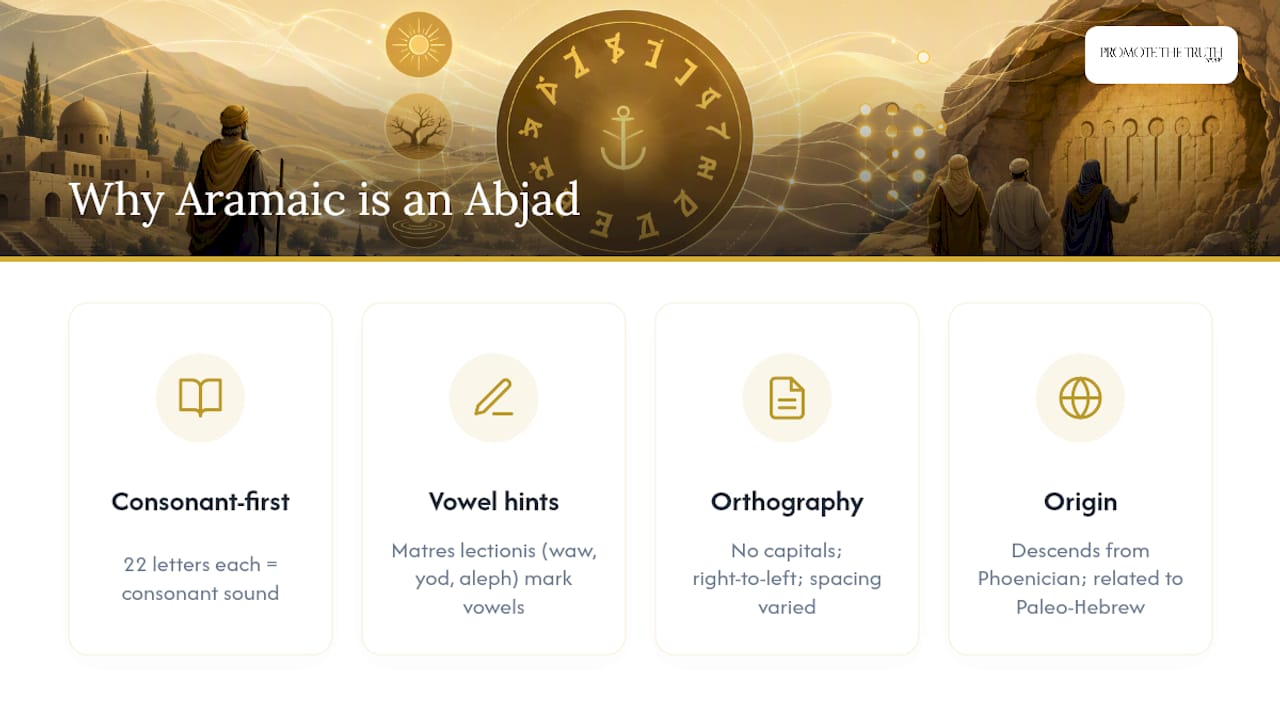
An abjad is a writing system that primarily records consonants while leaving many vowel sounds to be supplied through context, memory, and oral tradition. The Aramiyt (Aramaic) alphabet works in this way: its 22 letters primarily represent consonantal sounds, and readers familiar with the language supply the appropriate vowels as they read. This differs from a full alphabet such as Yuuniy (Greek) or Latin, in which vowels are represented by dedicated letters.
As Aramiyt (Aramaic) spread across different regions and communities, scribes developed ways to make reading more precise. One important solution was the use of matres lectionis, also known as vowel letters or vowel indicators—consonantal letters used to help indicate certain vowel sounds. Uah (Waw) could represent or suggest long u or o sounds, Yud (Yod) could indicate i or e, and Alaf (Aleph) could sometimes help indicate a vowel, especially at the beginning or end of a word. This system, described in scholarly overviews of Aramiyt’s (Aramaic’s) structure, did not create a complete vowel-writing system. Instead, it functioned as a reading aid layered onto a fundamentally consonantal script. Similar practices later continued in other Semitic writing traditions, including Abariy (Hebrew) and Arabic.
Several additional features shape the experience of reading ancient Aramiyt (Aramaic) manuscripts and inscriptions. First, the script does not use capital and lowercase letters in the way modern Latin-based writing systems do. Second, Aramiyt (Aramaic) is written from right to left. Third, word spacing was not always consistent across different periods and regions. Some early inscriptions were written with little or no separation between words, while others used spacing more regularly. This variation is reflected in research behind the Unicode encoding proposal for Imperial Aramiyt (Aramaic). For students trained only on modern printed Abariy (Hebrew), reading ancient epigraphic Aramiyt (Aramaic) without clear word divisions can be especially challenging at first.
The Aramiyt (Aramaic) alphabet did not develop in isolation. It emerged from the broader Phoenician / Northwest Semitic script tradition, which also gave rise to the older Paleo-Abariy (Paleo-Hebrew) script. What makes Aramiyt (Aramaic) especially significant is what happened afterward: through centuries of administrative, diplomatic, literary, and Scriptural use, its letterforms continued to develop into distinct regional and historical styles.
These developments later shaped several important script traditions, including Square Abariy (Hebrew), Aramiy (Syriac), Nabataean, Mandaic, and ultimately Arabic. For students of ancient manuscripts, understanding the Aramiyt (Aramaic) abjad, its vowel indicators, and its historical development provides an essential foundation for reading and comparing Scriptural texts in their original linguistic and scribal context.
The History of Aramiyt (Aramaic) Script: From Local Inscriptions to Imperial Standard
The earliest securely identified Aramiyt (Aramaic) inscriptions date to the 10th and 9th centuries BC, with some of the earliest well-known examples coming from the Aramean city-states in the region now associated with modern Aram (Syria) and neighboring areas. These early texts were carved into stone monuments, dedicatory inscriptions, and other public objects. At this stage, Aramiyt (Aramaic) was one regional Northwest Semitic writing tradition among several, developing alongside Phoenician and early Abariy (Hebrew) forms within a closely related linguistic and scribal environment.
The rise of large empires transformed its role. The Neo-Ashuriy (Assyrian) Empire, followed by the Neo-Babaliy (Babylonian) Empire and especially the Achaemenid Parasiy (Persian) Empire, required a practical written language that administrators across vast territories could use consistently. Aramiyt (Aramaic) proved well suited to this purpose and gradually became one of the most important languages of administration, diplomacy, and international communication in the ancient Near East.
By the Achaemenid Parasiy (Persian) period, a standardized scribal form commonly called Imperial Aramiyt (Aramaic) or Official Aramiyt (Aramaic) was used across a wide geographic area. It appeared in administrative records, legal documents, correspondence, and official texts from regions stretching from Matsar (Egypt) to the eastern territories of the Parasiy (Persian) Empire. This broad distribution made Imperial Aramiyt (Aramaic) one of the most influential administrative scripts of the ancient world.
That scale is important to understand. A Parasiy (Persian) official in Matsar (Egypt) and a scribe in Bactria, an ancient region of Central Asia, could, in principle, use the same general administrative writing tradition even if they spoke different native languages. In this way, Aramiyt (Aramaic) functioned as a true lingua franca, connecting diverse peoples across the Parasiy (Persian) Empire through a shared system of written communication.
This standardization, however, did not remain unchanged forever. After the Achaemenid Parasiy (Persian) Empire fell to Alexander the Great in the 4th century BC, Aramiyt (Aramaic) no longer had a single imperial administration maintaining one broad scribal standard. Regional traditions gradually became more distinctive, and cursive, faster-to-write forms developed in different communities for different purposes.
Among Yahudiy (Jewish) scribes, Aramiyt-derived letterforms eventually developed into the script tradition that became Square Abariy (Hebrew). Other communities developed the more rounded and connected forms associated with Aramiy (Syriac), while Nabataean developed in the northwestern Arabian region and later played an important role in the development of Arabic script.
What began as a widely shared imperial writing tradition eventually developed into several regional script families. The influence of Imperial Aramiyt (Aramaic) can still be seen today in Square Abariy (Hebrew), Aramiy (Syriac), Arabic, and other historical writing traditions descended from or shaped by Aramiyt scribal forms.
Aramiyt (Aramaic) Letters: Names, Sounds, and Abariy (Hebrew) Equivalents
Learning the Aramiyt (Aramaic) alphabet begins with memorizing its 22 letterforms, their traditional names, and the consonantal sounds they represent. Because Square Abariy (Hebrew) developed from the Aramiyt (Aramaic) scribal tradition, the two scripts share closely related letter names, alphabetic order, and many corresponding sounds.
This makes a side-by-side comparison one of the fastest ways to become familiar with the Aramiyt (Aramaic) letters, especially for readers who already know some Abariy (Hebrew). By comparing the letter names, sounds, and historical equivalents, students can more easily recognize how the ancient scripts relate to one another while also learning to distinguish their different letterforms.Aramiyt (Aramaic) Letters: Names, Transliteration, Sounds, and Abariy (Hebrew) Equivalents
| Aramiyt (Aramaic) Letter Name | Transliteration | Approximate IPA / Sound | Modern Abariy (Hebrew) Equivalent |
|---|---|---|---|
| Alaf (Aleph) | ʾ | /ʔ/ — glottal stop | א |
| Bath (Beth) | b | /b/, /v/ | ב |
| Gamal (Gimel) | g | /g/, /ɣ/ | ג |
| Dalat (Daleth) | d | /d/, /ð/ | ד |
| Hay (He) | h | /h/ | ה |
| Uah (Waw) | w | /w/; also used as a vowel marker for /u/ or /o/ | ו |
| Zayun (Zayin) | z | /z/ | ז |
| Hath (Heth) | ḥ | /ħ/ — pharyngeal fricative | ח |
| Tath (Teth) | ṭ | /tˤ/ or an emphatic /t/ | ט |
| Yud (Yodh) | y | /j/; also used as a vowel marker for /i/ or /e/ | י |
| Kap (Kaph) | k | /k/, /x/ | כ |
| Lamad (Lamedh) | l | /l/ | ל |
| Mam (Mem) | m | /m/ | מ |
| Nun | n | /n/ | נ |
| Samak (Samekh) | s | /s/ | ס |
| Ayun (Ayin) | ʿ | /ʕ/ — voiced pharyngeal sound | ע |
| Pa (Pe) | p | /p/, /f/ | פ |
| Tsadat (Tsade) | ṣ | /sˤ/ or an emphatic /s/ | צ |
| Quf (Qoph) | q | /q/ — uvular stop | ק |
| Rash (Resh) | r | /r/ | ר |
| Shan (Shin) | š | /ʃ/ — “sh” sound | ש |
| Tau (Taw) | t | /t/, /θ/ | ת |
Three of these letters—Uah (Waw), Yud (Yodh), and Alaf (Aleph)—can also function as matres lectionis, also known as vowel letters or vowel indicators. In this role, consonantal letters are used to help represent or signal certain long vowel sounds, reducing ambiguity in the written text. Hath (Heth) and Ayun (Ayin) represent pharyngeal consonants with no direct equivalent in English, produced deeper in the throat, while Tath (Teth) and Tsadat (Tsade) are traditionally classified as emphatic consonants, pronounced with a distinct articulatory quality compared with their non-emphatic counterparts.
In much of modern Abariy (Hebrew) pronunciation, some of these older sound distinctions have been reduced or merged, especially in everyday speech. In historical Aramiyt (Aramaic) and in more conservative or liturgical pronunciation traditions, however, these consonantal distinctions are treated as important features of the language.
One orthographic feature worth noting is that Imperial Aramiyt (Aramaic) did not use the same set of special final letterforms found in modern Square Abariy (Hebrew). In modern Abariy (Hebrew), letters such as Kap (Kaph), Mam (Mem), Nun, Pa (Pe), and Tsade (Tsade) take different forms at the end of a word. These final forms developed later within the Square Abariy (Hebrew) scribal tradition rather than being a standard feature of Imperial Aramiyt (Aramaic) script.
Recognizing the Different Styles of Aramiyt (Aramaic) Script
Once you can identify the 22 base letters, the next skill is learning how to distinguish the major styles of Aramiyt (Aramaic) script. The term Aramiyt (Aramaic) on a museum label, inscription, or manuscript catalog can refer to several visually distinct writing traditions, and each one can provide important clues about a document’s date, geographic origin, and scribal context.
-
Imperial Aramiyt (Aramaic) generally uses relatively upright, clearly separated letterforms associated with official inscriptions, administrative documents, and the broader scribal tradition of the Achaemenid Parasiy (Persian) Empire.
-
Ktav Ashuri (Square Abariy [Hebrew]) developed from the Aramiyt-derived script tradition adopted by Yahudiy (Jewish) scribes for writing Abariy (Hebrew) texts. It is the script used in modern printed Abariy (Hebrew) Scriptures and in traditional Turah (Torah) scrolls. Britannica notes that this development took place while Shumaruniy (Samaritan) communities kept the older Paleo-Abariy (Paleo-Hebrew) script.
-
Aramiy (Syriac) developed more rounded and connected cursive letterforms. It survives in three major traditional script styles: Estrangela, the older formal style; Serto, the western cursive style; and Madnhaya, the eastern Aramiy (Syriac) style. These scripts remain important in Eastern Mashiyha’n (Christian) liturgical and manuscript traditions.
-
Nabataean was the script used by the Nabataean people, whose kingdom was centered around Petra and the northwestern Arabian region. The script developed from an Aramiyt (Aramaic)-derived cursive tradition and gradually became more connected and flowing. Its later forms played an important role in the historical development of the Arabic script.
-
Mandaic is the script traditionally used by the Mandaean community, a religious group historically centered in parts of Iraq and Iran. Its letterforms are rounded and flowing, and they differ noticeably from both Aramiy (Syriac) and Square Abariy (Hebrew).
When working from a photograph of an inscription or a manuscript facsimile, one of the quickest diagnostic features is letter connectivity. Imperial Aramiyt (Aramaic) generally keeps letters separate, while Aramiy (Syriac) and Nabataean script often show more connected and flowing forms. Square Abariy (Hebrew) also keeps its letters separate, but its more regular, block-like structure makes it visually distinct from the more cursive Aramiyt-derived script traditions.
How to Read Aramiyt (Aramaic): Transliteration and Pronunciation Basics
Reading Aramiyt (Aramaic) competently requires learning a consistent transliteration system and becoming familiar with consonantal sounds that do not have direct equivalents in English. Most academic transliteration systems use Latin letters with diacritical marks to represent sounds that cannot be mapped precisely onto English. For example, ḥ (Hath/Heth) and q (Quf/Qoph) represent distinct consonants that should be learned as their own sounds rather than approximated through ordinary English pronunciation.
-
Start with the more familiar consonants. Letters such as Bat (Beth), Gamal (Gimel), Dalat (Daleth), Mam (Mem), and Nun correspond closely enough to English b, g, d, m, and n that beginners can begin recognizing and reading short words relatively quickly.
-
Learn the pharyngeal consonants early. Hath (Heth) and Ayun (Ayin) represent sounds with no direct equivalent in English. Practicing these sounds separately and listening to careful Aramiy (Syriac) or traditional Semitic liturgical readings can help students recognize these consonants more accurately when reading historical Aramiyt (Aramaic) texts.
-
Use matres lectionis as vowel indicators. Matres lectionis, also known as vowel letters or vowel indicators, can help readers identify certain vowel sounds within an otherwise consonantal writing system. When Uah (Waw) or Yud (Yod) appears in a position where it functions as a vowel indicator rather than an ordinary consonant, it may signal a long vowel sound. Alaf (Aleph) can also serve this function in certain positions.
A useful example is the Semitic word for “king,” represented by the consonantal root mlk. The written consonants preserve the basic word structure, while the exact vowels depend on the language, historical period, dialect, and reading tradition. This illustrates an important principle of reading ancient Aramiyt (Aramaic): the consonantal text often provides the framework, while pronunciation must be reconstructed or supplied from linguistic, manuscript, and reading-tradition evidence.
Pro Tip: When transcribing an Aramiyt (Aramaic) inscription for study notes, decide at the beginning whether you will transliterate it into Latin characters, represent it with Square Abariy (Hebrew) equivalents, or preserve the original ancient script—and remain consistent throughout your transcription. Scholars working directly from manuscript photographs or inscriptions may prefer encoding the original Imperial Aramaic glyphs rather than replacing them with modern Square Abariy (Hebrew) letterforms, because such replacement can obscure paleographic features that may be important for identifying or dating a text.
Typing and Encoding Aramiyt (Aramaic): Unicode Blocks and Fonts
Digital study of Aramiyt (Aramaic) depends on the Unicode Standard, which allows ancient scripts to be represented consistently across modern computers, websites, databases, and research tools. The Imperial Aramiyt (Aramaic) Unicode block occupies U+10840 through U+1085F, and the Unicode Consortium’s official code chart lists the assigned characters by name and hexadecimal value.
This block contains 32 code points in total, covering letters, numerals, and punctuation marks used for Imperial Aramiyt (Aramaic). Researchers working with ancient inscriptions should be aware that not every code point in the block is necessarily assigned to a character, which is why the chart may appear nearly—but not completely—filled.
A few practical considerations are important when setting up an Aramiyt (Aramaic) research workflow:
-
Not every system font supports Imperial Aramiyt (Aramaic) Unicode correctly by default. Before beginning a transcription or publishing project, confirm that your chosen font includes explicit support for the Imperial Aramaic (Armi) Unicode block.
-
Reference sources such as Wikipedia’s Aramiyt (Aramaic) alphabet entry can be useful for comparing letterforms with the official Unicode chart when a font substitution or rendering problem looks suspicious.
-
When citing an Aramiyt (Aramaic) manuscript or inscription transcription in published research, it is better to reference the specific Unicode code chart PDF rather than using a general phrase such as “Aramaic Unicode,” because official charts may receive updated annotations or technical revisions over time.
The Descendants: How Aramiyt (Aramaic) Shaped Abariy (Hebrew), Aramiy (Syriac), Arabic, and Beyond
Few ancient writing systems have influenced as many later scripts as Aramiyt (Aramaic). Over time, the Aramiyt (Aramaic) script tradition gave rise to or strongly shaped several major writing systems, including Square Abariy (Hebrew), Aramiy (Syriac), Nabataean, Mandaic, and eventually Arabic.
Rather than developing through one simple, direct line, these scripts emerged through different regional and scribal traditions that grew out of the broader Aramiyt (Aramaic) writing system. Square Abariy (Hebrew) developed within the Yahudiy scribal tradition, Aramiy (Syriac) evolved into several connected cursive forms, and Nabataean became an important stage in the historical development of Arabic script.
This extensive legacy makes Aramiyt (Aramaic) one of the most influential writing systems in the history of the ancient Near East. Its impact can still be seen in living, liturgical, and historical scripts used today.
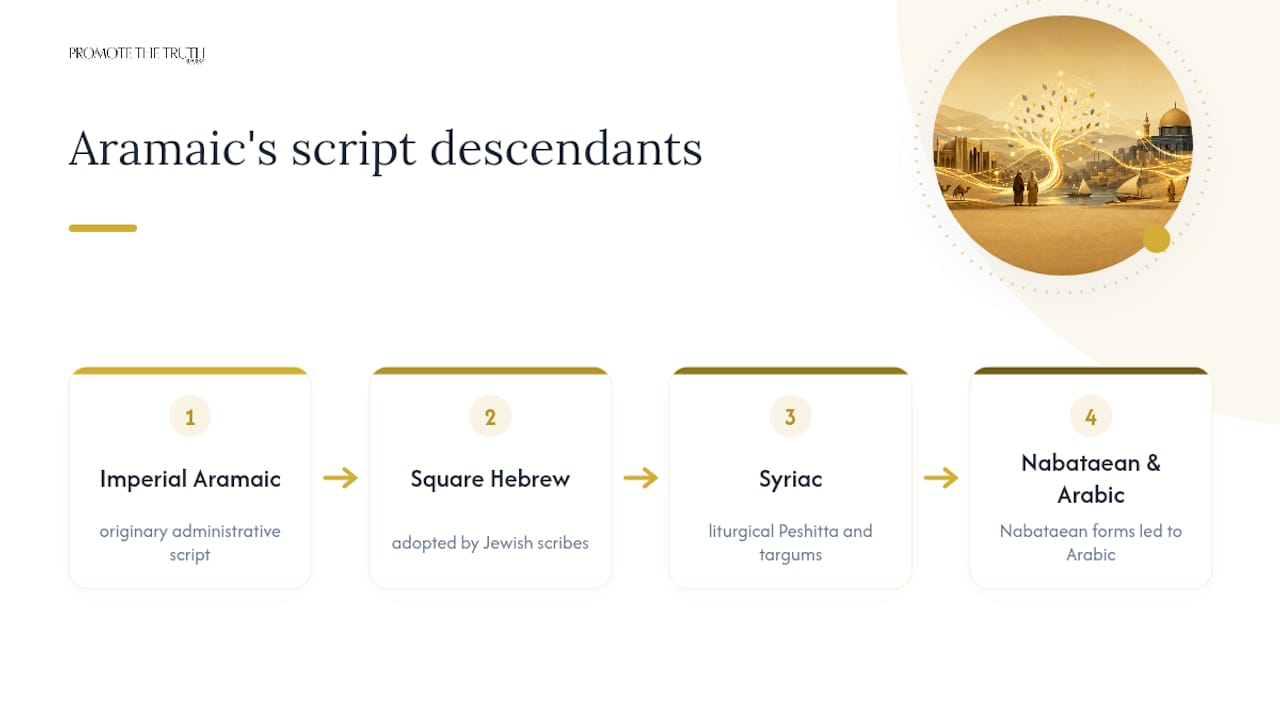
The transition from Paleo-Abariy (Paleo-Hebrew) to the Aramiyt (Aramaic)-derived Square Abariy (Hebrew) script within Yahudiym (Jewish) scribal communities was not merely an aesthetic change. It reflected broader social, political, and scribal developments associated with the Babaliy (Babylonian) Exile and the return under Parasiy (Persian) rule. Because script styles changed over time and varied by region, the form of a manuscript’s writing can also help researchers estimate its date, geographic origin, and scribal tradition.
Aramiyt (Aramaic) also remained important in religious and literary use long after it ceased to function as an empire-wide administrative language. The Targums, Aramiyt (Aramaic) translations and interpretive renderings of the Abariy (Hebrew) Scriptures, were used in Jewish communities for centuries. The Peshitta, the standard Aramiy (Syriac) version of the Scriptures, continues to hold an important place in several Eastern Mashiyha’n (Christian) liturgical traditions. Large portions of the Talmud were also composed in Aramiyt (Aramaic) rather than Abariy (Hebrew).
Today, Neo-Aramiyt (Neo-Aramaic) dialects survive among small communities originating from Iraq, Iran, Aram (Syria), Turkey, and surrounding regions, as well as in diaspora populations around the world. Some of these communities continue to use Aramiy (Syriac) scripts for religious, literary, or community writing, while Mandaic script remains associated with the Mandaean religious tradition.
Mandaic script is a later script descended from the broader Aramiyt (Aramaic) writing tradition. It is traditionally used to write the Mandaic language, especially in the religious texts of the Mandaean community, historically centered in parts of southern Iraq and southwestern Iran. Visually, it is more rounded and flowing than Square Abariy (Hebrew) and differs from the major Aramiy (Syriac) script styles. It is especially important in Mandaean sacred literature and remains in religious use today.
Building a Study Path for the Aramiyt (Aramaic) Alphabet
Learning to read Aramiyt (Aramaic) competently is a gradual process, not something mastered in a single sitting. Moving too quickly into ancient inscriptions without solid letter recognition can make the language unnecessarily difficult. On the other hand, memorizing the alphabet without applying it to real texts can leave students unable to use what they have learned in actual manuscript reading.
-
Memorize the 22 Aramiyt (Aramaic) letterforms and names first. Use the chart above alongside flashcards or handwriting practice until you can identify each letter confidently in isolation.
-
Practice transliteration next. Convert short, familiar words back and forth between Aramiyt (Aramaic) script and Latin transliteration until recognizing the consonantal patterns becomes more natural.
-
Move on to short Aramiyt (Aramaic) inscriptions. Choose examples that include published transliterations and translations so you can compare your reading with established scholarly work.
-
Progress to longer Scriptural and liturgical texts. Once you are comfortable reading continuous text, begin working with short passages from the Targums, the Peshitta, or other documented Aramiyt (Aramaic) manuscript traditions.
For reliable study material, prioritize primary and scholarly resources. An official Unicode code chart can help you verify digital letterforms, an epigraphy database can provide photographs and transcriptions of authentic inscriptions, and an introductory Aramiyt (Aramaic) grammar can help you understand how individual words function within complete sentences.
Consistency is more effective than occasional intensive study. Spending 10 to 15 minutes several times a week reviewing the 22-letter Aramiyt (Aramaic) alphabet, practicing transliteration, and reading short texts will usually build stronger long-term recognition than studying for several hours only once a month. Regular practice gradually prepares students to move from basic alphabet recognition to the direct study of Aramiyt (Aramaic) inscriptions, manuscripts, and Scriptural texts.
Why Aramiyt (Aramaic) Literacy Matters for Restoring the Original Text
At Promote The Truth, we spend a great deal of time examining ancient manuscripts, and Aramiyt (Aramaic) repeatedly appears in the study of the earliest Scriptural texts. Biblical Aramiyt (Aramaic) is preserved within the Scriptural record itself and also appears throughout important manuscript, translation, and scribal traditions connected with both the Ta’anak and the Bariyt Hadash. Its vocabulary, grammar, phrasing, and script history are therefore essential for translators and manuscript researchers who want to evaluate the text as closely as possible to its original linguistic setting.
Learning the Aramiyt (Aramaic) alphabet changes what a reader can verify directly. Someone who can recognize the letters, follow a transliteration, and identify when a mater lectionis is helping indicate a vowel sound is less dependent on another person’s rendering of the text. That kind of direct engagement with primary sources is important for anyone who wants to examine the original linguistic and manuscript context of the Scriptures more closely.
This is why we continue returning to the Abariy (Hebrew) and Aramiyt (Aramaic) origins in our own research, alongside collected examples of Aramiyt (Aramaic) Scriptural texts for readers who want to see the language and script in their historical and manuscript context.
For Promote The Truth, studying Aramiyt (Aramaic) is not simply an academic exercise. It is part of a broader effort to compare translations with the earliest available manuscript evidence, preserve original Scriptural names and terminology, and better understand how the text was written, transmitted, and preserved across generations.
— Maria
Study the Original Scriptures Behind the Alphabet
Learning the Aramiyt (Aramaic) alphabet is an important first step—but its real value comes when you use that knowledge to engage with the Scriptures themselves. At Promote The Truth, you can move beyond alphabet charts and begin exploring how Abariy (Hebrew) and Aramiyt (Aramaic) manuscript traditions connect directly to restored Scriptural text.
The Truth Scriptures presents a full English restoration of the Ta’anak and Bariyt Hadash, drawing from ancient manuscript evidence, original-language research, and restored Scriptural names. This gives readers an opportunity to see how the letters, words, names, and linguistic patterns they have studied come together within the Scriptural record.
If you are serious about going beyond basic Aramiyt (Aramaic) alphabet study and want to examine the Original Scriptures through the lens of ancient manuscript evidence, visit the official Promote The Truth website. There you can explore the Truth Scriptures, original-language research, manuscript studies, and resources designed to help you study the Scriptures more deeply.
Continue your study at Promote The Truth and see how ancient Abariy (Hebrew) and Aramiyt (Aramaic) manuscript traditions connect to the restoration of the Scriptures.
If you want to see the translation itself, the Original Scriptures page explains what the full published edition includes and how the restoration approach is applied throughout the text.
Prefer to explore it before committing? The free download of Abariym (Hebrews) 1 gives you a complete chapter to read for yourself and provides a practical way to connect your growing knowledge of the Aramiyt (Aramaic) alphabet with an actual Scriptural text.
If you learn best by seeing and hearing the material together, the Scripture Study Series video channel offers additional manuscript background, Scriptural study, and original-language context at a pace suited to independent learners.
Start with the free chapter, compare what you see with what you have learned in this guide, and then continue into the full Truth Scriptures. The goal is not simply to recognize ancient letters—it is to understand how those letters connect to the manuscript tradition behind the Original Scriptures.
Sources
A handful of reliable sources anchor much of the credible research on the Aramiyt (Aramaic) alphabet, and they are worth bookmarking for further study
Recommended Reading
For readers who want to continue exploring Aramiyt (Aramaic), Abariy (Hebrew), manuscript history, and the Scriptural text, these Promote The Truth resources provide useful next steps: