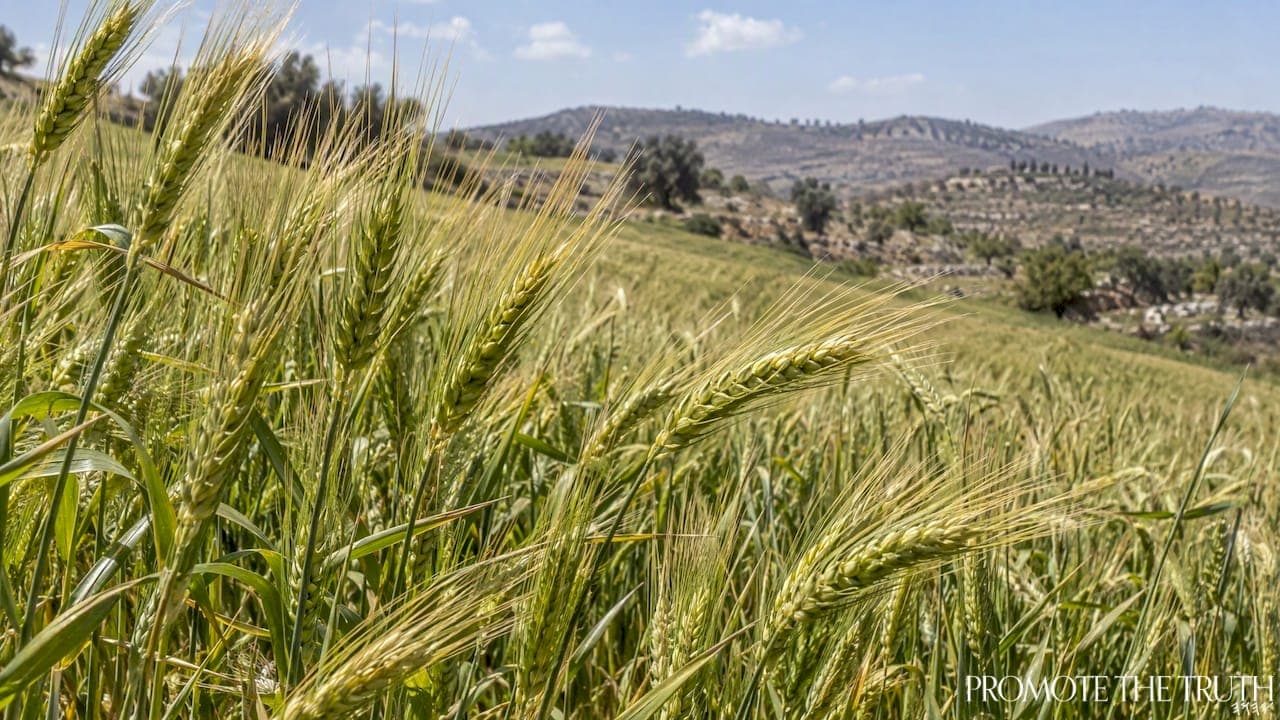
The Abiyb (Aviv) barley calendar starts the year from what the field shows rather than from a printed chart. When barley in the land of Yisharal (Israel) reaches the Abiyb (Aviv) stage, and the next new moon appears, the first month begins. If the barley is not ready, a thirteenth month is added and the year waits. This guide explains what Abiyb (Aviv) means, how ripeness is judged, why it matters for the appointed times, and how it differs from the fixed calendars most of us grew up with.
TL;DR
-
Abiyb (Aviv) is a stage of barley ripeness, not first of all a month name. The grain is full-sized and filled but still soft, and has not yet dried.
-
The year begins with the first new moon after barley in Yisharal (Israel) is found Abiyb (Aviv). If it is not, a thirteenth month is added.
-
The first month usually lands in March or April on the Gregorian calendar.
-
Fixed-rule calendars do not watch the barley. Sighting-based reckoning does, and that is the main difference between them.
-
To follow this calendar, you need three things: a report on the barley, a report on the new moon, and the Scriptures open in front of you.
Table of Contents
What Abiyb (Aviv) means
The Abariy (Hebrew) word Abiyb (also spelled Abib) describes grain at a particular moment. One Scripture-study reference defines it as ripe but soft and tender barley grain, often rendered “young,” “tender” or “green ear.” A general reference describes the stage as the point when the seeds have reached full size and are filled with starch but have not dried.
That is why a nineteenth-century Scriptural (biblical) encyclopedia treats the word first as a seasonal state of grain and only secondarily as a month name, a reading it says early translations support. The month took its name from the condition of the crop. The crop did not take its name from the month.
This is a small point with a large result. If Abiyb (Aviv) is a condition you observe, then the start of the year is something you confirm, not something you look up once and forget.
Where Abiyb (Aviv) appears in Scriptures
The name of the month appears in the instructions for the Feast of Yum Matsah (Unleavened Bread). Shamut (Exodus) 13:4 says Yisharal came out in the month of Abiyb (Aviv), and Shamut (Exodus) 23:15 repeats that the feast is to be kept at the appointed time in that month.
The command that makes it the head of the year comes earlier. In Shamut (Exodus) 12:2 the spring month is declared the beginning of months and the first month of the year. Scholars note that ancient Yisharal (Israel) also recognized a fall agricultural new year, which is why the spring reckoning of Shamut (Exodus) 12:2 needs to be read carefully against later practice.
There is also a witness from the plagues. In Shamut (Exodus) 9:31 the strikes the barley because it was in the ear, while the flax was in bud. A study of modern Abiyb (Aviv) searches reads this as a Scriptural (biblical) witness to barley being at the Abiyb (Aviv) stage while flax was still young.
For a fuller walk through the texts and manuscripts behind the month, see our study on the Abiyb (Abib) start.
How barley sets the start of the year
The logic is simple once you see the problem it solves. A lunar month is about 29 and a half days, so twelve of them fall short of a solar year. Left alone, the months would drift against the seasons, and the spring feast would slide into winter. Scholar notes that early Yisharaliym (Israelites) likely used a luni-solar calendar like their neighbors in Babaliy (Babylon) and the Patiyt (Phoenician) cities, and that the calendar followed the passing seasons.
The barley is the check. According to the same Abiyb (Aviv) study, if the barley was not ripe enough by the end of the twelfth month, a thirteenth month was added. The reason is practical: barley had to be ripe enough by the beginning of Niysan (Nisan) to yield ripe ears by the sixteenth, the day of the offering.
That same source reports that the accounts describe the calendar council intercalating a year when barley was not yet Abiyb (Aviv) by the end of the twelfth month, alongside other signs such as fruit trees and winter rains. So even in the later tradition, the barley was one of the markers.
Worked through in order, the decision looks like this:
-
Near the end of the twelfth month, observers in Yisharal (Israel) inspect the barley.
-
If it is Abiyb (Aviv), the next new moon begins the first month.
-
If it is not Abiyb (Aviv), a thirteenth month is added, and the check is repeated at the following new moon.
-
From the first month, the appointed times are counted: Yum Pasaha (Passover) on the 14th, Yum Matsah (Unleavened Bread) from the 15th, and the Yum Bakuriym (firstfruits) offering after.
The pattern is why this approach is sometimes summarized as a “barley and moon” calendar. For the moon half of that phrase, read our study on the sighted moon calendar.
What counts as Abiyb (Aviv), and what does not
This is where most disagreements begin, so it helps to be precise. The Abiyb (Aviv) study describes the stage as the wax stage: seeds are fully formed and fattened and feel like soft wax. The next stage, hard wax, is when the grain is ready for harvest by ancient methods.
The difference matters because of the thing. The meal offering on the 16th of the first month required barley in a state that could be harvested. So the standard is not “green and unripe,” and it is not “dry and fully mature.” It is grain that is filled, firm enough to be cut and prepared, and still tender.
| Stage | What you see and feel | Abiyb (Aviv)? |
|---|---|---|
| Green, filling | Seeds forming, milky when pressed | No, too early |
| Soft wax | Seeds full-sized, feel like soft wax | Yes |
| Hard wax | Seeds firm, ready for harvest by ancient methods | Past Abiyb (Aviv), harvest stage |
Two cautions. First, one stalk is not a field. Reports are more reliable when they come from several locations and describe how widespread the stage is. Second, a photograph of a green ear tells you little. The stage is judged by the grain itself.
The barley season in Yisharal (Israel)
Barley was harvested during Abiyb (Aviv), which, according to one reference work, generally corresponds with part of March and part of April, with the wheat harvest following some weeks later. That sequence explains why barley, the earlier grain, is the sign for the first month and why the wheat harvest is tied to the later feast of Weeks.
The link between farming and calendar is very old. The Gezer Calendar, a tenth-century BCE inscription, does not name months but lists the agricultural activities of the year, which shows how closely the ancient year followed the work in the fields.
If you want the larger picture of how this season fits the worship of ancient Yisharal, we cover it in how ancient Yisharal worship worked and in our study of firstfruits in Scripture.
Abiyb (Aviv)-based reckoning compared with fixed calendars
There are three broad ways people have kept the year. Each answers the same question, “when does the year begin?”, differently.
| Approach | How the month starts | How a leap month is decided |
|---|---|---|
| Sighting-based, Abiyb (Aviv) reckoning | New crescent moon observed | Barley ripeness in Yisharal (Israel) |
| Arithmetical Abariy (Hebrew) calendar | Calculated in advance | Fixed cycle of leap years |
| Gregorian calendar | Solar rules, no moon | Leap day every fourth year, with exceptions |
One thing readers often ask is, “What month is Abiyb (Aviv) in the Abariy (Hebrew) calendar?” Some explain that Abiyb (Aviv) is not the name of a modern Abariy (Hebrew) calendar month and that the word means the season of spring. The modern calendar calls the first month Niysan (Nisan). The style charts and the pre-exilic names are related but not identical: the pre-exilic name for that first month was Abiyb (Aviv), as we explain in our guide to the pre-exilic month names.
For a deeper comparison, see our study on lunar-solar versus Gregorian reckoning and the overview of calendar controversies in the Scriptures.
When does the first month fall?
It varies by year, which is the whole point. As a rule, it begins about the time of the March equinox, and the typical range runs through March and into April. The reference definition notes that the month begins about the time of the March equinox.
To see how close different reckonings can be.
That is the lesson in a nutshell. In a year when the barley and the moon line up with the arithmetical calendar, the dates are the same or within a day. In years when the barley lags, sighting-based reckoning waits a month, and the dates split apart. The barley is the reason, not a preference.
Because those dates move every year, treat any published table as a forecast. The confirmation comes from the field reports and the new moon sighting for that year. Our biblical feast calendar shows how the appointed times follow once the first month is set.
How to follow the Abiyb (Aviv)barley calendar yourself
-
Start in the text. Read Shamut (Exodus) 12:2, 13:4 and 23:15, and Shamut (Exodus) 9:31 for the barley.
-
Learn the stage. Know the difference between soft wax and hard wax before reading any field report.
-
Watch for reports near the end of winter. Look for reports from Yisharal (Israel) in the weeks before the equinox, and keep the new moon in view.
-
Decide the month. If the barley is Abiyb (Aviv) at the new moon, that day is the first of the first month. If not, wait for the next.
-
Count to Yum Pasaha (Passover). The Yum Pasaha (Passover) date is the 14th. Our study on Niysan 14 and the Scriptural Pasaha takes this step by step, and our comparison of Passover and Easter shows why the date matters.
A practical word for readers in the United States: the barley sign is always about Yisharal (Israel), not your backyard. A local crop in Missouri or Texas ripens on a different schedule and cannot decide the year for Scripture’s calendar. Local reports can help you learn the stage, but the decisive evidence is in the land the text speaks of.
Our perspective
We and many others believe the barley is a gift to the reader, not a burden. It ties the appointed times to something real that was created, a field, a season and a moon, so that the year of YAHUAH is not governed by a table made by men. When we study the manuscripts and the names, we see the same pattern again and again: what Scripture commands is observable.
We also know how heated this subject can be. Sincere believers read the same verses and arrive on different days. Our hope is to bring the reader back to the text, to the stage of the grain, and to the sighted moon, and to let the evidence be weighed with reverence. Where the barley is clear, the calendar is clear. Where it is not, patience is better than certainty.
If a month is added, it is not a failure of the calendar. It is the calendar doing its work.
— Maria
Study the calendar in the Scriptures themselves
The Abiyb (Aviv) barley calendar makes the most sense when the names and the text are in front of you. The Truth Scriptures™ Translation is a restoration English translation of the Ta’anak and Bariyt Hadash from ancient Abariy (Hebrew) and Aramiyt (Aramaic) manuscript sources, and the Truth Scriptures™ Digital Collection brings it to your devices. For guided study, the Virtual Retreat is offered at £197 one-off. You can also browse the free Truth Scriptures downloads, including a names and places resource.
FAQ
What does Abiyb (Aviv) barley mean?
Abiyb (Aviv) barley is barley at the stage where the seeds are fully formed and filled but still soft, like wax, and not yet dry. It is the sign the year waits for before the first month is set. The word itself comes from a Abariy (Hebrew) term for young, tender or green ears of grain.
What month is Abiyb (Aviv) on today’s calendar?
Abiyb (Aviv) falls in March and April on the Gregorian calendar, beginning near the March equinox. The modern Abariy (Hebrew) calendar names the first month Niysan (Nisan). Because the barley and moon decide the month in sighting-based reckoning, the exact date moves from year to year.
What happens if the barley is not Abiyb (Aviv)?
A thirteenth month is added, and the first month waits for the next new moon. The Abiyb (Aviv) study explains that the barley had to be ripe enough by the start of Niysan (Nisan) to produce ripe ears by the 16th. This is how the lunar months stay in step with the seasons.
Can I use barley from my own area to decide the year?
No. The sign is barley in the land of Yisharal (Israel), which is the land the commandment addresses. Local barley ripens on a different schedule, so it is useful for learning what the stage looks like but not for setting the date.
Sources
-
Modern Searches for Aviv Barley in the Context of the Biblical Calendar
-
Aviv barley and calendar diversity among Jews in Palestine (UCL)
-
Abib, Cyclopedia of Biblical, Theological and Ecclesiastical Literature