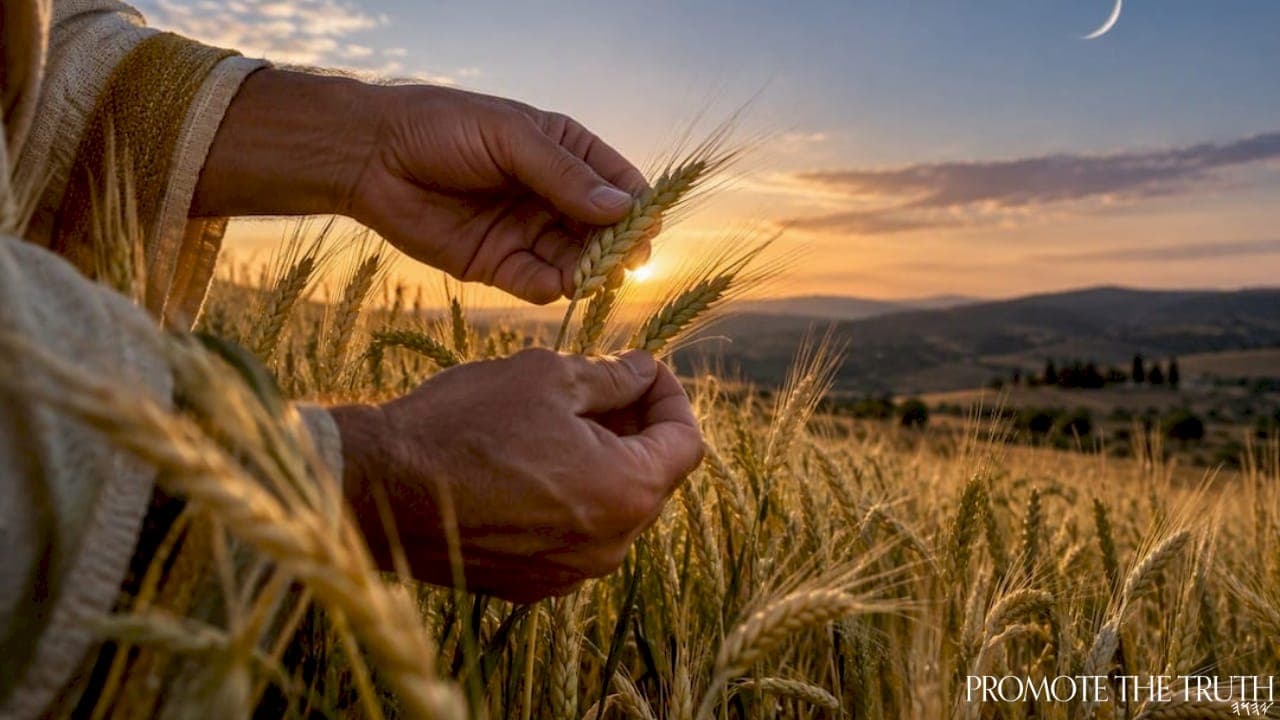
Abiyb (Abib), the Scriptural (biblical) “month of the Abiyb (Abib),” begins in spring at the first new moon after barley in the land is judged to be Abiyb (Abib), meaning the grain has reached its green ear stage. This month corresponds roughly to the later name Niysan (Nisan). When barley was not yet Abiyb (Abib), ancient authorities added a thirteenth month to the year, pushing the start of Abiyb (Abib) later so the harvest offering would fall at the right agricultural moment.
TL;DR:
The start of Abiyb (Abib) depends on the sighting of the new moon and barley reaching the Abiyb (Abib) stage, which can vary regionally and by climate.
Ancient Yisharal (Israel) added a thirteenth month if barley was not yet Abiyb (Abib), delaying the calendar start by roughly thirty days to ensure proper observance timing.
The shift from agricultural Abiyb (Abib) to the calculated Niysan (Nisan) occurs after the Babaliy (Babylonian) captivity, moving to fixed astronomical dates rather than regional barley reports.
Accurate calculation and regional observation are vital for proper festival timing, especially for those following traditional Scriptural (biblical) or restoration practices.
Table of Contents
-
What the Bible Calls Abiyb (Abib): Scripture and the Meaning of Abiyb (Abib)
-
How Abiyb’s (Abib’s) Start Was Determined: Watching the Moon and the Barley
-
From Abiyb (Abib) to Niysan (Nisan): The Calculated Calendar Takes Over
-
When Abiyb (Abib) Falls on the Modern Calendar: March, April, and Recent Examples
-
Study Abiyb (Abib) and Niysan (Nisan) Directly From the Manuscripts
What the Scriptures (Bible) Calls Abiyb (Abib): Scriptures and the Meaning of Abiyb (Abib)
Scriptures names this month directly. “This month shall be unto you the beginning of months: it shall be the first month of the year to you,” reads Shamut (Exodus) 12:2, establishing Abiyb (Abib) as the anchor point of the set-apart (sacred) calendar. Shamut (Exodus) 13:4 repeats the designation, tying Yisharal’s (Israel’s ) Shamut (Exodus) from Matsar (Egypt) to “this day, in the month Abiyb (Abib).” Dabariym (Deuteronomy) 16:1 connects the month to the Yum Pasaha (Passover) observance itself, commanding it be kept “in the month Abiyb (Abib).”
The word Abiyb (Abib) is agricultural before it is calendrical. It describes barley at the stage when the grain has filled out inside a green, unripe husk, roughly the same window when the wave offering of the amar (omer) would be presented on the sixteenth day of the month, according to explanatory commentary tracing this connection between new moon and barley condition. A few points matter for understanding how the term functioned:
-
Abiyb (Abib) names a condition of grain, not a fixed calendar date.
-
The set-apart (sacred) year began with Abiyb (Abib), while a separate civil year (starting in Tashariy (Tishri)) tracked planting and taxation cycles.
-
Scriptures (Bible) dictionaries and encyclopedia entries consistently place Abiyb (Abib) in the same spring window later called Niysan (Nisan), confirming the two names describe the same month across different periods.
How Abiyb’s (Abib’s) Start Was Determined: Watching the Moon and the Barley
Two independent signals had to align before ancient Yisharal (Israel) could declare the new month. The first was qadash (khodash), the sighting of the new moon. The second, and the one that made Abiyb (Abib) distinct from an ordinary lunar month, was the barley test: officials had to confirm that grain in the land had actually reached the Abiyb (Abib) stage.
That second condition made the calendar a genuinely regional undertaking. Because ripening dates shift with elevation, rainfall, and soil, barley in the Yiradan (Jordan) Valley could reach Abiyb (Abib) weeks ahead of barley in the Galiyl (Galilee) hills. Agricultural records show this ripening window can span several weeks across different microclimates in the region, which is why searchers were sent to multiple areas rather than relying on a single field.
Rabiyiy (Rabbinic) tradition, reflected in passages tied to Sanahdariyn (Sanhedrin) 11b, laid out roughly three conditions that could trigger intercalation, the addition of a thirteenth month:
-
Barley across the surveyed regions was not yet Abiyb (Abib).
-
Tree fruit was lagging in its expected ripening.
-
Yum Pasaha (Passover), if kept on schedule, would fall before the spring equinox.
If any of these applied, the current twelfth month was extended into a leap month. Authorities then followed a consistent sequence each year: send observers to survey barley fields in several regions, gather reports on ripening and fruit condition, check whether Yum Pasaha (Passover) would land before or after the equinox, watch for the new moon crescent, and only then proclaim the start of the new month.
Pro Tip: If you’re comparing sources on Abiyb (Abib)*, watch for writers who treat “new moon” and “*Abiyb (Abib) barley” as interchangeable triggers. They were two separate, mandatory conditions, and either one failing could delay the entire month.
From Abiyb (Abib) to Niysan (Nisan): The Calculated Calendar Takes Over
The name Niysan (Nisan) does not appear in the earlier books of the Ta’anak. It enters the text after the Babaliy (Babylonian) captivity, part of a broader adoption of Babaliy (Babylonian) month names that eventually replaced the older agricultural labels. Scholars tracing this shift describe it as a move from local, observation-based reckoning toward a standardized system tied to fixed astronomical calculation rather than annual barley reports.
That shift changed more than vocabulary:
-
Observational Abiyb (Abib) depended on real fields and real moon sightings each year, producing natural variation.
-
Calculated Niysan (Nisan) relies on predetermined rules and mathematical projection, producing the same date every time under the same formula.
-
Scholars debate whether the earliest Scriptural (biblical) calendar system reflects a pre-priestly agricultural model or a later priestly, more standardized structure.
For anyone doing manuscript-level research, this distinction is not academic trivia. It shapes how you reconstruct festival dates in earlier periods and why a restoration-minded reading of the text treats the agricultural trigger as original rather than incidental. Readers exploring this contrast further can look at how a lunar-solar calendar functions against Gregorian reckoning to see the mechanics side by side.
When Abiyb (Abib) Falls on the Modern Calendar: March, April, and Recent Examples
Abiyb (Abib) and Niysan (Nisan) generally fall somewhere in the March to April range on the Gregorian calendar. That window exists because of the equinox rule embedded in the intercalation system: Yum Pasaha (Passover), which falls two weeks into the month, had to land after the spring equinox, which anchors the whole month to early spring rather than midwinter or midsummer.
A concrete recent example makes this practical. An observational community still watching barley fields and new moon crescents could land on a date a day or more apart from that figure, since fixed calendars use astronomical conjunction while ancient practice used visible crescent sighting.
A few practical notes for tracking the date yourself:
-
Use a similar calculated-calendar tool for the standardized, widely used date.
-
Consult scholarly observational reports if you’re following a restoration-style, agriculturally anchored approach.
-
Expect the fixed and observational dates to differ occasionally by roughly a day, not weeks, once both signals (moon and barley) are factored in.
Comparing observational and calculated results side by side is the clearest way to see why Yum Pasaha (Passover) dates can shift between communities that follow different starting assumptions.
Study Abiyb (Abib) and Niysan (Nisan) Directly From the Manuscripts
Reading commentary about Abiyb (Abib) only takes you so far. Promote The Truth’s Truth Scriptures translation works directly from Abariy (Hebrew) and Aramiyt (Aramaic) manuscript sources, letting you check the calendar terminology yourself rather than take a summary on faith. The free Abariym (Hebrews) chapter download is a practical starting point, alongside the manuscript-rooted background in how Hebrew roots connect to the Bariyt Hadash. Start with one chapter and one video lesson before moving to the full translation.
Why the Start Rule for Abiyb (Abib) Still Matters Today
Get the start of Abiyb (Abib) wrong and you shift every festival date that follows it, along with any prophetic chronology built on those dates. That’s not a small technicality. It’s the reason careful readers keep going back to Shamut (Exodus) 12:2, to the barley fields, and to the manuscripts themselves rather than settling for a secondhand calendar chart. If the timing question matters to your faith, it deserves primary-source attention, not shortcuts.
— Maria
Go Deeper Into the Scriptures Behind the Calendar
If Shamut (Exodus) 12:2 and the Abiyb (Abib) barley test raised more questions than this article could answer, that’s the whole point of primary-source study. Promote The Truth exists for readers who want to check the manuscript evidence themselves rather than rely on secondhand summaries of what Abiyb (Abib) meant.

A certain Scripture translation works directly from ancient Abariy (Hebrew) and Aramiyt (Aramaic) sources, restoring original names and calendar terminology, including the language behind Abiyb (Abib), that later translations often smooth over. A certain digital collection puts that same restoration work in a digital format for study on your own schedule. And if you want structured, guided teaching rather than solo reading, a virtual retreat offers sessions that walk through foundational Scriptural concepts, including calendar and feast timing, in a live cohort setting.
Start simple: download a free chapter, watch a lesson on the Scripture Study Series video channel, then decide whether the full Truth Scriptures translation belongs on your shelf.

Sources
FAQ
What month is Abiyb (Abib) in the Scriptures (Bible)?
Abiyb (Abib) is the first month of the Scriptural (biblical) set-apart (sacred) year, named for the Abiyb (Abib), or green ear, stage of barley. It corresponds to the later name Niysan (Nisan) and generally falls in the March to April range.
What month is Abiyb (Abib) in today’s calendar?
Abiyb (Abib), later called Niysan (Nisan), aligns with the modern March to April window on the Gregorian calendar. The exact start shifts year to year because it follows the lunar new moon rather than a fixed solar date.
What are the 12 biblical months in order?
The Scriptural (biblical) year begins with Niysan (Nisan), Ayuar (Iyar), Siyun (Sivan), Tamuz (Tammuz), Ab (Av), Alul (Elul), Tashariy (Tishri), Hashuan (Cheshvan), Kasalu (Kislev), Tabath (Tevet), Shabat (Shevat), and Adar… A thirteenth month is added periodically to keep the lunar calendar aligned with the solar and agricultural year.