
The Scriptures (Bible) command Pasaha (Passover) to be observed on the fourteenth day of the first month, Abiyb (Abib), at evening. The Abariy (Hebrew) phrase used for this appointed time is beyn ha’arbayim, commonly translated as “between the evenings.”
Uiyqara (Leviticus) 23:5 (TST) states:
In the first New Moon, on the fourteenth day of the New Moon, between the evenings, is Pasaha, known as the Passover, to YAHUAH.”
Likewise, Bamadabar (Numbers) 9:3 (TST) states:
On the fourteenth day of this New Moon, starting at evening, you must perform it at its Appointed Time, following all its rules and instructions.
These passages identify the appointed date plainly: Pasaha belongs to the fourteenth day of the first New Moon month. The remaining question—and the point that continues to divide careful readers and calendar researchers—is how the phrase “between the evenings” should be understood in relation to the transition between the 14th and 15th days.
Key Takeaways
-
The Scriptures (Bible) identify the fourteenth day of the first month, Abiyb (Abib), as the appointed date for Pasaha (Passover).
-
The Abariy (Hebrew) phrase beyn ha’arbayim, meaning “between the evenings,” is central to understanding the timing of Pasaha and has been interpreted in different ways throughout history.
-
In the Truth Scriptures Translation (TST), Pasaha is understood as belonging to the fourteenth day, in harmony with Uiyqara (Leviticus) 23:5 and Bamadabar (Numbers) 9:3.
-
Determining the first month, Abiyb (Abib), requires careful attention to the Scriptural calendar, including the New Moon and the agricultural signs associated with Abiyb (Abib), so that the fourteenth day can be identified correctly each year.
-
Understanding the Bashurah (Gospel) accounts of Yahusha, who is YAHUAH, requires close attention to the Scriptural calendar, the meaning of beyn ha’arbayim, and the original Abariy (Hebrew) context surrounding the timing of Pasaha (Passover).
Table of Contents
-
The Scriptural Commands That Establish the Pasaha (Passover) Date
-
Abiyb (Abib), Niysan (Nisan), and the Scriptural Calendar Behind the Date
-
Pasaha’s Fourteenth Day vs. Seven Days of Feast of Unleavened Bread
-
The Bashurah (Gospels) Accounts, the Last Supper, and Niysan (Nisan) 14
The Scriptural Commands That Establish the Pasaha (Passover) Date
The Scriptures do not leave the date of Pasaha (Passover) to guesswork, tradition, or human preference. Instead, YAHUAH establishes the appointed time through clear and repeated instructions. The Ta’anak identifies the day using consistent language, anchoring the observance to the fourteenth day of the first New Moon.
Uiyqara (Leviticus) 23:5 (TST) declares:
“In the first New Moon, on the fourteenth day of the New Moon, between the evenings, is Pasaha, known as the Passover, to YAHUAH.”
Likewise, Bamadabar (Numbers) 9:3 (TST) repeats the command:
“On the fourteenth day of this New Moon, starting at evening, you must perform it at its Appointed Time, following all its rules and instructions.”
Both passages anchor Pasaha (Passover) to a specific day—the fourteenth day of the first New Moon—and to a specific appointed time associated with between the evenings. The Scriptures do not present Pasaha merely as a general season or a flexible period of observance. Rather, they establish a defined (Appointed Time). The commanded date and time of Pasaha (Passover) is therefore rooted in these explicit Scriptural instructions.
Shamut (Exodus) 12 provides the practical instructions surrounding this command. After establishing the appointed date, the chapter explains how Pasaha (Passover) is to be observed:
-
The lamb is selected on the tenth day of the first month and kept until the fourteenth day.
-
It is slaughtered between the evenings on the fourteenth day, as instructed in Shamut (Exodus) 12.
-
The meat is roasted and eaten during the appointed night of the observance.
-
Any portion remaining until morning must be burned with fire, a detail discussed in this BibleHub examination of Shamut (Exodus) 12:10, where later Rabbinic interpretations are also considered.
-
The command is established as a continual statute, showing that the observance was intended to continue beyond the generation that experienced the original Shamut (Exodus).
Bamadabar (Numbers) 9 confirms that Yisharal (Israel) observed these instructions in practice. The chapter records that the people kept Pasaha (Passover) on the fourteenth day at evening, directly corresponding to the command already given. It also addresses situations in which an individual was ceremonially unclean or away on a journey, permitting a second Pasaha (Passover) one month later. This provision reinforces the importance of the appointed date by establishing a separate, specifically designated time for those unable to observe the first Pasaha.
Taken together, Uiyqara (Leviticus) 23, Shamut (Exodus) 12, and Bamadabar (Numbers) 9 present a consistent Scriptural framework. The appointed date is the fourteenth day of the first New Moon. The appointed timing is described as between the evenings. The observance is to be kept according to YAHUAH’s command.
The key interpretive question is therefore not whether the Scriptures identify the fourteenth day, but how the phrase beyn ha’arbayim—“between the evenings” should be understood within that fourteenth-day framework. That question becomes central when comparing later calendar traditions, the timing of the meal, and the Bashurah (Gospel) accounts of Yahusha, who is YAHUAH.
What “Between the Evenings” Actually Means
The Abariy (Hebrew) phrase beyn ha’arbayim is one of the most important expressions in the discussion surrounding the timing of Pasaha (Passover). It is commonly translated as “between the evenings,” although English Bible translations also render it as “at evening,” “in the evening,” or “at twilight.”
The challenge is that ancient Abariy (Hebrew) expressions of time do not always correspond neatly to modern clock-based divisions. The word evening can describe a period of transition rather than one precise instant, which is why beyn ha’arbayim has been interpreted in different ways throughout history.
Two major interpretations have shaped the discussion:
-
Earlier-evening interpretation: beyn ha’arbayim is understood as an evening period connected directly with the fourteenth day, keeping the Pasaha observance within the appointed 14th day.
-
Late-afternoon interpretation: beyn ha’arbayim is understood as the latter portion of the fourteenth day, generally between the declining sun and sunset, with the meal then occurring after sunset as the fifteenth day begins under a sunset-to-sunset calendar reckoning.
Later Rabbinic Jewish practice generally followed the second interpretation, placing the slaughter of the Pasaha lamb in the late afternoon of the 14th of Abiyb (Abib)/Niysan (Nisan) and eating the meal after sunset. By contrast, those who favor the earlier-evening interpretation argue that the Scriptural wording repeatedly places Pasaha itself on the fourteenth day, making it difficult to move the central observance into the following day.
A survey of the ongoing debate over when Pasaha (Passover) should be observed presents the major arguments surrounding these different interpretations.
From the PTT/TST perspective, however, the decisive point is the repeated Scriptural identification of Pasaha with the fourteenth day of the first New Moon month. Uiyqara (Leviticus) 23:5 places Pasaha on the fourteenth day, while Bamadabar (Numbers) 9:3 again commands that it be performed on that same appointed day.
This means that beyn ha’arbayim should be interpreted within the Scriptural framework of the fourteenth day itself, rather than allowing later calendar traditions to redefine the appointed date.
The broader Scriptural calendar also provides important context. In Barashiyt (Genesis) 1:14, the heavenly lights are given for signs, Appointed Times, days, and years, while also distinguishing day from night. Within the PTT/TST understanding of YAHUAH’s calendar, the daylight portion of the day begins with the coming of light and continues until dusk. This framework becomes important when determining where beyn ha’arbayim belongs in relation to the 14th and 15th days.
Therefore, the central question is not whether Pasaha belongs to the fourteenth day—the Scriptures state that plainly—but where the period called beyn ha’arbayim, “between the evenings,” falls within that appointed day.
For the PTT/TST interpretation, the answer must preserve the Scriptural distinction between the fourteenth-day Pasaha and the fifteenth-day Feast of Unleavened Bread. The two appointed times are related, but they should not be collapsed into a single date.
Pro Tip: When reading the word “evening” in an English Scriptures (Bible) translation, check the underlying Abariy (Hebrew) expression. The ordinary word ereb and the fuller phrase beyn ha’arbayim are related, but they are not identical expressions. Treating them as though they always mean exactly the same thing can create confusion when studying the Scriptural Pasaha (Biblical Passover) date, Abiyb (Abib) 14, Niysan (Nisan) 14, and the timing of Pasaha (Passover)**.
Abiyb (Abib), Niysan (Nisan), and the Lunar-Solar Calendar Behind the Date
Before the fourteenth day of Pasaha (Passover) can be identified, the first question is: Which New Moon month is the first month of the Scriptural year? The Scriptures establish that the year begins with a specific New Moon.
Shamut (Exodus) 12:2 (TST) states:
“This New Moon shall mark the beginning of months for you. It shall be the first month of the year for you.”
This command provides the starting point for the Scriptural calendar. The first New Moon does not merely mark another month; it establishes the first month of the year, from which the remaining Appointed Times are counted.
The first month is associated with Abiyb (Abib), a term connected with ripening ears of grain. This ties the Scriptural calendar not merely to a numerical count of months, but also to the agricultural season. The relationship between Abiyb (Abib) and the barley harvest provides an important seasonal marker for determining when the first New Moon month occurs.
In later Scriptural usage, this first month is also called Niysan (Nisan). The name Niysan (Nisan) reflects the later Aram Nahriy (Mesopotamian)/Babaliy (Babylonian) naming system and appears in post-exilic Scriptural texts, while Abiyb (Abib) preserves the earlier agricultural designation.
Within the PTT/TST understanding of YAHUAH’s calendar, determining the first month involves several related Scriptural signs:
-
Identify the New Moon. The beginning of a new lunar cycle establishes a New Moon and therefore a new month. Different calendar traditions have disagreed over whether this should be determined by direct observation, astronomical calculation, or another lunar marker, making the Scriptural definition of the New Moon an important part of the discussion.
-
Confirm the season of Abiyb (Abib). The first month must occur when the agricultural conditions associated with Abiyb (Abib) are present. Historically, this helped keep the calendar aligned with the proper season and could require an additional month when the lunar months had moved too far ahead of the agricultural cycle.
-
Count to the fourteenth day. Once the first New Moon month has been established, the fourteenth day becomes the appointed date for Pasaha (Passover). The remaining question is how the beginning and ending of a Scriptural day should be reckoned—a subject that directly affects the interpretation of beyn ha’arbayim, “between the evenings.”
This makes the Scriptural calendar lunar-solar, rather than purely lunar or purely solar. The Moon provides the recurring cycle for the months, while the seasonal and agricultural signs keep those months aligned with the proper time of year.
This distinction matters. A purely lunar calendar, such as the Islamic calendar, moves through the seasons because it does not periodically realign its months with the solar year. The modern Gregorian calendar, by contrast, is fundamentally solar. The Scriptural calendar described in connection with Abiyb (Abib), New Moons, Appointed Times, and the harvest combines lunar months with seasonal alignment.
Promote The Truth’s exploration of lunar-solar calendar mechanics examines why this relationship between the heavenly signs, the agricultural season, and the appointed months is important for identifying the correct dates of YAHUAH’s Appointed Times.
For Pasaha (Passover), this means the date cannot be established simply by selecting a modern calendar date labeled Niysan (Nisan) 14. The Scriptural sequence must first establish the first New Moon month of Abiyb (Abib), and only then can the fourteenth day be properly identified.
Pasaha’s (Passover’s) Fourteenth Day vs. Yum Matsah’s (Feast of Unleavened Bread’s) Seven Days
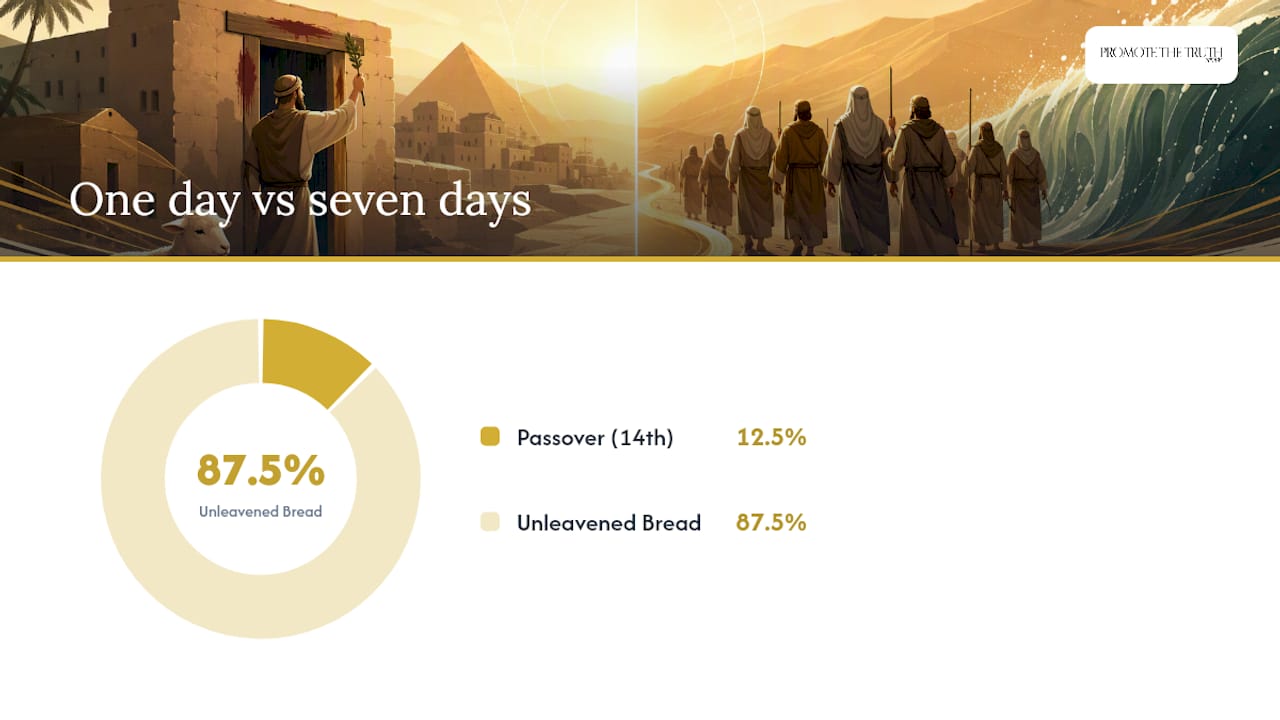
Pasaha (Passover) and Yum Matsah (Feast of Unleavened Bread) are closely connected, but the Scriptures present them as distinct Appointed Times with different dates and durations. In casual discussion, the two observances are often blended together, yet the Scriptural text keeps their timing clearly separated.
Pasaha (Passover) is appointed for the fourteenth day of the first New Moon month, while Yum Matsah (Feast of Unleavened Bread) begins on the fifteenth day and continues for seven days.
Uiyqara (Leviticus) 23:5–6 (TST) states:
5 In the first New Moon, on the fourteenth day of the New Moon, between the evenings, is Pasaha, known as the Passover, to YAHUAH.
6 On the fifteenth day of this same New Moon begins the Yum Matsah, known as the Feast of Unleavened Bread, to YAHUAH. Seven days you shall eat unleavened bread.
This sequence is direct. Verse 5 identifies Pasaha on the fourteenth day, while verse 6 introduces Yum Matsah on the fifteenth day as a separate seven-day observance.
The ritual instructions reinforce that distinction:
-
The Pasaha lamb is slaughtered on the fourteenth day, beyn ha’arbayim—“between the evenings”—according to Shamut (Exodus) 12.
-
The Pasaha meal belongs to the appointed Pasaha observance, while Yum Matsah begins on the fifteenth day.
-
During Yum Matsah, unleavened bread is eaten for seven days, and leaven is removed in accordance with the Scriptural instructions.
-
Any portion of the Pasaha lamb remaining until morning is to be burned with fire, marking the completion of that specific Pasaha meal.
This distinction is important when studying the Scriptural Pasaha (Biblical Passover) date, because combining Pasaha and Yum Matsah into one undifferentiated observance can blur the Scriptural sequence of the 14th and 15th days.
Some later traditions speak of an eight-day Pasaha (Passover) festival, particularly in diaspora Yahudiym (Jewish) practice, where an additional festival day developed in connection with historical uncertainties over calendar determination. The Scriptural text itself, however, specifies seven days for Yum Matsah, beginning on the fifteenth day, while Pasaha is appointed on the fourteenth day.
From the PTT/TST perspective, the distinction is therefore straightforward: Pasaha belongs to the fourteenth day, and Yum Matsah begins on the fifteenth day and continues for seven days. Recognizing that sequence is essential for understanding Abiyb 14, Niysan 14, the timing of Pasaha, and the Scriptural calendar established by YAHUAH.
The Bashurah (Gospel) Accounts, the Last Supper, and Niysan 14
The Bariyt Hadash (New Testament) accounts of Yahusha, His final meal with the Emissaries (Apostles), and His death are closely connected to the question of the timing of Pasaha (Passover). Because the four Bashurah (Gospel) accounts present these events from different perspectives, readers, manuscript researchers, and scholars have examined their chronology for centuries.
The Synoptic Bashurah (Gospels)—Matatiyahu (Matthew), Maraqu (Mark), and Luqah (Luke)—describe Yahusha, who is YAHUAH sharing a meal with His Emissaries using language directly associated with Pasaha (Passover). Many understand these accounts as describing a meal connected with the fourteenth day of Abyib (Niysan).
The Bashurah of Yahuhanan (John) presents additional details that have led to ongoing discussion. Yahuhanan (John) refers to the "Preparation" in connection with the day of Yahusha, who is YAHUAH's, death. Some interpret this to mean that Yahusha, who is YAHUAH, died at approximately the same time the Pasaha lambs were being slaughtered. Under that interpretation, the nailing on the Stake (crucifixion) corresponds with the fourteenth day, while the final meal occurred earlier.
Several important points should be considered when examining this chronology:
-
The expression “day of Preparation” in first-century usage could refer to preparation for the weekly Shabat (Sabbath) and does not necessarily refer exclusively to Pasaha (Passover). Therefore, the phrase alone does not resolve the chronological question.
-
Harmonizing the four Bashurah (Gospel) accounts requires careful attention to each writer’s description of the sequence of day, evening, night, Preparation, and Shabat. Assuming that every writer followed a single later standardized calendar may introduce difficulties that were not present in the original historical setting.
-
It is also important not to read later Rabbinic calendar traditions back into the first century. Historical evidence from the Second Ahiykal (Temple) period suggests that more than one calendrical tradition existed among the Yahudiym (Jews).
None of these chronological questions changes the clear instruction given in the Turah (Torah). Uiyqara (Leviticus) 23:5 and Bamadabar (Numbers) 9:3 identify Pasaha (Passover) as occurring on the fourteenth day of the first New Moon month. Any interpretation of the Bashurah (Gospel) accounts should therefore be considered in light of that Scriptural foundation.
From the Promote The Truth (PTT) and Truth Scriptures (TST) perspective, the central question is not whether Pasaha (Passover) belongs to the fourteenth day, but how Yahusha, who is YAHUAH's final meal, His death, the Preparation, and the beginning of Yum Matsah (Feast of Unleavened Bread) fit together within YAHUAH’s Scriptural calendar.
For this reason, the chronology of the Last Supper, Niysan 14, the nailing on the stake, and Pasaha (Passover) remains one of the most carefully examined subjects in Scriptural calendar studies. The best approach is to begin with the commands recorded in the Ta’anak, compare each Bashurah (Gospel) account carefully, and allow the Scriptural evidence to guide the interpretation rather than reading later traditions back into the text.
How to Determine Niysan (Nisan) 14 on Today’s Calendar
Determining the modern Gregorian equivalent of Niysan (Nisan) 14 begins with the Scriptural pattern established in the Truth Scriptures (TST). The first step is to identify the first New Moon month, because Shamut (Exodus) 12:2 (TST) states:
This New Moon shall mark the beginning of months for you. It shall be the first month of the year for you.”
From that Scriptural starting point, the fourteenth day can then be identified.
-
Identify the first New Moon. Within the PTT/TST understanding of YAHUAH’s Scriptural calendar, the New Moon establishes the beginning of a new month. Barashiyt (Genesis) 1:14 also identifies the heavenly lights as signs for Appointed Times, days, and years, providing the broader Scriptural foundation for reckoning time.
-
Confirm the season of Abyib. The first New Moon month must remain aligned with the agricultural season of Abyib rather than being determined by lunar calculation alone. This seasonal connection helps identify the proper first month of the Scriptural year. Pasaha is also associated with the period of the full moon, since the 14th or 15th day of a lunar month occurs approximately two weeks after the New Moon.
-
Count forward to the fourteenth day. Once the first New Moon month has been established, count to the fourteenth day. Uiyqara (Leviticus) 23:5 (TST) identifies the fourteenth day as the appointed date for Pasaha (Passover), while Bamadabar (Numbers) 9:3 (TST) likewise commands that Pasaha be performed on the fourteenth day at its Appointed Time. The remaining question is how beyn ha’arbayim—“between the evenings”—should be understood within that fourteenth-day framework.
Quick Reference: Because Pasaha (Passover) follows the Scriptural lunar-solar calendar rather than a fixed Gregorian date, its modern calendar equivalent changes from year to year. It normally falls during March or April, depending on when the first New Moon month of Abyib is established.
Modern Yahudiy (Jewish) calendars and astronomical lunar-data services can be useful for comparison when identifying proposed dates for Niysan 14 and Niysan 15. However, those resources may follow calendar assumptions that differ from the PTT/TST understanding of YAHUAH’s calendar. A published date should therefore not be accepted automatically without examining how that calendar determines the New Moon, the first month, the beginning of a day, and the timing of “between the evenings.”
For the PTT/TST approach, the goal is not simply to locate a modern calendar entry labeled “Niysan 14.” The Scriptural sequence must first be established: identify the first New Moon month of Abyib, count to the fourteenth day, and then determine the appointed timing according to the Scriptural instructions in Uiyqara 23:5 and Bamadabar 9:3.
Why Getting the Date Right Still Matters
Determining the correct date for Pasaha (Passover) is far more than an academic discussion about Abariy (Hebrew) grammar or ancient calendars. It directly affects how believers observe one of YAHUAH’s Appointed Times. If the Scriptural timing is misunderstood, the observance itself may be kept on the wrong day or missed altogether.
The discussion surrounding “between the evenings” raises a broader question: Do we allow the Scriptures to define our understanding, or do we rely primarily on later traditions and inherited interpretations? Uiyqara (Leviticus) 23:5 and Bamadabar (Numbers) 9:3 present the Scriptural instructions clearly. Much of the difficulty comes from centuries of interpretation rather than from the wording of the Abariy (Hebrew) text itself.
For that reason, careful manuscript study remains essential. Returning to the earliest available Abariy (Hebrew) manuscripts helps readers distinguish between the Scriptural wording and later interpretive traditions. Rather than assuming that a long-established calendar practice must be correct, believers are encouraged to examine the evidence preserved in the Scriptures themselves.
Ultimately, every interpretation should be measured against the Scriptural text. The evidence presented in this study supports the observance of Pasaha (Passover) on the fourteenth day at evening, in harmony with the Scriptural commands. Readers are therefore encouraged to examine the manuscript evidence carefully, test every interpretation against the Scriptures, and allow YAHUAH’s Word—not tradition alone—to remain the final authority.
— Maria
Study the Pasaha (Passover) Command in Its Original Language
Understanding Pasaha (Passover) begins with examining the command as closely as possible in the earliest available Abariy (Hebrew) and Aramiyt (Aramaic) manuscript traditions, rather than relying only on centuries of later translation and interpretation.
That is why the Truth Scriptures were created: to bring readers back to the Ta’anak and Bariyt Hadash, with special attention to the ancient manuscript record, the Set-Apart Name YAHUAH, and original Scriptural terminology.
For readers seeking to understand YAHUAH's Appointed Times, the timing of Pasaha (Passover), and the meaning of expressions such as beyn ha'arbayim ("between the evenings"), the Truth Scriptures (TST) provide a focused starting point for studying the Scriptural text and comparing the manuscript evidence.

If you want to see how the Truth Scriptures (TST) approach restoration before committing to the full text, start with the free download of Abariym (Hebrews) 1. It gives you a direct sample of how the translation handles manuscript language, restored Scriptural terminology, and the kind of careful wording examined throughout this study of Pasaha (Passover) and beyn ha’arbayim—“between the evenings.”
For continued study, the Scripture Study Series video channel offers free teaching on YAHUAH’s Appointed Times, the Scriptural calendar, Abariy (Hebrew) terminology, manuscript evidence, and other foundational subjects. These resources are designed to help readers move beyond inherited assumptions and examine the Scriptural text more closely for themselves.
Begin with the free Abariym (Hebrews) 1 download, compare the wording carefully, and then explore the complete Truth Scriptures through the Original Scriptures page when you are ready to go deeper. If your goal is to understand Pasaha (Passover), Niysan 14, YAHUAH’s calendar, and the original Scriptural language from a manuscript-focused perspective, these resources provide a practical place to continue your study.
Primary Sources for Further Study
The following Scriptural passages and supporting resources form the foundation for this study of the Pasaha (Passover) date, Niysan 14, Abiyb 14, and the meaning of beyn ha’arbayim—“between the evenings.”
-
Uiyqara (Leviticus) 23:5 (TST), Bamadabar (Numbers) 9:3 (TST), and Shamut (Exodus) 12 (TST) remain the primary Scriptural passages for determining the appointed date and timing of Pasaha (Passover). These texts should be the starting point for any study of the fourteenth day of the first New Moon month.
-
The commanded date and time of Pasaha (Passover) provides a detailed examination of the Abariy (Hebrew) expression beyn ha’arbayim—“between the evenings”—and its relationship to the timing of Pasaha.
-
Chabad’s explanation of Passover and the full moon provides additional background on the relationship between the Yahudiy (Jewish) calendar, the lunar cycle, Niysan, and the full moon.
-
For readers interested in more formal academic study, accredited Bible colleges in Iowa provide examples of structured programs covering Scriptural studies, Scriptural languages, manuscript history, and related subjects.
These resources should be considered alongside the Truth Scriptures (TST) and the Scriptural commands themselves. Secondary sources can provide valuable historical and linguistic context, but the central question of the Scriptural (Biblical) Passover date and timing should ultimately be examined against the wording preserved in Uiyqara 23:5, Bamadabar 9:3, and Shamut 12.
Sources
Frequently Asked Questions
When Was Pasaha (Passover) Observed When Yahusha Was Nailed on the Stake?
The Bashurah (Gospel) accounts connect Yahusha’s final meal, His nailing on the stake, and His death with the Pasaha (Passover) season. The Bashurah of Yahuhanan (John), in particular, refers to the Preparation in connection with the day of Yahusha’s death, which has led some readers to understand His death as occurring during Abiyb (Niysan) 14.
Although the precise relationship between the four Bashurah (Gospel) accounts continues to be studied, the Scriptural chronology places these events within the appointed period of Pasaha (Passover) and Yum Matsah (Feast of Unleavened Bread).
When Did YAHUAH Establish Pasaha (Passover)?
YAHUAH established Pasaha (Passover) before the children of Yisharal (Israel) departed from Matsar (Egypt). The original command is recorded in Shamut (Exodus) 12 and is later reaffirmed in Uiyqara (Leviticus) 23:5 and Bamadabar (Numbers) 9:3.
These passages identify Pasaha (Passover) with the fourteenth day of the first New Moon month, at its appointed time. The command was established as a continual statute, demonstrating that Pasaha was not limited only to the generation that experienced the original Shamut (Exodus).
What Day Was Abiyb (Niysan) 14 When Yahusha, who is YAHUAH Died?
The Scriptures do not provide a Gregorian calendar date for Abiyb (Niysan) 14, because the Gregorian calendar did not exist during the first century. Instead, researchers compare ancient Abariy (Hebrew) calendar systems, lunar observations, historical records, and manuscript evidence in an effort to reconstruct the chronology.
For this reason, the exact modern-calendar equivalent of Abiyb (Niysan) 14 in the year of Yahusha’s, who is YAHUAH’s death remains a subject of historical and chronological study. What the Scriptural text establishes clearly is the importance of the fourteenth day of the first New Moon month in determining the appointed timing of Pasaha (Passover).