The Moon has long been an important part of understanding the Creator’s calendar. The Moon’s changing appearance, its conjunction with the Sun, and its relationship with the solar year all provide important markers for understanding the Calendar of the Creator YAHUAH.
However, understanding the Moon’s visible phases should not be confused with determining the beginning of a month by waiting for the first visible crescent.
According to Promote The Truth, the Calendar of the Creator is a Lunar-Solar calendar based on the Moon and the Sun. The first day of each month is New Moon Day, and New Moon Day begins at the following dawn after the Moon’s conjunction, when the Moon is completely dark. The conjunction represents the final day of the previous month.
This distinction is important because the calendar determines the timing of the weekly Shabats and YAHUAH’s annual Appointed Times.
TL;DR:
The Calendar of the Creator is based on the Moon and Sun (Lunar-Solar).
The Moon’s visible phases can help us understand the progression of the lunar month.
The beginning of the month is not determined by waiting for the first visible crescent.
According to Promote The Truth, the complete-dark conjunction is the last day of the month.
New Moon Day begins at the following dawn after conjunction.
Lunar months contain 29 or 30 days.
The weekly Shabats occur on the 8th, 15th, 22nd, and 29th days of the Lunar-Solar month.
The Moon’s approximate phases correspond with these monthly markers: the 8th around half illumination, the 15th around the full Moon, the 22nd around the opposite half Moon, and the 29th around little or no visible Moon.
The last day of the month is not necessarily the 29th day; a 30th day may occur before New Moon Day.
The Lunar-Solar year uses the spring/vernal equinox as an anchor point.
A 13th month is sometimes required to keep the lunar year aligned with the solar year.
Promote The Truth presents the Yihazaqal (Ezekiel) timeline as evidence supporting the inclusion of a 13th month…
Table of Contents
How the Calendar of the Creator Works
The original discussion of a sighted-moon calendar correctly recognizes that the Moon is important to understanding a lunar calendar. However, its definition of the beginning of the month needs to be corrected to align with the Calendar of the Creator presented by Promote The Truth.
It begins with Barashiyt (Genesis) 1:14-19, where YAHUAH establishes the lights in the heavens for:
-
Signs
-
Appointed Times
-
Days
-
Years
The greater light, the Sun, rules the day, while the lesser light, the Moon, rules the night.
This establishes the foundation for the Lunar-Solar Calendar of the Creator.
Promote The Truth explains that the Calendar of the Creator uses the Moon and Sun, rather than the Roman Gregorian Calendar, to establish the Creator’s appointed cycles of time.
What Makes a New Moon Day?
The most important correction to a traditional “sighted crescent” explanation concerns New Moon Day.
Some states that a month begins when the waxing crescent is first seen after sunset. That is not the method. According to the Calendar of the Creator:
The Moon’s conjunction is the last day of the month.
The following dawn is New Moon Day.
A conjunction occurs when the Sun, Moon, and Earth are aligned and the Moon’s illuminated face is turned away from the Earth. During this period, the Moon is completely dark and no part of it can be seen as illuminated.
Promote The Truth explains:
“New Moon Day begins the following dawn” after the Moon’s conjunction.
Therefore, the process is:
Complete-dark Moon / conjunction → final day of the month → following dawn → New Moon Day
This is the key principle to understand when following the Calendar of the Creator.
Scriptural Evidence for the Covered or Dark Moon
Mashaliym (Proverbs) 7:20
The passage refers to the dark New Moon Day.
It also points to:
Tahliym (Psalms) 81:3
which refers to the New Moon during its covering as an Appointed Time and Feast Day.
These passages are explanation of why New Moon Day is connected with the covered or completely dark Moon rather than the first visible crescent.
Understanding the Moon’s Visible Phases
Although the visible crescent does not determine the beginning of the month according to the actual calendar, observing the Moon remains useful.
The Moon’s changing illumination provides visible markers that help students understand where they are within the Lunar-Solar month.
Promote The Truth identifies the approximate lunar phases associated with the four regular weekly Shabats:
| Lunar Day | Shabat | Approximate Moon Phase |
| Day 8 | First Shabat | Approximately half illuminated |
| Day 15 | Second Shabat | Approximately full Moon |
| Day 22 | Third Shabat | Approximately the opposite half |
| Day 29 | Fourth Shabat | Little or no visible Moon |
These phases are useful observational markers, but the exact amount of visible illumination should not be confused with the actual determination of the calendar day.
The conjunction is the critical marker for determining the end of the lunar month.
Which Astronomical Calculations Are Useful?
Astronomical calculations can help a person understand the Moon’s position, illumination, conjunction, and relationship to the Sun.
The original article discussed several astronomical factors, including:
-
Moon age
-
Elongation
-
Altitude
-
Moonset
-
Sunset
-
Atmospheric conditions
-
Horizon visibility
These are legitimate astronomical considerations when studying what can be observed in the sky.
However, they should not be used to introduce a different calendar rule.
Some discussed visibility prediction systems and criteria for determining whether a crescent could be seen. But those calculations may help explain why a crescent or other lunar phase is visible, but they do not determine when New Moon Day begins.
The fundamental calendar question is:
When did the Moon reach conjunction and become completely dark?
The next dawn begins New Moon Day.
Turning the New Moon Into a Monthly Calendar
Once the conjunction and New Moon Day are understood, following the monthly cycle becomes straightforward.
Promote The Truth explains that the Calendar of the Creator uses months of either 29 or 30 days.
If the month ends on Day 29:
The 29th day is the final day of the month.
The following dawn is New Moon Day.
If the month ends on Day 30:
The 30th day is the final day of the month.
The following dawn is New Moon Day.
The basic sequence is therefore:
New Moon Day → Days 2-7 → Day 8 Shabat → Days 9-14 → Day 15 Shabat → Days 16-21 → Day 22 Shabat → Days 23-28 → Day 29 Shabat → Day 30 if necessary → New Moon Day
Promote The Truth explains that after New Moon Day, four complete weeks of seven days follow, with the weekly Shabats occurring on days 8, 15, 22, and 29.
Why Weather and Visibility Still Matter
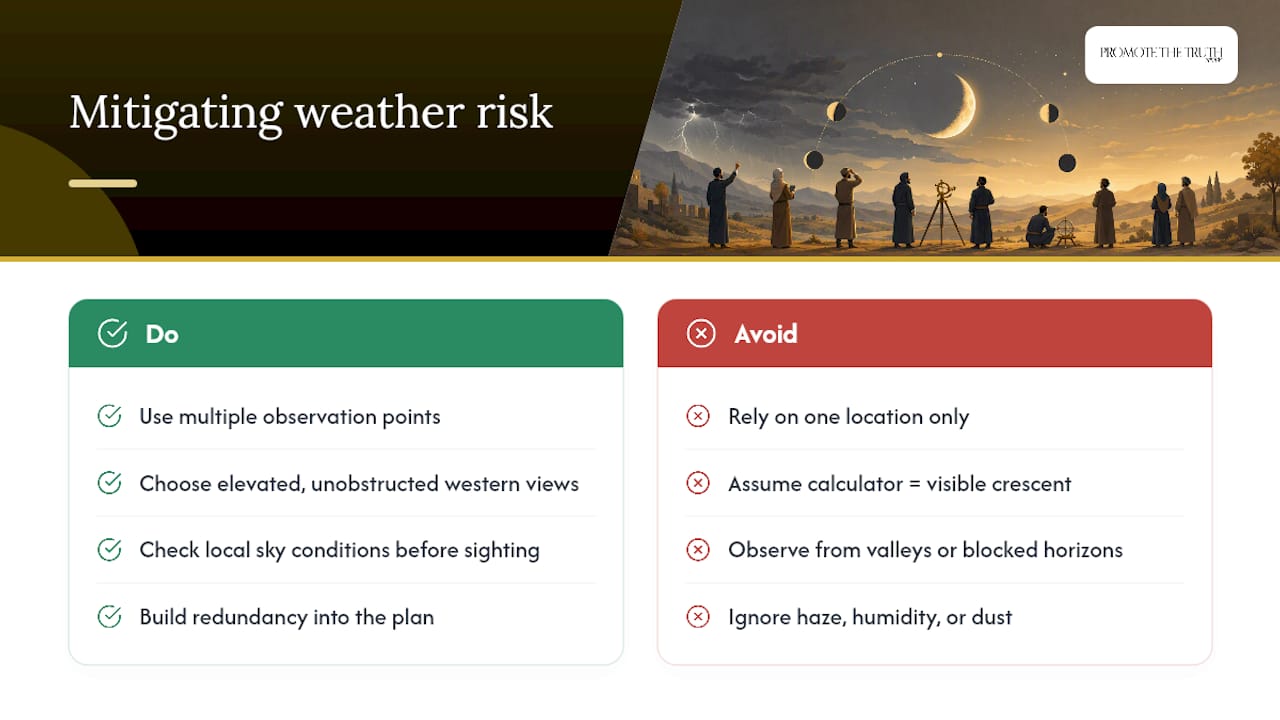
It is correct that atmospheric conditions can affect what an observer can see. Clouds, haze, humidity, dust, elevation, and horizon obstructions can all interfere with observations of the Moon.
That information remains useful when studying the Moon.
However, under the Calendar of the Creator, a local crescent sighting is not the authority for beginning a new month.
A person may have difficulty seeing the Moon because of:
-
Clouds
-
Haze
-
Dust
-
Humidity
-
Buildings
-
Mountains
-
Trees
-
Horizon obstruction
-
Atmospheric conditions
These conditions can affect what a person sees, but they do not change the actual lunar conjunction.
The Moon’s relationship to the Sun and Earth occurs regardless of whether an observer has a clear view of the sky.
Therefore, visibility conditions are important for studying lunar observation but should not be confused with the calendar’s underlying mechanism.
Why Local Crescent Sightings Do Not Determine New Moon Day
Research emphasizes that lunar visibility can differ from one location to another because of local sunset times, geography, weather, and horizon conditions.
That observation is correct as an astronomical matter.
A crescent can be visible from one location and invisible from another.
But this creates a problem if the first visible crescent is used as the authority for establishing the beginning of the month: different locations can potentially establish different dates.
The Calendar of the Creator instead identifies the conjunction as the final day of the month and the following dawn as New Moon Day.
This means that the calendar is not dependent upon whether a particular community happened to see a crescent.
The visible phases remain useful for learning the Moon’s cycle, but they are not the basis for changing the calendar from one geographical location to another.
The Four Weekly Shabats
After New Moon Day begins, the monthly Shabat pattern becomes easy to follow.
The weekly Shabats are:
8th day
15th day
22nd day
29th day
Promote The Truth explains that these dates can correspond to different days of the Roman Gregorian Calendar because the Gregorian system runs continuously rather than resetting with each New Moon.
For example, if New Moon Day occurs on a Wednesday according to the Roman Gregorian Calendar, the four regular Shabats for that lunar month will occur on Wednesdays of that Gregorian calendar as well.
The following month begins with another New Moon Day, resetting the monthly Lunar-Solar cycle.
What Happens After the Fourth Shabat?
After the fourth Shabat on Day 29, there may be:
-
A New Moon Day immediately following the 29th day, or
-
A 30th and final day before New Moon Day.
This depends upon when the conjunction occurs.
Promote The Truth specifically explains that the final day is determined by the Moon being completely dark, and New Moon Day follows at the next dawn.
Determining the Lunar-Solar New Year
The Calendar of the Creator is Lunar-Solar, not merely lunar.
This means the Moon establishes the monthly cycle while the Sun establishes the solar year.
Promote The Truth explains that the average lunar year is approximately 354 days, while the solar year is approximately 365 days. This creates a difference of approximately 11 days each year.
Without an adjustment, lunar months would gradually move away from their relationship with the solar seasons.
The Calendar of the Creator therefore uses a solar anchor.
The Vernal Equinox
Promote The Truth identifies the spring/vernal equinox as the anchor point for the Lunar-Solar calendar.
The Lunar-Solar New Year begins with the New Moon closest to the spring/vernal equinox.
This allows the lunar months to remain aligned with the solar year.
Why a 13th Month Is Sometimes Required
Because the lunar year is approximately 11 days shorter than the solar year, an additional month is periodically required.
Promote The Truth explains that there are seven 13-lunation years within a 19-year solar cycle, commonly referred to as the Metonic Cycle.
The basic pattern can be represented as:
Solar Year: approximately 365 days
12-Lunation Year: approximately 354 days
Difference: approximately 11 days
After another year, the difference accumulates.
Eventually, an additional lunar month is required to restore alignment with the solar year.
Promote The Truth presents this as an essential feature of a genuine Lunar-Solar Calendar.
Proof of a 13th Month
Some may focused heavily on astronomical visibility and local sighting. But the discussion of the 13th month is more important because it explains how the Lunar-Solar calendar remains aligned with the seasons.
Promote The Truth uses the timeline recorded in Yihazaqal (Ezekiel) as evidence supporting the existence of a 13th month.
Yihazaqal (Ezekiel) received visions and instructions from YAHUAH during the captivity of king Yahuiykiyn (Jehoiachin). The account provides several dated events that must be reconciled with the number of days involved in YAHUAH’s instructions.
Yihazaqal’s (Ezekiel’s) Timeline
Promote The Truth identifies the following dates:
-
Yihazaqal (Ezekiel) 1:1-2 — the 5th day of the 4th month in the 5th year of king Yahuiykiyn’s (Jehoiachin’s) captivity.
-
Yihazaqal (Ezekiel) 3:15 — the account reaches the 11th day of the 4th month.
-
Yihazaqal (Ezekiel) 4:1-11 — YAHUAH instructs Yihazaqal (Ezekiel) to lie on his left side for 390 days and then his right side for 40 days, totaling 430 days.
-
Yihazaqal (Ezekiel) 8:1 — another dated event occurs on the 5th day of the 6th month in the 6th year.
Promote The Truth explains that this timeline does not fit adequately within a strict solar or 12-month lunar framework, but that including a 13th month provides the additional time required.
The actual matter presents the following calculation:
18 + 30 + 29 + 30 + 29 + 30 + 29 + 30 + 29 + [29] + 30 + 29 + 30 + 29 + 30 + 5 = 436 days
The bracketed 29-day 13th month supplies the additional time required within the proposed Lunar-Solar calculation.
The purpose of this section is not simply to add another calendar calculation. It demonstrates why the Calendar of the Creator includes an intercalated month when required.
Why Does Calendar Matter?
The calendar determines the timing of YAHUAH’s Appointed Times.
Promote The Truth explains that the Scriptural calendar is based upon both the Moon and the Sun.
If a lunar calendar were allowed to continue without adjustment, the lunar months would gradually move through the solar seasons.
The 13th month prevents that drift.
This is particularly important for annual Appointed Times such as:
-
Pasaha (Passover)
-
Yum Sakut (Feast of Tabernacles)
The Lunar-Solar structure keeps the appointed seasons connected to their proper place within the solar year.
How to Follow the Calendar of the Creator
A simple monthly workflow based on the source is:
1. Understand the conjunction
The conjunction is when the Sun, Moon, and Earth are aligned and the Moon is completely dark.
2. Recognize the final day
The complete-dark conjunction corresponds to the last day of the current month.
3. Begin New Moon Day
The following dawn begins New Moon Day.
4. Begin counting the month
New Moon Day establishes the first day of the new lunar month.
5. Count the Shabat days
The weekly Shabats occur on:
8 → 15 → 22 → 29
6. Determine whether there is a 30th day
If the conjunction occurs after the 29th day, the month contains a 30th day.
7. Begin the next month
After the final day, the following dawn begins another New Moon Day.
8. Maintain the Lunar-Solar year
Use the vernal equinox as the solar anchor and include a 13th month when necessary to maintain alignment between the lunar and solar cycles.
Who Verifies a New Moon?
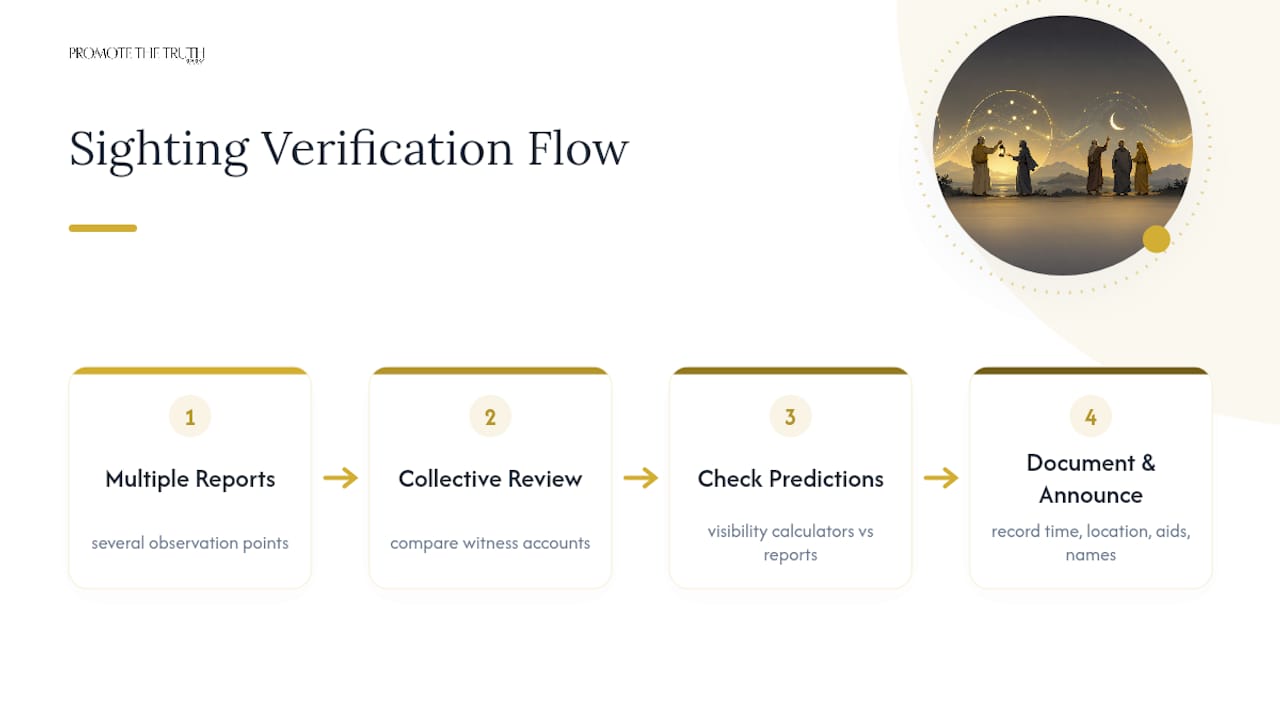
It is not necessary for the calendar methodology as it does not establish New Moon Day through a local crescent-sighting committee.
The relevant question is not:
“Did someone see the first crescent?”
The relevant question is:
“When did the Moon reach conjunction, and when does the following dawn begin?”
Astronomical information can assist with understanding the timing of conjunction, but the calendar itself is established through the Moon and Sun as the Creator’s timekeeping mechanisms.
How Apps and Digital Tools Can Help
The original article correctly recognizes that digital tools can make astronomical information easier to access.
Modern tools can help users examine:
-
Lunar position
-
Moon phases
-
Conjunction timing
-
Sunrise and sunset
-
Lunar illumination
-
Solar position
-
Calendar dates
However, technology should remain a tool for understanding the heavenly signs, rather than replacing the Creator’s calendar with a different methodology.
Promote The Truth itself states that a Calendar of the Creator application is intended to help people keep track of the calendar according to geographical location while they learn to observe the Moon and Sun.
Weekly Shabat and Annual Feast Days
The regular weekly Shabats begin at dawn and end at dusk, according to Promote The Truth.
The regular Shabats occur on:
Day 8
Day 15
Day 22
Day 29
There are also specific Shabats associated with certain annual Feasts. It identifies specific Feast Shabats associated with Pasaha (Passover) and Yum Kapar (Day of Atonement) as beginning at evening on the preceding day. These are marked separately on the calendar.
This distinction is important when using the Calendar of the Creator to determine the days of YAHUAH’s annual Appointed Times.
A Publisher’s Note on Scripture-Based Calendars
This article draws on research and manuscripts related to lunar-based timekeeping and discusses how the Creator’s calendar differs from the Gregorian system most of the world now follows. The research is connected to the Truth Scriptures, which is a restoration translation project built from ancient Abariy (Hebrew) and Aramiyt (Aramaic) sources.
Readers wanting the deeper scriptural reasoning behind sighting-based months can explore Creator’s calendar resources or broader discussions of lunar-solar timekeeping versus the Gregorian system. This article offers educational and scriptural guidance, not a binding legal ruling. Sighting decisions ultimately rest with local observers and communities applying the principles covered here.
— Maria
Sources
-
Promote The Truth is a platform dedicated to advocating for transparency and honesty in information dissemination, aiming to combat misinformation and promote credible, fact-based content across various media channels.
FAQ
What Is the Difference Between a Sighted Moon Calendar and the Calendar of the Creator?
A sighted-crescent calendar begins the month when an observer sees the first visible crescent.
The Calendar of the Creator does not use that method. It teaches that the Moon's complete-dark conjunction is the last day of the month, and the following dawn is New Moon Day.
Does the First Visible Crescent Begin the Month?
No.
The visible crescent can be useful for observing the Moon's cycle, but according to actual calendar it does not establish New Moon Day.
New Moon Day follows the complete-dark conjunction.
What Is a Lunar Conjunction?
A lunar conjunction occurs when the Sun, Moon, and Earth are aligned so that the illuminated portion of the Moon faces away from Earth.
The Moon is completely dark during the conjunction and cannot be seen as an illuminated disk.
How Long Is a Month?
The Calendar of the Creator uses months of either 29 or 30 days.
What Happens When the Month Has 29 Days?
When the 29th day is the final day of the month, the following dawn begins New Moon Day.
What Happens When the Month Has 30 Days?
When the 30th day is the final day of the month, New Moon Day begins at the following dawn.
What Days Are the Weekly Shabats?
The regular weekly Shabats occur on:
8th, 15th, 22nd, and 29th days of the Lunar-Solar month.
Why Can the Moon Look Different From Night to Night?
The Moon's visible illumination changes as it moves through its lunar cycle.
Around Day 8 it is approximately half illuminated, around Day 15 it is approximately full, around Day 22 it is approximately half illuminated in the opposite phase, and around Day 29 there may be little or no visible Moon.
Can Weather Affect Moon Observation?
Yes.
Clouds, haze, dust, humidity, elevation, and horizon obstructions can affect whether a person can see the Moon.
However, these conditions do not determine when conjunction occurs.
Why Is the Calendar Called Lunar-Solar?
It is called Lunar-Solar because it uses both the Moon and the Sun.
The Moon establishes the monthly cycle, while the solar year provides the seasonal framework.
Why Is a 13th Month Needed?
The lunar year is approximately 11 days shorter than the solar year.
A 13th month is therefore periodically added to keep the Lunar-Solar calendar aligned with the solar cycle. Promote The Truth identifies seven 13-lunation years within a 19-year cycle.
What Is the Anchor Point for the New Year?
The spring/vernal equinox is the anchor point used by the Lunar-Solar calendar.
The New Year begins with the New Moon closest to the spring/vernal equinox.
Does the Gregorian Calendar Determine the Shabat?
No.
The Gregorian Calendar runs continuously, whereas the Calendar of the Creator establishes the monthly Shabat pattern through the Lunar-Solar calendar.