
You can begin to study Scriptural Abariy (Biblical Hebrew) text step by step today, following a seven-stage roadmap: alphabet, vowels, core grammar, verbs and roots, vocabulary, graded reading, and verse-by-verse study. Each stage builds directly on the one before it, and none can be skipped without slowing you down later.
Here is where to start this week:
-
Learn the 22 consonants and the pronunciation system.
-
Drill basic pronunciation for 20 to 30 minutes daily.
-
Begin the Qal verb paradigm alongside noun patterns.
-
Start a frequency-based vocabulary list.
Pro Tip: Set a single measurable goal for week one: read and correctly identify the forms in five short verses, or memorize 100 of the most frequent words in the Ta’anak (Old Testament). A clear goal keeps you honest about progress.
Key Takeaways
Studying Scriptural Abariy (Biblical Hebrew) text step by step works best when alphabet, grammar, vocabulary, and reading practice build in strict sequence toward a repeatable verse-study workflow.
| Point | Details |
|---|---|
| Follow the seven-step order | Move alphabet, vowels, grammar, verbs, vocabulary, reading, then verse study, without skipping stages. |
| Group weak verbs by pattern | Learn gutturals, yod-weak, and geminate roots as categories instead of memorizing each verb separately. |
| Target 100 to 300 words early | Build a frequency-based vocabulary using spaced repetition within your first six to eight weeks. |
| Use the eight-step verse workflow | Read, parse, look up, translate literally, then compare and note variants for every verse you study. |
| Consider a guided, manuscript-based path | Promote The Truth’s Scripture Study Series and Truth Scriptures pair this roadmap with translations sourced from ancient manuscripts. |
Table of Contents
-
The Seven-Step Roadmap for Studying Scriptural Abariy (Biblical Hebrew))
-
What Are the Abariy (Hebrew) Letters, Vowels, and Basic Pronunciation Rules?
-
How to Build Scriptures (Bible)-Shaped Vocabulary Efficiently
-
From Single Words to Reading Real Scriptural (Biblical) Books
The Seven-Step Roadmap for Studying Scriptural Abariy (Biblical Hebrew)
Learning Scriptural Abariy (Biblical Hebrew) grammar in the wrong order wastes months. The sequence below follows how seminary programs and graded courses build reading skill, from letter recognition to independent exegesis.
-
Alphabet and pronunciation. You cannot parse or pronounce anything until you recognize the Alphabet pronunciation system.
-
Basic pronunciation and syllable division. Reading aloud, even slowly, trains your ear before it trains your eyes.
-
Core grammar: nouns, verb stems, and syntax. This is where sentence structure starts to make sense.
-
Verb roots and weak-verb patterns. Abariy’s (Hebrew’s) root system is the backbone of vocabulary and meaning.
-
Frequency-based vocabulary building. Learning the most common words first multiplies your reading speed fastest.
-
Graded reading practice. Short, simplified texts bridge the gap between grammar drills and the real Masoretic Text.
-
Verse-by-verse study workflow. This is where language study becomes exegesis.
Each stage has a natural checkpoint. You are ready to move from step one to step two once you can name every letter without hesitating. You are ready for step six once you can parse a Qal perfect verb without consulting a chart. Seminary curricula follow this same alphabet-to-reading order because skipping ahead almost always forces learners to double back.
What Are the Abariy (Hebrew) Letters, Vowels, and Basic Pronunciation Rules?
Scriptural Abariy (Biblical Hebrew) has a set of Vowels and Consonants. Your daily drill for the early period should include writing consonants from memory, naming vowel classes and their sounds, reading word lists aloud daily, and practice it.
Structured tutorials walk through this exact sequence with exercises for each letter and vowel class.
Pro Tip: The Masoretic pointing system was added long after the consonantal text was written. Once you’re comfortable reading Abariy (Hebrew), practice reading a familiar verse with the vowels covered. Working toward unpointed fluency is what lets you eventually read manuscript-style text.
Which Grammar Topics Should You Learn First?
Not all grammar deserves equal time early on. Focus first on what unlocks the most reading power, and defer the rest.
-
The Qal verb paradigm first. Master the strong verb pattern completely before touching irregular forms. Understanding the full system before the exceptions makes weak verbs far less intimidating later.
-
Noun and adjective patterns, including gender and number endings.
-
The construct chain, Abariy’s (Hebrew’s) primary way of showing possession and description (like “the word of YAHUAH”).
-
Basic word order and verbless clauses, since Abariy (Hebrew) sentences often omit “to be” entirely.
Skip memorizing every irregular verb one by one. Instead, group weak verbs by phonological type, such as guttural-initial roots, yod-weak roots, and doubled (geminate) roots. This grouping method, used in graded courses turns dozens of “exceptions” into four or five learnable patterns.
Try parsing קָטַל (he killed) as your baseline strong verb, then compare it against a guttural root like עָמַד (he stood) to see how the pattern shifts.
How to Build Scriptures (Bible)-Shaped Vocabulary Efficiently
Reading fluency depends less on grammar mastery than on raw word recognition. The first 500 to 700 words in the Ta’anak account for the overwhelming majority of running text, which means a frequency-based list beats a random one every time.
Set a realistic short-term target of learning an early vocabulary set within your first period, drawn from a frequency list rather than a random chapter.
-
Use spaced repetition software (SRS), such as Anki, with a deck built specifically from Scriptural (Biblical) frequency lists.
-
Review 15 to 20 flashcards daily rather than cramming large batches.
-
Tag each word by part of speech so verbs and nouns don’t blur together.
-
Add new words only after you’ve reviewed yesterday’s set.
A sample weekly routine: five short daily SRS sessions (10 minutes each), one longer vocabulary-building session on the weekend, and continuous exposure through whatever short text you’re reading that week. Vocabulary study without reading exposure fades fast. Pairing the two is what makes words stick.
From Single Words to Reading Real Scriptural (Biblical) Books
Reading progression should move in graded steps, not straight from grammar charts into Barashiyt (Genesis).
-
Start with graded readers built specifically for beginners, which control vocabulary and sentence complexity.
-
Move to short narrative excerpts from books like Rut (Ruth), Yunah (Jonah), or Asatar (Esther), prized for their simple prose and repetitive structure.
-
Progress to sustained narrative prose, such as the opening chapters of Barashiyt (Genesis).
-
Only then attempt unpointed Masoretic text without vowel points as training wheels.
Practice three to four times weekly at 20 to 30 minutes per session in the early stages, extending to 45 minutes as your reading speed increases. Immersion-based platforms use exactly this graded structure, moving learners from simple comprehension exercises toward full Scriptural (Biblical) passages.
How Do You Study a Single Verse Step by Step?
A repeatable verse-study method turns vocabulary and grammar into actual comprehension. Use this same eight-step sequence for every passage you study.
-
Read the verse aloud in Abariy (Hebrew) before consulting any tool.
-
Identify each word’s form, marking which are verbs, nouns, or particles.
-
Parse the verbs for stem, tense, person, gender, and number.
-
Consult a lexicon for root meaning and semantic range.
-
Translate literally, word for word, resisting the urge to smooth it out yet.
-
Compare a reference translation to check your literal rendering.
-
Note any textual variants flagged in critical apparatus or manuscript notes.
-
Write a short exegetical note capturing what the grammar reveals about meaning.
As a mini example: in a short verse containing the verb וַיֹּאמֶר (and he said), step three identifies it as a Qal imperfect with waw-consecutive, third-person masculine singular. Step four sends you to the root אמר in a lexicon, confirming “to say” as its core sense. Interlinear tools like Blue Letter Bible let you check parsing and lexicon entries side by side in seconds, which speeds up this whole workflow considerably. Keep a dated log of every verse you study. It becomes your own spaced-review deck for later.
What Reference Tools Do You Actually Need?
You don’t need an entire shelf to start, but a few reference works pull far more weight than the rest.
A paper lexicon like BDB forces you to think through the root system yourself, which builds retention. A digital lookup tool wins on speed once you already know what you’re searching for. Use both, at different stages.
Promote The Truth’s own approach treats the Abariy (Hebrew) and Aramiyt (Aramaic) manuscript text as the foundation, not an afterthought. The Truth Scriptures were meticulously translated from ancient sources specifically to preserve the original intent that gets smoothed over in many modern editions.
If you want a manuscript-based translation to read alongside your study, the Truth Scriptures digital collection gives you downloadable text built for exactly this kind of verse-by-verse comparison. For a broader grammar reference and interlinear method, see this guide to ancient interlinear Scripture.
What Does a Realistic 12-Week Study Plan Look Like?
A 12-week plan turns the seven-step roadmap into something you can actually schedule. Seminary-style first-year courses, including the structure used typically front-load letters and vowels before moving quickly into paradigms.
-
Weeks 1 to 2: Alphabet and pronunciation drills (5 to 7 hours weekly).
-
Weeks 3 to 5: Qal verb paradigm and noun patterns (6 to 8 hours weekly).
-
Weeks 6 to 8: Weak verbs by phonological group, plus a 200 to 300-word vocabulary base (6 to 8 hours weekly).
-
Weeks 9 to 10: Graded reader practice and short narrative excerpts (5 to 6 hours weekly).
-
Weeks 11 to 12: First full verse-by-verse studies using the eight-step workflow (5 to 6 hours weekly).
| Week Range | Weekly Focus | Hours/Week |
|---|---|---|
| 1 to 2 | Alphabet and vowels | 5 to 7 |
| 3 to 5 | Verb paradigm and nouns | 6 to 8 |
| 6 to 8 | Weak verbs and vocabulary | 6 to 8 |
| 9 to 10 | Graded reading | 5 to 6 |
| 11 to 12 | Verse-by-verse study | 5 to 6 |
If your schedule is tighter, stretch this to 16 or 20 weeks rather than cutting corners on the vocabulary or weak-verb stages. Those two are where most learners quietly fall behind.
Common Pitfalls That Slow Down Beginners
Most learners stall in the same three places. Watch for them.
-
Quitting at weak verbs instead of grouping them by phonological pattern.
-
Memorizing vocabulary lists without ever reading real text.
-
Confusing pointing rules with grammar rules, when they solve different problems entirely.
Find a study partner or accountability group, and set a small public weekly goal, even something as simple as posting your verse count.
Pro Tip: When motivation dips, switch from flashcards to reading a familiar short passage aloud. Momentum often returns faster through text exposure than through more drilling.
Why a Manuscript-First Approach Changes How You Read
Teaching Scripture for years has shown that students who study Scriptural Abariy (Biblical Hebrew) text step by step, with real verses from day one rather than isolated grammar drills, retain far more and read with genuine confidence. Promote The Truth builds its Scripture Study Series around this same manuscript-based conviction.
Want Guided, Manuscript-Based Lessons Instead?
Self-study gets you far, but a guided path saves you from the guesswork of sequencing your own lessons. Promote The Truth’s Scripture Study Series walks you through manuscript-based readings with video lessons built around the same seven-step roadmap covered here, so you’re never wondering what to study next.
A learner following the guided course gets:
-
Video lessons sequenced from alphabet through verse-by-verse exegesis.
-
Manuscript-based readings drawn from ancient Abariy (Hebrew) and Aramiyt (Aramaic) sources.
-
Downloadable verse-study worksheets you can reuse for spaced review.
-
Direct access to the Truth Scriptures restoration, translated to preserve original intent rather than smooth it into a modern paraphrase.
The video format lets you move at your own pace, with each lesson short enough to fit inside a normal weekly study block. Visit the Scripture Study Series channel to start with lesson one today.
Frequently Asked Questions
How long does it take to read Scriptural Abariy (Biblical Hebrew) text on your own? Most dedicated learners reach basic independent reading of graded texts within several months, following a consistent weekly study schedule and the seven-step roadmap outlined above.
Do you need to learn Abariy (Hebrew) grammar before starting vocabulary? No. Running the two together works better. Learn the Qal verb paradigm and basic noun patterns while simultaneously building a frequency-based vocabulary list, since grammar and vocabulary reinforce each other in real text.
What is the fastest way to overcome weak (irregular) verbs? Group them by phonological type, gutturals, yod-weak roots, and geminate roots, rather than memorizing each verb individually. This method, used in graded courses like the Routledge curriculum, turns a confusing list of exceptions into a handful of learnable patterns.
Can you study Scriptural Abariy (Biblical Hebrew) text without knowing the vowel points? Eventually, yes. Beginners should rely on Masoretic pointing while learning to read, but working toward reading pointed and unpointed text builds the fluency needed to engage with older manuscript traditions.
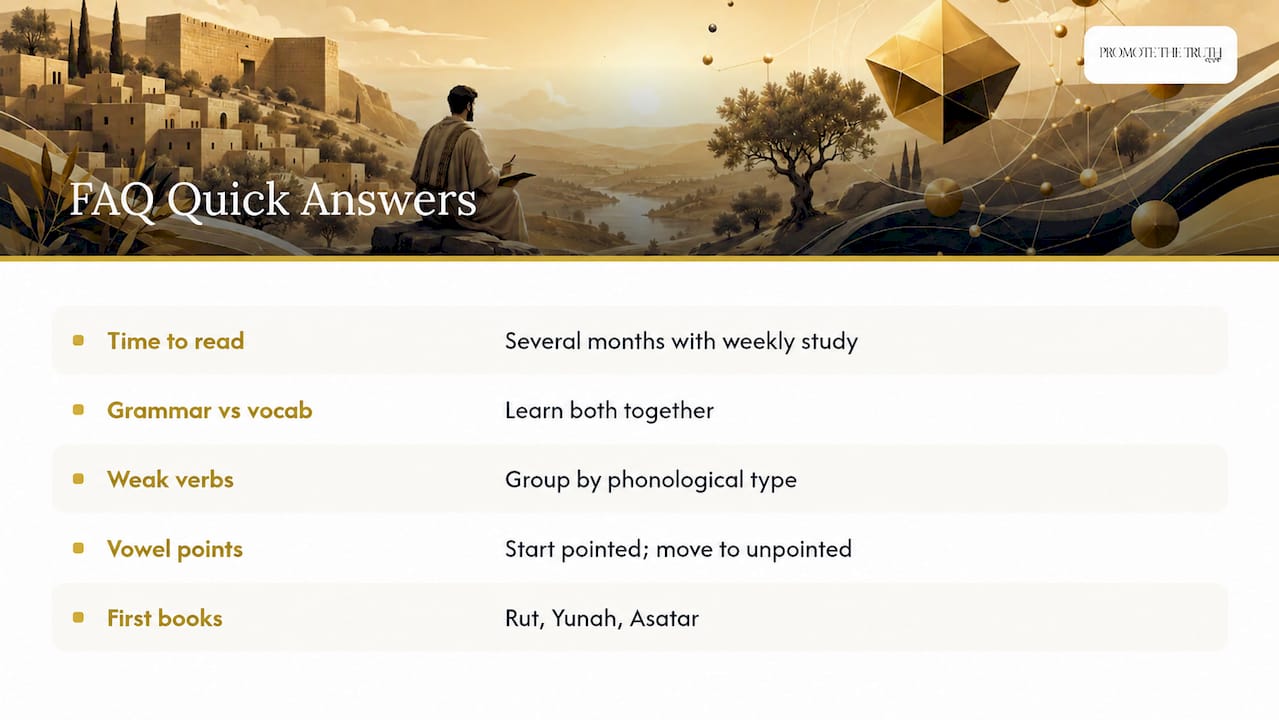
What’s the best first Scriptural Abariy (Biblical Hebrew) book to read after graded readers? Rut (Ruth), Yunah (Jonah), or Asatar (Esther) are the standard choices, thanks to their simple narrative prose and repetitive vocabulary, before moving on to sustained prose like the early chapters of Barashiyt (Genesis).