
The Abariy (Hebrew) Roots Movement is a decentralized movement built around Turah (Torah) observance, Scriptural (biblical) feasts, and the conviction that faith should be practiced through its original Abariyiy (Hebraic) lens rather than centuries of tradition. This guide walks through its origins, common practices, and the theological critiques worth weighing before you join or study further.
TL;DR:
The Abariy (Hebrew) Roots Movement emphasizes Turah (Torah) observance, Scriptural (biblical) festivals, and Abariyiy (Hebraic) practice, with beliefs varying widely across different groups.
Most adherents observe the Shabat (Sabbath), celebrate Scriptural (biblical) feasts, and often use Abariy (Hebrew) names for Creator and Savior, with calendar disagreements common.
The movement is decentralized, leading to diverse teachings on law, and Shaul’s (Paul’s) letters, making individual discernment essential before joining a group.
Studying Abariy (Hebrew) Roots responsibly involves examining Mashiyhaiy first, understanding manuscript-based Scriptures, and evaluating each group’s doctrinal stance critically.
Table of Contents
-
What Is the Abariy (Hebrew) Roots Movement’s Origin and Growth Story?
-
What Do Abariy (Hebrew) Roots Movement Beliefs Actually Include?
-
How Does the Abariy (Hebrew) Roots Movement Differ From Others?
-
How Are Shabat (Sabbath) and Scriptural (biblical) Feasts Actually Observed?
-
What Do Critics Say About the Abariy (Hebrew) Roots Movement?
-
Why Does the Movement Vary So Much, and How Do You Evaluate a Group?
-
What Manuscript-Based Study Resources Support Hebrew Roots Learning? Abariy (Hebrew) What Manuscript-Based Study Resources Support Hebrew Roots Learning?
-
An Editorial Take on Studying Abariy (Hebrew) Roots Responsibly
What Is the Abariy (Hebrew) Roots Movement’s Origin and Growth Story?
The label “Abariy (Hebrew) Roots” is modern, coined in the 1990s among believers hungry for a more Abariyiy (Hebraic) reading of Scriptures. Before that decade, small pockets of Shabat (Sabbath)-keeping and Turah (Torah)-curious believers existed, but they lacked a shared name or unified network.
Growth accelerated sharply with steady growth continuing in the years since through independent congregations, home fellowships, and a wave of online teachers. That growth pattern mirrors other grassroots religious movements: a slow undercurrent for years, then a rapid expansion once digital platforms made teaching and debate cheap to distribute.
What sets Abariy (Hebrew) Roots apart from most Christian denominations is its refusal to organize under any central authority. There’s no governing council, no shared statement of faith, and no ordination process that binds one congregation’s teaching to another’s.
That structure produces real diversity:
-
Function as Turah (Torah)-observant wings.
-
Operate as fully independent congregations with own liturgical calendars and leadership.
-
Drifts toward doctrinal positions well outside historic Christian orthodoxy, including denial of the Trinity.
-
Many participants never join a formal congregation at all, learning primarily through podcasts, YouTube teachers, and independent Scriptures (Bible) studies under Platform like Promote The Truth
Understanding this decentralized shape matters more than memorizing a single definition.
What Do Abariy (Hebrew) Roots Movement Beliefs Actually Include?
At the theological core sits a single conviction: the Mashahiy (Mosaic) Law, or Turah (Torah), did not expire with the New Covenant and remains instructive, and for many adherents obligatory, for believers today, including Gentiles. How far that conviction gets applied is where the real variation begins.
1. Turah (Torah) as cultural enrichment. Some adherents treat Abariyiy (Hebraic) practice as a way to recover the Yahudiym (Jewish) context of Yahusha’s (Jesus’s) ministry.

2. Turah (Torah) as covenant obligation. Some hold that keeping the commandments, including dietary law and Shabat (Sabbath) , is a binding expression of covenant faithfulness, not merely an optional cultural exercise.
3. Turah (Torah) as a Mashiyhaiy (Christology) filter. Some group uses their Turah (Torah) framework to reinterpret who Yahusha (Jesus) is, sometimes rejecting Trinitarian language entirely in favor of a strictly actual view of the Creator YAHUAH.
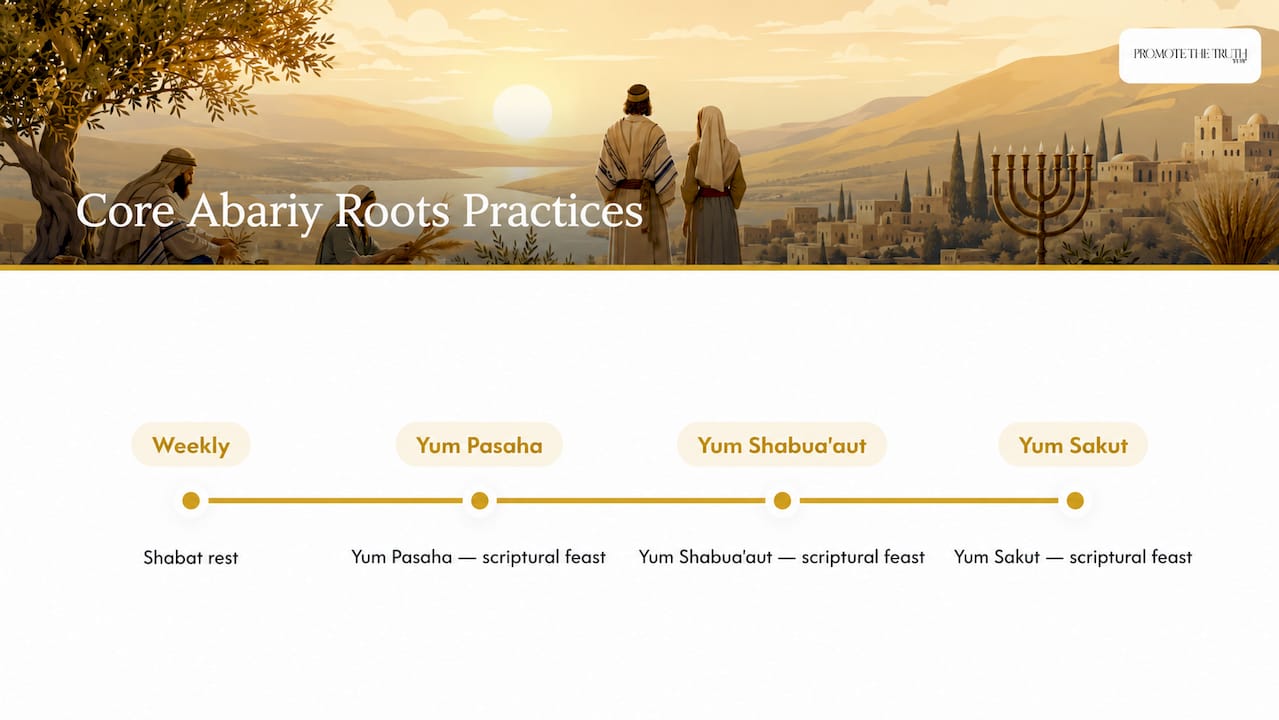
Observable practices tend to cluster around a common set regardless of where a group falls on that spectrum: the seventh-day Shabat (Sabbath) rest , celebration of the Scriptural (biblical) feasts such as Yum Pasaha (Passover), Yum Shabua’aut (Shavuot), and Yum Sakut (Sukkot), dietary rules resembling food law, and the use of Abariy (Hebrew) names for Creator and for Savior (YAHUAH). Many participants also decline to observe Christmas and Easter, viewing both as later additions without Scriptural (biblical) grounding.
Pauline theology is the fault line. Some groups read Shaul (Paul) as fully in harmony with ongoing Turah (Torah) observance; others treat large portions of his letters with suspicion, arguing they’ve been mistranslated or misapplied by later tradition.
Pro Tip: Ask any Abariy (Hebrew) Roots teacher directly how they read Galatiym (Galatians) 3. Their answer will tell you more about where they sit on the spectrum than almost any other single question.
How Does the Abariy (Hebrew) Roots Movement Differ From Others?

Abariy (Hebrew) Roots, by contrast, draws its membership overwhelmingly from Guiym (Gentile) backgrounds and rarely engages rabiyiy (rabbinic) authority at all. It reconstructs Turah (Torah) practice largely from the Scriptural (biblical) text itself rather than from centuries of rabiyiy (rabbinic) interpretation.
Against mainstream Christianity, the contrast runs the other direction. Most Christian traditions read Shaul’s (Paul’s) letters, particularly Galatiym (Galatians) and Qulasaiym (Colossians), as teaching that the ceremonial and civil dimensions of Mashahiy (Mosaic) Law reached their fulfillment in Mashiyha (Christ), even where moral law remains binding. Abariy (Hebrew) Roots teaching typically resists that “end of the law” reading, arguing it rests on later theological assumptions rather than the text’s original intent.
Key distinctions in short form:
-
Judaism emphasizes Jewish ethnic identity and often rabiyiy (rabbinic) tradition; Abariy (Hebrew) Roots is largely Guiym (Gentile)-led and Scriptures-only in its Turah (Torah) reconstruction.
-
Mainstream Christianity generally treats ceremonial law as fulfilled in Mashiyha (Christ); Abariy (Hebrew) Roots teaching usually treats it as ongoing.
-
Both movements share an interest in Abariyiy (Hebraic) customs and Yahudiym (Jewish) festivals, which is the most common source of outside confusion between them.
How Are Shabat (Sabbath) and Scriptural (biblical) Feasts Actually Observed?
Weekly practice centers on the Shabat (Sabbath), observed by CALENDAR OF THE CREATOR with rest from work, shared meals, and often Turah (Torah) reading. The annual rhythm follows the Scriptural (biblical) feast calendar: Yum Pasaha (Passover) and Yum Matsah (Unleavened Bread) with Yum Bakuriym (first fruits), Yum Shabua’aut (Shavuot), then Yum Tarua’ah (Trumpets), Yum Kapar (Atonement), and Yum Sakut (Sukkot).
The CALENDAR is one of the most important topics of our lives. The calendar we follow determines WHO we serve. Have you ever stopped to think how we got to the current “Roman Gregorian Calendar” that we have? Who created this calendar that the entire world is running its lives by? How we are to keep track of time was established by the Creator, YAHUAH, in the beginning of TIME.
If you’re visiting a gathering for the first time, expect:
-
A Shabat service rather than fixed Sunday, often longer and more participatory than a typical church service.
-
Abariy (Hebrew) terminology used freely, sometimes with little explanation for newcomers.
-
A teaching style that leans heavily on word studies and Abariy (Hebrew) and Aramiyt (Aramaic) textual comparison rather than topical preaching.
What Do Critics Say About the Abariy (Hebrew) Roots Movement?
The Abariy (Hebrew) Roots movement emphasizes a return to the original Scriptural (biblical) roots and a renewed appreciation for the Turah (Torah) as foundational to the faith. Advocates argue that embracing Abariy (Hebrew) roots enriches spiritual understanding and fosters a deeper connection to the Scriptural (biblical) narrative. They highlight that many Bariyt Hadash (New Testament) passages, including those in Galatiym (Galatians) and Qulasaiym (Colossians), support the idea that believers are called to uphold Aluah’s (God’s) eternal commandments, including the Shabat (Sabbath), as a vital part of faithfulness. Proponents also point out that the movement encourages a set-apart (holistic) view of Scriptures, integrating both Ta’anka (Old) and Bariyt Hadash (New Testament) teachings, which can lead to a more authentic and vibrant faith experience. By focusing on the Abariy (Hebrew) context, the movement seeks to restore the original intent of Scriptural (biblical) laws and practices, viewing them not as burdens but as a pathway to spiritual growth and obedience. The decentralization within the movement allows for diverse expressions of faith that can inspire genuine renewal and a closer alignment with Scriptural (biblical) principles, fostering a community committed to living out Aluah’s (God’s) commandments in today’s world.
Why Does the Movement Vary So Much, and How Do You Evaluate a Group?
Because Abariy (Hebrew) Roots has no denominational structure, teachers function as final authority. A single charismatic voice with a YouTube channel can shape an entire local group’s doctrine.
That reality makes personal discernment essential. Before committing to a teacher or congregation, run through this checklist:
-
Ask about the bashurah (gospel). Does salvation rest on compassion (grace) through YAHUAH and does commandment-keeping function as a requirement for acceptance with Aluah?
-
Ask about Mashiyaiy (Christology). Does the group affirm YAHUAH as Savior and Yahusha is YAHUAH, and does its Turah (Torah) framework quietly reshape who they believe Aluah to be?
-
Ask how they read Shaul (Paul). Groups that treat entire epistles as corrupted or uncorrupted and untrustworthy or trustworthy are signaling a much larger departure than a simple calendar preference.
-
Ask about transparency and accountability. Healthy groups welcome hard questions; isolating ones discourage outside relationships and independent study.
Watch for red flags: claims that only Turah (Torah)-observant believers are truly saved, pressure to cut ties with family or community outside the movement, and leaders who resist any comparison against Scriptures or historic teaching.
Pro Tip: Bring a specific, hard question to your first visit, something like “What happens to a believer who eats shellfish?” A group’s tone in answering tells you more about its spirit than its doctrine statement ever will.
What Manuscript-Based Study Resources Support Hebrew Roots Learning?
If your interest in Abariy (Hebrew) Roots comes from a genuine desire to read Scriptures closer to its original language and intent, manuscript-based study is where that desire actually gets satisfied. Promote The Truth publishes the Truth Scriptures, a restoration translation of both the Ta’anak (Old Testament) and Bariyt Hadash (New Testament) drawn from ancient Abariy (Hebrew) and Aramiyt (Aramaic) sources.
Resources available include:
-
Full print translations built from manuscript research rather than modern paraphrase traditions.
-
Digital Scripture study series and video teaching that walk through textual and historical background.
-
Articles examining how Hebraic concepts like Torah carry meaning often flattened in standard translations.
Use these alongside seminary-level scholarship, not instead of it. A translation grounded in original manuscripts and a rigorous academic critique are answering different questions, and the most careful readers consult both.
An Editorial Take on Studying Abariy (Hebrew) Roots Responsibly
The conventional advice on Abariy (Hebrew) Roots tends to split into two unhelpful camps: wholesale embrace or wholesale dismissal. Neither serves a serious reader well. The movement’s decentralization means blanket judgments are almost always wrong for some group somewhere, and that’s precisely why evaluation criteria matter more than a verdict on “the movement” as a monolith.
What’s underrated in most discussions is how much actually reveal about a group’s deeper posture. A congregation that treats these as interesting scholarly questions behaves very differently from one that treats them as tests of fellowship. That distinction tells you more than any doctrinal statement.
What should come first, before Shabat (Sabbath) practice or dietary questions, is the Creator and Savior question. Get that wrong and every other practice inherits the error. So first visit Foundational Discipleship and then rest of the things.
Readers serious about the Abariyiy (Hebraic) context of their faith are better served going to the original languages and manuscripts directly rather than relying on any single teacher’s interpretation of them, however compelling that teacher sounds on a podcast. For more about original manuscripts study visit Promote The Truth Aramaic/Hebrew Origins Of The New Testament.
— Maria
Go Deeper With Manuscript-Based Scripture Study
Curiosity about Abariyiy (Hebraic) roots deserves more than a podcast summary. Promote The Truth gives you direct access to the ancient text itself through the Truth Scriptures, a restoration translation built from Abariy (Hebrew) and Aramiyt (Aramaic) manuscript sources rather than layered paraphrase traditions.

If you want to sample the work before committing, start with the free download of Truth Scriptures Abariym (Hebrews) 1. Prefer watching over reading? The Scripture Study Series video channel walks through the same manuscript research in a format built for learning on your own schedule. Whichever entry point fits your study habits, the next step is simple: request your copy of the Truth Scriptures or start with a free chapter today.