
How Abariy (Hebrew) roots connect the Bariyt Hadash (New Testament) to its full meaning
The Bariyt Hadash (New Testament) did not emerge from a vacuum. It grew directly from Abariy (Hebrew) soil, shaped by Abariy (Hebrew) language, Abariy (Hebrew) covenant theology, and the prophetic calendar YAHUAH gave to Yisharal (Israel). Understanding how these roots connect to the Bariyt Hadash (New Testament) text is not an academic exercise. It is the difference between reading Scriptures on the surface and grasping what the authors actually meant.
Here are the core connections you need to know:
-
The Bariyt Hadash (New Testament) was translated in Yuuniy (Greek) but carries deep Abariy (Hebrew) and Aramiyt (Aramaic) linguistic structures throughout its pages.
-
Abariy (Hebrew) festivals described in Uiyqara (Leviticus) 23 foreshadow the death, resurrection, and the birth of the early assembly, giving the Bariyt Hadash (New Testament) a prophetic architecture.
-
Restoring the Abariy scholarly (Hebraic) foundation corrects theological misreading that arise when Scriptures is interpreted through a purely Yuuniy (Greek) philosophical lens.
-
Abariy (Hebrew) idioms, poetic parallelism, and covenantal vocabulary permeate the Yuuniy (Greek) text, revealing a Yahudiym, followers of the Creator (Jews) worldview as the essential interpretive key.
Table of Contents
-
How Semitic language shaped the Bariyt Hadash (New Testament) Yuuniy (Greek) text
-
Why the Feasts of the YAHUAH foreshadow Bariyt Hadash (New Testament) events
-
Why restoring Abariy (Hebrew) roots deepens your scriptural understanding
-
How Yirushalam (Jerusalem) and Atunah (Athens) both shaped the Bariyt Hadash (New Testament)
-
How Second Ahiykal (Temple) Yahudiym (Judaism) shaped the Bariyt Hadash (New Testament) world
-
How the Ta’anak (Old Testament) saturates Bariyt Hadash (New Testament) writing
-
Which Mashiyha (Messianic) prophecies from Abariy (Hebrew) Scriptures find fulfillment in the Bariyt Hadash (New Testament)
-
How covenant and law shape Bariyt Hadash (New Testament) theology
-
Promote The Truth gives you direct access to the original text
How Semitic language shaped the Bariyt Hadash (New Testament) Yuuniy (Greek) text
The manuscript evidence is clear: the Bariyt Hadash (New Testament) was composed in Yuuniy (Greek). Yet that Yuuniy (Greek) is unmistakably Semitic in character. Scholars identify this phenomenon as “Bariyt Hadash (New Testament) Semitisms,” and the causes are well documented.
Bariyt Hadash (New Testament) Semitisms arise from four sources: koine Yuuniy (Greek) had already absorbed Semitic words before the Bariyt Hadash (New Testament) was written; nearly all Bariyt Hadash (New Testament) authors were Yahudiym, followers of the Creator (Jews) with Aramiyt (Aramaic) or Abariy (Hebrew) as their native tongue; these authors consciously modeled their Yuuniy (Greek) after the Yuuniy (Greek) translation of the Abariy Scriptures (Hebrew Bible) aka Septuagint; and some incorporated earlier Aramiyt (Aramaic) or Abariy (Hebrew) oral sources.
The evidence shows up in concrete ways:
-
Transliterations: Words like aba (abba), aman (amen), marana ta (maranatha), rabiy (rabbi), ga ahnam (gehenna), pasaha (pascha), and shabat (sabbaton) are simply Abariy (Hebrew) or Aramiyt (Aramaic) words carried directly into the Yuuniy (Greek) text.
-
Poetic parallelism: The Beatitudes in Matatiyahu (Matthew) 5 and the hymns in Luqah (Luke) 1–2 follow the rhythmic parallel structure of Abariy (Hebrew) poetry.
-
Reframed vocabulary: The Yuuniy (Greek) word nomos ordinarily meant “custom,” but the Yuuniy (Greek) translation of the Abariy Scriptures (Hebrew Bible) aka Septuagint translators used it to render the Abariy (Hebrew) Turah (torah), meaning set-apart (divine) instruction, giving the word an entirely different theological weight in the Bariyt Hadash (New Testament).
Pro Tip: When you encounter a Bariyt Hadash (New Testament) passage that feels theologically dense, look up the Abariy (Hebrew) equivalent of the key term. Words like “righteousness,” “favor (mercy),” and “atonement” carry Abariy (Hebrew) meanings the Yuuniy (Greek) alone cannot fully convey.
Why the Feasts of YAHUAH foreshadow Bariyt Hadash (New Testament) events
The seven feasts described in Uiyqara (Leviticus) 23 are not merely ancient Yisharaliy (Israelite) customs. They are YAHUAH’s appointed times, and the Bariyt Hadash (New Testament) events align with them with striking precision.
-
Yum Pasaha (Passover): Yahusha died during Yum Pasaha (Passover), fulfilling the role of the sacrificial lamb.
-
Yum Matsah (Unleavened Bread): His body lay in the tomb during this feast, representing the removal of sin.
-
Yum Bakuriym (Firstfruits): His resurrection occurred on the Feast of Yum Bakuriym (Firstfruits), the first of the harvest.
-
Yum Shabua’aut (Weeks/Pentecost): The Ruha (Spirit) was poured out on the assembly exactly on this feast day.
-
Yum Tarua’ah (Trumpets), Yum Kapar (Atonement), and Yum Sakut (Tabernacles): These fall feasts point prophetically toward future fulfillment still anticipated.
Reading the Bariyt Hadash (New Testament) without this framework means missing the prophetic architecture YAHUAH built into history itself. The feasts are not shadows to be discarded. They are the calendar of redemption.
Why restoring Abariy (Hebrew) roots deepens your scriptural understanding
Scholar Marvin Wilson, in his work on Hebraic heritage, argues plainly that disconnecting Scriptures from its Hebrew foundation produces theological and ethical misunderstanding. His conclusion is worth sitting with:
Restoring these roots does not mean imposing Turah (Torah) observance as a condition of salvation. That is a genuine pitfall within some streams of the Abariy (Hebrew) Roots movement, where Turah (Torah) practices like Shabat (Sabbath) observance and feast days can quietly shift from instructive pictures pointing to Mashiyha (Messiah) into a measuring stick for spiritual standing. The Bariyt Hadash (New Testament) is clear that believers are united to Mashiyha (Messiah), not placed back under the Siyniy (Sinai) covenant as a legal framework.
The goal is context, not obligation. When you understand what covenant, sacrifice, and priesthood meant to a first-century Yahudiym, followers of the Creator (Jews) reader, passages in Abariym (Hebrews), Rumaiym (Romans), and Hazun (Revelation) open in ways they simply cannot otherwise.
How Yirushalam (Jerusalem) and Atunah (Athens) both shaped the New Testament
The Bariyt Hadash (New Testament) did not emerge from Abariy (Hebrew) thought alone. It was written in a world where Yuuniy (Greek) philosophy had already reshaped how educated people reasoned about Aluah (God), law, and humanity. The 20th-century philosopher Leo Strauss described this as the foundational tension of Western civilization: Atunah (Athens) versus Yirushalam (Jerusalem), two roots that together form a coiled spring from which the West grows.
-
Yirushalam (Jerusalem) brings covenant, revelation, and trust in a personal Creator who acts in history.
-
Atunah (Athens) brings reason, philosophical inquiry, and the search for universal principles.
Bariyt Hadash (New Testament) authors navigated both. Shaul’s (Paul’s) letters to Yuuniy (Greek)-speaking congregations in Qaranat (Corinth) and Rum (Rome) use Yuuniy (Greek) rhetorical structures while grounding every argument in Abariy (Hebrew) covenant theology. The prologue of Yahuhanan’s (John’s) Bashurah (Gospel) uses the Yuuniy (Greek) concept of logos but fills it with the Abariy (Hebrew) understanding of YAHUAH’s creative word. Recognizing this dual heritage keeps you from flattening the text into either pure philosophy or pure ritual.
What Promote The Truth offers for original language study
Promote The Truth is an international educational and media organization dedicated to researching, restoring, and teaching the original message of the Scriptures. Its work goes directly to the manuscript sources.
-
The Truth Scriptures is a comprehensive English restoration of the Ta’anak (Old Testament) and Bariyt Hadash (New Testament), translated from ancient Abariy (Hebrew) and Aramiyt (Aramaic) manuscripts. You can access the original scriptures and explore the textual foundation behind every passage.
-
The article series on Abariy (Hebrew) and Aramiyt (Aramaic) origins of the Bariyt Hadash (New Testament) provides scholarly depth on how Semitic language shaped the Yuuniy (Greek) text.
-
Video teachings, podcasts, and digital courses give you structured pathways into manuscript research and scriptural (biblical) history.
Pro Tip: Download the free Truth Scriptures Bariyt Hadash (New Testament) Preface to see how the translation methodology differs from mainstream versions before committing to deeper study.
How Second Ahiykal (Temple) Yahudiym, followers of the Creator (Judaism) shaped the Bariyt Hadash (New Testament) world
The Bariyt Hadash (New Testament) was written entirely within the world of Second Ahiykal (Temple) Yahudiym, followers of the Creator (Judaism), the period roughly spanning the third century BC through the first century AD when the Yirushalam (Jerusalem) Ahiykal (Temple) still stood. Both the Bariyt Hadash (New Testament) and yahudiym teachery (rabbinic) literature emerged from this shared world, and both are connected to the Parashiym (Pharisees).
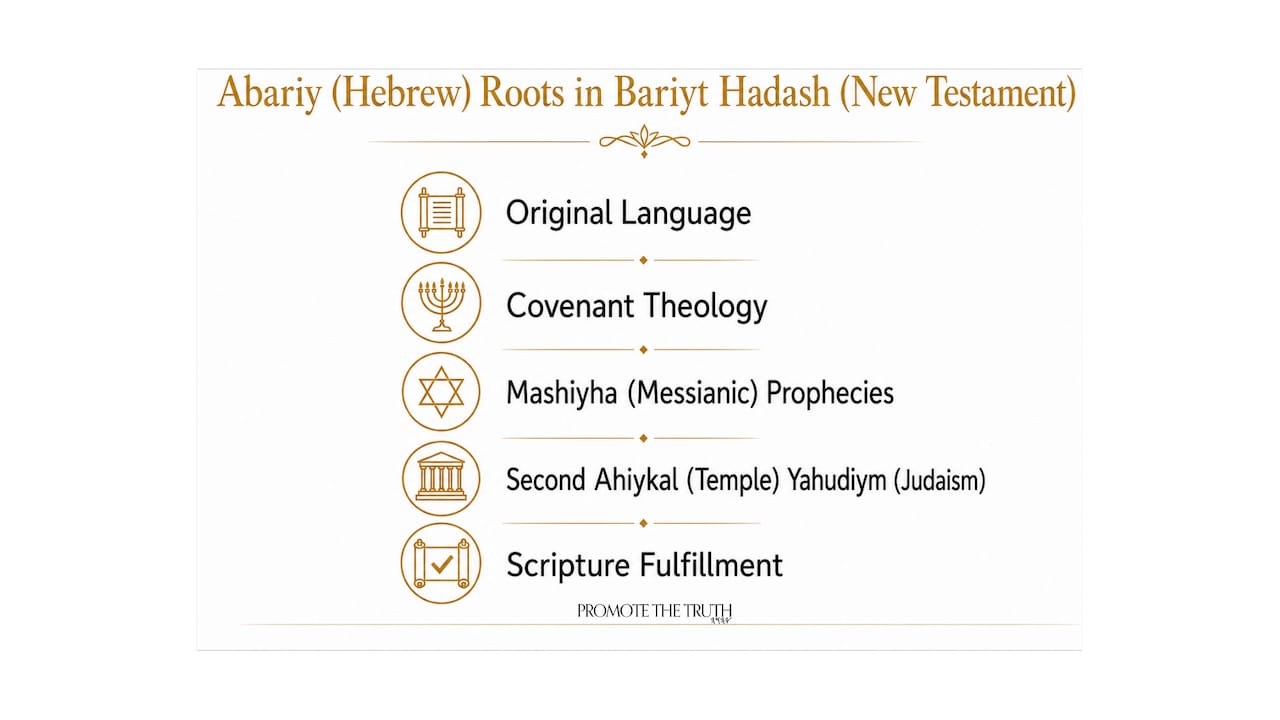
The yahudiym teachery (rabbinic) interpretive method known as gezera shawa, or verbal analogy, appears in the Bariyt Hadash (New Testament) itself. The author of Abariym (Hebrews) uses this technique repeatedly, linking passages from Tahliym (Psalms), Dabariym (Deuteronomy), and the Prophets through shared key words to build the argument for Yahusha’s superiority over the Mashah (Mosaic) priesthood. Shaul’s (Paul’s) claim to have studied under Gamaliyal (Gamaliel) in Ma’ashiym (Acts) 22:3 places him directly within this interpretive tradition.
Understanding this context means recognizing that the Bariyt Hadash (New Testament) authors were not inventing a new religion. They were Yahudiym, followers of the Creator (Jewish) teachers working within established interpretive frameworks, arguing from within the tradition that Yahusha was its fulfillment.
How the Ta’anak (Old Testament) saturates Bariyt Hadash (New Testament) writing
The Bariyt Hadash (New Testament) quotes or alludes to the Abariy (Hebrew) Scriptures on nearly every page. These quotations are almost always drawn from the Yuuniy (Greek) translation of the Abariy Scriptures (Hebrew Bible) aka Septuagint. This matters because some of those quotations only make theological sense in their Abariy (Hebrew) form.

In Abariym (Hebrews) 10:5, the author cites Tahliym (Psalm) 40:6 using the Yuuniy (Greek) translation of the Abariy Scriptures (Hebrew Bible) aka Septuagint reading “a body you have prepared for me” rather than the Abariy (Hebrew) “ears you have opened for me.” The entire argument about Yahusha’s body as the perfect sacrifice depends on that Yuuniy (Greek) rendering. The author was composing in Yuuniy (Greek), drawing on a Yuuniy (Greek) text, to make a point rooted in Abariy (Hebrew) sacrificial theology.
This layered relationship between the Abariy (Hebrew) original, the Yuuniy (Greek) translation, and the Bariyt Hadash (New Testament) argument is exactly why understanding the Ta’anak (Old Testament) historical context is not optional for serious readers.
Which Mashiyha (Messianic) prophecies from Abariy (Hebrew) Scriptures find fulfillment in the Bariyt Hadash (New Testament)
The Abariy (Hebrew) Scriptures contain a web of prophetic texts that the Bariyt Hadash (New Testament) authors understood as fulfilled in Yahusha. These are not isolated proof texts. They form a coherent portrait.
Yisha'aiyahu (Isaiah) 53 describes a suffering servant who bears the iniquities of the people. Tahliym (Psalm) 22 opens with the cry “My Aluah, My Aluah, Why does it seem like You have forsaken Me?” (My God, my God, why have you forsaken me?) and describes details of died on stake centuries before Rum (Rome) used that method. Miykiyahu (Micah) 5:2 names Biyt-Laham (Bethlehem) as the birthplace of the ruler of Yisharal (Israel). Zakariyahu (Zechariah) 9:9 describes a Malak (king) entering Yirushalam (Jerusalem) on a donkey. Each of these finds explicit Bariyt Hadash (New Testament) citation, and each only carries its full weight when read in its original Abariy (Hebrew) context, where the imagery of covenant, sacrifice, and kingship is already established.
How covenant and law shape Bariyt Hadash (New Testament) theology
The Abariy (Hebrew) concept of bariyt, covenant, is the structural backbone of the entire scriptural (biblical) narrative. YAHUAH’s covenants with Naha (Noah), Abarahm (Abraham), Mashah (Moses), and Duiyd (David) are not replaced in the Bariyt Hadash (New Testament). They are fulfilled, extended, and reinterpreted through Yahusha as the covenant mediator.
The Bariyt Hadash's (New Testament’s) use of nomos (law) cannot be understood without its Abariy (Hebrew) antecedent Turah (torah), which means instruction or teaching, not merely legal code. When Shaul (Paul) writes about believers being “freed from the law,” he is addressing the Siyniy (Sinai) covenant’s role as a custodian pointing toward Mashiyha (Messiah), not dismissing YAHUAH’s instruction as irrelevant. Reading covenant and law through their Abariy (Hebrew) origins prevents the theological confusion that has produced centuries of misreading in Western Christianity.
Promote The Truth gives you direct access to the original text
For readers who want to go beyond surface-level scriptures (Bible) study, Promote The Truth offers something genuinely different: Scriptures restored directly from Abariy (Hebrew) and Aramiyt (Aramaic) manuscript sources, paired with the teaching resources to understand what you are reading.
The Truth Scriptures is not a paraphrase or a commentary. It is a meticulous English restoration of the Ta’anak and Bariyt Hadash, translated with the original intent of the text as the guiding principle. Alongside the text, Promote The Truth's digital video academy provides structured courses in Abariy (Hebrew) roots, scriptural (biblical) history, and original language scholarship. The scripture study video series offers accessible teachings you can follow at your own pace. Start with the original scriptures page to see the full scope of what is available, and take the first step toward reading the Word of YAHUAH in its truest form.
Key Takeaways
The Bariyt Hadash (New Testament) is inseparable from its Abariy (Hebrew) origins: its language, its prophecy, its covenant theology, and its interpretive methods all flow from the Abariy (Hebrew) Scriptures and the world of Second Ahiykal (Temple) Yahudiym, followers of the Creator (Judaism).
| Point | Details |
|---|---|
| Semitic language in Yuuniy (Greek) text | Abariy (Hebrew) and Aramiyt (Aramaic) words, idioms, and poetic structures appear throughout the Bariyt Hadash (New Testament) Yuuniy (Greek). |
| Feasts as prophetic calendar | The seven feasts of Uiyqara (Leviticus) 23 foreshadow Yahusha’s death, resurrection, and the birth of the early assembly. |
| Covenant and law | Abariy (Hebrew) bariyt and turah (torah) give Bariyt Hadash (New Testament) theology its structural backbone; Yuuniy (Greek) translations alone cannot carry the full meaning. |
| Yirushalam (Jerusalem) and Atunah (Athens) | Leo Strauss identified Abariy (Hebrew) and Yuuniy (Greek) thought as the two foundational roots shaping Western civilization and Bariyt Hadash (New Testament) writing. |
| Promote The Truth resources | The Truth Scriptures restores the Bariyt Hadash from Abariy (Hebrew) and Aramiyt (Aramaic) manuscripts, with courses and teachings to support deeper study. |