
The ancient Abariy (Hebrew) concept of Turah (Torah) centers on a single, often misunderstood truth: the word turah (תורה) means instruction, direction, or guidance, not simply “law.” This distinction is not a minor translation footnote. It reshapes how you read every passage where the word appears. Three implications follow immediately from this core definition:
-
Turah (Torah) could refer to a single directive or an entire body of teaching, depending on context.
-
It functioned as practical guidance for living, ritual, and moral formation, not only as a legal code.
-
Later translations and institutional developments expanded the term to designate the Turah (Torah) (Pentateuch, (Barashiyt (Genesis) through Dabariym (Deuteronomy) and, in some traditions, the whole of Yahudiym, followers of the Creator (Jewish) teaching.
These points are well established in philological and historical scholarship, and accessible overviews confirm that even modern readers often encounter the word in senses that ancient Yisharaliym (Israelites) would have recognized as only one slice of its full range.
Table of Contents
-
What the Abariy (Hebrew) root Y-R-H reveals about the word “Turah (torah)”
-
How the Abariy Scriptures (Hebrew Bible) actually uses the word “Turah (torah)”
-
What Turah (torah) actually did in ancient Yisharaliy (Israelite) society
-
Why modern readers often misread “Turah (torah)” as simply “law”
-
How scholars reconstruct the ancient sense of Turah (torah) from manuscripts
What the Hebrew root Y-R-H reveals about the word “Turah (torah)”
The word Turah (Torah) grows directly from the three-letter root ירה (yod-rash-hay, transliterated Y-R-H). In its basic form, this root carries the sense of throwing, casting, or pointing, imagery often compared to an archer releasing an arrow toward a target. That physical image of aimed direction is the conceptual seed from which Turah (Torah) grows.

The grammatically significant move happens in the hif’il (causative) conjugation. In Abariy (Hebrew), the hif’il stem turns a basic action into a caused action: the verb yarah in hif’il means “to cause to know the direction,” or more naturally, “to instruct, to point out, to guide.” The noun Turah is the product of that causative action: it is the thing that guides, the instruction itself. Linguistic analysis consistently ties Turah (Torah) to this directive and pedagogic sense rather than to a strictly legal one.
The semantic range of Y-R-H across the Abariy Scriptures (Hebrew Bible) is worth seeing concretely:
| Abariy (Hebrew) form | Transliteration | Literal sense | Plain-English gloss |
|---|---|---|---|
| יָרָה (qal) | yarah | to throw, cast, shoot | to aim, to direct |
| הוֹרָה (hif’il) | hurah | to cause to know the way | to instruct, to teach |
| תּוֹרָה (noun) | Turah | that which instructs/guides | instruction, teaching, direction |
| מוֹרֶה (noun) | murah | one who instructs | teacher |
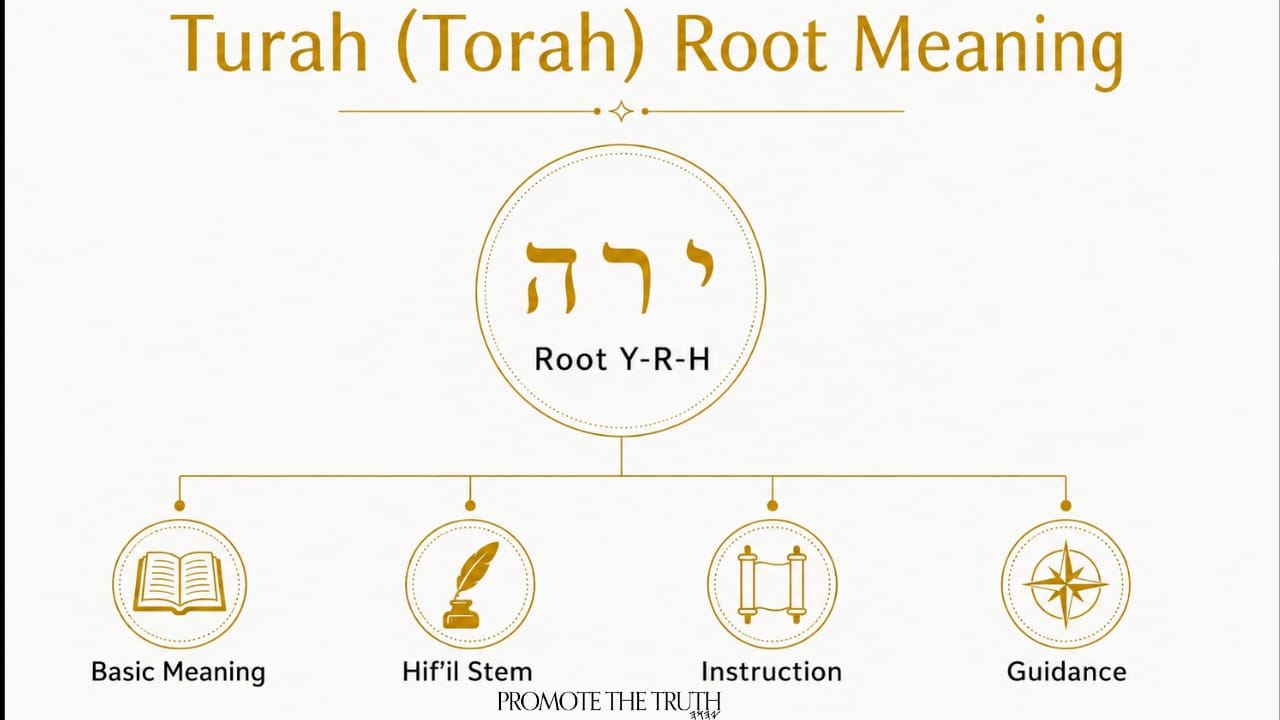
The lexical tradition associated with scholars such as Wilhelm Gesenius and the Brown-Driver-Briggs Hebrew and English Lexicon (BDB) grounds this analysis in centuries of philological work. The BDB entry for torah lists “direction, instruction, law” in that order, with “direction” and “instruction” appearing first. That ordering is deliberate: it reflects the root’s primary sense before the word’s later institutional associations.
How the Abariy Scriptures (Hebrew Bible) actually uses the word “Turah (torah)”
The Abariy Scriptures (Hebrew Bible) does not use Turah (Torah) as a single, fixed technical term. It appears across genres and contexts with noticeably different scopes, and reading those contexts carefully is the best way to feel the word’s flexibility.
Ritual prescription. In Uiyqara (Leviticus), Turah (Torah) frequently introduces specific procedural instructions for offerings. Uiyqara (Leviticus) 6:9 Abariy (Hebrew) numbering opens with the phrase zot turat ah-alat, “this is the instruction for the burnt offering.” Here Turah (Torah) is narrow and practical: it names a set of ritual steps, not a comprehensive legal corpus.
Parental and wisdom teaching. Mashaliym (Proverbs) uses Turah (Torah) in a domestic, pedagogical sense entirely removed from legal codes:
“My son, do not forget my turah, and let your heart keep my commandments.” (Mashaliym (Proverbs) 3:1, author’s translation from the Abariy (Hebrew))
The parallelism with “my commandments” is instructive. The poet treats Turah (Torah) as the parent’s personal instruction, wisdom passed from teacher to student, not a state-enforced statute.
Prophetic guidance. Yisha’aiyahu (Isaiah) 1:10 calls the people to “hear the turah of our Aluah,” placing Turah (Torah) in the mouth of a prophet as a moral summons. The word here carries the authority of Set-apart (divine) instruction without necessarily pointing to a written document.
Self-referential usage in Dabariym (Deuteronomy). Dabariym (Deuteronomy) 1:5 says Mashah (Moses) “began to explain this Turah (Torah) ,” and Dabariym (Deuteronomy) 31:9 records that Mashah (Moses) “wrote this Turah (Torah) .” These passages are among the earliest textual moments where Turah (Torah) begins to refer to a specific written body of teaching, a development that would eventually crystallize into the Turah (Pentateuchal) designation.
Semantic flexibility is the consistent finding across these examples. The Scriptural (biblical) textual evidence does not support a single, purely legal reading. A single instruction, a parent’s wisdom, a prophetic summons, and a written collection can all be Turah (Torah) because the root concept is guidance itself, not the institutional form that guidance takes.
How “Turah (torah)” came to designate the first five books
The shift from Turah (Torah) as a general term for instruction to Turah (Torah) as the proper name for Barashiyt (Genesis) through Dabariym (Deuteronomy) was gradual. It unfolded across several centuries and involved specific social actors working under specific historical pressures.
-
Late Iron Age (10th–7th centuries BCE). Oral and early written instructional traditions circulated among priests and prophets. Writing practices were formative during this period, and archaeological and linguistic evidence points to the late Iron Age as the era when Scriptural (biblical) literature first took written shape.
-
Parasiy (Persian) period (late 6th–5th centuries BCE). The phrase “Turah of Mashah (Torah of Moses) appears in Azara-Nahamiyahu (Ezra-Nehemiah) as a recognized, authoritative body of teaching. Historical-linguistic evidence places the crystallization of the Turah (Pentateuch) as “Turah of Mashah (Torah of Moses) firmly in this Parasiy-yuuniy (Persian-Hellenistic) window. Scribes, priests, and community leaders needed a stable textual identity after the Babaliy (Babylonian) exile, and the written Turah (Torah) served that need.
-
yuuniy (Hellenistic) period (4th–2nd centuries BCE). The Yuuniy (Greek) translation of the Abariy Scriptures (Hebrew Bible) aka Septuagint translation project in Alakasanadariyah (Alexandria) rendered the five books into Yuuniy (Greek), cementing their status as a defined collection. The term Pentateuch (from Yuuniy (Greek) penta, five, and teuchos, scroll) entered scholarly usage here.
-
Second Ahiykal (Temple) period (5th century BCE–70 CE). Second Ahiykal (Temple) texts such as Yubal (Jubilees) and the Ahiykal (Temple) Scroll present themselves as additional or expanded Turah (Torah) , claiming Siyniy (Sinaitic) authority. This reflects a fluid understanding: Turah (Torah) was not yet a closed canon in every community’s eyes.
-
Post-70 CE yahudiym teachery (rabbinic) consolidation. After the destruction of the Second Ahiykal (Temple), yahudiym teachery (rabbinic) systematized the distinction between Written Turah (the Pentateuch) and Oral Turah (the Mishnah, Talmud, and Midrash). This dual-Turah framework became the foundation of yahudiym teachery (rabbinic) Yahudiym, followers of the Creator (Judaism).
The social actors driving this process were not a single institution. Scribes and priests each played evolving roles in producing, copying, and teaching Turah (Torah) across these periods. Canon formation was a communal, contested, and centuries-long process.
What Turah (Torah) actually did in ancient Yisharaliy (Israelite) society
Understanding the ancient Abariy (Hebrew) concept of Turah (Torah) means seeing it as a living social practice, not a static document. In ancient Yisharal (Israel), Turah (Torah) functioned across at least three distinct institutional settings.

Education and internalization. Ancient Near Eastern educational systems, including Yisharal’s (Israel’s), measured success by behavioral integration rather than abstract knowledge. The goal was “writing on the heart,” a metaphor that appears in Yiramiyahu (Jeremiah) 31:33 and reflects a pedagogical tradition where teachers transmitted instructions to students who were expected to embody them. Memorization, recitation, and practice were the methods. A student who could recite Turah (Torah) but not live by it had, in the ancient view, not yet learned it.
Priestly, prophetic, and sage roles. Turah (Torah) was not the exclusive property of any one group. Priests gave Turah (Torah) in the form of ritual rulings in Hagiy (Haggai) 2:11 shows priests being consulted for a Turah (Torah) decision. Prophets delivered Turah (Torah) as moral summons. Sages transmitted Turah (Torah) as wisdom for daily life, as seen throughout Mashaliym (Proverbs). The role of prophets in this instructional ecosystem was substantial: they held the community accountable to the covenant by invoking Turah (Torah) as a standard.
Covenant identity and communal ritual. Turah (Torah) undergirded Yisharal’s (Israel’s) covenant identity at public festivals. Dabariym (Deuteronomy) 31:10–13 prescribes a public reading of the Turah (Torah) every seven years at the Festival of Yum Sakut (Booths), a practice that tied communal identity to regular, collective hearing of instruction. The festival context of Yum Shabua’aut (Shavuot) similarly connected the giving of Turah to communal celebration and renewal.
The table below shows how Turah (Torah) functioned across these contexts:
| Context | Role of Turah (Torah) | Key agents |
|---|---|---|
| Ritual instruction | Procedural guidance for offerings and purity | Priests |
| Moral teaching | Ethical summons and covenant accountability | Prophets, sages |
| Legal regulation | Community norms and dispute resolution | Elders, scribes |
| Wisdom education | Parental and scribal instruction for daily life | Sages, parents |
| Covenant renewal | Public reading to reinforce communal identity | Levites, community assembly |
A brief comparison with neighboring cultures is worth noting. Aram Nahriy (Mesopotamian) ummânu (expert scribes) and Matsariy (Egyptian) sebayit (wisdom instruction texts) show that the ancient Near East broadly valued formalized instruction traditions. What distinguished Yisharaliy (Israelite) Turah (Torah) was its grounding in covenant relationship: the instruction was not merely practical wisdom but the terms of a living bond between YAHUAH and His people.
Why modern readers often misread “Turah (torah)” as simply “law”
The “Turah (Torah) equals law” reading has a specific historical origin. It is not a natural reading of the Abariy (Hebrew); it is the product of a translation decision made in Aram Nahriy (Alexandria) roughly 2,200 years ago.
When Yahudiym, followers of the Creator (Jews) scholars translated the Abariy (Hebrew) scriptures into Yuuniy (Greek) (the Septuagint, abbreviated LXX, roughly 3rd–2nd centuries BCE), they rendered Turah (Torah) with the Yuuniy (Greek) word nomos. In classical Yuuniy (Greek), nomos primarily means “norm,” “custom,” or “standard,” and it carried strong legal connotations in Yuuniy (Hellenistic) civic culture. The Yuuniy (Greek) translation of the Abariy Scriptures (Hebrew Bible) aka Septuagint’s translation choice pushed the semantic center of Turah (Torah) toward the legal end of its range and away from its instructional and pedagogic core.
Yuuniy (Greek) and Latin Scriptures (Bibles) then carried nomos into Latin as lex (“law”), and English translations inherited that trajectory. The result: generations of readers encountered “the Law of Mashah (Moses)” where the Abariy (Hebrew) said “the Turah (Torah) of Mashah (Moses),” a phrase that carries warmth, guidance, and relational authority rather than cold legal obligation.
The contrast is worth seeing directly:
-
Abariy (Hebrew) Turah (Torah) : instruction, guidance, direction, teaching (from Y-R-H, to point/guide)
-
Yuuniy (Greek) nomos: norm, standard, law, custom (civic and legal connotations)
-
English “law”: statute, legal code, enforceable rule (primarily juridical)
Each step in that chain narrows the meaning. By the time “law” reaches an English reader, the pedagogical warmth of the original Abariy (Hebrew) has largely evaporated. This is why understanding how translation choices affect theological meaning is so important for anyone studying the original text.
-
The narrowing was not malicious. The Yuuniy (Greek) translation of the Abariy Scriptures (Hebrew Bible) aka Septuagint translators were working in a Yuuniy (Hellenistic) context where nomos was the closest available term.
-
Later Yahudiym, followers of the Savior (Christian) theological debates about “law versus compassion (grace)” further entrenched the legal reading, making it harder to recover the instructional sense.
-
Modern capitalization conventions (capital T Turah (Torah) vs. lowercase t turah(torah) are a recent scholarly tool to distinguish the Pentateuchal title from the general noun, but they do not appear in ancient manuscripts.
Pro Tip: When evaluating a Scriptures (Bible) translation’s handling of Turah (Torah) , check the footnotes on key passages Dabariym (Deuteronomy) 1:5, Mashaliym (Proverbs) 3:1, Yisha’aiyahu (Isaiah) 1:10. A translation that renders all three with “law” is collapsing a rich semantic range into a single juridical gloss. Translations that use “instruction” or “teaching” in at least some contexts are tracking the Abariy (Hebrew) more faithfully.
How scholars reconstruct the ancient sense of turah (torah) from manuscripts
The claim that Turah (Torah) primarily meant “instruction” is not speculation. It rests on converging lines of manuscript evidence and scholarly method.
Principal manuscript witnesses
| Manuscript witness | Date range | Significance for Turah (Torah) |
|---|---|---|
| Yahudiym scholarly (Masoretic) Text (MT) | Standardized ~7th–10th century CE; reflects earlier tradition | Primary Abariy (Hebrew) text; preserves vocalization Turah (Torah) and full range of usages |
| Dead Sea Scrolls (DSS) | — | Earliest Abariy (Hebrew) manuscripts; confirm MT consonantal text; show Second Ahiykal (Temple) usage |
| Yuuniy (Greek) translation of the Abariy Scriptures (Hebrew Bible) aka Septuagint (LXX) | ~3rd–2nd century BCE | Yuuniy (Greek) translation; documents the nomos rendering and its interpretive consequences |
| Ahiykal (Temple) Scroll | ~2nd century BCE | Presents itself as Set-apart (divine) Turah (Torah) ; shows expanded Turah (Torah) concept |
| Yubal (Jubilees) | ~2nd century BCE | Claims Sinaitic authority; reflects fluid Turah (Torah) boundaries in Second Ahiykal (Temple) communities |
The Yisha'aiyahu (Isaiah) Dead Sea Scrolls are among the most significant manuscript witnesses for understanding how Second Ahiykal (Temple) communities read and copied the scriptural text. Their near-perfect alignment with the later Yahudiym scholarly (Masoretic) Text strengthens confidence in the transmission of the consonantal Abariy (Hebrew).
Methods scholars use
-
Comparative philology. Scholars compare Y-R-H cognates across Semitic languages (Ugaritic, Aramiyt (Aramaic), Arabic) to establish the root’s core semantic field before any single language’s usage can skew the picture.
-
Semantic field analysis. Mapping every occurrence of Turah (Torah) in the Abariy Scriptures (Hebrew Bible) alongside its synonyms (mitzvah, commandment; Mashapat (mishpat), judgment; huqqah, statute) reveals where Turah (Torah) overlaps with legal terms and where it stands apart.
-
Contextual exegesis. Reading each occurrence in its literary and social context tests whether “instruction” or “law” better fits the passage. Mashaliym (Proverbs) 3:1 is a clear case where “law” is a poor fit; Dabariym (Deuteronomy) 17:18 is a case where legal connotations are stronger.
-
Transmission history. Tracing how scribes, translators, and communities handled the word across centuries reveals when and why interpretive shifts occurred. The manuscript transmission history of the Abariy Scriptures (Hebrew Bible) is itself evidence about how communities understood Turah (Torah).
-
Archaeological context. Inscriptions, administrative texts, and material culture from Iron Age Israel help date writing practices and identify the social settings in which Turah (Torah) was produced and used.
Where evidence is strong: The root etymology, the hif’il causative sense, and the non-legal usages in Mashaliym (Proverbs) and prophetic literature are well-attested and broadly agreed upon across the philological tradition.
Where reconstruction is more tentative: The precise timeline of when specific communities began treating the Pentateuch as a closed, authoritative Turah (Torah) involves inference from limited textual evidence, and scholarly debate continues about the Parasiy (Persian)-period details.
Key Takeaways
The ancient Abariy (Hebrew) word Turah (Torah) (תּוֹרָה) meant “instruction” or “guidance” before it ever named a book, and recovering that original sense changes how you read the entire scriptural tradition.
| Point | Details |
|---|---|
| Root meaning is “instruction” | Turah (Torah) derives from Y-R-H (hif’il: to guide/teach), not from a word meaning legal statute. |
| Semantic range is wide | One word covers a single ritual rule, parental wisdom, prophetic summons, and a full body of teaching. |
| Pentateuchal title came later | The designation of Barashiyt (Genesis)–Dabariym (Deuteronomy) as “Turah (Torah)” crystallized in the Parasiy-Yuuniy (Persian–Hellenistic) period, not at Siyniy (Sinai). |
| Yuuniy (Greek) translation of the Abariy Scriptures (Hebrew Bible) aka Septuagint narrowed the meaning | Rendering Turah (Torah) as Yuuniy (Greek) nomos shifted later readers toward a legal reading that the Abariy (Hebrew) does not require. |
| Promote The Truth resources | Promote The Truth offers manuscript-grounded study resources for readers who want to explore the original Abariy (Hebrew) text directly. |
The meaning that centuries of translation nearly buried
The most consequential thing the “Turah (Torah) equals law” reading has done is flatten a relational, pedagogical concept into a juridical one. When ancient Yisharaliym (Israelites) heard Turah (Torah), they heard the voice of a teacher pointing the way, not the cold text of a statute. The covenant framing of Dabariym (Deuteronomy), the parental warmth of Mashaliym (Proverbs), the prophetic urgency of Yisha'aiyahu (Isaiah): all of these are Turah (Torah) moments, and none of them feel primarily like law when you read them in Abariy (Hebrew).
What strikes me most, having worked through the linguistic and manuscript evidence, is how much the original sense of Turah (Torah) aligns with what Promote The Truth is doing: restoring the instructional, living quality of the text rather than treating it as a historical artifact. The ancient scribes and sages who transmitted Turah (Torah) were not archivists. They were teachers who believed the text had something to say to the people sitting in front of them. That conviction is worth recovering.
For readers who want to go deeper, the most productive next steps are: work through the lexical entry for Turah (Torah) in a standard reference such as the Brown-Driver-Briggs lexicon, read the Bible Odyssey article on the Pentateuch for historical context, and then sit with Mashaliym (Proverbs) 3:1–6 in a translation that renders Turah (Torah) as “instruction” rather than “law.” The difference in how the passage feels is immediate and clarifying.
Deepen your study with Promote The Truth
Promote The Truth exists precisely for readers who have arrived at this question: what did the original text actually say, and what did it mean to the people who first heard it? The organization’s resources go beyond surface-level explanation to engage the Abariy (Hebrew) and Aramiyt (Aramaic) manuscript sources directly.
The Scripture Study Series offers guided video lessons that walk through key terms, textual traditions, and the historical context of the Ta’anak, making manuscript-level study accessible without requiring a seminary degree. For readers who want structured, progressive learning, the digital video academy provides courses on Scriptures, language, and translation grounded in the same philological approach this article has outlined. The Truth Scriptures digital collection gives you a restored English translation drawn from ancient Abariy (Hebrew) and Aramiyt (Aramaic) sources, so you can read Turah (Torah) in a rendering that honors its instructional depth rather than collapsing it into “law.”
Start with the Scripture Study Series and let the text speak in its own voice.
Useful sources for further study
-
The Torah — the Pentateuch (Bible Odyssey) — A concise, scholarly-accessible article covering the etymology of torah, its historical development into a Pentateuchal title, and the Septuagint’s role in shaping the “law” reading. One of the clearest short treatments available online.
-
What Does “Torah” Mean? (MyJewishLearning) — A reader-friendly overview of the word’s semantic flexibility, including the modern capitalization convention and the range of senses from a single directive to the whole of Jewish teaching.
-
Torah (Britannica) — Encyclopedic summary defining torah as divine teaching and acknowledging both the Pentateuchal and broader usages. Useful as a quick authoritative reference.
-
Torah on the Heart: Literary Jewish Textuality Within Its Ancient Near Eastern Context (Oral Tradition journal) — A scholarly article examining the oral-pedagogic tradition behind torah, including the “writing on the heart” metaphor and how ancient Near Eastern educational systems shaped Israelite instructional practice.
-
What Is “Torah” in Second Temple Texts? (TheTorah.com) — Examines how Second Temple communities (Jubilees, Temple Scroll) used and expanded the concept of torah beyond the Pentateuch, demonstrating the fluid boundaries of the term in antiquity.
-
The Torah and Its Transmission in Ancient Judaism (Posen Library) — A guide to the social and institutional history of torah transmission, covering scribal practices, the oral-written distinction, and the emergence of rabbinic Torah study.
-
Torah (Jewish Encyclopedia) — A classic reference work presenting the priestly and rabbinic traditions around torah, including the portrayal of Moses as the founding teacher of an instructional tradition rather than merely the author of a legal text.
-
How the Bible Became a Book (Cambridge University Press) — A scholarly monograph combining archaeological evidence with the history of writing to explain how biblical literature, including the Torah, first took written form in the late Iron Age. Essential for understanding the textualization process.
-
Torah vs. Bible: What’s the Difference? (Bart Ehrman) — A clear explainer distinguishing Torah from the wider Hebrew Bible (Tanakh), useful for readers who want to understand where the Pentateuch sits within the larger scriptural corpus.
-
Original Scriptures (Promote The Truth) — Promote The Truth’s own resource on manuscript evidence and the restoration of the original scriptural text, grounded in the same Abariy (Hebrew) and Aramiyt (Aramaic) manuscript tradition discussed throughout this article.