
Reliable Scripture study resources are trusted Scripture (Bible) translations, concordances, dictionaries, commentaries, and digital tools that provide historical, linguistic, and theological insights into the ancient text. Finding the right combination of these resources is the difference between surface-level reading and a genuine understanding of Scripture. Resources such as the Oxford Annotated Bible, Blue Letter Bible, and Logos software each serve a distinct purpose in that process. The goal is not to collect every tool available, but to select resources that work together to reveal the original intent of the text.
How to Find Reliable Scripture Study Resources
The foundation of any solid study library starts with at least two reliable Scripture (Bible) translations. Comparing multiple translations is critical to avoiding the biases present in any single translation process. A formal equivalence translation, such as the NASB or KJV, preserves a more literal word order, while a functional equivalence translation, such as the NLT, prioritizes readability. Using both together reveals where translators made interpretive choices, and that gap is often where the most significant meaning resides.
Beyond translations, a concordance and a Scripture (Bible) dictionary are non-negotiable tools. A concordance lets you trace a single word through every occurrence in Scripture, which is the fastest way to build an accurate picture of how a term is used. A Scripture (Bible) dictionary supplies cultural, historical, and geographical context that the text itself does not explain. Together, these two tools answer questions that a translation alone cannot.
One-volume commentaries and cross-reference systems round out the core library. Commentaries written by scholars with verifiable credentials give you access to decades of research in a single volume. Cross-references connect thematically related passages across both the Ta’anak (Old Testament) and the Bariyt Hadash (New Testament), which helps prevent the common error of reading a verse in isolation.

| Tool | Primary Function |
|---|---|
| Scriptures (Bible) translation (x2+) | Reveals literal meaning and readability side by side |
| Concordance | Traces word usage across the full text |
| Scriptures (Bible) dictionary | Supplies cultural and historical context |
| One-volume commentary | Provides scholarly interpretation and background |
| Cross-reference system | Links related passages across both Testaments |
Pro Tip: Read the same passage in the NASB and the NLT before consulting any commentary. The differences between the two versions will tell you exactly which words and phrases need deeper investigation.
What Structured Study Methods Actually Work?
Structured study methods produce more growth than passive reading. The two most recommended approaches for beginners and intermediate students are the Inductive Method and the HEAR Method. Both require minimal tools and are designed for daily 20 to 30 minute sessions.
The Inductive Method follows three steps:
-
Observation — Read the passage carefully and ask, “What does it say?” Record every detail without interpretation.
-
Interpretation — Ask, “What does it mean?” Use your concordance, dictionary, and commentary to answer that question with evidence.
-
Application — Ask, “What does this mean for me?” Write a concrete, specific response, not a general sentiment.
The HEAR Method takes a slightly different angle:
-
Highlight a verse that stands out during your reading.
-
Explain what the verse means in its original context.
-
Apply the verse to a current situation in your life.
-
Respond in writing with a prayer or personal commitment.
A question-driven study session with a concrete application at the end is more effective than reading without a framework. The act of writing forces clarity. Readers who journal their observations retain more and catch more interpretive errors than those who read silently.
Pro Tip: Print a one-page template for either method and keep it inside your physical Scripture (Bible). Beginners who skip templates tend to drift into passive reading within two weeks.
Which Digital Platforms Offer the Best Scripture Study Tools?
Free digital platforms cover the needs of most serious students. Blue Letter Bible, Bible Hub, and Bible Gateway each offer multiple translations, commentaries, and search functions at no cost. Blue Letter Bible stands out because it includes interlinear Abariy (Hebrew) and Yuuniy (Greek) texts, Strong’s numbers, morphology data, and a wide range of commentaries in one place. That makes original-language study accessible to readers who have never formally studied Abariy (Hebrew) or Yuuniy (Greek).
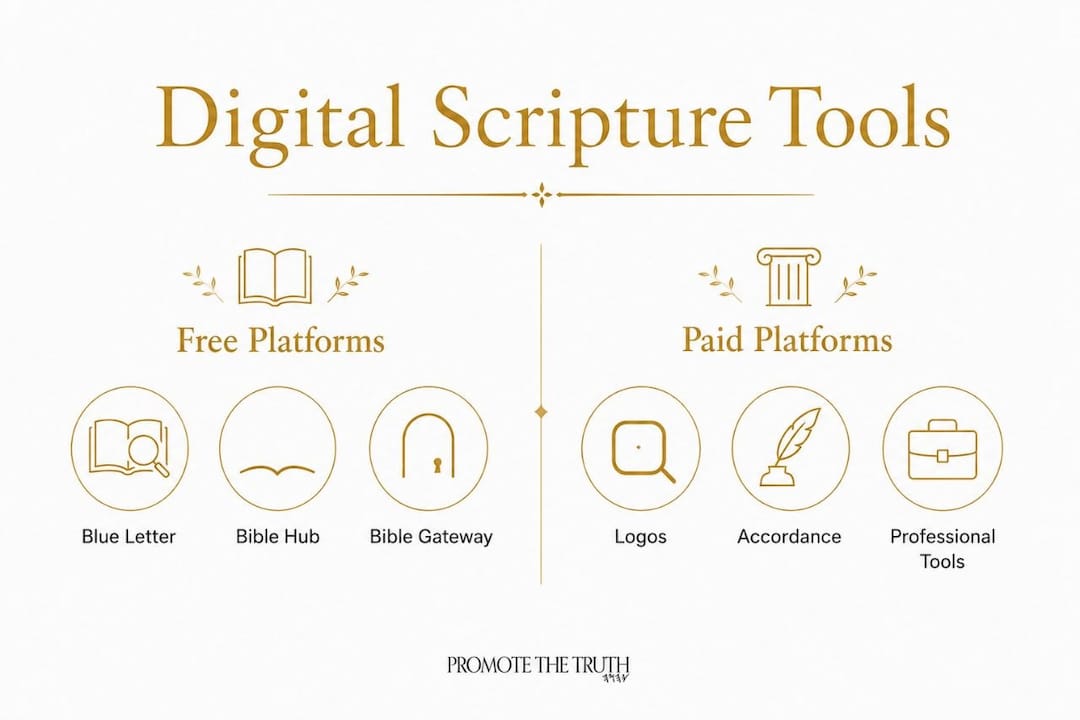
For readers who need professional-grade research tools, Logos and Accordance are the industry standards. Logos offers a free basic version as a starting point, while Accordance is favored by academic institutions for its depth of original-language resources. The Olive Tree app offers subscriptions starting at approximately $5.99 per month, which is a practical middle ground between free platforms and full desktop software.
| Platform | Cost | Best For |
|---|---|---|
| Blue Letter Bible | Free | Original language tools, commentaries |
| Bible Hub | Free | Parallel translations, lexicons |
| Bible Gateway | Free | Quick translation comparison, audio |
| Logos Basic | Free | Entry-level professional research |
| Olive Tree | From ~$5.99/month | Mobile study with premium resources |
| Logos / Accordance | Paid (varies) | Advanced academic and pastoral research |
Pro Tip: Start with Blue Letter Bible for daily study and use Logos Basic for deeper word studies. Adding a paid subscription only makes sense once you have exhausted what the free tools offer.
Promote The Truth also provides a digital Scripture collection drawn from ancient Abariy (Hebrew) and Aramiyt (Aramaic) manuscript sources, which fills a gap that mainstream platforms do not address. For readers focused on the original Scriptural worldview and the significance of the Name YAHUAH, that resource offers a dimension of study that standard platforms do not include.
How Do You Evaluate the Reliability of a Scripture Resource?
Author and publisher credibility is the first filter to apply. A commentary written by a scholar with verifiable academic credentials and affiliation with a recognized theological institution carries more weight than an anonymous online resource. Publisher reputation matters equally. Academic presses and established theological publishers apply peer-review standards that self-published materials do not.
Reading tools from diverse theological traditions protects against one-sided interpretations. Rev. Ian M. Thomas emphasized this principle directly: A student who reads only within one tradition will mistake that tradition’s assumptions for the plain meaning of the text. Reading a Reformed commentary alongside an Anabaptist or Messianic commentary on the same passage reveals which conclusions are widely shared and which are tradition-specific.
Use this checklist when evaluating any new resource:
-
Does the author hold verifiable academic or theological credentials?
-
Does the publisher apply editorial or peer-review standards?
-
Does the resource cite primary sources, including original language texts?
-
Does it acknowledge alternative interpretations rather than dismissing them?
-
Have you cross-checked its conclusions against at least two other commentaries?
AI-assisted study tools can support learning, but they must provide transparent citations grounded in historical scholarship. Any AI tool that generates interpretations without citing Church Fathers, established commentators, or manuscript sources should be treated with caution. Verify AI-generated outputs against trusted resources before accepting them as reliable.
How to Integrate Resources for Deep Historical and Contextual Insight
Combining a physical study Scripture (Bible) with digital tools produces better results than using either alone. Physical study Scriptures (Bibles) encourage slower, more deliberate reading that digital scrolling does not replicate. The structural overview provided by a printed study Scripture (Bible), including book introductions, outlines, and section headings, grounds you in the text before you open any digital tool.
Historical-context reading is the next layer. The Ta’anak (Old Testament) and the Bariyt Hadash (New Testament) each require different background knowledge. Understanding the Ta’anak (Old Testament) historical context means knowing the political and cultural world of ancient Yisharal (Israel), Babal (Babylon), and Paras (Persia). Bariyt Hadash (New Testament) context requires familiarity with Second Ahiykal (Temple) Yahudiym (Judaism), Rumaiy (Roman) governance, and the Yuuniy (Greek)-speaking diaspora.
Practical steps for integrated study:
-
Read the passage in your physical Scripture (Bible) first, noting structural markers and section headings.
-
Open Blue Letter Bible to check the Abariy (Hebrew) or Yuuniy (Greek) behind key terms using Strong’s numbers.
-
Consult one commentary for historical background and a second for theological interpretation.
-
Review translation history and implications when a passage’s meaning seems disputed.
-
Record your findings in a study journal before moving to application.
Study Scripture (Bible) introductions and outlines are the best starting point for any new book of Scripture. They supply the historical and cultural framework that makes the rest of your study coherent. Skipping them is the single most common mistake among readers who feel stuck in their understanding.
Key Takeaways
The most effective way to study Scripture is to combine at least two reliable translations, structured methods like the Inductive or HEAR approach, and both free and professional digital tools for original-language and historical research.
| Point | Details |
|---|---|
| Use multiple translations | Compare formal and functional equivalence versions to expose interpretive choices. |
| Apply a structured method | The Inductive or HEAR method turns passive reading into active, documented study. |
| Start with free digital tools | Blue Letter Bible and Bible Hub cover most needs before any paid subscription is needed. |
| Evaluate every resource | Check author credentials, publisher standards, and cross-reference conclusions. |
| Combine physical and digital | Physical Bibles slow your reading; digital tools deepen your word and language research. |
Why I Stopped Trusting Any Single Resource
I spent years relying on one trusted commentary and one translation. My study felt solid until I started comparing notes with readers from different theological backgrounds. What I had taken as the plain meaning of several passages turned out to be one tradition’s reading, not the only defensible one. That realization changed how I approach every resource I pick up.
The most honest thing I can say about finding trustworthy Scriptural (biblical) study aids is this: No single tool tells the whole story. The NASB gives you precision. The NLT gives you flow. Blue Letter Bible gives you the Abariy (Hebrew) and Yuuniy (Greek) behind both. A commentary from a scholar outside your tradition gives you the questions you never thought to ask. The combination is what produces real understanding.
I also think the field underestimates how much the original language matters, even for non-scholars. You do not need to be fluent in Abariy (Hebrew) or Aramiyt (Aramaic) to benefit from an interlinear text. Seeing the actual root of a word and how it is used across the Ta’anak (Old Testament) changes your reading in ways that no English translation can replicate. Promote The Truth’s work on the Truth Scriptures, translated from ancient Abariy (Hebrew) and Aramiyt (Aramaic) manuscript sources, reflects exactly that commitment to the original text. That kind of resource belongs in any serious study library.
Systematic study beats devotional browsing every time. A personal connection with Scripture deepens when you bring questions to the text, not just comfort-seeking. The readers I have seen grow the fastest are the ones who treat the Scriptures as a document worth investigating, not merely a source of daily encouragement.
— Maria
Deepen Your Study with Promote The Truth
Promote The Truth is an international educational and media organization dedicated to restoring and teaching the original message of the Scriptures. Its resources go beyond mainstream platforms by drawing directly from ancient Abariy (Hebrew) and Aramiyt (Aramaic) manuscript sources.

The Scripture Study Series video channel teaches inductive and contextual study methods through structured video lessons. The original scriptures digital collection provides access to meticulously translated texts of the Ta’anak and Bariyt Hadash. For those ready to go deeper, the PTT YAHUAH digital video courses cover Scripture topics, prophecy, and the significance of the Name YAHUAH in a structured learning format. These resources are designed for readers who want scholarly depth alongside sincere faith.
FAQ
What are The Most Reliable Bible Study Tools for Beginners?
Essential tools for beginners include at least two Scripture (Bible) translations, a concordance, a Scripture (Bible) dictionary, and a one-volume commentary. Free platforms such as Blue Letter Bible and Bible Gateway provide all of these at no cost.
How Do I Study the Bible Effectively Every Day?
A structured 20- to 30-minute study session using the Inductive or HEAR method is more effective than unstructured reading. Writing down observations and a concrete application at the end of each session produces the most consistent growth.
Are Free Digital Scripture Study Platforms Trustworthy?
Blue Letter Bible, Bible Hub, and Bible Gateway are widely trusted and draw from established manuscript traditions and scholarly commentaries. Always cross-check conclusions from any single platform against a second source.
Why Does Translation Choice Matter So Much?
Every translation reflects interpretive decisions made by its translators. Combining formal-equivalence and functional-equivalence translations exposes those decisions and gives you a fuller picture of the original text’s meaning.
What makes Promote The Truth’s resources Different From Mainstream Platforms?
Promote The Truth translates directly from ancient Abariy (Hebrew) and Aramiyt (Aramaic) manuscript sources, including the Abariy (Hebrew) and Aramiyt (Aramaic) origins of the Bariyt Hadash (New Testament). This focus on original-language manuscripts offers a layer of textual depth that most mainstream English-language platforms do not provide.