
Verse by verse study is defined as a systematic method of examining Scripture one verse at a time, prioritizing depth of understanding over speed of reading. This approach, also called exegetical or analytical Scriptures (Bible) study, moves you from passive reading to active discovery. Rather than skimming chapters for general impressions, you slow down to observe what the text actually says, interpret its original meaning, and apply it to your life. Tools like lexicons, cross-reference Scriptures (Bible), and structured journals support this process at every stage.
What is verse by verse study and why does it matter?
Verse-by-verse study is a structured, systematic approach that examines Scripture slowly, one line at a time, emphasizing historical, theological, and contextual analysis rather than quick reading. It replaces brief devotionals with longer, thorough sessions that cover entire books of the Scriptures (Bible) in detail. That shift from quantity to quality is what makes this method so effective for genuine comprehension.
Many readers finish chapters without truly understanding what they read. Pastors Stephen Armstrong and Paul LeBoutillier emphasize that verse study combats information overload and highlights Scripture’s unified narrative. The method treats the Scriptures (Bible) not as a collection of isolated quotes but as one interconnected message with structure, logic, and authorial intent.

The method is also accessible to non-experts. Verse-by-verse study relies on direct observation and questions rather than external expert interpretations. You do not need a seminary degree to begin. You need patience, a reliable translation, and a willingness to ask hard questions of the text.
How does the step by step verse study process work?
The standard method follows five clear steps. Each step builds on the previous one, creating a complete picture of what a verse means and how it applies to your life.
-
Write a personal paraphrase. Restate the verse in your own words without looking at a commentary. This forces you to engage with the text directly and reveals immediately what you do and do not understand.
-
Ask the six Ws. Apply Who, What, When, Where, Why, and How to every verse. Maintaining a questioning mindset using these six questions prevents personal bias and helps you discover the author’s original intent.
-
Find cross-references. Locate other verses that use the same language or address the same theme. Cross-references show how Scripture interprets itself and prevent you from reading one verse in isolation.
-
Analyze keywords and theological terms. Look up key words in a lexicon to find their original Abariy (Hebrew) or Aramiyt (Aramaic) meaning. This step often unlocks layers of meaning invisible in English translation alone.
-
Record personal application. Write down one or two ways the verse speaks to your current life. Keep this focused and honest.
Organizing these steps works best with a structured format. A multi-column journal or chart gives each step its own column, so your observations, questions, cross-references, and applications stay organized and easy to review later. Digital apps and spreadsheets work equally well if you prefer a screen to paper.
-
Use a dedicated notebook or journal for each book of the Scriptures (Bible) you study.
-
Color code observations, interpretations, and applications with different ink colors.
-
Date each entry so you can track how your understanding grows over time.
How does verse by verse study compare to other Scriptures (Bible) study methods?
Verse-by-verse study is not the only way to engage Scripture, but it offers distinct advantages over topical and thematic approaches. Understanding the differences helps you choose the right method for your goal.
| Method | Focus | Strength | Best used for |
|---|---|---|---|
| Verse by verse | Individual verse detail | Deep accuracy and context | Thorough book study |
| Topical study | A single theme across books | Broad overview of a concept | Understanding doctrine |
| Chapter study | One chapter at a time | Narrative flow and structure | Story-driven books |
| Thematic study | Recurring themes across Scripture | Seeing patterns and unity | Comparative analysis |
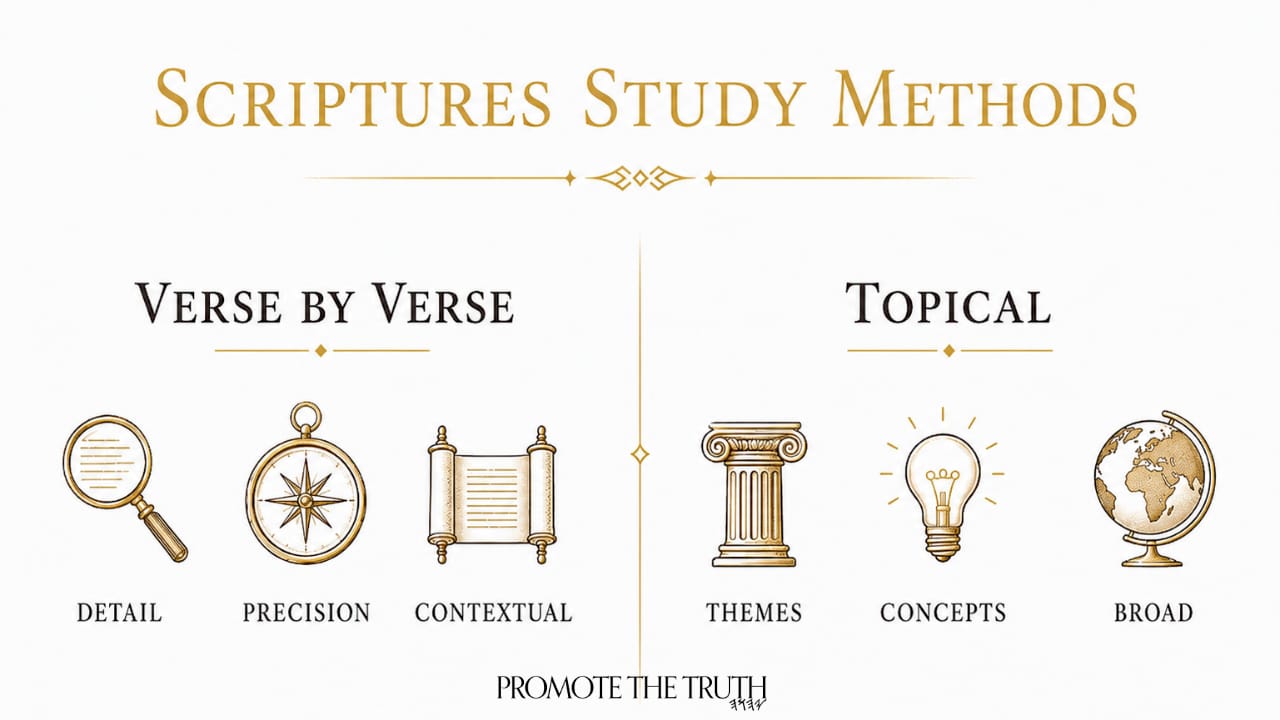
Verse-by-verse study excels at precise interpretation and avoiding misapplication. When you examine every verse in sequence, you cannot skip the difficult passages or cherry-pick verses that confirm what you already believe. That discipline produces more accurate and honest understanding.
Topical study, by contrast, pulls verses from multiple books to build a picture of a single concept. That approach is useful for understanding a doctrine like forgiveness or covenant, but it carries a real risk. Verses removed from their original context can be misread. Verse-by-verse study and topical study work best together, with verse-by-verse providing the accurate foundation that topical study draws from.
What tools and resources support effective verse analysis techniques?
The right tools make verse-by-verse study faster, deeper, and more sustainable. You do not need an expensive library. A focused set of reliable resources covers most needs.
-
A trusted translation. Choose a translation that prioritizes accuracy to the original manuscripts. Promote The Truth publishes the Truth Scriptures, a comprehensive English restoration translated from ancient Abariy (Hebrew) and Aramiyt (Aramaic) sources, which makes it especially suited for verse-level analysis.
-
A lexicon. Strong’s Concordance and the Brown-Driver-Briggs Abariy (Hebrew) Lexicon give you access to original language definitions without requiring fluency in Abariy (Hebrew) or Aramiyt (Aramaic).
-
Cross-reference Scriptures (Bible). A Scriptures (Bible) with margin cross-references lets you trace themes and language across books without a separate concordance.
-
A study journal. Verse mapping includes isolating key words, looking up original language definitions, identifying cross-references, and summarizing the verse’s meaning in a journal format. This visual approach improves retention and builds disciplined habits.
-
Commentaries. Experts recommend using trusted commentaries alongside verse study to grasp broader theological insights. Commentaries bridge individual verse insights to scriptural (biblical) scholarship without replacing personal discovery.
-
Video and audio resources. Promote The Truth’s Scripture study video channel provides organized lessons that complement your personal verse study with teaching from historical and manuscript perspectives.
Pro Tip: Before buying any commentary, read a sample entry on a passage you have already studied yourself. A good commentary confirms and deepens your findings. A poor one replaces your thinking with someone else’s.
What are common challenges in verse by verse Scriptures (Bible) study?
Verse-by-verse study is rewarding, but it comes with real obstacles. Knowing them in advance keeps you from quitting when the process feels slow or frustrating.
Losing context by isolating verses. The most common mistake is treating a single verse as a complete, standalone statement. Effective verse study requires reading entire books or passages multiple times first to grasp the flow, then slowing down for detailed analysis. Read the full chapter before you study any single verse in it.
Trying to apply every verse exhaustively. Many beginners try to create exhaustive applications for every verse, which leads to burnout. Experienced students recommend recording brief devotional thoughts for most verses and selecting only a few to develop fully. Depth on a few verses beats shallow notes on every verse.
Moving too fast. The method only works if you slow down. Rushing through five steps in two minutes produces surface-level notes that look thorough but are not. Give yourself permission to spend an entire session on one or two verses.
-
Read the full book in one sitting before starting verse-level work.
-
Set a realistic session goal: two to five verses per sitting is sustainable for most people.
-
Resist the urge to consult a commentary before writing your own paraphrase and questions.
-
Return to your notes after a week and add new observations. Understanding deepens with time.
Pro Tip: If you feel stuck on a verse, write down every question you have about it before looking anything up. Questions are the engine of this method. A verse that confuses you is a verse that will teach you the most.
How does verse study deepen spiritual growth and scriptural literacy?
Consistent verse-by-verse study trains your mind in scriptural (biblical) structure, authorial intent, and theological themes. That training produces a kind of scriptural literacy that general reading cannot build. You begin to recognize patterns, repeated phrases, and structural signals that reveal how the text was designed to be read.
Verse-by-verse study shifts focus from quantity of pages read to quality of understanding, enhancing recall and comprehension. It also mitigates the “firehose” effect of consuming too much information too quickly. When you slow down, the text becomes memorable rather than forgettable.
The method also builds confidence. You learn to read Scripture in historical context and to ask the right questions of any passage. Over time, you stop depending entirely on teachers or commentators to tell you what a verse means. You develop your own informed, grounded interpretation rooted in observation and evidence.
The deepest benefit is transformation. Verse-by-verse study moves readers from passive learners to active discoverers, recognizing structure and logical flow in Scripture. That active engagement changes how you read, how you think, and how you apply what you believe.
Key Takeaways
Verse-by-verse study is the most accurate method for understanding Scripture because it requires direct observation, contextual reading, and structured analysis before any application is drawn.
| Point | Details |
|---|---|
| Core definition | Verse-by-verse study examines Scripture one verse at a time for depth over speed. |
| Five-step method | Paraphrase, ask six Ws, cross-reference, analyze keywords, and record application. |
| Context is non-negotiable | Read the full book or passage before analyzing any single verse in isolation. |
| Avoid burnout | Develop full applications for only a few verses per session, not every verse. |
| Tools that help | Lexicons, cross-reference Scriptures (Bibles), study journals, and trusted commentaries support accuracy. |
Why we believe slow study is the most honest kind
The first time we committed to verse-by-verse study on a single chapter, we spent three sessions on five verses. That felt inefficient. Then we realized we had understood those five verses more deeply than entire books we had read quickly before.
What changed our practice most was accepting that confusion is not failure. When a verse resists easy understanding, that resistance is the text asking you to stay longer. The six-Ws questioning method gave us a structure to sit with difficulty rather than skip past it. We stopped treating hard verses as obstacles and started treating them as the most important ones.
The other shift was separating observation from interpretation. Most people jump straight to “what does this mean for me?” before they have honestly answered “what does this actually say?” That sequence matters more than any tool or resource. Get the observation right first. Everything else follows from that.
For anyone studying the original Abariy (Hebrew) and Aramiyt (Aramaic) texts, the rewards multiply. Words that English translations flatten into single terms carry multiple layers of meaning in the source language. Verse-by-verse study is the only method slow enough to catch those layers. That is not an academic exercise. It is the difference between hearing a message and understanding who sent it and why.
— Maria
Deepen your verse study with Promote The Truth
Verse-by-verse study is most rewarding when you have reliable resources built for serious students of Scripture. Promote The Truth provides exactly that.
The Scripture study video channel offers organized lessons drawn from historical and manuscript research, designed to complement your personal verse analysis. For students who want to go further, the digital video academy provides structured courses on scriptural (biblical) history, prophecy, and the original Scriptural worldview. Promote The Truth also publishes the Truth Scriptures, translated from ancient Abariy (Hebrew) and Aramiyt (Aramaic) sources, giving you direct access to the original scriptural texts your verse study deserves.
FAQ
What is verse by verse Scriptures (Bible) study?
Verse-by-verse Scriptures (Bible) study is a systematic method that examines Scripture one verse at a time, using observation, interpretation, and application to build deep, accurate understanding.
How many steps does the verse-by-verse method involve?
The standard method involves five steps: writing a personal paraphrase, asking the six Ws, finding cross-references, analyzing keywords in the original language, and recording personal application.
How is verse-by-verse study different from topical study?
Verse-by-verse study follows the sequential text of a book for contextual accuracy, while topical study pulls verses from across Scripture to explore a single theme or doctrine.
Can beginners use the verse-by-verse method?
Yes. The method relies on direct observation and structured questions rather than expert knowledge, making it accessible to anyone willing to read carefully and ask honest questions of the text.
How do you avoid losing context during verse analysis?
Read the entire book or passage multiple times before analyzing individual verses. Practitioners caution against treating verses as isolated statements; the bigger picture is what gives each verse its meaning.