
What Is a Topical Scripture (Bible) Study, and Why Does It Matter?
A topical Scripture (Bible) study is a method of studying Scripture by selecting a specific theme and tracing it through every relevant passage from Barashiyt (Genesis) to Hazun (Revelation). Instead of reading one book from beginning to end, you gather passages from multiple books, authors, genres, and historical periods to develop a comprehensive Scriptural (Biblical) understanding of a single topic. The goal is to see the whole counsel of Scripture, allowing Scripture to interpret Scripture rather than relying on a single passage in isolation.
This approach differs significantly from a word study or a book study. A word study follows a specific Abariy (Hebrew) or Yuuniy (Greek) word throughout Scripture to understand its meaning and usage. A book study, on the other hand, follows the author’s message from beginning to end. A topical study focuses on a single subject or theme, tracing how it is progressively revealed throughout Scripture—even when different words, expressions, or related concepts are used.
Key Elements of a Topical Scripture Study
-
A clearly defined theme or question that guides every passage you examine.
-
A cross-canonical approach, drawing from both the Ta’anak (Old Testament) and the Bariyt Hadash (New Testament).
-
Contextual reading of every passage within its literary, historical, and Scriptural setting.
-
Synthesis, combining all the evidence into a unified Scriptural (biblical) understanding of the topic.
Why Is a Topical Scripture (Bible) Study Worth Your Time?
A topical Scripture (Bible) study is especially valuable when you’re seeking answers to a specific life question or wanting to understand a Scriptural doctrine more completely. Whether you’re wrestling with anxiety, grief, forgiveness, faith, or another important topic, this method allows you to examine the entire Scriptural (biblical) witness on that subject rather than relying on only one or two familiar passages.
By gathering relevant verses from throughout Scripture, you gain a broader, more balanced understanding of what the Word of YAHUAH teaches. This approach helps you see how a theme unfolds progressively from Barashiyt (Genesis) to Hazun (Revelation), providing greater clarity, context, and confidence in your study.
Benefits of a Topical Scripture Study
-
A unified Scriptural message: Discover how YAHUAH’s teaching on a subject develops from the earliest writings to the latest.
-
Practical application: Apply Scriptural principles directly to the life questions or challenges that prompted your study.
-
Greater theological depth: Tracing a theme across different authors, literary genres, and historical settings reveals patterns and connections that a single passage cannot fully provide.
-
Flexible and versatile: This method is effective for studying doctrines, life situations, character studies, prophetic themes, and many other Scriptural topics.
A topical Scripture (Bible) study works best alongside—not as a replacement for—verse-by-verse Scripture study. Each method serves a distinct purpose, and together they provide a more complete understanding of the Word of YAHUAH. Many of the most diligent students of Scripture combine both approaches to gain greater accuracy, deeper insight, and a fuller understanding of the Scriptural message.
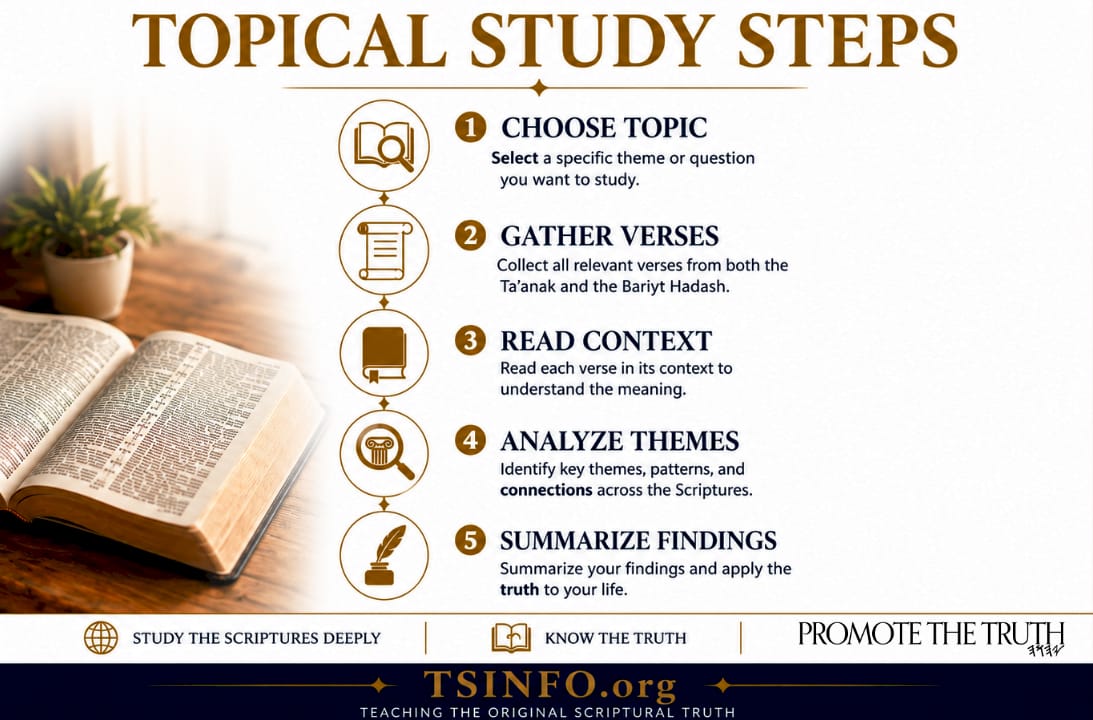
How to Conduct a Topical Scripture (Bible) Study: A Step-by-Step Guide
A topical Scripture (Bible) study follows a clear and systematic process. By using the steps below, you can move from a broad question to a well-grounded Scriptural (biblical) conclusion based on the full counsel of Scripture.
-
Define your topic and write a guiding question. Be specific. “What does Scripture teach about forgiveness toward enemies?” is far more workable than simply “forgiveness.”
-
Brainstorm keywords and related concepts. Think beyond the obvious word. For “peace,” also search for rest, stillness, trust, and Shalum (shalom). A topical study requires searching for synonyms and implied concepts, not just a single keyword.
-
Collect at least 20 relevant passages. Use a concordance, a topical Scripture (Bible), and cross-references to build your list. Cast a wide net before narrowing it.
-
Read every passage in its literary and historical context. This step protects you from misapplication. The surrounding chapter, the author’s purpose, and the original audience all shape what a verse actually teaches.
-
Narrow your list to 5–7 representative passages. Choose verses that answer your question most clearly, represent the diversity of perspectives in your list, and add balance to your understanding.
-
Synthesize your findings. Write a composite statement of what Scripture teaches about your topic. Note where themes converge, where tensions exist, and what the overall message is.
Pro Tips for Staying on Track
-
Write your guiding question at the top of your notes and return to it after each passage
-
Include passages that complicate or challenge your initial assumption, not only those that confirm it.
-
Note the genre of each passage (poetry, prophecy, epistle, or narrative), because genre shapes meaning.
Pro Tip: Start with passages you already know, then use cross-references to discover related verses you have never studied. This approach builds your list organically and often reveals the most illuminating connections.

Essential Tools for Topical Scriptures (Bible) Study
The right resources make the process far more thorough. Both print and digital options serve this purpose well.
-
Strong’s Exhaustive Concordance: Indexes every word in the King James Version with its original Abariy (Hebrew) or Yuuniy (Greek) root, allowing you to search by concept across the entire text.
-
NIV and NAS Concordances: Useful for readers working with modern English translations.
-
Nave’s Topical Scriptures (Bible): Organizes Scripture alphabetically by theme, with extensive lists of related verses. It is one of the most trusted print resources for this method.
-
Thompson Chain-Reference Scriptures (Bible): Links related passages through a numbered chain system printed in the margins, making it ideal for tracing themes while reading.
-
Blue Letter Scriptures (Bible) (blueletterbible.org): A free digital tool that combines concordance searches, original language lexicons, and cross-references in one place.
-
Scriptures (Bible) cross-references:Printed in the center column of most study Scriptures (Bibles), they provide a quick starting point for finding related passages.
-
Scriptures (Bible) dictionaries: Provide background information on terms, customs, and historical context, helping to clarify what a passage meant to its original audience.
Deepen your understanding of the Scriptures with trusted study resources from Promote The Truth. Built upon ancient Abariy (Hebrew) and Aramiyt (Aramaic) manuscript traditions, these resources are designed to help you explore the original languages and context of Scripture with greater accuracy and confidence. Whether you’re studying a specific topic, tracing key themes, or examining the text verse by verse, the Truth Scriptures translation and companion study materials provide valuable tools to help you grow in your understanding of the Word of YAHUAH. Start exploring these resources today and take your Scripture study to the next level.
Limitations and Cautions You Should Know
A topical Scripture (Bible) study carries real risks when practiced carelessly. One of the most common mistakes is taking verses out their literary and historical context, resulting in proof-texting rather than a genuine understanding of Scripture. A verse taken from a Tahliym (Psalm) of lament, for example, communicates something different from similar words found in a legal instruction or a prophetic oracle.
Be aware of these common pitfalls:
-
Confirmation bias: Selecting only passages that support a predetermined conclusion while ignoring those that introduce nuance or present a different perspective. A Balanced understanding of Scriptures requires intentionally considering passages that challenge your assumptions.
-
Overlooking figurative language: Poetry, wisdom literature, and prophecy often use metaphors, symbolism, and figures of speech that should not automatically be interpreted as literal doctrinal statements.
-
Incomplete passage analysis: Reading a single verse without considering its surrounding context can completely change—or even reverse—its intended meaning.
-
Over-reliance on topical study alone: A topical Scripture (Bible) study is most effective when used alongside verse-by-verse study, not as a replacement for it.
Always compare your conclusions with the full chapter and the broader context of Scripture. Reading the Word of YAHUAH within its historical, literary and Scriptural context is one of the most reliable safeguards against misunderstanding and misapplication.
What Scholars Say About Synthesis and Context in Topical Scripture (Bible) Study
The most challenging part of a topical Scripture (Bible) study is not collecting verses—it is moving from a list of passages to a genuine Scriptural (biblical) understanding of the topic. The final step, synthesis, is where careful study, sound interpretation, and spiritual insight come together to reveal the broader message of Scripture.
Best Practices for a Successful Topical Scripture Study
-
Recognize that Scriptural themes develop progressively throughout Scriptural (biblical) history. Earlier passages often lay the foundation, while later passages provide greater clarity and fulfillment.
-
Treat apparent tensions as opportunities for deeper study, not as contradictions to dismiss or explain away. Careful examination of context often reveals how passages complement one another.
-
Select your five to seven key passages carefully. Choose verses that represent the breadth and diversity of your findings, not simply the clearest or most familiar examples.
-
Keep your guiding question visible throughout the study. Your final synthesis should answer that specific question based on the whole witness of Scripture.
Pro Tip: Choose a topic based on a genuine question you or your community is facing. Topical Scripture (Bible) studies rooted in real-life questions often lead to deeper understanding, stronger application, and more meaningful engagement with the Word of YAHUAH.
Promote The Truth’s Scripture study video series demonstrates this approach by exploring Scriptural themes with careful attention to the original-language nuances of the ancient Abariy (Hebrew) and Aramiyt (Aramaic) texts, as well as the manuscript evidence behind them. Each study is designed to help you gain a deeper, more accurate understanding of the Word of YAHUAH through context-driven, verse-by-verse teaching.
Popular Topics for Topical Scriptures (Bible) Studies
Some subjects draw students back repeatedly because of their depth and practical significance. Strong starting points include:
-
Faith and trust in YAHUAH: Traces the theme from Abarahm’s (Abraham’s) covenant through the Tahliym (Psalms) to the epistles.
-
Prayer: Yahusha, who is YAHUAH’s (Jesus’s), teachings in the Bashurah (Gospels), the Tahliym (Psalms) as models of prayer, and Shaul’s (Paul’s) instructions together form a rich and comprehensive picture.
-
Forgiveness: Covers both set-apart (divine) forgiveness and the command to forgive others, with significant development across both Testaments.
-
The Name of YAHUAH: A study of profound manuscript significance, tracing how the Name appears, how it was suppressed, and how it is being restored.
-
Salvation and redemption: A foundational doctrinal topic that spans the entire canon.
-
Fear and anxiety: Immediately practical, with direct application to everyday life.
-
The Set-apart (Holy) Spirit: A theme that develops significantly from the Ta’anak to the Bariyt Hadash.
-
Marriage and covenant relationships: Draws from the Turah (Torah), Wisdom Literature, the Nabiyaiym (Prophets), and the epistles.
-
End times and prophecy: Requires careful contextual study because of the wide range of literary genres involved.
Common Challenges and How to Overcome Them
Every student of Scripture encounters the same obstacles when conducting a topical study. Knowing these challenges in advance makes them much easier to overcome.

Too many verses, not enough focus. Collect broadly at first, then narrow your list deliberately. Your final 5–7 passages should represent the full range of your topic, not just the most familiar verses. Depth in a few passages is better than shallow coverage of many.
Passages that seem to contradict each other. This is not a problem to solve by ignoring one side. Read both passages carefully in context, note the genre and audience, and let the tension inform your synthesis. Mature Scriptural (biblical) understanding embraces complexity without forcing a false resolution.
Difficulty knowing where to start. Write your guiding question before you open a concordance. A clear question gives every search direction and keeps your study from drifting into unrelated topics.
Losing track of findings across many passages. Use a simple two-column format: the passage reference on the left and a one-sentence summary of what it teaches on the right. By the time you reach the synthesis step, your notes will already be organized.
Key Takeaways
A topical Scripture (Bible) study traces a single theme throughout Scripture, and its value depends entirely on reading each passage in context before attempting synthesis.
| Point | Details |
|---|---|
| Core definition | A topical study gathers passages from across the entire Scriptures (Bible) on a single theme to build a unified understanding. |
| Essential process | Define a guiding question, collect 20+ passages, read each one in context, and then narrow your list to 5–7 passages for in-depth study. |
| Critical caution | Reading verses without their literary context leads to proof-texting rather than sound Scriptural (biblical) interpretation |
| Best tools | Strong’s Concordance, Nave’s Topical Scriptures (Bible), Thompson Chain-Reference Scriptures (Bible), and Blue Letter Scriptures (Bible) cover most study needs. |
| Complement, not replace | Topical study works best alongside verse-by-verse study, not as a substitute for it. |
Go Deeper with Promote The Truth

Promote The Truth is dedicated to restoring and teaching the original message of the Scriptures through careful study of ancient Abariy (Hebrew) and Aramiyt (Aramaic) manuscript sources. Whether you are beginning your first topical Scripture study or refining a method you have practiced for years, the Promote The Truth Scripture Study Video Series provides in-depth, context-driven teaching grounded in manuscript research and original-language study.
For those who want to study from a translation that seeks to preserve the original intent of the text, the Truth Scriptures project offers a carefully restored English rendering of both the Ta’anak and the Bariyt Hadash. These resources are designed to help serious students examine Scripture with greater accuracy, clarity, and confidence.
The eternal message of YAHUAH deserves to be studied with honor and diligence. Start your deeper Scripture study with Promote The Truth, and explore the Truth Scriptures resources to grow in your understanding of the Word of YAHUAH today.